Economic Affairs
News Type
News
Date
Paragraphs

Stanford students worked together to pitch marketing ideas to a major Japanese airline at an event last Tuesday. The event, called an “ideathon,” is part of a series of events seeking to strengthen the U.S.-Japan relationship through exchange of ideas.

The ideathon was the first of its kind at the Shorenstein Asia-Pacific Research Center, led by the Japan Program under the rubric of the Stanford Silicon Valley-New Japan Project (SV-NJ). The project is supported in part by All Nippon Airways (ANA), the Japanese airline featured at the event.

Nineteen students participated, from both undergraduate and graduate levels and across disciplines – including students from the Graduate School of Business, and other majors including economics, mathematics, computer science, philosophy and East Asian studies.

Placed on a team with others they had just met, students were encouraged to assemble quickly and generate solutions to the challenge: how can ANA strengthen its brand awareness in the United States?

ANA is seeking to double in size in the next three years, yet it faces a few obstacles in this endeavor, including a customer base that is mostly in Japan and low brand visibility internationally, according to a senior employee that presented at the event.

“Who had heard of ANA before this event?” asked Hiroyuki Miyagawa, a marketing executive at ANA. Few hands raised in the audience.

Organized into four teams, each student team was joined by an ANA employee who listened in and offered guidance and a chance to learn from a longtime practitioner.

One and a half hours later, with Post-it notes and scribbled diagrams sprinkled across tables, each team emerged ready to present their 3-minute pitch to a panel of judges. The panel included executives from ANA, the World Innovation Lab (WiL), a venture capital firm in Palo Alto, and bTrax, a San Francisco based design firm.

Below are a few pictures from the event.


Image
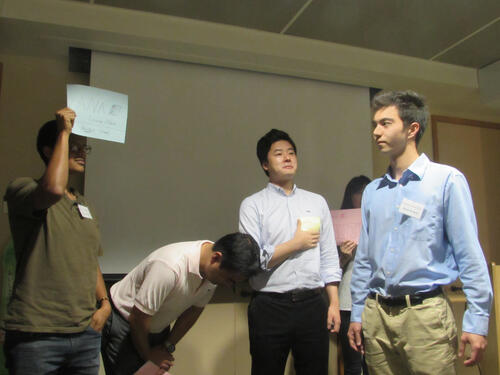
ideathon team three

Team Three acts out a skit.  |  They proposed that ANA establish lounges for the general public to gather in and purchase goods from Uniqlo and Muji, two Japanese lifestyle retailers. The lounges would offer a place to reinforce ANA's brand outside of the airport, they said.


Image
ideathon team four

Team Four puts their heads together to generate ideas.  |  In their pitch, the team noted that baseball is a popular sport among Americans and Japanese. They recommended baseball be a focus of the marketing campaign, and said television and social media would best reach the target audience.


Image
ideathon team five

Team Five explains their marketing approach.  |  Flying can lead to some unpleasant experiences, and a way ANA can set itself apart is to make those experiences manageable, and even enjoyable, they said. Their proposal was to bring new amenities to the in-flight experience such as a care package for people who sit in the middle seat.


Image
ideathon team one

Team One poses for a picture after their presentation.  |  In their pitch, they recommended using ANA’s association with Japan to differentiate from other global airlines. Their approach included creating a film that features an American celebrity traveling on ANA.


The winning team was Team One whose concept was to use a celebrity figure – Ellen DeGeneres – in their advertising. They said that the target audience could relate to DeGeneres, and her already-established following would be an advantage.

The judges commended Team One for the creativity of their idea and its level of feasibility. Team One consisted of students Yaqian Fan, Michael Hong, Sam Ide, Lu Li and Adelbert Tan.

Kenji Kushida, a Stanford alumnus and project leader of SV-NJ, said:

“When I was a student, I craved for an opportunity to brainstorm solutions to real-world challenges and to do it in an environment that provided instant feedback,” he said, “We were able to make that happen here with the support of ANA and WiL, and are thrilled with the outcome."

Hero Image
ideathon headline cropped
All News button
1
Encina Hall E301616 Serra StreetStanford, CA94305-6055
(650) 723-6530
0
shuichiro_nishioka_headshot_crop.jpg Ph.D.

Shuichiro Nishioka joins the Walter H. Shorenstein Asia-Pacific Research Center (Shorenstein APARC) during the 2015-16 academic year from the West Virginia University’s Department of Economics where he serves as an Associate Professor.

His research covers the broad issues on International Trade, Economic Development, and East Asian Economies. During his time at Shorenstein APARC, Nishioka will conduct research projects on the expanding inequality in China and Japan.

Nishioka previously affiliated for research and teaching at the Research Institute of Economy, Trade and Industry, the University of Pittsburgh and Hitotsubashi University. He contributes to articles to publications including the Journal of International Economics, the Journal of Development Economics, and European Economic Review.

Nishioka holds a PhD and an MA in Economics from the University of Colorado at Boulder, and a BA in Economics from Yokohama National University. 

Visiting Scholar
Authors
News Type
News
Date
Paragraphs

The United States and European countries can take steps to avoid making the same economic mistakes that Japan committed during the latter's "lost decade," a Stanford economist wrote in a new paper.

The study, published in the IMF Economic Review, describes the reasons Japan was not able to pull out of its long recession in the 1990s, offering some lessons for U.S. and European leaders in the wake of the 2007-09 meltdown.

In particular, the delay in bank recapitalization and the lack of structural reforms in the economic sphere kept Japan from realizing a full recovery, wrote Takeo Hoshi, the Henri and Tomoye Takahashi senior fellow at Stanford's Freeman Spogli Institute for International Studies.

"Bank recapitalization" refers to a governmental reorganization of failing banks, often involving the use of public money to keep them solvent. "Structural reforms" describes how a government might overhaul its economic structures to increase business competition – such as deregulation to cut costs for firms.

The shortcomings in these two policy areas "retarded Japan's recovery from the crisis and were responsible for its stagnant post-crisis growth," said Hoshi, whose co-author was Anil K. Kashyap, an economics professor at the University of Chicago Booth School of Business.

Risky bank lending

Japan's "lost decade" originally referred to the 1990s, though the country has still not regained the economic power it enjoyed in the 1970s and 1980s. Some say Japan has actually experienced two lost decades if the 2000s are counted as well.

Faced with a huge financial crisis at the dawn of its lost decade, Japan had to navigate challenges that other advanced economies had not confronted since the Great Depression, Hoshi and Kashyap wrote.

However, government leaders made mistakes, Hoshi said. One was failure to rehabilitate the banks and another was to misunderstand the nature of the problems afflicting the Japanese economy. For example, much like the United States in 2007-09, the Japanese banks had made many dubious loans to risky customers.

"Instead of recognizing that major structural adjustments were needed, much of the policy response was calibrated under the assumption that Japan faced a simple cyclical problem that could be addressed with indiscriminate fiscal stimulus," wrote Hoshi, the director of the Japan Program at the Walter H. Shorenstein Asia-Pacific Research Center.

For example, on the demand side, monetary policy was not as expansionary as it could have been, he said. Deflation persisted for a long time. And fiscal stimulus packages – such as tax cuts – were inconsistent. Meanwhile, much of Japan's fiscal spending took the form of public works projects that had low productivity.

As for structural reforms, the Japanese government lacked a sense of urgency. For example, even in the reform-minded administration of former Prime Minister Junichiro Koizumi, only eight of the proposed 35 reform initiatives would have directly boosted growth. Of the others, 16 might have indirectly supported growth and 11 would have had no effect on growth, Hoshi said.

Drastic change needed

Unfortunately, some European nations seem to be following Japan's lead, Hoshi said.

"In France, Italy and Spain, bank recapitalization has been delayed and the structural reforms have been slow. Without drastic changes, they are likely to follow Japan's path to long economic stagnation," Hoshi and Kashyap wrote.

The problems that held back Japan seem to be less serious in the U.S., Hoshi said: "Employment protection is low in the United States and the labor market shows high mobility. The regulatory advantage for incumbent firms is smaller than in Europe or Japan and starting new business is relatively easy."

As the researchers noted, the United States and Germany are in a bit better economic shape, partly due to the fact that they did undertake structural reforms sooner rather than later. The U.S. was able to recapitalize its banks more quickly, for example.

Still, five years after the failure of the Lehman Brothers investment bank left the world's financial markets in chaos, the U.S. and Europe are not yet back to what had looked normal before the crisis, according to the research. For instance, employment levels have not reached the levels seen before the 2007-09 crash.

"The U.S. recovery has been tepid despite a number of extraordinary macroeconomic policies (at least in the traditional sense). This suggests that the U.S. economy also has problems, but they are just different from those in Japan and in Europe," Hoshi said.

In the years leading up to the financial crisis, the researchers wrote, U.S. growth was fueled by a consumption boom from rapid housing price increases and rising debt levels.

"In a broad sense, the U.S. economy before the crisis was similar to the Japanese or Spanish economies," noted Hoshi, adding that in Japan, the speculative investment boom in the late 1980s masked structural problems.

Clifton Parker is a writer for the Stanford News Service.

Hero Image
flickr stock board tokyo
An onlooker examines a stock board, Tokyo, Japan.
Flickr/Kondo Atsushi
All News button
1
Paragraphs

This paper reexamines Japanese policy choices during its banking crisis in the 1990s and draws some lessons relevant for the United States and Europe in the aftermath of the global financial crisis of 2007–09. The paper focuses on two aspects of postcrisis economic policy of Japan: the delay in bank recapitalization and the lack of structural reforms. These two policy shortcomings retarded Japan’s recovery from the crisis and were responsible for its stagnant postcrisis growth. The paper also suggests some political economy factors that contributed to the Japanese policies. In France, Italy, and Spain bank recapitalization has been delayed and the structural reforms have been slow. Without drastic changes, they are likely to follow Japan’s path to long economic stagnation. The situation in Germany looks somewhat better mainly because the structural reform was undertaken before the crisis. Although the recovery has been slow in the United States as well, the problems are at least different from those faced by Japan then and many European countries now.

All Publications button
1
Publication Type
Journal Articles
Publication Date
Journal Publisher
IMF Economic Review
Authors
Takeo Hoshi
Authors
News Type
Commentary
Date
Paragraphs

The Walter H. Shorenstein Asia-Pacific Research Center honored Wall Street Journal reporter Jacob Schlesinger with the Shorenstein Journalism Award last Monday. Schlesinger received the award, which includes a $10,000 cash prize, for his work on Japan that spans nearly three decades.

Since 2002, the annual award has sought to recognize journalists who are outstanding in their field of reporting on the Asia-Pacific, and whose work has helped enhance Western understanding of the region. A jury selects the finalist, which alternates each year between an American and Asian journalist.

At an evening ceremony, Stanford professor Gi-Wook Shin presented Schlesinger with the award surrounded by supporters and friends including Michael Armacost and John Roos '77, (J.D. ‘80), two former U.S. ambassadors to Japan, who both came to know Schlesinger personally during their diplomatic posts.

Earlier in the day, Schlesinger delivered a keynote speech on Japan’s economy and the media. Stanford economist Takeo Hoshi and Shorenstein APARC associate director Daniel Sneider joined him on the panel, along with New York Times deputy executive editor Susan Chira.

Schlesinger was a visiting fellow at Shorenstein APARC at Stanford's Freeman Spogli Institute for International Studies. Under the advisory of then-Shorenstein APARC director Daniel Okimoto, he worked on a book manuscript at Stanford which became Shadow Shoguns: The Rise and Fall of Japan’s Postwar Political Machine.

“No foreign journalist has covered Japan longer, or understood its political economy more deeply, than Jacob M. Schlesinger…” Okimoto said in the award announcement.

Schlesinger is based at the Journal’s Tokyo bureau as Senior Asia Economics Correspondent and Central Banks Editors, Asia, and tweets with the handle @JMSchles.

He answered a few questions for Shorenstein APARC about Japan’s political and economic climate, as well as the changing face of media there.

Image

Schlesinger spoke on a panel with Stanford's Daniel Sneider and Takeo Hoshi, and The New York Times's Susan Chira, followed by a private evening reception.

You’ve covered Japan for the Wall Street Journal for nearly a decade on the ground, in the late 1980s and early 90s and again since 2009. What has changed, or remained the same?

When I first covered Japan in the late ‘80s and early ‘90s, there was huge interest in -- and also a fair amount of mistrust and hostility toward -- Japan. Americans feared that Japan’s economy was going to somehow “defeat” ours (though I don’t think that notion ever really made sense), and constantly accused Japan of unfairly taking advantage of the global free trade system, exporting heavily to us while keeping its market closed to our goods.

After the bubble burst, and, more recently, Japan’s trade surplus disappeared, the anger toward Japan dissipated. But so, in some ways, did the interest. There are far fewer foreign correspondents today in Japan than there were when I was first there 25 years ago.

I think that the rise of Prime Minister of Japan Shinzo Abe, and Abenomics, has revived interest in Japan a bit, but in different ways. People want to know if Japan will rebound, in part as a counterweight to China, which has really surged in economic and political influence in the time since I was last in Japan. That perhaps may be one of the biggest changes -- the fact that so much is now seen through the prism of China. For a time China simply overshadowed Japan but now it has actually, in some ways, revived interest in it. 

What are the greatest challenges you’ve found in explaining the state of the Japanese economy and U.S.-Japan relations?

As I say, one challenge has been in getting people interested, and in explaining to them why it matters. China in particular has become such a big story that Americans sometimes lose sight of Japan's significance as well.

Another challenge is that Japan is a country where change, even big change, often happens in slow, subtle, steady steps. Japanese rhetoric tends to downplay the dramatic and to cast things in indirect terms, which can make it harder to describe statements and developments in ways that are accurate, and will seem interesting to readers.

Can you describe Abenomics and its current status?

Abenomics is Prime Minister Abe's program to try and end Japan's long slump, sometimes branded the “lost decades.” The most concrete and effective action to date has been a much more aggressive policy of monetary stimulus, following Abe's shake-up at the Bank of Japan (the nation’s central bank), where he imposed new leadership. That might be able to lift short-term growth. But Abe’s ambition to raise Japanese growth over the long-run – to a pace near that enjoyed by the United States and other advanced economies – requires extensive structural reforms. Abe has talked a lot about implementing such reforms, but has so far been rather timid in what he has proposed and pursued.

Abenomics also hit a deep pothole in 2014, when Abe decided to proceed with a plan to raise the sales tax, a policy aimed at reducing Japan’s very large outstanding government debt. The depressing impact of the tax basically offset the gains from the Bank of Japan’s stimulus, and Japan last year fell into recession.

It now appears that Japan is slowly pulling out of the recession, and, to ensure that his stimulus polices now work at full force, Abe has delayed plans for a second tax hike that had been scheduled for this year. That may set back long-held goals to reduce government debt, but it should help the chief Abenomics goal of exiting the long deflationary slump.

I'd say overall that Abenomics has a decent chance of lifting Japanese growth a bit higher than it would otherwise have been, but that a dramatic change in Japan’s fortunes would probably require a more dramatic change in policies, something Abe has promised but hasn’t really shown signs of seriously pursuing.

Recently, the United States invited Prime Minister Abe for a state visit (in addition to leaders of other Asian nations). What issues would likely top the agenda?

Both countries are hoping, overall, that the visit will deepen ties between the two governments at a time of great change and challenge in Asia. Whatever one might think of Prime Minister Abe and his agenda, this visit does offer a special opportunity to expand relations, simply because he has now been in office long enough to make multiple trips to Washington as prime minister -- a rare feat over the past quarter century of Japan's notorious carousel politics. The Japanese government is eager for Abe to be able to address a session of the U.S. Congress, which could carry great symbolic significance. He would be the first Japanese leader to do so in more than half a century, since Prime Minister Hayato Ikeda in the early 1960s. That's a pretty long gap, when you consider that Japan has, over that period, long been hailed as one of America's most important allies.

In terms of specific issues, the chief economic agenda item is the Trans-Pacific Partnership free trade pact. It's an ambitious project attempting to set the economic rules for the Pacific economies for the 21st century. And while 12 countries are included, the United States and Japan are by far the biggest, and both sides are hoping that a bilateral agreement by the time Abe meets President Obama could give the broader deal sufficient momentum to be concluded this year.

On the military front, the United States and Japan are updating the terms of their mutual defense pact and hope to do so in ways that will give Japan's military more latitude to participate in joint operations.

While not part of the official agenda, Americans will be eager to hear what Abe has to say about history issues as the world marks the 70th anniversary of the end of World War II.

Abe and his aides have repeatedly challenged some of the established views of Japan and its behavior during the war, including recently directly asking the American publisher McGraw-Hill to change its account of so-called “comfort women,” women forced into prostitution under Japan's war-time military. Such statements and actions have irritated many Americans and stoked anger in China and South Korea. American officials in particular are concerned about deteriorating relations between Japan and South Korea -- the two principle U.S. military allies in Asia -- and are eager for Abe to try and do more to bridge the gap, particularly on history issues. 

Newspapers have played a large role in Japanese society; the nation boasts one of the highest readerships in the world. Where do you see the future of news media in Japan?

Japan, as you say, has one of the most -- perhaps the most -- literate and well-informed populations in the world. News readership and news viewership is extremely high. People are extremely knowledgeable about current events.

Oddly, for a country that is also very tech literate, digital media has been relatively slow to catch on in Japan. Most people still get their main news from print papers, or magazines, and there has not been -- at least not yet -- a real surge in new, credible online-only, or online-originated media sources to challenge the mainstream media, the way platforms like Politico, the Huffington Post, or BuzzFeed have popped up in the United States.

The Japanese media has also suffered from some serious setbacks to its credibility in recent years. There was tremendous soul-searching after the 2011 Fukushima nuclear disaster about whether the Japanese press had done enough, either before the accident, or in the immediate aftermath, to cover aggressively the flaws and mistakes in the country's nuclear energy policies.

More recently, over the past year there have been damaging battles, in varying degrees, over the accuracy, and independence, of three of the country's largest, and most-respected news organizations, the Asahi Shimbun newspaper, the Yomiuri Shimbun newspaper, and the NHK national broadcaster. I worry that the result, fair or not, could prompt further erosion in the credibility of the Japanese media. That's potentially a big problem at a time of great change, great political and policy debate -- and when the political opposition is so weak that the media arguably has a heightened role at this moment as a check on power.

You were a visiting scholar at Shorenstein APARC. How did your time at the Center impact your work?

The Center was a tremendous opportunity for me in so many ways. It is rare for a journalist to be able to break out of the steady deadline pressures of a newsroom, and soak up an academic atmosphere. Being at Shorenstein APARC was a fantastic way to do that. It offered the best elements of an ivory tower, without feeling isolated. It gave me chances to interact with policymakers there as visiting fellows, as well as some of the top experts in the field who were based there.

I have to give particular thanks to Dan Okimoto, who ran Shorenstein APARC at the time and Jim Raphael, who was director of research. When I was at Shorenstein APARC, I was researching and writing a book on Japanese politics. The feedback from Dan, Jim and others made it a much better work. But beyond the book, the depth and perspective that I gained from my immersion at Shorenstein APARC has helped shape my writing since then.

Hero Image
award shot
Stanford professor Gi-Wook Shin (Right) presented the 2014 Shorenstein Journalism Award to Wall Street Journal reporter Jacob Schlesinger (Left).
Rod Searcey
All News button
1
Date Label
Paragraphs

The global Information and Communications Technologies (ICT) industry has experienced a rapid, radical reorganization of industry leaders and business models—most recently in mobile. New players Apple and Google abruptly redefined the industry, bringing a wave of commoditization to carriers and equipment manufacturers. Technologies, corporate strategies, and industry structures are usually the first places to look when explaining these industry disruptions, but this paper argues that it was actually a set of political bargains during initial phases of telecommunications liberalization, which differed across countries, that set the trajectories of development in motion. This paper shows how different sets of winners and losers of domestic and regional commoditization battles emerged in various ICT industries around the world. Carriers won in Japan, equipment manufacturers in Europe, and eventually, computer services industry actors rather than communications firms emerged as winners in the United States. These differences in industry winner outcomes was shaped by the relative political strength of incumbent communications monopolies and their will to remain industry leaders, given the political system and political dynamics they faced during initial liberalization. The U.S. computer services industry, which developed independently of its telecommunications sector due to antitrust and government policy, eventually commoditized all others, both domestically and abroad. This paper contends that a political economy approach, tracing how politics and regulatory processes shaped industry structures, allows for a better understanding of the underlying path dependent processes that shape rapidly changing global technological and industry outcomes, with implications beyond ICT.

All Publications button
1
Publication Type
Journal Articles
Publication Date
Journal Publisher
Journal of Industry, Competition and Trade
Authors
Kenji E. Kushida
Authors
News Type
News
Date
Paragraphs

Innovation is a vital component of economic development, and the United States and Japan provide clear examples of how a knowledge-based economy can lead to sustainable growth. But Japan has sometimes encountered obstacles in bringing its wealth of ideas into the global market. A conference at Stanford seeks to help shift that reality.

“Japan is changing,” said panelist Gen Isayama, founder of the World Innovation Lab. “We’re seeing entrepreneurs…but we need a new role model – new stars emerging in Japan to excite younger people.”

For two days, 21 experts from Japan and the United States gathered at the Stanford-Sasakawa Peace Foundation New Channels Dialogue to discuss innovation, promote exchange of best practices, and enhance connections between the two countries.

The conference was sponsored by the Sasakawa Peace Foundation (SPF) and organized by the Japan Program at the Walter H. Shorenstein Asia-Pacific Research Center (APARC), in association with the U.S.-Japan Council.

“The New Channels project is intended to open a new arena of dialogue between new voices, and a new generation of experts and policymakers on both sides of the Pacific. And to tie them back into the existing structure of alliance governance,” said SPF President Yuji Takagi, in his opening remarks.

“The complex challenges of today’s world provide even greater momentum to work together across sectors,” Shorenstein APARC Director Gi-Wook Shin added.

In its second year, the conference hosted more than 100 attendees from the San Francisco Bay Area, drawing students, scholars and industry and government people to Encina Hall for the daylong public forum on Jan. 22. The first and second panels focused on the state of innovations in Silicon Valley and Japan, the third and fourth panels examined how the two countries could better work together toward innovation-driven growth.

The first set of panelists started by discussing characteristics of Silicon Valley, and how it defined itself during the tech boom of the 1980s/90s, and led to the rise of the Internet and telecomm industries that rapidly spread around the world.

Silicon Valley is often identified for its innovative ideas, and its ability to convert those ideas into market-ready goods and services. Panelists said that networks and open access to venture capital drive that ability to push ideas through quickly, an essential characteristic in today’s real-time world.

“It’s never been easier to start a company,” said Patrick Scaglia, a consultant at Startup Ventures and former senior executive at Hewlett Packard.

Silicon Valley continues to attract entrepreneurs and potential investors, and is positioned to continue to do so. Scaglia noted that 47.3 million dollars was invested in startups last year alone, the highest seen since 2009.

Areas currently being pioneered by Silicon Valley entrepreneurs include medical and mobile technologies. Norman Winarsky, president of SRI Ventures, pointed to breakthroughs in robotics and wearable devices, showing a clip from a TED talk on bionic prosthetics. Additional predicted trends include a return to hardware and possibly greater entrepreneurism coming directly out of universities, particularly from students.

Image
stanfordspf dashboard

(Left photo) Tak Miyata (left), a general partner at Scrum Ventures, talks with Ryuichiro Takeshita (right), a corporate affiliate visiting fellow at Shorenstein APARC. (Right photo) Japan Program Research Associate Kenji Kushida leads a discussion on Japan's innovation ecosystem. A gallery of photos from the public forums can be viewed here.

Japan has historically produced successful entrepreneurs such as Konosuke Matsushita (founder of Panasonic Corporation), Akio Morita (founder of Sony Corporation), and Soichiro Honda (founder of Honda Motor Company), but large firms have come to dominate the economy. Recently, however, the country has been producing a cadre of successful startups, some of which have already grown to become quite large. For example, Japanese companies Rakuten and DeNA have commanded the e-commerce space, and similarly, Mixi in the social media space.

Panelists noted that more Japanese startups are going global compared to a decade ago. Yusuke Asakura, a visiting scholar at Stanford’s U.S.-Asia Tech Management Center, pointed to companies that produced applications like Metaps, an Android monetization app, and Gumi, a social networking gaming app.

But Japan hasn’t reached its greatest potential due to various barriers – market, institutional, and cultural. Mr. Isayama said, at the moment, there aren’t enough ventures and risk capital in Japan. Greater accessibility to both could propel startups more fully into the global market.

C. Jeffrey Char, president of J-Seed Ventures, said another obstacle was the quantity of mergers & acquisitions (M&A).

“If there was more M&A, it would actually improve the ecosystem a lot more – it would turbocharge it,” he said. “Because when investors get their money back quicker and when entrepreneurs get paid off quicker, a lot of times they will go and start another company.”

If greater M&A existed in Japan it would create a “benevolent cycle” of funding and inject the momentum necessary to support an environment for entrepreneurial success.

Networking, labor mobility, and a highly skilled workforce are additional components that aided in Silicon Valley’s success, and areas that Japan could learn from. Government support for entrepreneurs is rising; the third arrow of ‘Abenomics’ policy aims to jumpstart growth based on a number of measures, including diversification of its workforce through increased immigration and female participation.

Offering an additional point, Professor Kazuyuki Motohashi, the Sasakawa Peace Fellow at Shorenstein APARC, suggested that cultural differences might pose one of the biggest challenges to U.S.-Japan collaboration.

Americans are more likely to embrace failure as an essential part of the creative process; Japanese typically don’t celebrate failure as much nor valorize the entrepreneur to the same degree.

“We don’t have to change the culture,” Motohashi said. “The important [thing] is to overcome these differences and develop a mutual understanding.”

Teaching younger generations about the entrepreneurial mindset could also improve societal attitudes toward risk-taking. Former U.S. Ambassador to Japan John Roos said celebrating the entrepreneur was the most important factor in creating a vibrant innovation ecosystem in Japan. “In the end, if you have the proper mindset, you can overcome everything else."

A detailed summary report of the New Channels Dialogue will be released in the coming months on the Shorenstein APARC website.

Image
stanfordspf group

Panelists pose for a group shot outside Encina Hall. A conference agenda, final report and listing of the panelists can be viewed here.

Hero Image
rsd15 004 0148a
A Stanford conference brings together 21 experts on innovation in Japan and Silicon Valley.
Rod Searcey
All News button
1
-


The Stanford Silicon Valley-New Japan Project
Public Forum Series with Networking
 

Speaker: Robert Cole (Bio)

Image
cole robert ashx

Tuesday, January 27, 2015
5:00 – 5:30 pm Networking
5:30pm - 7:00pm Lecture
Cypress Semiconductor Auditorium (CISX Auditorium)

Public Welcome • Light Refreshments

The Silicon Valley - New Japan Project


Cypress Semiconductor Auditorium (CISX Auditorium)
Paul G. Allen Building, Stanford University
330 Serra Mall, Stanford CA 94305
https://www.google.com/maps?q=CISX+Cypress+Semiconductor+Auditorium@37.4295793,-122.1748332

Robert Cole Professor Emeritus, Haas School of Business, University of California Berkeley
Seminars
-
Image
100611 050 copy

Stanford-Sasakawa Peace Foundation New Channels Dialogue 2015

"Innovation: Silicon Valley and Japan"

January 22, 2015

Bechtel Conference Center, Encina Hall, Stanford University

Sponsored and organized by the Sasakawa Peace Foundation (SPF) and the Shorenstein Asia-Pacific Research Center (APARC) in Association with U.S.-Japan Council 
 

The Japan Program at Shorenstein APARC, Stanford University is continuing the "New Channels" dialogue which started in 2013 with support from the Sasakawa Peace Foundation. The project was launched to create new channels of dialogue between experts and leaders of younger generations from the United States, mostly from the West Coast, and Japan under name of "New Channels: Reinvigorating U.S.-Japan Relations," with the goal of reinvigorating the bilateral relationship through dialogue on 21st century challenges faced by both nations. 

Last year, in its inaugural year, the Stanford-SPF New Channels Dialogue 2014 focused on energy issues. This year's theme is innovation and entrepreneurship, which will take place on January 22 at Stanford University with participants that include business leaders, academia and experts from both the United States and Japan. On January 23, a closed dialogue among participants will be held at Stanford.

Shorenstein APARC will be tweeting about the conference at hashtag, #StanfordSPF. Join the conversation with the handle, @StanfordSAPARC.


Brief Agenda

9:15-9:30 
Welcome: 
Gi-Wook Shin, Director, Shorenstein APARC, Stanford University 
Yuji Takagi, President, Sasakawa Peace Foundation 
 

9:30-10:50 
Panel Discussion I: Current State of Silicon Valley Innovations

Chair: Kazuyuki Motohashi, Sasakawa Peace Fellow, Shorenstein APARC, Stanford University

Panelists: 
Richard Dasher, Director, US-Asia Technology Management Center, Stanford University 
Tak Miyata, General Partner, Scrum Ventures 
Patrick Scaglia, Consultant and Technology Advisor, Startup Ventures and former senior executive, Hewlette Packard 
Norman Winarsky, Vice President, SRI Ventures, SRI International 


11:10-12:30 
Panel Discussion II: Current State of Innovations in Japan

Chair: Kenji Kushida, Research Associate, Japan Program, Shorenstein APARC, Stanford University 

Panelists: 
Yusuke Asakura, Former CEO, mixi 
Takuma Iwasa, CEO, Cerevo 
Yasuo Tanabe, Vice President and Executive Officer, Hitachi Ltd. 
Hiroaki Yasutake, Managing Executive Office and Director, Rakuten


12:30-13:30 
Lunch


13:30-14:50 
Panel Discussion III: Taking Silicon Valley Innovations to Japan

Chair: Richard Dasher, Director, US-Asia Technology Management Center, Stanford University 

Panelists: 
Jeff Char, President, J-Seed Ventures, Inc. and Chief Mentor, Venture Generation 
Akiko Futamura, President and CEO, InfiniteBio 
Allen Miner, Founder, Chairman & CEO, SunBridge Corporation 
John Roos, former U.S. Ambassador to Japan 
 

15:10-16:30 
Panel Discussion IV: The Japanese Innovation Ecosystem and Silicon Valley: Bringing them Together (How Japanese firms can make use of SV?)

Chair: Takeo Hoshi, Director, Japan Program, Shorenstein APARC, Stanford University

Panelists: 
Robert Eberhart, Assistant Professor, Santa Clara University and STVP Fellow, Stanford University 
Gen Isayama, CEO and Co-Founder, WiL (World Innovation Lab) 
Naoyuki Miyabe, Principal, Miyabe & Associates, LLC 
Hideichi Okada, Senior Executive Vice President, NEC Corporation 
 

Innovation: Silicon Valley and Japan
Download pdf

Bechtel Conference Center
Encina Hall
616 Serra St., 1st floor
Stanford University
Stanford, CA 94305

Conferences
Subscribe to Economic Affairs