Security

FSI scholars produce research aimed at creating a safer world and examing the consequences of security policies on institutions and society. They look at longstanding issues including nuclear nonproliferation and the conflicts between countries like North and South Korea. But their research also examines new and emerging areas that transcend traditional borders – the drug war in Mexico and expanding terrorism networks. FSI researchers look at the changing methods of warfare with a focus on biosecurity and nuclear risk. They tackle cybersecurity with an eye toward privacy concerns and explore the implications of new actors like hackers.

Along with the changing face of conflict, terrorism and crime, FSI researchers study food security. They tackle the global problems of hunger, poverty and environmental degradation by generating knowledge and policy-relevant solutions. 

Paragraphs

This essay is part of the H-Diplo International Security Studies Forum 35 (2022) on the Scholarship of Nancy Bernkopf Tucker.

Nancy Tucker is widely and appropriately recognized for her brilliant scholarship and teaching abilities, but too few know about her important contributions to the United States while serving at the State Department (1986-1987) and the Office of the Director of National Intelligence (2006-2007). Three factors account for this lack of recognition: Nancy’s self-effacing modesty, the propensity of academics to view even temporary assignments to government positions as digressions from serious scholarly activity, and the failure of government agencies to acknowledge individual contributions to what are inherently collective undertakings. This essay is intended both to illuminate Nancy’s contributions to the national security enterprise and to encourage other accomplished scholars to explore what they can gain from and contribute to the work of government agencies.

All Publications button
1
Publication Type
Journal Articles
Publication Date
Journal Publisher
International Security Studies Forum
Authors
Thomas Fingar
Authors
Oriana Skylar Mastro
News Type
Commentary
Date
Paragraphs

This opinion piece first appeared in the New York Times.


President Biden’s recent trip to Asia nearly went off without a hitch — until Taiwan came up. Mr. Biden was asked whether the United States would respond “militarily” if China sought to retake the self-ruled island by force.

“Yes,” he said. “That’s the commitment we made.”

It was one of the most explicit U.S. defense guarantees for Taiwan in decades, appearing to depart from a longtime policy of “strategic ambiguity.” But it’s far from certain that the United States could hold off China.

I have been involved in dozens of war games and tabletop exercises to see how a conflict would turn out. Simply put, the United States is outgunned. At the very least, a confrontation with China would be an enormous drain on the U.S. military without any assured outcome that America could repel all of China’s forces. Mr. Biden’s comments may be aimed at deterring a Chinese attack, and hopefully they will.

After a decades-long military modernization, China has the world’s largest navy and the United States could throw far fewer ships into a Taiwan conflict. China’s missile force is also thought to be capable of targeting ships at sea to neutralize the main U.S. tool of power projection, aircraft carriers. The United States has the most advanced fighter jets in the world but access to just two U.S. air bases within unrefueled combat radius of the Taiwan Strait, both in Japan, compared with China’s 39 air bases within 500 miles of Taipei.

If China’s leaders decide they need to recover Taiwan and are convinced that the United States would respond, they may see no other option but a pre-emptive strike on U.S. forces in the region. Chinese missiles could take out key American bases in Japan, and U.S. aircraft carriers could face Chinese “carrier killer” missiles. In this scenario, superior U.S. training and experience would matter little.


Sign up for APARC newsletters to receive our experts' analysis.


The need to project power across vast distances also makes U.S. forces vulnerable to China’s electronic and cyberwarfare capability. China could disrupt networks like the United States Transportation Command, which moves American assets around and is considered vulnerable to cyberattacks. China may also have the ability to damage satellites and disrupt communications, navigation, targeting, intelligence-gathering, or command and control. Operating from home turf, China could use more-secure systems like fiber-optic cables for its own networks.

Under a best-case battle scenario for the United States, China would attack only Taiwan and refrain from hitting American forces to avoid drawing in U.S. military might. This would allow the United States time to bring its forces into the region, move others to safety and pick where and when it engages with China.

If the United States did ever intervene, it would need regional allies to provide runways, ports and supply depots. But those partners may be eager to stay out of the crossfire.

I’m not the only one who’s worried. A 2018 congressionally mandated assessment warned that America could face a “decisive military defeat” in a war over Taiwan, citing China’s increasingly advanced capabilities and myriad U.S. logistical difficulties. Several top former U.S. defense officials have reached similar conclusions.


Mr. Biden’s remarks were made in the context of Ukraine, and America’s failure to prevent that war may be driving his thinking on Taiwan. Mr. Biden may be calculating that Russia’s setbacks in Ukraine will give China pause and that guaranteed U.S. intervention in a conflict over Taiwan would cost Beijing too much, even if it took the island.

But comparing Ukraine and Taiwan is problematic. Beijing views Taiwan — self-ruled since 1949 — as an integral part of Chinese territory since ancient times, a significantly deeper attachment than Vladimir Putin’s obsession with Ukraine. Reunifying the island with the mainland is one of the Chinese Communist Party’s most cherished goals, and China would see U.S. intervention as a bitter betrayal of the “one China” principle — the idea that China and Taiwan belong together, which Washington has acknowledged since the 1970s.

China’s military is bigger and more formidable than Russia’s, and its economy far larger, more resilient and globally integrated. Rallying support for economic sanctions against Beijing during a conflict — China is the biggest trading partner of many countries — would be more challenging than isolating Russia.

The White House is once again walking back Mr. Biden’s comments, saying official policy has not changed.

If so, then Mr. Biden should stop rocking the boat and focus instead on strengthening America’s position in the Taiwan theater. This doesn’t just mean more weapons for Taiwan and a more robust U.S. military presence in the region, though the former would help the island hold out if China attacked, and both would boost deterrence.

It also means shrewd diplomacy. Mr. Biden needs to stand firm against Chinese intimidation of Taiwan, while working to ease Beijing’s anxieties by demonstrating a stronger U.S. commitment to a peaceful resolution of the Taiwan issue. Mr. Biden should also persuade regional friends to provide more bases for the United States to use. This not only increases U.S. operational flexibility but also heightens deterrence.

Whatever Mr. Biden’s calculations, departing from the “strategic ambiguity” that has helped keep peace for decades misses the point. The main question for President Xi Jinping must be not whether the United States would join in, but whether China could beat the United States in a battle for Taiwan. Twenty years ago, China’s poorly trained army and largely obsolete naval and air forces had no chance. But that was then.

Many will applaud Mr. Biden for standing up for democratic Taiwan in the face of Chinese threats. But he could be putting the island in greater danger, and the United States may not be able to come to the rescue.

Read More

Vladamir Putin and Xi Jinping shake hands.
Commentary

Beijing Is Used to Learning from Russian Failures

The invasion of Ukraine is offering useful lessons for the PLA.
Beijing Is Used to Learning from Russian Failures
Portrait of Emily Feng with text about her winning the 2022 Shorenstein Journalism Award.
News

NPR's Beijing Correspondent Emily Feng Wins 2022 Shorenstein Journalism Award

Feng, whose compelling and bold reporting has amplified the voices of Chinese citizens amid rapidly deteriorating press freedom in the country, is the recipient of the 21st Shorenstein Journalism Award.
NPR's Beijing Correspondent Emily Feng Wins 2022 Shorenstein Journalism Award
Benxi steel plant
Commentary

Next Steps in U.S.-China Climate Cooperation

There are multiple, concreate areas for constructive cooperation between the United States and China as they tackle growing environmental challenges.
Next Steps in U.S.-China Climate Cooperation
Hero Image
Honor guards prepare to raise the Taiwan flag in the Chiang Kai-shek Memorial Hall square.
Honor guards prepare to raise the Taiwan flag in the Chiang Kai-shek Memorial Hall square ahead of the Taiwanese presidential election on January 14, 2016 in Taipei, Taiwan.
Ulet Ifansasti/ Getty Images
All News button
1
Subtitle

Many will applaud Mr. Biden for standing up for democratic Taiwan in the face of Chinese threats. But he could be putting the island in greater danger, and the United States may not be able to come to the rescue.

Date Label
Authors
Oriana Skylar Mastro
News Type
Commentary
Date
Paragraphs

This commentary first appeared in Foreign Policy.

Russia’s invasion of Ukraine has been a double disaster for President Vladimir Putin, as he faces a poorly performing military combined with an inability to shield his country from economic punishment. Both of these possibilities historically have also been sources of apprehension for the Chinese Communist Party (CCP). But China’s leadership turned its anxiety into action about 10 years ago, deliberately working to fix many of the problems and minimize the risks currently plaguing Russia in Ukraine.

One result is that the Chinese military is more likely to perform well even though it has not fought a war since 1979, when it lost thousands of troops in a punitive but brief invasion of Vietnam. Adding to that, China’s economy is both far larger and deliberately more diversified than Russia’s. A sanctions effort like the one presently aimed at Russia would be much harder to sustain against China. These two observations do not mean deterrence won’t hold, only that the unfolding events in Ukraine will likely do little to make Beijing more cautious.

Nearly everyone overestimated Russia’s military capabilities—including probably Putin himself. During its invasion of Ukraine, Russia’s air-ground coordination has been ineffective, and Russian forces have shown risk-adverse tendencies in the air. Russia has also struggled with logistics and keeping its military supplied. Notably, it appears that Russia acted on bad intelligence and therefore did not believe initial strikes that maxed out its firepower were necessary. Furthermore, many Russian weapons platforms are outdated (for example, its Cold War-era tanks), and modern Su-57 fighter jets and T-14 Armata tanks only exist in comparatively small numbers.

The Chinese military used to clearly exhibit the same deficiencies. But over the past decade, it has embraced significant reforms, creating a much more capable fighting force that should give even the United States pause.


Sign up for APARC newsletters to receive our experts' commentary and analysis.


Chinese President Xi Jinping identified similar training and competency issues [to the human element of Russia’s failures in Ukraine] in the PLA 10 years ago. But under his command, the PLA has been proactively implementing significant reforms to avoid similar pitfalls.

First, while Russia allowed its conventional capabilities to atrophy, Chinese military spending has exploded over the past three decades, increasing by 740 percent (in comparison to Russia’s 69 percent) from 1992 to 2017. According to data from the Stockholm International Peace Research Institute, China spent almost four times on its military in 2020 than Russia ($244.9 billion to $66.8 billion). In 1999, less than 2 percent of its fighter jets were fourth-generation, 4 percent of its attack submarines were modern, and none of its surface ships were. Twenty years later, not only did China have much more of everything, but the majority was the most advanced, modern versions available—with China exhibiting advantages over Russia, even in combat aircraft, a traditional area of weakness for China.

Indeed, People’s Liberation Army (PLA) commentators often refer to China’s economic might as one of the reasons their military would outperform Russia’s—Russia has been “stingy” with its military modernization and production of precision-guided munitions primarily because of a lack of resources. By contrast, China has more than 2,200 conventionally armed ballistic and cruise missiles, making the PLA Rocket Force the world’s largest ground-based missile force. Estimates place the number of missiles positioned against Taiwan alone at around 1,000.

Russia’s poor performance does remind us that it takes more than just a lot of fancy systems to win a war (though having more advanced systems and more of them surely would have helped). The human element of Russia’s failures is front and center. Putin probably did not have an open and honest communication channel with the military, which was fearful of providing unfavorable information to the erratic leader. Russian troops were largely considered incompetent, but Putin thought superior technology could overcome human deficiencies.

Chinese President Xi Jinping identified similar training and competency issues in the PLA 10 years ago. But under his command, the PLA has been proactively implementing significant reforms to avoid similar pitfalls. And unlike Putin, who apparently believed technology could overcome deficiencies in personnel, Xi came to the opposite conclusion. When he came to power, he took one look at the military and recognized that with all its fancy equipment, the PLA probably could not fight and win wars and perform the missions it had been assigned. Of particular importance, according to China’s national military strategy, was to fight local wars under informationalized conditions. This meant that the network between platforms and people—the ease of connectivity—was the main feature of modern warfare. China needed the best equipment; an advanced command, control, computers, communication, intelligence, surveillance, and reconnaissance (C4ISR) network; and tons of precision-guided munitions. But perhaps most importantly, it needed troops that could leverage these systems to conduct seamless operations across services and top-down through the chain of command.

The Chinese military is learning lessons from Ukraine, whether it is to stockpile more precision-guided munitions, ensure solid command and control, or cut off internet access [...], which will only serve to improve its warfighting capability in the future.

What followed was a series of slogans—the two incompatibles, two inabilities, two big gaps, the five incapables—all designed to point out the organizational and personnel issues of the military and focus leadership attention and resources on fixing the issue. A massive military reorganization followed with moves such as reorganizing effective combat units to be smaller so that they can mobilize more quickly and can remain self-sufficient for long periods of time. This means, in contrast with the Russian military, the PLA will likely have less reliance on generals at the front lines. China also established theater commands to facilitate joint operations and prioritized realism in its military exercises to help it prepare for real combat. Part of all of this was Xi’s demand that the military communicate its failures and weaknesses so that they could be addressed. Moreover, to improve command and control, China has moved toward engaging in multidomain joint operations all while standing up a new joint operations center that will ensure that, unlike with the Russian military, orders will be communicated and understood at the lowest levels. Indeed, the main reason that Xi has not yet made a play for Taiwan is likely his desire to hone this command and control structure and practice joint operations in realistic conditions for a few more years—a cautious and pragmatic approach that the situation in Ukraine only encourages further.

The PLA itself acknowledges that it still has some distance to go with training, particularly with regard to joint operations, but it looks as if the hard work is paying off. The complexity and scale of China’s national military exercises are eye-opening. It takes a great deal of planning, synchronization, and coordination to take service-level operations to the joint level. China appears to have made great strides in this area. The United States has observed, for example, China executing deep-attack air operations in its exercises that have combined intelligence, surveillance, and reconnaissance (ISR) with multi-domain strike; lift for rapid mobility and advanced fighter manuevers. Russia has relied heavily on artillery and tanks, now and historically, while the PLA is showing a more balanced approach to combined arms operations.

For all these reasons, we should not expect the Chinese military to perform as poorly in its first real military operation since 1979. The PLA is structurally superior to the Russian military. And the Chinese know it. Granted, it’s hard to know whether some of the outlandish claims in the Chinese media are true—that the PLA Air Force would actually “be able to take out the Ukrainian air force in one hour.” But one thing is for certain—the Chinese military is learning lessons from Ukraine, whether it is to stockpile more precision-guided munitions, ensure solid command and control, or cut off internet access to prevent the leaking of information to the West, which will only serve to improve its warfighting capability in the future.

That does not mean it’s perfect. China is still in the process of building its corps of noncommissioned officers, recruiting more college graduates and technical experts so as to be less reliant on conscripts and shift away from an officer-heavy structure. Also, there is always the possibility that Xi’s anti-corruption campaign, which has impacted even the highest levels of the military, may begin to impinge on these reforms. But to date, it seems that those against necessary reforms have been largely targeted. In other words, Xi has not had to choose yet between his goals of consolidating domestic power and the professionalization of the armed forces.

The economic side is less about what has happened in the past six weeks than what will happen in the next six months or even six years. As tempting as it is in the case of Russia’s invasion, the impact of economic sanctions cannot be properly evaluated over a short time period. The need for a longer time horizon also applies to Russia-China economic comparisons, as it will generally require more extensive and more durable sanctions to deter or compel China than it would Russia.

Russia is thought, at least, to be highly vulnerable to sanctions applied to date. And it is certainly the case that China can be harmed by sanctions. Beijing is more integrated in global trade and finance than Moscow and thus has more to lose. But integration cuts both ways—compared with Russia, more countries would be harmed to a greater extent by equivalent actions taken against China. Further, China has demonstrated greater capacity to weather extended economic blows. This combination of features reduces the willingness of the United States and others to enforce durable sanctions, a fact that Beijing well appreciates.

The CCP survived three decades of worse poverty than experienced by the Soviet Union at the time, a self-inflicted depression in 1989-90 paralleling in some respects the events that ended the Soviet Union, the global financial crisis, and another partly self-inflicted economic wound via China’s determination to maintain its zero-COVID policy in 2021-22.

During more recent events, Beijing has been able to mobilize first greater capital resources than Moscow and then far greater. In 2020, the World Bank put China’s gross fixed capital formation at 20 times Russia’s. Xi attacked some of China’s richest citizens, as well as other elements of the private sector, in part because he believed them too intertwined with foreign capital. These were voluntary steps by China that mirror how the world currently seeks to punish Russia. Whatever their wisdom, Xi knows China can afford them, while Russia’s capability is in doubt.

Some Russian foreign reserves have been effectively frozen and some financials excluded from the Society for Worldwide Interbank Financial Telecommunication (SWIFT), limiting international transactions. In the short term, these steps could have a similar impact on China, but they would be much harder to sustain.

Beijing has conducted currency swaps with dozens of countries that will want their renminbi to be useful. China also holds foreign government bonds in amounts that countries cannot ignore. U.S. Treasurys see the largest holdings, but there are also sizable quantities of Japanese government bonds, for instance. With official Chinese reserves upwards of $3 trillion, perhaps five times Russia’s, a partial freeze would quickly wear on governments and firms looking for bond buyers.

For any SWIFT restrictions that interfere with outbound U.S. portfolio investment, that volume stood at $85 billion in Russia and $1.15 trillion in China in 2020. The stock of U.S. direct investment was 10 times higher in China than Russia—companies willing to exit Russia would face leaving a lot more behind in a China contingency. Most broadly, the yuan can erode the role of the dollar; the ruble certainly cannot. Beijing lacks the will to allow free movement of the yuan and make it a true reserve currency, but heavy, durable sanctions might change that.

On the goods side, existing pressure to spare Russian vital exports would be more intense in China’s case. The loss of Russian oil and gas exports of $230 billion in 2021 threatens energy markets. Chinese exports are at least as important within chemicals, textiles, household appliances, industrial machinery, and consumer electronics. Would they all be exempted?

Certain Russian exports, such as palladium, play supply chain roles beyond their direct financial value. As expected from its manufacturing and export volumes, China’s supply chain participation is far larger than Russia’s, extending from inputs crucial to global pharmaceuticals to processed rare earths crucial to clean-energy applications. Russian ships have been banned from some ports. By tonnage, Russia accounts for a bit over 1 percent of the world’s commercial fleet, while China accounts for more than 11 percent. Banning Chinese ships would cause seaborne trade to noticeably contract, hitting supply chains that would already be strained by the diversion of Chinese goods.

Even an area of clear Russian advantage—lower import dependence—is double-edged. Inhibiting Chinese imports of iron ore or integrated circuits, for example, would hit the country hard. But China is such a huge purchaser that many producers would refuse to join a sustained embargo against it. As elsewhere, the barriers to Russian imports adopted thus far could hurt China only in the unlikely event that they are maintained for many months.

From how to remain in power to how to advance on the international stage, militarily and economically, the CCP has been learning what not to do from the Russian or Soviet experience for decades. Chinese strategists are unquestionably evaluating whether the nature of warfare has changed or if they failed to consider some critical factors necessary for success. Chinese economists are certainly looking to identify missed vulnerabilities based on how the economic dimension of the war in Ukraine plays out—and will work to address them to prevent exploitation by the United States and others.

Not that it will all be easy for Beijing. But China is already better prepared than Russia, economically and militarily. The steps to support Ukraine and punish Russia are immediately less potent in a China contingency. And an unfortunate side effect of the tragedy in Ukraine is that China has a relatively low-cost opportunity to learn—it may become a more formidable challenger than it would’ve been otherwise. The United States and its allies should realize that their effectiveness with regard to Russia is highly unlikely to translate. In a Taiwan contingency, the United States must be able to immediately implement both a stronger package of actions aimed at China and also a second package aimed at minimizing the long-term cost of the first.

Read More

Putin and Xi
Commentary

An Uncomfortable Friendship: Understanding China’s Position on the Russia-Ukraine War and Its Implications for Great Power Competition

On WBUR’s "On Point" and Fox 2 KTVU, Center Fellow Oriana Skylar Mastro shares insights about China's alignment with Russia and the worldwide implications of its calculus on Ukraine.
An Uncomfortable Friendship: Understanding China’s Position on the Russia-Ukraine War and Its Implications for Great Power Competition
Protesters display placards in front of the Representative Office of the Moscow-Taipei Coordination Commission to protest against Russia’s military invasion of Ukraine on February 25, 2022 in Taipei, Taiwan.
Commentary

Invasions Are Not Contagious

Russia’s War in Ukraine Doesn’t Presage a Chinese Assault on Taiwan
Invasions Are Not Contagious
millward
News

Unpacking the Crisis in Xinjiang: James Millward on China's Assimilationist Policies and U.S.-China Engagement

APARC Visiting Scholar James Millward discusses PRC ethnicity policy, China's crackdown on Uyghur Muslims and other minorities in Xinjiang province, and the implications of the Xinjiang crisis for U.S. China strategy and China's international relations.
Unpacking the Crisis in Xinjiang: James Millward on China's Assimilationist Policies and U.S.-China Engagement
Hero Image
Vladamir Putin and Xi Jinping shake hands.
All News button
1
Subtitle

The invasion of Ukraine is offering useful lessons for the PLA.

Date Label
-
Banner card for the 2022 Oksenberg Conference

This year’s Oksenberg Conference, "Prospects for the New Sino-Russian Partnership,” explores the “why” and “so what” of this newly bolstered alliance that has been declared as a partnership “with no limits.” What does it mean for the U.S. and other non-autocratic states? Given Russia’s invasion of Ukraine and the unprecedented economic sanctions that the US and its allies have slapped on Russia in the wake of that attack, the more immediately important question is: What does this alliance mean for China? How strong is this new bond with Russia? China now finds itself in an extremely difficult position as it tries to protect its own economic relationships with the US and its allies in Europe and Asia. What can or will China do about Russia? How was this alliance sold to the domestic audience of each country?

A roundtable of experts on China and Russia, including those with extensive government experience, joins us to examine this critically important relationship and address the many questions that it raises. Each panelist will present 10-12 minutes of opening remarks before turning to a moderated discussion. During the last 20 minutes, the moderator will pose curated questions to the roundtable from the audience.

The Oksenberg Conference is held annually and honors the legacy of the late Stanford professor Michel Oksenberg (1938-2001), who was a Senior Fellow at Shorenstein APARC and the Freeman Spogli Institute for International Studies. Professor Oksenberg also served as a key member of the National Security Council when the U.S. normalized relations with China, and consistently urged that the U.S. engage with Asia in a more considered manner. In tribute, the Oksenberg Lecture recognizes distinguished individuals who have helped to advance understanding between the U.S. and the nations of the Asia-Pacific.

Panelists in alphabetical order:

Una Aleksandra Bērziņa-Čerenkova is a political scientist, China scholar, Head of Political Science Doctoral Programme and China Studies Centre at Rīga Stradiņš University, Head of the Asia program at the Latvian Institute of International Affairs, a member of the China in Europe Research Network (CHERN) and European Think Tank Network on China (ETNC). She has held a Senior visiting research scholar position at Fudan University School of Philosophy, Shanghai, China, and a Fulbright visiting scholar position at the Center for East Asian Studies, Stanford University. Bērziņa-Čerenkova publishes on PRC political discourse, contemporary Chinese ideology, EU-China relations, Russia-China, and BRI and her most recent monograph is Perfect Imbalance: China and Russia.

Thomas Fingar is the former first Deputy Director of National Intelligence for Analysis and Chairman of the National Intelligence Council, currently at Stanford as a Shorenstein APARC Fellow in the Freeman Spogli Institute for International Studies. From 2005-2008, he served as the first Deputy Director of National Intelligence for Analysis and, concurrently, as Chairman of the National Intelligence Council. Fingar previously served as Assistant Secretary of the State Department's Bureau of Intelligence and Research (2000-2001 and 2004-2005), Principal Deputy Assistant (2001-2003), Deputy Assistant Secretary for Analysis (1994-2000), Director of the Office of Analysis for East Asia and the Pacific (1989-1994), and Chief of the China Division (1986-1989). Fingar's most recent books are Uneasy Partnerships: China and Japan, the Koreas, and Russia in the Era of Reform (Stanford, 2017), Fateful Decisions: Choices that will Shape China’s Future, co-edited with Jean Oi (Stanford, 2020), and From Mandate to Blueprint: Lessons from Intelligence Reform (Stanford, 2021)

Alex Gabuev is a Senior Fellow at the Carnegie Endowment for International Peace. His research is focused on Russia's policy toward East and Southeast Asia, political and ideological trends in China, and China's relations with its neighbors—especially those in Central Asia. Prior to joining Carnegie, Gabuev was a member of the editorial board of Kommersant publishing house and served as deputy editor in chief of Kommersant-Vlast, one of Russia's most influential newsweeklies. He has previously worked as a nonresident visiting research fellow at the European Council on Foreign Relations (ECFR) and taught courses on Chinese energy policy and political culture at Moscow State University. Gabuev is a Munich Young Leader of Munich International Security Conference and a member of Council on Foreign and Defense Policy (Russia).

Michael McFaul is Director at the Freeman Spogli Institute for International Studies, the Ken Olivier and Angela Nomellini Professor of International Studies in the Department of Political Science, and the Peter and Helen Bing Senior Fellow at the Hoover Institution. McFaul is also an International Affairs Analyst for NBC News and a columnist for The Washington Post. He served for five years in the Obama administration, first as Special Assistant to the President and Senior Director for Russian and Eurasian Affairs at the National Security Council at the White House (2009-2012), and then as U.S. Ambassador to the Russian Federation (2012-2014). He has authored several books, most recently the New York Times bestseller From Cold War to Hot Peace: An American Ambassador in Putin’s Russia. Earlier books include Advancing Democracy Abroad: Why We Should, How We Can; Transitions To Democracy: A Comparative Perspective (eds. with Kathryn Stoner); Power and Purpose: American Policy toward Russia after the Cold War (with James Goldgeier); and Russia’s Unfinished Revolution: Political Change from Gorbachev to Putin.

Evan Medeiros is a Professor and Penner Family Chair in Asia Studies in the School of Foreign Service at Georgetown University and former top advisor on the Asia-Pacific in the Obama Administration, responsible for coordinating U.S. policy toward the Asia-Pacific across the areas of diplomacy, defense policy, economic policy, and intelligence. Prior to joining the White House, Medeiros worked for seven years as a senior political scientist at the RAND Corporation and served at the Treasury Department as a Policy Advisor-China to Secretary Hank Paulson Jr., working on the U.S.-China Strategic Economic Dialogue. Medeiros is a member of the Board of Directors of the National Committee on U.S.-China Relations, a member of the International Advisory Board of Cambridge University's Centre for Geopolitics, and a Life Member of the Council on Foreign Relations.

Jean Oi (Moderator) is the William Haas Professor of Chinese Politics in the Department of Political Science and a Senior Fellow of the Freeman Spogli Institute for International Studies (FSI) at Stanford University. She also directs the China Program at the Walter H. Shorenstein Asia-Pacific Research Center at FSI and is the founding Lee Shau Kee Director of the Stanford Center at Peking University. Oi has published extensively on political economy and the process of reform in China. Her books include State and Peasant in Contemporary China: The Political Economy of Village Government and Rural China Takes Off: Institutional Foundations of Economic Reform. Recent edited volumes include Zouping Revisited: Adaptive Governance in a Chinese County, co-edited with Steven Goldstein, and Fateful Decisions: Choices That Will Shape China's Future, co-edited with Thomas Fingar. 

Jean C. Oi

Via Zoom.

Una Aleksandra Bērziņa-Čerenkova

Freeman Spogli Institute for International Studies
Stanford University
Encina Hall, C-327
Stanford, CA 94305-6055

(650) 723-9149 (650) 723-6530
0
Shorenstein APARC Fellow
Affiliated Scholar at the Stanford Center on China's Economy and Institutions
tom_fingar_vert.jpg PhD

Thomas Fingar is a Shorenstein APARC Fellow in the Freeman Spogli Institute for International Studies at Stanford University. He was the inaugural Oksenberg-Rohlen Distinguished Fellow from 2010 through 2015 and the Payne Distinguished Lecturer at Stanford in 2009.

From 2005 through 2008, he served as the first deputy director of national intelligence for analysis and, concurrently, as chairman of the National Intelligence Council. Fingar served previously as assistant secretary of the State Department’s Bureau of Intelligence and Research (2000-01 and 2004-05), principal deputy assistant secretary (2001-03), deputy assistant secretary for analysis (1994-2000), director of the Office of Analysis for East Asia and the Pacific (1989-94), and chief of the China Division (1986-89). Between 1975 and 1986 he held a number of positions at Stanford University, including senior research associate in the Center for International Security and Arms Control.

Fingar is a graduate of Cornell University (A.B. in Government and History, 1968), and Stanford University (M.A., 1969 and Ph.D., 1977 both in political science). His most recent books are From Mandate to Blueprint: Lessons from Intelligence Reform (Stanford University Press, 2021), Reducing Uncertainty: Intelligence Analysis and National Security (Stanford University Press, 2011), The New Great Game: China and South and Central Asia in the Era of Reform, editor (Stanford University Press, 2016), Uneasy Partnerships: China and Japan, the Koreas, and Russia in the Era of Reform (Stanford, 2017), and Fateful Decisions: Choices that will Shape China’s Future, co-edited with Jean Oi (Stanford, 2020). His most recent article is, "The Role of Intelligence in Countering Illicit Nuclear-Related Procurement,” in Matthew Bunn, Martin B. Malin, William C. Potter, and Leonard S Spector, eds., Preventing Black Market Trade in Nuclear Technology (Cambridge, 2018)."

Selected Multimedia

CV
Date Label
Alex Gabuev
Evan Medeiros
Conferences
-
Guarding Dictatorship: The organization, tactics, and scale of China's surveillance state

The Hoover Project on China's Global Sharp Power invites you to Guarding Dictatorship: The organization, tactics, and scale of China's surveillance state on Tuesday, April 12, 2022, from 2:00 pm - 3:00 pm PT, in partnership with CDDRL and the China Program at APARC.

China has built an extensive, sophisticated, and highly effective apparatus to monitor the activities of its population and target, in particular, perceived threats to regime security. China's "whole-of-nation" approach has produced a surveillance apparatus few dictatorships can match. The country's rapid economic growth also allows the Communist Party to upgrade the technological capabilities of this apparatus and strengthen its political monopoly. Featuring Minxin Pei (Senior Fellow, Claremont-McKenna College). Followed by a conversation with Larry Diamond (Senior Fellow, Hoover Institution, and Mosbacher Senior Fellow in Global Democracy at FSI), Jean Oi (Senior Fellow at FSI, Director of the China Program at APARC), and Glenn Tiffert (Research Fellow, Hoover Institution).

ABOUT THE SPEAKER

Minxin Pei is the Tom and Margot Pritzker '72 Professor of Government and chairman of the Government Department at Claremont McKenna College. He specializes in Chinese domestic politics, economic reform, and foreign policy. Dr. Pei is also a non-resident senior fellow at the German Marshall Fund of the United States and was the inaugural Library of Congress Chair in U.S.-China Relations (2019).

FOLLOWED BY A CONVERSATION WITH

Jean C. Oi is the William Haas Professor of Chinese Politics in the Department of Political Science and a senior fellow in the Freeman Spogli Institute for International Studies at Stanford University. She directs the China Program at the Walter H. Shorenstein Asia-Pacific Research Center (APARC) and is the Lee Shau Kee Director of the Stanford Center at Peking University.

Glenn Tiffert is a research fellow at the Hoover Institution and a historian of modern China. He co-chairs the Hoover project on China’s Global Sharp Power and works closely with government and civil society partners to document and build resilience against authoritarian interference with democratic institutions. Most recently, he co-authored and edited Global Engagement: Rethinking Risk in the Research Enterprise (2020).

MODERATED BY

Larry Diamond is a senior fellow at the Hoover Institution, ​Mosbacher Senior Fellow in Global Democracy at the Freeman Spogli Institute for International Studies (FSI), and a Bass University Fellow in Undergraduate Education at Stanford University. He co-chairs the Hoover Institution’s programs on China’s Global Sharp Power and on Taiwan in the Indo-Pacific Region.

Online via Zoom

Minxin Pei

Department of Political Science
Stanford University
616 Serra Street
Stanford, CA 94305-26044

(650) 723-2843 (650) 725-9401
0
Senior Fellow at the Freeman Spogli Institute for International Studies
William Haas Professor in Chinese Politics
jean_oi_headshot.jpg PhD

Jean C. Oi is the William Haas Professor of Chinese Politics in the department of political science and a Senior Fellow of the Freeman Spogli Institute for International Studies at Stanford University. She is the founding director of the Stanford China Program at the Walter H. Shorenstein Asia-Pacific Research Center. Professor Oi is also the founding Lee Shau Kee Director of the Stanford Center at Peking University.

A PhD in political science from the University of Michigan, Oi first taught at Lehigh University and later in the Department of Government at Harvard University before joining the Stanford faculty in 1997.

Her work focuses on comparative politics, with special expertise on political economy and the process of reform in transitional systems. Oi has written extensively on China's rural politics and political economy. Her State and Peasant in Contemporary China (University of California Press, 1989) examined the core of rural politics in the Mao period—the struggle over the distribution of the grain harvest—and the clientelistic politics that ensued. Her Rural China Takes Off (University of California Press, 1999 and Choice Outstanding Academic Title, 1999) examines the property rights necessary for growth and coined the term “local state corporatism" to describe local-state-led growth that has been the cornerstone of China’s development model. 

She has edited a number of conference volumes on key issues in China’s reforms. The first was Growing Pains: Tensions and Opportunity in China's Transformation (Brookings Institution Press, 2010), co-edited with Scott Rozelle and Xueguang Zhou, which examined the earlier phases of reform. Most recently, she co-edited with Thomas Fingar, Fateful Decisions: Choices That Will Shape China’s Future (Stanford University Press, 2020). The volume examines the difficult choices and tradeoffs that China leaders face after forty years of reform, when the economy has slowed and the population is aging, and with increasing demand for and costs of education, healthcare, elder care, and other social benefits.

Oi also works on the politics of corporate restructuring, with a focus on the incentives and institutional constraints of state actors. She has published three edited volumes related to this topic: one on China, Going Private in China: The Politics of Corporate Restructuring and System Reform (Shorenstein APARC, 2011); one on Korea, co-edited with Byung-Kook Kim and Eun Mee Kim, Adapt, Fragment, Transform: Corporate Restructuring and System Reform in Korea (Shorenstein APARC, 2012); and a third on Japan, Syncretism: The Politics of Economic Restructuring and System Reform in Japan, co-edited with Kenji E. Kushida and Kay Shimizu (Brookings Institution, 2013). Other more recent articles include “Creating Corporate Groups to Strengthen China’s State-Owned Enterprises,” with Zhang Xiaowen, in Kjeld Erik Brodsgard, ed., Globalization and Public Sector Reform in China (Routledge, 2014) and "Unpacking the Patterns of Corporate Restructuring during China's SOE Reform," co-authored with Xiaojun Li, Economic and Political Studies, Vol. 6, No. 2, 2018.

Oi continues her research on rural finance and local governance in China. She has done collaborative work with scholars in China, including conducting fieldwork on the organization of rural communities, the provision of public goods, and the fiscal pressures of rapid urbanization. This research is brought together in a co-edited volume, Challenges in the Process of China’s Urbanization (Brookings Institution Shorenstein APARC Series, 2017), with Karen Eggleston and Wang Yiming. Included in this volume is her “Institutional Challenges in Providing Affordable Housing in the People’s Republic of China,” with Niny Khor. 

As a member of the research team who began studying in the late 1980s one county in China, Oi with Steven Goldstein provides a window on China’s dramatic change over the decades in Zouping Revisited: Adaptive Governance in a Chinese County (Stanford University Press, 2018). This volume assesses the later phases of reform and asks how this rural county has been able to manage governance with seemingly unchanged political institutions when the economy and society have transformed beyond recognition. The findings reveal a process of adaptive governance and institutional agility in the way that institutions actually operate, even as their outward appearances remain seemingly unchanged.

Selected Multimedia

Director of the China Program
Lee Shau Kee Director of the Stanford Center at Peking University
Faculty Affiliate at the Stanford Center on China's Economy and Institutions
Date Label
Glenn Tiffert
Panel Discussions
Authors
Callista Wells
News Type
News
Date
Paragraphs

As reports of leveled mosques, detention camps, and destroyed cultural and religious sites in China's Xinjiang province emerged in the mid-to-late 2010s, the world took notice of the Chinese Communist Party's (CCP) flagrant oppression of Uighur Muslims and other minorities. Under the Xi Jinping administration, the Xinjiang region in northwestern China has experienced what is perhaps the greatest period of cultural assimilation since the Cultural Revolution. This massive state repression represents a primary research focus for Dr. James Millward, Professor of Inter-societal History at the Walsh School of Foreign Service at Georgetown University, who joined both APARC's China Program and the Stanford History Department as a visiting scholar for winter quarter 2022.

Millward's specialties include the Qing empire, the silk road, and historical and contemporary Xinjiang. In addition to his numerous academic publications on these topics, he follows and comments on current issues regarding Xinjiang, the Uyghurs and other Xinjiang indigenous peoples, PRC ethnicity policy, and Chinese politics more generally. We caught up with Millward to discuss his work and experience at Stanford this past winter quarter. Listen to the conversation: 


Sign up for APARC's newsletters to receive analysis and commentary from our scholars and guest speakers.


Aggressive Assimilating Thrust

Millward emphasizes the importance of documenting the scope and scale of the crisis in Xinjiang. "What's happened in the last four or five years in Xinjiang is of great global importance and interest to people," he says, and although it is still early to write the history of this period of repression, "it's important at least to try and get an organized draft of it down and to try to begin to interpret rather than just narrate the litany of things going on: the camps, the digital surveillance, forced labor, birth depressions, and try and put it all into some kind of framework where we can understand it." 

China’s crackdown on Uyghur Muslims and other minorities in Xinjiang is part of aggressive intolerance of cultural and political diversity that is emerging as a central feature of Xi Jinping’s tenure, explains Millward. The shift in the CCP's assimilationist policies constitutes a complete "reversal of what had been an earlier approach to diversity in China," which allowed for 56 different nationalities to have regional autonomy. His aim is to "point out a really aggressive assimilating thrust under the Xi Jinping regime [...] and then also to look more clearly at settler colonialism in Xinjiang."

To learn more about the historical context of current events in Xinjiang and how to understand them against contemporary Chinese politics, tune in to Millward's public lecture of February 2, 2022, “The Crisis in Xinjiang: What’s Happening Now and What Does It Mean?

In this talk, Millward explains how PRC assimilationist policies, if most extreme in Xinjiang, are related to the broader Zhonghua-izing campaign against religion and non-Mandarin language and perhaps even to intensified control over Hong Kong and efforts to intimidate Taiwan.

U.S.-China Cooperation Amid Strained Ties

The Xinjiang crisis has affected how the United States views China, bringing an unexpected unity to the usually-polarized American foreign policy arena. "The Xinjiang issue has contributed to the broad-spectrum feeling in the American political sphere that engagement with China has failed," notes Millward. The parallels between China's repression of minorities and some of the worst events in the 20th century in Europe "have brought together the political sides in America and rallied them around a much stronger anti-China stance," he says.

From Millward's perspective, however, it is not only possible but also necessary for the United States to act on Xinjiang and press China on its human rights record while cooperating with China on other issues. "This is the art of diplomacy, you have to compartmentalize and deal with different issues, particularly with two countries as large as the United States and China." In Millward's view, areas pertinent to U.S.-China collaboration are varied and transcend global challenges such as climate change or pandemics. Those are simplistic dichotomies," he says. "We have 300,000 Chinese students in our universities and we welcome them and learn a lot from them [...] We benefit from Chinese expertise in all sorts of ways."

Millward spent a productive winter quarter at APARC. Returning to Stanford as a visiting scholar provided him a unique opportunity to reconnect with his past on The Farm and survey all that has changed in the years since he completed his doctorate under the tutelage of the late Professor Harold Kahn. "The trailer park where I lived as a first-year graduate student is no more, and I couldn't even find the footprint of where it was."

Portrait of James Millward

James Millward

Visiting Scholar at APARC
Full Biography

Read More

From top left, clockwise: Lauren Hansen Restrepo, James Millward, Darren Byler and Gardner Bovingdon speaking at a panel at APARC.
News

The Human Rights Crisis in Xinjiang Uyghur Autonomous Region

The Human Rights Crisis in Xinjiang Uyghur Autonomous Region
Putin and Xi
Commentary

An Uncomfortable Friendship: Understanding China’s Position on the Russia-Ukraine War and Its Implications for Great Power Competition

On WBUR’s "On Point" and Fox 2 KTVU, Center Fellow Oriana Skylar Mastro shares insights about China's alignment with Russia and the worldwide implications of its calculus on Ukraine.
An Uncomfortable Friendship: Understanding China’s Position on the Russia-Ukraine War and Its Implications for Great Power Competition
money
News

Bargaining Behind Closed Doors: Why China’s Local Government Debt Is Not a Local Problem

New research in 'The China Journal' by APARC’s Jean Oi and colleagues suggests that the roots of China’s massive local government debt problem lie in secretive financing institutions offered as quid pro quo to localities to sustain their incentive for local state-led growth after 1994
Bargaining Behind Closed Doors: Why China’s Local Government Debt Is Not a Local Problem
Hero Image
millward
All News button
1
Subtitle

APARC Visiting Scholar James Millward discusses PRC ethnicity policy, China's crackdown on Uyghur Muslims and other minorities in Xinjiang province, and the implications of the Xinjiang crisis for U.S. China strategy and China's international relations.

Authors
News Type
Commentary
Date
Paragraphs

In February 2022, China’s Xi Jinping and Russia’s Vladimir Putin declared a partnership with no limits. Soon after, Russia invaded Ukraine, complicating the relationship of the two nations.

In conversation  WBUR's "On Point" with Meghna Chakrabarti, Center Fellow Oriana Skylar Mastro discussed the dynamics of the China-Russia relationship, and the implications of the war in Ukraine. 


Sign up for APARC newsletters to receive our experts' commentary and analysis.

"We shouldn't expect China to be forthcoming about support for Russia in Ukraine."
Oriana Skylar Mastro

According to Mastro, what China wants from the Russia-Ukraine War is a quick resolution through a negotiated settlement that provides Russia security assurances from the West and China legitimacy if they need to use force over Taiwan. "The China-Russia alignment is extremely deep," said Mastro "but the scope [of their security partnership] is very narrow." At present, Russia helps China challenge U.S. hegemony in Asia, but "we shouldn't expect China to be forthcoming about support for Russia in Ukraine."

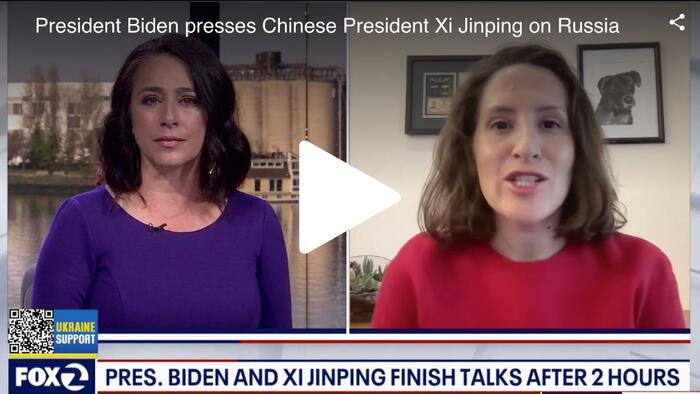
Mastro also spoke to Fox 2 KTVU following a two-hour phone call between President Biden and Chinese President Xi Jinping, in which Biden Warned Xi of ‘Consequences’ if China aids Russia’s invasion of Ukraine. Mastro remarked that China has "not come out in condemnation of this blatant use of force and China can't stand on the sidelines and expect for its reputation not to be tarnished if they continue to support Russia, even implicitly."

Image
Oriana Skylar Mastro on KTVU with a host of the show "Mornings on 2"

Mastro suggested that this moment has serious implications for the U.S.-China great power competition and that success in the U.S.-China relationship "isn’t about [the two powers] but about [their] relationships with the rest of the world...the United States is trying to compete with China economically, politically, and militarily around the world and [the United States has] commitments everywhere...China is very focused on the region, at least militarily, and that makes it difficult for the United States to compete."

Read More

Protesters display placards in front of the Representative Office of the Moscow-Taipei Coordination Commission to protest against Russia’s military invasion of Ukraine on February 25, 2022 in Taipei, Taiwan.
Commentary

Invasions Are Not Contagious

Russia’s War in Ukraine Doesn’t Presage a Chinese Assault on Taiwan
Invasions Are Not Contagious
Army Reserve members during practice
Commentary

Ukraine Is a Distraction from Taiwan

Getting bogged down in Europe will impede the U.S.’s ability to compete with China in the Pacific.
Ukraine Is a Distraction from Taiwan
Chinese military propaganda depicting the Second Taiwan Strait Crisis of 1958.
News

Reassessing China’s Capabilities and Goals for Strategic Competition

On the World Class podcast, Oriana Skylar Mastro argues that in order to set effective policy toward China, the United States needs to better understand how and why China is projecting power.
Reassessing China’s Capabilities and Goals for Strategic Competition
Hero Image
Putin and Xi Getty Images
All News button
1
Subtitle

On WBUR’s "On Point" and Fox 2 KTVU, Center Fellow Oriana Skylar Mastro shares insights about China's alignment with Russia and the worldwide implications of its calculus on Ukraine.

Paragraphs
Cover of the book 'Strategy in the Contemporary World' and screenshot of first page of Oriana Skylar Mastro's chapter "Chinese Grand Strategy"

This chapter briefly covers the history of Chinese grand strategy since 1949 before focusing most heavily on China's strategy of rejuvenation under Xi Jinping. It also covers some of the domestic factors that have influenced Chinese grand strategy over time. It then highlights two components central to China's grand strategy — its approach to international institutions and its maritime ambitions. The chapter ends with a discussion of the United States shift to great power competition with China.

Below is an excerpt from Mastro's chapter in Strategy in the Contemporary World, edited by John Baylis, James J. Wirtz, and Jeannie L. Johnson, reproduced by permission of Oxford University Press.
 

All Publications button
1
Publication Type
Book Chapters
Publication Date
Subtitle

In Strategy in the Contemporary World, edited by John Baylis, James J. Wirtz, and Jeannie L. Johnson, Oriana Skylar Mastro examines the evolution of Chinese grand strategy from Mao Zedong to Xi Jinping, its drivers, and its implications.

Authors
Oriana Skylar Mastro
Book Publisher
Oxford University Press
Paragraphs

Image
Cover of the journal Asia Policy (vol 17.1, Jan. 2022)
How should we understand China’s grand strategy and intentions? The ascendance of Xi Jinping and the beginning of a slew of economic projects like the Belt and Road Initiative, interpreted by many as a tool in the framework of strategic competition with the United States, caused many to see Beijing as increasingly expansionist.5 Some more alarmist analysts, such as Department of Defense policy adviser Michael Pillsbury, have characterized China as having a grand scheme to supplant the United States as the sole global superpower.6 Others see strategic folly in overestimating the threat, focusing instead on the strong fundamentals of U.S. power7 or emphasizing China’s weaknesses and domestic challenges.8 Indeed, the range of academic inquiry and conflicting viewpoints is a testament to the complexity of understanding China and its role on the global stage.

Enter The Long Game: China’s Grand Strategy to Displace American Order, one of the most recent and significant attempts to understand what China wants. Written by Rush Doshi, a former Brookings fellow turned National Security Council staffer in the Biden administration, the book encapsulates rigorous social-scientific research approaches, clear argumentation, and policy relevance as well as is accessible to the average reader. 

All Publications button
1
Publication Type
Journal Articles
Publication Date
Subtitle

Oriana Skylar Mastro reviews Rush Doshi’s book The Long Game: China’s Grand Strategy to Displace American Order (New York: Oxford University Press, 2021).

Journal Publisher
Asia Policy
Authors
Oriana Skylar Mastro
Authors
Oriana Skylar Mastro
News Type
Commentary
Date
Paragraphs

This essay was originally published in Foreign Affairs magazine.

As Russian President Vladimir Putin intensifies his assault on Ukraine, a growing number of U.S. military and foreign policy analysts are voicing concern that China may be emboldened by Russia’s example and try to take Taiwan by force. “If Russia can grab chunks of Ukraine or install a puppet regime and withstand economic sanctions, that could embolden nationalists in China to look to Taiwan and think they could do the same,” Ian Johnson, a China expert at the Council on Foreign Relations, has argued. Representative Michael McCaul, Republican of Texas, made a similar argument in an interview last month, as did retired Army General Jack Keane, who said that Chinese President Xi Jinping sees “weakness in the West and how that can advantage him in terms of his national objectives as well.”

Xi is certainly watching events in Ukraine, but his calculus for whether to use force against Taiwan is shaped primarily by domestic factors, not foreign ones. As I have argued in Foreign Affairs, Chinese leaders are considering “armed reunification” with Taiwan more seriously than at any time in the last 50 years. But Xi will assert Chinese control over the island only if he is confident his military can conduct a successful amphibious invasion and if he believes the timing is right for his own career.


Sign up for our newsletters to receive in-depth analysis from our experts.


Shifts in the international environment would be important for Taiwan if they changed Xi’s thinking on either count. But the war in Ukraine has not. Xi’s views about U.S. power and resolve and about the likely international response to an invasion of Taiwan probably remain unchanged. If anything, China’s desire not to invite comparisons with Russia at a time when the world is united against Moscow will lengthen its timeline for taking control of Taiwan, not shorten it.

Too Big to Sanction?

The economic sanctions that the United States, Canada, and many European countries have imposed on Russia give China little reason for pause. To the contrary, these punitive measures simply confirm Beijing’s previous assessments of the possible economic repercussions of using force against Taiwan. Chinese leaders expect the economic costs of an invasion to be heavy but acceptable—partly because of how the international community has responded to Chinese provocations in the past and partly because Beijing’s foreign policy is designed to convince countries to stay out of China’s “internal” affairs, such as the status of Taiwan.

That is not to say the economic measures Washington and its allies have imposed on Russia in recent days are insignificant. The United States and European countries have blocked Russia’s access to most of its foreign currency reserves, making it impossible for Moscow to intervene to prop up its collapsing currency. They have frozen the assets of senior Russian officials, including Putin himself. And they have moved to exclude big Russian banks from SWIFT, the global financial messaging system.

China’s ability to retaliate against the West with economic sanctions of its own is much greater than Russia’s.
Oriana Skylar Mastro

But the United States and its allies could do more to punish Russia. They could bar all transactions with Russia, whether trade or financial. They could seize all Russian assets within their jurisdictions. Washington could announce secondary sanctions on anyone using U.S. dollars for any transaction with Russia. Most important, the United States could use these and other measures to prevent Russia from exporting oil and gas. Letting Russia continue to export oil and gas would be like letting China sell consumer electronics even after it had taken Taiwan by force.

If the United States and its allies have been cautious in their response to Russia, they are likely to be even more restrained when responding to China — and Beijing knows it. China’s ability to retaliate against the West with economic sanctions of its own is much greater than Russia’s. Singapore, which announced trade and banking restrictions against Moscow, trades about $2.5 billion worth of goods with Russia each year — but $57 billion worth of goods with China. China’s leaders likely do not fear U.S.-led economic sanctions in the event of a Taiwan takeover because they probably think that China’s own productive capacity, resources, and friendly partners will allow them to survive on their own, especially since China will soon be the world’s largest economy. They are probably right. China could absorb the types of sanctions being imposed on Russia. And given China’s ability to inflict pain on Western countries, any measures levied against Beijing would likely be softer than those imposed on Moscow.

Taiwan Is Not Ukraine

The Western military response to Russia’s invasion of Ukraine will have an even smaller impact than sanctions on China’s thinking about Taiwan. True, neither the United States nor NATO has deployed troops to fight on Ukraine’s behalf. And U.S. military assistance to Ukraine has been modest: late last month, President Joe Biden instructed the State Department to release up to an additional $350 million worth of weapons from U.S. stocks to Ukraine.

But Russia would have to invade a NATO ally without provoking a U.S. military response for Chinese leaders to seriously question Washington’s commitment to defending Taiwan. Biden has made clear from the beginning of the crisis that his administration will never send troops to Ukraine—a stark contrast with his rhetoric on Taiwan. Just last week, Biden stated unequivocally that the United States would defend Taiwan in the event of a Chinese attack. As a show of support, he also sent to the island a delegation of former U.S. officials led by Mike Mullen, a former chairman of the Joint Chiefs of Staff.

Chinese planners largely assume the United States would intervene militarily on behalf of Taiwan.
Oriana Skylar Mastro

In any case, Chinese planners largely assume the United States would intervene militarily on behalf of Taiwan. What some of them question is whether the United States could amass enough forces fast enough to blunt a Chinese assault on the island. Ironically, if the United States had launched a military operation in response to Russia’s invasion of Ukraine, Chinese leaders would have had further reason to question Washington’s ability to thwart a Chinese assault on Taiwan. The United States does not have the resources to fight the Russians in Europe and prepare adequately for a great-power war in Asia.  

Of course, these facts have not prevented China from trying to manipulate the narrative to undermine Taiwan’s resolve. Chinese state media has been flush with stories about how the United States did not come to Ukraine’s aid and therefore won’t come to Taiwan’s either. Like much of what appears on Chinese state media, however, these stories reflect what Chinese leaders want the world to believe—not what they believe themselves.

Not the Right Time

Chinese leaders are without a doubt considering an attack on Taiwan, but now is not the right time. China’s military is still honing the capabilities it would need to take and hold the island. And Xi is unlikely to take a dangerous gamble on Taiwan before the next Party Congress in late 2022, when he is widely expected to secure a third term as general secretary of the Chinese Communist Party. Xi is also working hard to lessen China’s technological dependence on the West, thus minimizing the impact on any further decoupling after a possible war. For all these reasons, an assault on Taiwan before 2025 is unlikely.

If anything, the crisis in Ukraine creates an additional incentive for China to wait. Beijing does not want the world to equate the two scenarios. From China’s perspective, Ukraine is an independent country engaged in a border dispute with Russia. Taiwan, by contrast, “has always been an inalienable part of China’s territory,” as China’s ambassador to the Association of Southeast Asian Nations, Deng Xijun, put it late last month. In other words, linking the two issues would undermine China’s claim to the island.

China also understands that moving against Taiwan now would solidify fears in the West of an axis of autocrats. The United States may not have the resolve to fight a protracted war to defend Taiwan. But suddenly faced with a need to defend freedom and democracy against an authoritarian alliance, Washington could muster a greater military response and convince its allies to do the same. Partly for this reason, China has desperately tried to maintain some semblance of neutrality during the Ukrainian crisis.

Russia’s invasion of Ukraine has certainly changed aspects of the international order. It has rallied European countries against Russia, prompted Germany to increase defense spending, and even convinced historically neutral countries such as Finland, Sweden, and Switzerland to take a stance against Moscow. From China’s perspective, however, nothing Russia or its adversaries have done meaningfully alters the calculus on Taiwan. 

Headshot of Oriana Skylar Mastro

Oriana Skylar Mastro

Center Fellow at the Freeman Spogli Institute for International Studies

Read More

Army Reserve members during practice
Commentary

Ukraine Is a Distraction from Taiwan

Getting bogged down in Europe will impede the U.S.’s ability to compete with China in the Pacific.
Ukraine Is a Distraction from Taiwan
President Xi and Kim Jong Un meet on a TV screen
Commentary

North Korea Is Becoming an Asset for China

Pyongyang’s Missiles Could Fracture America’s Alliances
North Korea Is Becoming an Asset for China
Chinese military propaganda depicting the Second Taiwan Strait Crisis of 1958.
News

Reassessing China’s Capabilities and Goals for Strategic Competition

On the World Class podcast, Oriana Skylar Mastro argues that in order to set effective policy toward China, the United States needs to better understand how and why China is projecting power.
Reassessing China’s Capabilities and Goals for Strategic Competition
Hero Image
Protesters display placards in front of the Representative Office of the Moscow-Taipei Coordination Commission to protest against Russia’s military invasion of Ukraine on February 25, 2022 in Taipei, Taiwan.
Lam Yik Fei/ Getty Images
All News button
1
Subtitle

Russia’s War in Ukraine Doesn’t Presage a Chinese Assault on Taiwan

Date Label
Subscribe to Security