


Southeast Asia: China’s Long Shadow
News Type
Commentary
Date
Paragraphs
This essay was first published in the political quarterly Democracy Journal. It is part of a four-essay collection, titled The Stakes in Asia, on the future of U.S.-Asian relations. This essay focuses on the nations of Southeast Asia, the three other essays on China, Japan, and South and North Korea.
EVERYTHING WILL BE OKAY” read the t-shirt worn by 19-year-old Ma Kyal Sin, also known as “Angel,” in Mandalay, Myanmar, on March 3, 2021. Hundreds of thousands of mostly young Burmese had thronged the streets of their country’s cities to continue protesting the military’s seizure of power the month before. She had joined them to serve on the front line, hoping to protect her unarmed companions from the advancing police. She was shot in the back of the head and died. Soon after she was buried, the junta exhumed her body, took it away, and filled her grave with concrete. The regime then claimed that autopsy results showed the bullet in her brain could only have been fired by another demonstrator. Yet when she was shot, she had her back to the oncoming police.
Everything is not okay in Myanmar and won’t be for some time to come. As of the beginning of April, the country’s military, or Tatmadaw, led by the coup’s leader, army General Min Aung Hlaing, had killed an estimated 400 unarmed Burmese, who were guilty of nothing but peacefully protesting the general’s merciless usurping regime. By mid-April, the junta’s murders exceeded 700 in number.
Nor is everything okay next door in Thailand, another mainland Southeast Asian state. Seven years have passed since that country’s latest coup in 2014—the 13th successful seizure of power there since the overthrow of its then-absolute monarchy in 1932. Although elections were finally held in 2019, the military manipulated them to reinforce its rule. Young Thais have been demonstrating against the government off and on since early in 2020.
East of Thailand are three more China-facing states in mainland Southeast Asia: Cambodia, Laos, and Vietnam. Cambodia’s dictator Hun Sen has kept his grip on power for more than 36 years, a record exceeded in Asia only by the Ayatollah Khameini in Iran. In March 2021, a Cambodian court did Hun Sen’s bidding yet again by sentencing the nine senior members of the country’s already banned opposition party, including its leader, to more than two decades in prison, effectively barring them from ever returning home from exile.
Laos is, in effect, a fiefdom of the harshly dominant Lao People’s Revolutionary Party (LPRP), whose leaders have quashed opposition, curtailed liberties, and forcibly suppressed the formation of a civil society independent of that single-party state. Vietnam’s draconian law on cybersecurity outlaws the “organizing, activating, colluding, instigating, bribing, cheating or tricking, manipulating, training, or drilling” of “people to oppose the State of the Socialist Republic of Vietnam,” while also criminalizing undefined actions such as “causing confusion,” “distorting history,” and “denying revolutionary achievements.” Unsurprisingly, Laos and Vietnam rank 172nd and 175th, respectively, on the 2020 World Press Freedom Index of 180 countries.
[Sign up for our newsletters to receive the latest commentary and analysis from our experts.]
The Mainland-Maritime Contrast
Myanmar, Thailand, Cambodia, Laos, and Vietnam constitute sub-continental Southeast Asia. Myanmar, Laos, and Vietnam share land borders with China. The remaining Southeast Asian states—the Philippines, Malaysia, Brunei, Indonesia, Singapore, and Timor-Leste—are peninsular or insular in character and farther from China. It is common practice in Southeast Asian studies to distinguish the China-proximate five “landed” or mainland countries in northwestern Southeast Asia from the “maritime” six farther to the south and the east.
Six of the ten members of the Association of Southeast Asian Nations are “Not Free”: Brunei, Cambodia, Laos, Myanmar, Thailand, and Vietnam. More than half of ASEAN is despotic by this measure, and of those six authoritarian members, five are on the mainland.
Geography and geology are not the same. Of the five mainland countries, four have seacoasts; only Laos is land-locked. All of the six maritime states are entirely or partly archipelagic. But Malaysia and Singapore are subcontinental in that they occupy the southernmost end of peninsular Southeast Asia. A projected three-stranded set of overland railroads connecting Malaysia and Singapore to mainland China, if completed, could socioeconomically enhance their subcontinental character. The strands would run southward from Kunming, the capital city of China’s Yunnan province, through Myanmar, Laos, and Vietnam to Bangkok in Thailand and onward through Malaysia to Singapore. Completing these north-south connections has been a priority of Xi Jinping’s Belt and Road Initiative (BRI).
Fears of “mainlandization”—Sinification—have arisen in that context. China’s presence is already amply manifest in the northern parts of Myanmar and Laos, where economic and cultural enclaves have formed around the influxes of tourists and immigrants from the PRC. Expatriate and local Chinese dominate the economy of Myanmar’s second largest city, Mandalay, where young Ma Kyal Sin died. Mandarin is widely spoken there. If the BRI succeeds, if the north-south tracks are laid and maintained, and if traffic then flourishes back and forth to the mutual “win-win” benefit of China and all of the five Southeast Asian economies along the way, Beijing could further enlarge its footprint in the region.
Could does not mean will. The world economy shrank by more than 4 percent in 2020. Infrastructure is costly, and its returns are long-term. To varying extents in different countries, envisioned connectivity has become a casualty of the COVID-19 pandemic, as governments have closed borders to reduce transmission of the virus and its variants. In 2019-2020, the pace of overseas lending by China’s policy banks slowed, and Chinese spending on megaprojects in the BRI fell to its lowest level ever. China’s latest five-year plan calls for “dual circulation,” abroad as well as at home, but the domestic economy is given priority.
That said, China’s economic growth in 2021 could reach 8 percent and thereby fuel Beijing’s campaign for influence in mainland Southeast Asia. In Laos, for example, aggressive Chinese lenders and corrupt local elites have indebted that country to the point that its lucrative electricity exports may soon be controlled by China. As one of the poorest members of the Association of Southeast Asian Nations (ASEAN), Laos needs those revenues. Majority control over the country’s network of high-voltage power lines could give Beijing leverage that it could wield to ensure that Laos remains a compliant “friend” of China.
As illustrated by the case of China-facing Laos, the distribution of despotism in Southeast Asia tends to reinforce the mainland-maritime divide. “Many have said over the years that ASEAN is a club of dictators,” a Human Rights Watch official observed in 2016.
That harsh judgment is less of an exaggeration than one would wish. According to Freedom House, six of the ten members of the Association of Southeast Asian Nations are “Not Free”: Brunei, Cambodia, Laos, Myanmar, Thailand, and Vietnam. More than half of ASEAN is despotic by this measure, and of those six authoritarian members, five are on the mainland. The only maritime autocracy is tiny Brunei, an absolute monarchy perched on the coast of Borneo facing the South China Sea. The remaining four ASEAN states—Indonesia, Malaysia, the Philippines, and Singapore—are all maritime and rated “Partly Free.” The lone “Free” country in the region is Timor-Leste, which occupies three neighboring bits of territory in the Indonesian archipelago and is not a member of ASEAN, although it would like to join.
Three crude descriptions follow: First, mainland Southeast Asia is autocratic. Second, maritime Southeast Asia is semi-democratic—a middle or mixed position reflected in the balance between the two smallest sea-linked states by population, autocratic Brunei and democratic Timor-Leste. Third, ASEAN’s membership tilts authoritarian, being six-tenths autocratic, four-tenths semi-democratic, and zero tenths democratic by Freedom House standards.
China’s Role: ‘Stability’ Over Democracy
How should China and its strategy be factored into these comparisons? Is geography destiny? Xi Jinping and his advisors would like their Southeast Asian counterparts to think so. Consider Beijing’s proposal for an ASEAN-China Community of Common Destiny. Does “community of common destiny” express China’s empathy, its presumption, or its intention to possess and preempt? Beijing wants its Southeast Asian neighbors to treat the idea of sharing a community as reassuring proof of how much and how sincerely China cares about them and their region. But a common destiny precludes divergent scenarios and destinations. If China’s destiny is to remain a party-state dictatorship under one leader for life, does Beijing want that same fate to encompass the rest of Southeast Asia? Does it strive to “mainlandize” the entire region by reinforcing top-down rule in “Not Free” Southeast Asia and making the “Partly Free” maritime states “Not Free” as well?
Shorn of all pretense, Xi Jinping’s hope is that China’s southern neighbors will look at a map and give up [...] Although China’s political template is authoritarian, Xi is not an evangelist for autocracy in Southeast Asia.
China is not evangelically despotic toward its neighbors in an ideological sense. “Socialism with Chinese characteristics” is an unexportable mishmash—oxymoronic in theory, contingent in practice, and parochial by its very name. As a candidate for travel beyond the PRC, it lacks legs. Nor is China counting on converting Southeast Asians into loyal fans of a Chinese model. Beijing is vigorously trying to bolster its soft power and incentivize its neighbors to acknowledge and join a Chinese sphere of regional influence voluntarily. The ASEAN states collectively are already China’s largest trading partner and vice versa. But if public diplomacy and economic embraces fail, it is fatalism, not communism, that Beijing is betting on.
Shorn of all pretense, Xi Jinping’s hope is that China’s southern neighbors will look at a map and give up. Why? Because, as the PRC’s current top diplomat Yang Jiechi famously told his ASEAN counterparts in 2010, “China is a big country and other countries are small countries, and that’s just a fact.” As if big China were saying to its small neighbors: Our common destiny is to experience and accept the disparity between us, for we and you are destined to remain unequal, whether you like it or not. Take the South China Sea. We—the PRC—were always destined to absorb nearly all of that body of water based on Chinese sovereignty “formed over the course of over two thousand years,” to quote Jiechi in 2016.
The South China Sea is not lebensraum. It is not viewed in Beijing the way Berlin saw Poland in August 1939. Nevertheless, Xi’s China continues to manufacture destiny with Chinese characteristics in the heartwater of Southeast Asia by creating maritime facts on the water that Southeast Asians cannot reverse. These include China’s forcible possession of land features claimed by ASEAN’s littoral states; its conversion of those features into military bases from which it can threaten the region; and its orchestration of at-sea collisions, near-collisions, encirclements, and swarmings to stop Southeast Asians from fishing or from lifting undersea oil and gas even within their own Exclusive Economic Zones, all in clear violation of the UN Convention on the Law of the Sea. Beijing hopes that someday its control over the South China Sea and the land features it has weaponized there will be “just a fact” that ASEAN’s members will have had to accept, their lack of China’s size and strength having convinced them that they have no choice but to kowtow. Rather than trying to seed the region with despotisms in China’s image, Beijing prefers to encourage Southeast Asian fatalism, and with it the passivity and resignation to subservience that sheer necessity would imply.
Although China’s political template is authoritarian, Xi is not an evangelist for autocracy in Southeast Asia. If, as has been claimed, Xi’s China is “ideologically bankrupt,” it has no surplus in ideas to spend convincing the world to mimic its doctrine. As exportable advice, the formula that Beijing does represent—regime legitimation by economic performance—is more pragmatic than ideological. There are, nevertheless, three ways in which Chinese foreign policy in Southeast Asia affects, and is affected by, the more despotic character of ASEAN’s mainland compared with its maritime member states.
As it seeks to influence its neighbors and the world beyond, Xi’s China may be ideologically promiscuous. But Beijing does love stability. When Adam Prezorskwi described democracy as “institutionalized uncertainty,” he noted its potentially beneficial effect. The unpredictability of electoral outcomes in a democratic system is stabilizing insofar as it motivates a losing candidate not to turn against the system but rather to run again within it. The chance of victory—positive uncertainty—may warrant another try.
But institutionalized uncertainty is anathema to the Communist Party of China. The power and authority of the CPC under a could-be leader for life supplies the institutionalized certainty that a stable dictatorship needs—or thinks it needs—to survive. Rapid economic growth and the systematic forestalling of civil society in China continue at least to postpone recourse to another Tiananmen massacre. In roughly comparable ways, institutionalized repression in Laos, Cambodia, and Vietnam has helped keep those dictatorships stable—so far. Beijing’s faith in the stabilizing power of institutionalized certainty makes dealing with foreign despots a subjectively rational choice. And doing so can at least simplify Chinese diplomacy. Democracies have more actors who need to be taken into account, including critics of China whose barbs are protected speech.
Consider Myanmar. Given Beijing’s economic and strategic stake in using Myanmar as a way station for greater Chinese access to the Indian Ocean, Xi is probably furious that Senior General Min Aung Hlaing has rendered Myanmar unstable and unpredictable. The general’s regime is not innately pro-China. But Beijing likely calculates that a democratic alternative to military rule could jeopardize China’s position even more. In the days immediately following the Tatmadaw’s seizure of power, Beijing did not even acknowledge that a coup had taken place, calling it a mere “cabinet reshuffle” and blocking the UN Security Council from criticizing what had occurred. Inside Myanmar, anti-China protests ensued, with accusations stemming from rumors that China might even have encouraged the coup due to its own despotic character and inclination. The rumors sound unfounded, but the fact that they circulated among democracy-minded opponents of the junta could only reinforce Beijing’s preference for military rule.
Xi’s China craves praise. Chinese “wolf warrior” diplomats in Southeast Asia have not been shy about urging and thus implicitly requiring recipients of Chinese “gifts,” including vaccines for local use against the COVID-19 virus, to publicly thank China for its generosity—preferably in profuse terms. In a democracy that values personal worth more than hierarchical deference and obligatory gratitude, kowtowing may be unpopular. In contrast, under a despot, obligatory upward fawning may be normal and thus more easily performed to please a foreign donor. An authoritarian patron may welcome such expressions of fealty as signs of submission. In addition, China’s often visceral dismissal of foreign criticism, compared with the normality of critique in democratic states, would suggest that Beijing prefers to deal with leaders of governments that enforce gratitude for reasons of material dependence on China, as opposed to those who refuse to self-censor. Looking back and forward toward the future, China’s history as a presumptuous empire and its Xi-led quest for “rejuvenation” to recover former glory, before its “century of humiliation” by the West, are not conducive to comportment as a Westphalian state dealing on a basis of equality with other states.
Third and finally, if authoritarian China is about product with little regard for process, whereas democratic society reverses those priorities, it stands to reason that China’s policymakers may, other things being equal, prefer to partner with autocratic heads of state who can get things done, never mind how.
Pushing Back and Looking Forward
Deterministically structural explanations of China’s influence in Southeast Asia—size, proximity, a magnetic economy—overlook the human factor: the capacity of the region’s people and leaders to question and reject dependence on tectonic conditions that stack the deck in China’s favor. To Beijing’s likely chagrin, that capacity is amply evident in the opinions of elite-level Southeast Asians who follow their countries’ foreign affairs. The ISEAS-Yusof Ishak Institute’s consecutive annual surveys of the views of these individuals have revealed their rising mistrust of China and, conversely, their rising trust of the United States.
Sampled in 2018, these elites mistrusted China and the United States in equal measure. In that year, 52 percent had little to no confidence that China would “do the right thing” in world affairs, while 51 percent said the same thing about the United States. But in 2019 and 2020, that pox on both houses has consistently and markedly evolved in China’s disfavor. By 2020, 63 percent of the Southeast Asian respondents mistrusted China, compared with 31 percent who mistrusted America. If that shift seems odd in light of the destabilizing idiosyncrasies of Donald Trump, it should be noted that the 2020 survey was conducted late in the final year of his presidency and the questions were about what China and the United States could be expected to do in the future. China’s hope for loyal neighbors received a further blow in the answers to a question about whether ASEAN, were it forced to align itself with one of the two big rivals, should side with China or with the United States. Although 39 percent of the respondents opted for China, 62 percent chose the United States.
Opinions are malleable. The popularities of China and the United States will fluctuate in tandem with future events. Although the survey research cited above has portrayed China as untrustworthy, expansionists in Beijing could take comfort in the data on Southeast Asian perceptions of relative power as a matter of fact, trustworthiness aside. Asked in 2020 which country or regional organization (such as ASEAN or the European Union) was the most influential economic power in Southeast Asia, 76 percent said China. Merely 7 percent named America. China won as well, though by a less overwhelming margin, when the same question was asked regarding political and strategic influence. That China is most consequential in those regards garnered 49 percent agreement, compared with 30 percent who thought the United States fitted that description. In effect, the survey inadvertently endorsed China’s cultivation of acquiescent fatalism in Southeast Asia—destiny over opportunity, realpolitik over moralpolitik—to the marginal advantage of Beijing.
In the months and years to come, major outside actors—the United States, Japan, and India among others—could work with autonomy-seeking Southeast Asian states to slow the Chinese juggernaut in Southeast Asia.
China is not significantly or consistently more or less popular in mainland Southeast Asia than it is in the maritime part of the region. Mistrust of China, for example, is highest in mainland Vietnam and in the maritime Philippines, albeit for different reasons. The Vietnamese remember their history of resistance to domination by China and resent its current bullying in the South China Sea. The latter behavior also angers Filipinos, whose own post-colonial history has tended, with exceptions, to involve accommodation with the United States. But the existence of a structural straitjacket that a Sinocentric understanding of “common destiny” would imply is more evident in the countries located closer to China that are accordingly less able to ignore their huge, overbearing, and censorial neighbor.
China is not willfully spreading autocracy in Southeast Asia. China’s relations with its neighbors are motivated by interest not ideology. With the stark exception of Vietnam, however, one can envision an authoritarian symbiosis of sorts developing between despotic China and potential satellite despotisms along its southern land border. Myanmar could become a test case in this context. If the junta crushes the opposition, if ASEAN does little more than slap the wrist of its murderous member, and if Western outrage drives the Tatmadaw into China’s arms, the growth of a Chinese sphere of influence based on authoritarian connivance could someday even split ASEAN roughly into its northwestern-subcontinental and southeastern-archipelagic parts.
Nevertheless, at least for now, the bravery of the martyred Ma Kyal Sin and her co-protestors in Myanmar, and of their counterparts in Thailand protesting against their own military regime, evokes, at least for now, a less despotic and subordinated future for Southeast Asia. Authoritarian instability is not an oxymoron. China’s own domestic stability and prosperity are not guaranteed. Its soft power deficit is real, and its overreaching under Xi Jinping could continue to vindicate Southeast Asian distrust. In the months and years to come, major outside actors—the United States, Japan, and India among others—could work with autonomy-seeking Southeast Asian states to slow the Chinese juggernaut in Southeast Asia.
A fresh wave of democratization in Southeast Asia is not on the horizon. But the destiny of even the already undemocratic mainland portion of Southeast Asia is not—not yet at least—made in Beijing.
Read More

![[Left] Gita Wirjawan and the Endgame logo; [Right] Donald K. Emmerson](https://fsi9-prod.s3.us-west-1.amazonaws.com/s3fs-public/styles/375x211_x2/public/hero/emmerson_indonesia_endgame_hero.png?h=c4d9845d&itok=2daL3k4c)

Hero Image

All News button
1
Subtitle
Chinese foreign policy in Southeast Asia affects, and is affected by, the more despotic character of ASEAN’s mainland compared with its maritime member states. But the destiny of even the already undemocratic mainland portion of Southeast Asia is not—not yet at least—made in Beijing.
ASEAN Centrality and the Way Forward: Donald Emmerson on Endgame
News Type
News
Date
Paragraphs
Indonesia is the largest nation in Southeast Asia, but it is still dwarfed by the outsized influence China has in the region. Like many Southeast Asian nations, Indonesia desires strategic autonomy over its foreign policy and statecraft. But as the antagonism between the United States and China grows, there is increasing pressure for Indonesia and the rest of the region to choose sides in the great power competition.
Donald K. Emmerson, director of the Southeast Asia Program, joins Gita Wirjawan on the podcast Endgame to discuss the challenges Indonesia faces as it tries to chart a course of policies that balance its domestic needs and desire for autonomy with the international geopolitical sparrings occurring in its backyard in the South China Sea. The full podcast episode is available below.
[Subscribe to our newsletters to stay up to date on our scholars' research.]
Emmerson draws from his recent book, The Deer and the Dragon: Southeast Asia and China in the 21st Century, to frame the struggle Indonesia faces. Internally, Indonesia faces challenges to its democracy and in managing political and cultural diversity. Externally, there is the challenge of trying to simultaneously work within the often-fractured and disunified structure of ASEAN while still rebutting pressures from China.
In this sense, Indonesia must behave as the mousedeer in local folklore and nimbly navigate around its larger rivals with clever politics and policies. But the realities of the situation are much more complicated. Emmerson and Wirjawan take a deep dive into Indonesia's history, culture, politics, and position in the region and how those factors may affect the country's trajectory towards an endgame. Below is the video version of their conversation.
Get a Copy of The Deer and the Dragon
Read More


Hero Image
![[Left] Gita Wirjawan and the Endgame logo; [Right] Donald K. Emmerson](https://fsi9-prod.s3.us-west-1.amazonaws.com/s3fs-public/styles/895x498_x2/public/hero/emmerson_indonesia_endgame_hero.png?h=c4d9845d&itok=xvd3WV8a)
All News button
1
Subtitle
On the Endgame podcast, Southeast Asia Program Director Donald K. Emmerson discusses the history and politics that have shaped Indonesia in the past and how that context now affects the country's position in the intensifying rivalry between China and the United States.
APARC Experts on the Outlook for U.S.-Asia Policy Under the Biden Administration
News Type
News
Date
Paragraphs
In the last four years of the Trump presidency, there has been no shortage of inflammatory rhetoric directed towards both partners and competitors in the Asia-Pacific. With the Biden administration now about to take office, APARC convened a center-wide panel to discuss how different regions of the Asia-Pacific are responding to the incoming presidency and recent events in the United States, and what issues the new administration should consider as it moves into a new era of U.S.-Asia policies. The panelists included APARC Director Gi-Wook Shin, FSI Center Fellow Oriana Skylar Mastro, Japan Program Director Kiyoteru Tsutsui, Southeast Asia Program Director Donald K. Emmerson, and Shorenstein Fellow Thomas Fingar. Watch the full discussion below:
[Subscribe to APARC’s newsletters to get our latest commentary and analysis]
Soft Power and U.S.-China Competition
One thing the Trump administration has identified correctly and managed to get consensus on, says Chinese military and security expert Oriana Skylar Mastro, is that the United States is in a great-power competition with China. Biden now accepts this framework, and Mastro expects him to maintain the basic principles of U.S. Asia policy, such as strategic ambiguity and ensuring Taiwan’s defense through arms sales. The difference will be in Biden’s approach, which is based on “multilateralism, strengthening partnerships, and not trying to provoke Beijing for the sake of provoking Beijing.” This approach, believes Mastro, is going to improve the U.S. position in terms of competition.
Beijing has never built its attractiveness on its political system. But the Trump administration has made political values the core of its soft power strategy. So when you have hits against political values, those hurt the United States much more than it hurts China.
Oriana Skylar Mastro
FSI Center Fellow
A core component of the U.S.-China great-power competition, however, is soft power — the ability of countries to get what they want through persuasion or attraction in the form of culture, values, and policies. Soft power, argues Mastro, is an area that is very hard for a president to have control over and rebuild, and American soft power has taken a tremendous hit with the breach of the U.S. Capitol on January 6. Demonstrating the decline of American democracy, the scenes from the pro-Trump mob attack have been a win for China and are hardly encouraging for U.S. partners and allies.
Biden can do a lot to tackle U.S. domestic problems and improve the political image of America abroad. But soft power, concludes Mastro, is organic. “I fear that President-elect Biden is going to learn that soft power, once lost, is very difficult to regain.”
The U.S.-Japan Alliance and Security in the Asia-Pacific
In shifting to relations between the United States and Japan, Kiyoteru Tsutsui focuses on how the traditional aspects of the Japan-U.S. alliance are playing out in the current geopolitical theater. In Tsutsui’s view, Japan’s early brushes with Chinese might in the 2010s has left the country particularly keen on ensuring that a strong counterbalance exists to China’s strategic advantage.
To that end, Japan has proactively partnered with other nations on trade deals such as the Regional Comprehensive Economic Partnership (RCEP) and Comprehensive and Progressive Agreement for Trans-Pacific Partnership (CPTPP). The fact that both of these major free trade agreements were concluded without U.S. involvement is significant, and whether President Biden makes any response will be “one the more closely watched issues among foreign policy experts in the coming years,” by Tsutsui’s measure.
The reemergence of ‘the Quad,’ and even discussions of a ‘Quad+’ that includes nations such as South Korea, is of particular interest to Tsutsui. Such groups provide additional avenues for further developing the ‘free and open Indo-Pacific’ strategy originally envisioned by Prime Minister Abe. But Tsutsui is also not opposed to the idea of engaging China directly in multilateral efforts as long as China understands the U.S. and Japan’s resolve in countering Chinese aggression and non-peaceful ambitions.
The Korean Peninsula in the Spotlight
When it comes to engagement on the Korean peninsula, Gi-Wook Shin hopes the new administration will avoid a reactionary response and backsliding into old habits. The temptation to respond with an “anything but Trump’s” approach to handling relations with North Korea may be strong, particularly given the president’s unusually forward relationship with North Korean leader Kim Jong Un, but Shin counsels to not set aside everything Trump did in regards to the DPRK.
It is important for Biden to send Kim Jong Un a clear message that if North Korea is willing to negotiate again with the United States, then they should not try to make any provocation but wait until his team is ready to reengage.
Gi-Wook Shin
Director of APARC and the Korea Program
“Bringing North Korea and Kim Jong Un more into the international community was an important step that no other president has made,” he says. Shin strongly cautions against a return to the strategic patience typical of the Obama era. With Kim’s consolidated control and North Korea’s wielding far more advanced nuclear capabilities and significantly strengthened ties to China than it did eight years ago, a return to previous patterns of diplomacy would fail to address the present circumstances on the Korean peninsula. Shin urges the Biden administration to reemphasize human rights and deepening dialogues with its diplomatic counterparts in Seoul. He foresees an improvement in U.S.-ROK relations but warns that North Korea can be a source of tension between the two allies.
Opportunities for Allies in Southeast Asia
Donald Emmerson also recommends strengthening diplomatic ties to the nations of Southeast Asia and the Association of Southeast Asian Nations (ASEAN). By his assessment, “ASEAN needs creativity. It needs new ideas rather than simply following the path of least resistance.” Emmerson envisions this well-spring of creativity coming in part from robust new efforts by the United States to engage with the region diplomatically and academically.
Existing forums such as the Bali Democracy Forum can provide a ready-made platform for engagement, while active participation in gatherings such as the Global Town Hall organized earlier this year by the Foreign Policy Community of Indonesia (FPCI) provide easy opportunities for the United States to meaningfully engage with Southeast Asia.
An Outlook on the Broader Asia-Pacific
Closing out the panel’s remarks, Thomas Fingar offers measured optimism for the future. “I think the incoming U.S. approach to the countries in Asia, China included, is going to be pragmatic and instrumental, not transactional. Every nation who thinks they can contribute, does contribute, and is willing to play by a rules-based order can be part of the solution.”
Fingar expects the Biden administration’s foreign policy to be “focused on problems, not places” — to be driven less by particular animosity or affection for certain countries and more by addressing global issues that promote American interests, such as climate change, the impediments in the international system to advancing American economy, and preserving security.
By consensus, the incoming Biden administration’s most immediate concerns are overwhelmingly domestic. But as Mastro articulated, the effects of the United States’ domestic policies directly impact its perception, standing, and sphere of influence around the globe.
Effective relationships between the United States and the Asia-Pacific cannot be sustained in the long term with an ongoing ‘America first’ agenda or by pursuing zero-sum goals. Rather, the Biden administration must focus on finding solutions to multilateral needs by working side-by-side with Asian nations as co-sponsors and co-leaders.
Read More
Hero Image

All News button
1
Subtitle
Ahead of President-elect Biden’s inauguration and on the heels of the attack on the U.S. Capitol by a pro-Trump mob that has left America shaken, an APARC-wide expert panel provides a region-by-region analysis of what’s next for U.S. policy towards Asia and recommendations for the new administration.
Donald Emmerson Outlines Southeast Asia's Need to Balance Regional Politics and Influnce from China
News Type
News
Date
Paragraphs
Southeast Asia is geographically and economically dwarfed by China. But that does not mean the region must inevitably bend to the will and ambitions of the PRC. Like the small but nimble mousedeer of local mythology, Southeast Asia may outwit the larger dragon through careful navigation and shrewd negotiation. Can this diverse region rally together, or will differences in culture, history, and society continue to hobble efforts to create a coordinated response to China's influence? The Deer and the Dragon: Southeast Asia and China in the 21st Century, a new edited volume by Donald K. Emmerson, seeks to understand this dynamic and give context on the complexities of Southeast Asian geopolitics both within the region and in a global context.
On October 22, 2020, Emmerson virtually joined the National Committee on U.S.-China Relations and the New York Southeast Asia Network, along with Ann Marie Murphy of Seton Hall, to discuss The Deer and the Dragon and further explore the region's standing in relation to current international affairs. Watch below:
[Subscribe to APARC's newsletters to stay informed about current research and upcoming events.]
An audio recording of the event is also available for listening below:
Read More


Hero Image

All News button
1
Subtitle
Southeast Asia Program Director Donald Emmerson joined the National Committee on U.S.-China Relations for a discussion with Ann Marie Murphy on his new edited volume, "The Deer and the Dragon: Southeast Asia and China in the 21st Century."
Scot Marciel
1
marciel7@stanford.edu
Oksenberg-Rohlen Fellow
Scot Marciel was the Oksenberg-Rohlen Fellow at the Freeman Spogli Institute for International Studies, affiliated with the Walter H. Shorenstein Asia-Pacific Research Center from 2022-2024. Previously, he was a 2020-22 Visiting Scholar and Visiting Practitioner Fellow on Southeast Asia at APARC. A retired diplomat, Mr. Marciel served as U.S. Ambassador to Myanmar from March 2016 through May 2020, leading a mission of 500 employees during the difficult Rohingya crisis and a challenging time for both Myanmar’s democratic transition and the United States-Myanmar relationship. Prior to serving in Myanmar, Ambassador Marciel served as Principal Deputy Assistant Secretary for East Asia and the Pacific at the State Department, where he oversaw U.S. relations with Southeast Asia.
From 2010 to 2013, Scot Marciel served as U.S. Ambassador to Indonesia, the world’s fourth most populous country. He led a mission of some 1000 employees, expanding business ties, launching a new U.S.-Indonesia partnership, and rebuilding U.S.-Indonesian military-military relations. Prior to that, he served concurrently as the first U.S. Ambassador for ASEAN Affairs and Deputy Assistant Secretary of State for Southeast Asia from 2007 to 2010.
Mr. Marciel is a career diplomat with 35 years of experience in Asia and around the world. In addition to the assignments noted above, he has served at U.S. missions in Turkey, Hong Kong, Vietnam, Brazil and the Philippines. At the State Department in Washington, he served as Director of the Office of Maritime Southeast Asia, Director of the Office of Mainland Southeast Asia, and Director of the Office of Southern European Affairs. He also was Deputy Director of the Office of Monetary Affairs in the Bureau of Economic and Business Affairs.
Mr. Marciel earned an MA from the Fletcher School of Law and Diplomacy, and a BA in International Relations from the University of California at Davis. He was born and raised in Fremont, California, and is married with two children.
Hide publication sections
Off
Strategy in the South China Sea
News Type
Commentary
Date
Paragraphs
Stretching from China in the north to Indonesia in the south, the South China Sea – the third largest of the world’s 100-plus seas – possesses rich oil and natural gas reserves, constitutes a thriving fishing zone, and transits a vast amount of trade. It is also the center of disputes over issues of territorial sovereignty and maritime rights and interests involving China, Brunei, Indonesia, Malaysia, the Philippines, Taiwan, and Vietnam.
No Chinese behavior in Southeast Asia illustrates the “binary of strength over weakness more clearly than Beijing’s unilateral, adamant, and expansive assertion of full sovereignty over or proprietary rights in virtually all of the waters and land features in the South China Sea,” writes APARC’s Southeast Asia Program Director Donald K. Emmerson in his upcoming volume The Deer and the Dragon: Southeast Asia and China in the 21st Century. The fallout from COVID-19 and increased military activity in the region raise the risk of conflict between China and the United States, which has a strong interest in preventing China from controlling the disputed waterway.
Against this background, the U.S. Embassy in Kuala Lumpur, Malaysia, hosted a virtual conversation with Emmerson, titled “Strategy in the South China Sea.” Held on May 12, 2020 (May 13 in Kuala Lumpur), the discussion drew attendees from across the United States and Southeast Asia. Emmerson's analysis focuses on issues such as the tactics China has used to advance its goal in the South China Sea; how the countries of Southeast Asia are reacting to the situation and whether they are pursuing defined strategies regarding the tensions in the region; and what an ASEAN strategy in the South China Sea might look like. Listen to his remarks at this link.
Read More


Hero Image

All News button
1
Subtitle
Donald K. Emmerson analyzes China’s tactics in the South China Sea and how the countries of Southeast Asia are reacting to the tensions in the disputed waterway.
Display Hero Image Wide (1320px)
No
The Deer and the Dragon
Paragraphs
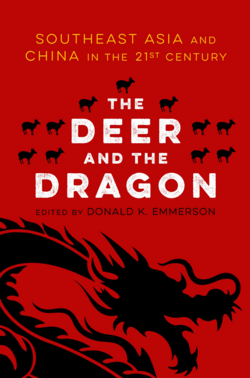
Southeast Asia is arguably the most diverse region in the world. Accordingly, rather than addressing the exact same question, the contributors to this volume have — as experts on Southeast Asia-China relations — explored the matters they see as most important and most deserving of exploration and exposure. After the editor’s introduction, the chapters proceed in pairs. Each pair and a closing chapter cover a distinctive theme in Southeast Asia’s interactions with China.
Featured among the historical and economic contexts needed to understand the interactions are security and development as Chinese goals and how diversified beyond China Southeast Asia’s trading partners are. Southeast Asian and Chinese perceptions of each other are examined using survey research and by asking whether China views the region as its “strategic backyard.” Two actual or intended expansions are analyzed: expanded Chinese sovereignty over the South China Sea and Beijing’s interest in using “overseas Chinese” to expand its influence in the region. The chapters on strategies analyze the very different ways of approaching China preferred by Singapore and Indonesia. Rather than documenting the obvious inequalities of size and power between China on the one hand and Cambodia and Laos on the other, the essays on disparities show how relations with China interact with asymmetries inside these two states. Policy implications of differing distances are drawn in the pieces on how Southeast Asia’s proximity to China affects the prospect of Chinese regional dominance as compared with far-off America’s role and as seen through the lens of Beijing’s far-flung Maritime Silk Road. A final chapter on a seventh theme features a Myanmar analyst’s retrospection on myths and illusions that have arisen to cloud how that country’s relations with China are interpreted, with possible implications for understanding Sino-Southeast Asian dealings with China more broadly.
Learn more about the book and listen to a podcast conversation with Donald K. Emmerson >>
Reviews
"The Deer and the Dragon offers a novel contribution to studies of China–Southeast Asia relations from a diverse set of voices, inviting the authors into an enriching conversation with one another. It also provides a welcome riposte to prevailing depictions of Southeast Asia as either powerless to challenge a rising China or as mere pawns in a great game between Beijing and Washington."
— Hunter Marston, Journal of Asian Security and International Affairs (Vol. 8, Issue 2, July 2021)
"In The Deer and the Dragon, Emmerson, one of the most eminent thinkers on Southeast Asia, has rallied an army of top regional experts to examine the nature, dynamics and implications of the power asymmetries between China and the countries of Southeast Asia.”
— Yun Sun, Contemporary Southeast Asia (vol. 42, no. 3, Dec 2020)
"[T]his rich compilation unearths multiple dimensions of China’s geo-economic and geo-strategic intentions in Southeast Asia, while speaking to the dynamics of power and agency [...] It will be invaluable for scholars of Southeast Asia looking to understand China’s past, future and present interactions with the region."
— Anna Buckley, Security Challenges (Vol. 16, no. 4, Dec. 2020)
"As China’s relations with most of its southern neighbors deteriorate, there is a crying need for a detailed, nuanced study to explain why. The Deer and the Dragon is the book we have been waiting for. Its diverse points of view, depth of research, and sophistication of analysis make the book essential reading."
— Nayan Chanda, Global Asia
“The authors of this commendably well-edited book are among the finest experts on China’s relations with Southeast Asia. The result does justice both to the complex and multifaceted nature of China’s regional influence and to the diversity and increasing self-assertiveness of its southern neighbors, who are far from mere pawns in a game of chess between big powers.”
— Richard Heydarian, author of The Indo-Pacific: Trump, China, and the New Struggle for Global Mastery
All Publications button
1
Publication Type
Books
Publication Date
Subtitle
Southeast Asia and China in the 21st Century
Book Publisher
Shorenstein APARC
Book Publisher External URL
U.S. Ambassador to Vietnam Meets with Stanford Experts
News Type
News
Date
Paragraphs
APARC’s Southeast Asia Program recently hosted the U.S. Ambassador to Vietnam Dan Kritenbrink, who joined faculty members from the Freeman Spogli Institute for International Studies and other Stanford experts for a roundtable discussion about U.S.-Vietnam relations and U.S. strategy in Southeast Asia.
Ambassador Kritenbrink outlined the priorities of the U.S. Mission Vietnam and commended the Vietnamese leadership on its cooperation on a range of issues that span economic development, nuclear nonproliferation, regional security, and people-to-people ties.
The year 2020 marks a quarter of a century since the United States and Vietnam established diplomatic relations. Vietnam is now the fastest-growing economy in Southeast Asia and has emerged as a U.S. partner in pushing back against Beijing's claims in the South China Sea. Yet there are limits to the partnership, as Vietnam is not a democracy and its communist government, having adopted a hedging strategy, is pursuing a multi-country foreign policy, including advancing defense ties with Russia.
 Roundtable discussion participants listening to Ambassador Kritenbrink..
Roundtable participants listening to Ambassador Kritenbrink. Photo credit: Noa Ronkin.
The issues considered during the roundtable discussion with the Ambassador included some of the challenges and opportunities for Vietnam, which has more leverage to engage the region this year as it serves as chair of the Association of Southeast Asian Nations (ASEAN). It certainly has a full agenda for its chairmanship amid geopolitical tensions in the region, the need to balance the U.S.-China friction, the spread of COVID-19, a slowdown in global trade, and the looming environmental and social impacts posed by the threats to the Mekong river.
Ambassador Kritenbrink began his posting in Vietnam in November 2017 and has served as an American diplomat since 1994. He has completed multiple assignments related to Asia, including the roles of senior advisor for North Korea policy at the Department of State; senior director for Asian affairs at the National Security Council, where he worked on Vietnam and oversaw the negotiation of two Joint Statements regarding the U.S. Comprehensive Partnership with Vietnam; seven years in senior roles in the U.S. Embassy Beijing; and three prior diplomatic postings in Japan.
Hero Image

All News button
1
APARC Delegation Visits Hanoi and Bangkok
News Type
News
Date
Paragraphs
Southeast Asia, home to over 640 million people across 10 countries, is one of the world’s most dynamic and fastest growing regions. APARC just concluded the year 2019 with a Center delegation visit to two Southeast Asian capital cities, Hanoi and Bangkok, where we spent an engaging week with stakeholders in the academic, policy, business, and Stanford alumni communities.
Led by APARC Director Gi-Wook Shin, the delegation included APARC Deputy Director and Asia Health Policy Program Director Karen Eggleston, Southeast Asia Program Director Donald Emmerson, and APARC Associate Director for Communications and External Relations Noa Ronkin. Visiting Scholar Andrew Kim joined the delegation in Bangkok.
With a focus on health policy, our first day in Hanoi included a visit to Thai Nguyen University, a meeting with government representatives at the Vietnam Ministry of Health, and a seminar on healthy aging and innovation jointly with Hanoi Medical University.
Image
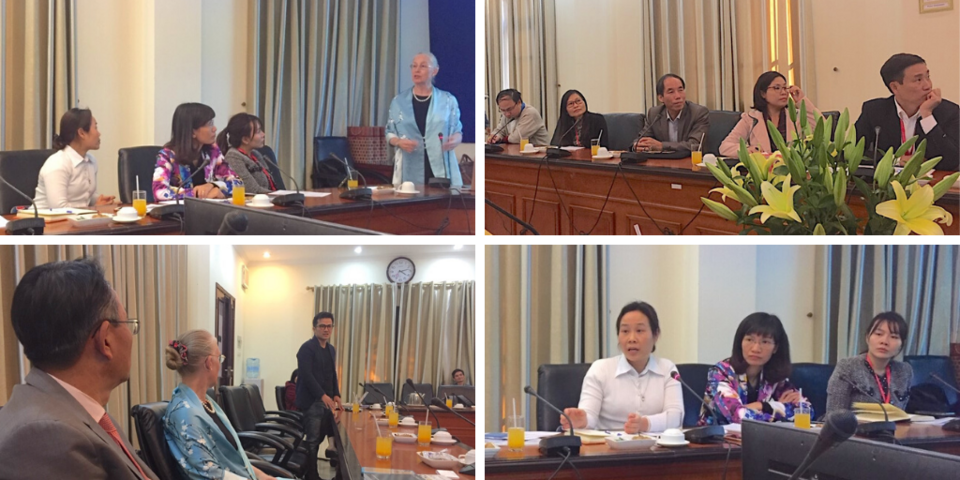
Karen Eggleston and participants at the roundtable held at Hanoi Medical University, December 9, 2019.
Throughout the day, Eggleston presented some of her collaborative research that is part of two projects involving international research teams: one that assesses public-private roles and institutional innovation for healthy aging and another that examines the economics of caring for patients with chronic diseases across diverse health systems in Asia and other parts of the world. We appreciated learning from our counterparts about the health care system and health care delivery in Vietnam.
Shifting focus to international relations and regional security, day 2 in Hanoi opened with a roundtable, “The Rise of the Indo-Pacific and Vietnam-U.S. Relations,” held jointly with the East Sea Institute (ESI) of the Diplomatic Academy of Vietnam (DAV). Following a welcome by ESI Director General Nguyen Hung Son, the program continued with remarks by Shin, Emmerson, ESI Deputy Director General To Anh Tuan, and Assistant Director General Do Thanh Hai.
Image
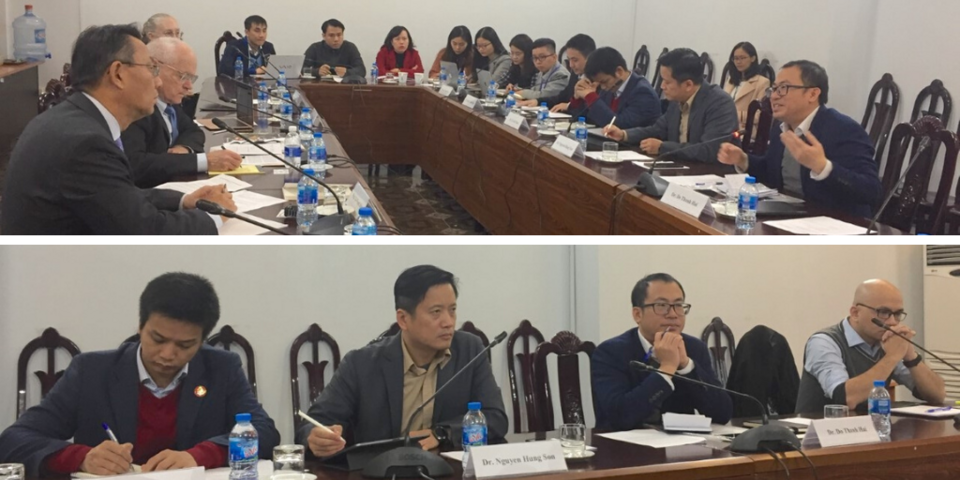
Roundtable at the Diplomatic Academy of Vietnam, December 10, 2019.
The long-ranging conversation with DAV members included issues such as the future of the international order in Asia; the U.S. withdrawal from multilateralism; the concern about a lack of U.S. engagement in Southeast Asia, sparked by President Trump’s absence from the November 2019 summit of the Association of Southeast Asian Nations (ASEAN) at a time when China is bolstering its influence in the region and when ASEAN hopes to set a code of conduct with China regarding disputed waters in the South China Sea; the priorities for Vietnam as it assumes the role of ASEAN chair in 2020; and the challenges for the Vietnam-U.S. bilateral relationship amid the changing strategic environment in Southeast Asia.
In the afternoon we were joined by members of the American Chamber of Commerce in Hanoi at an AmCham-hosted Lunch ‘n’ Learn session on Vietnam's challenges and opportunities amid the U.S.-China rivalry. The event featured Emmerson in conversation with AmCham Hanoi Executive Director Adam Sitkoff.
Image
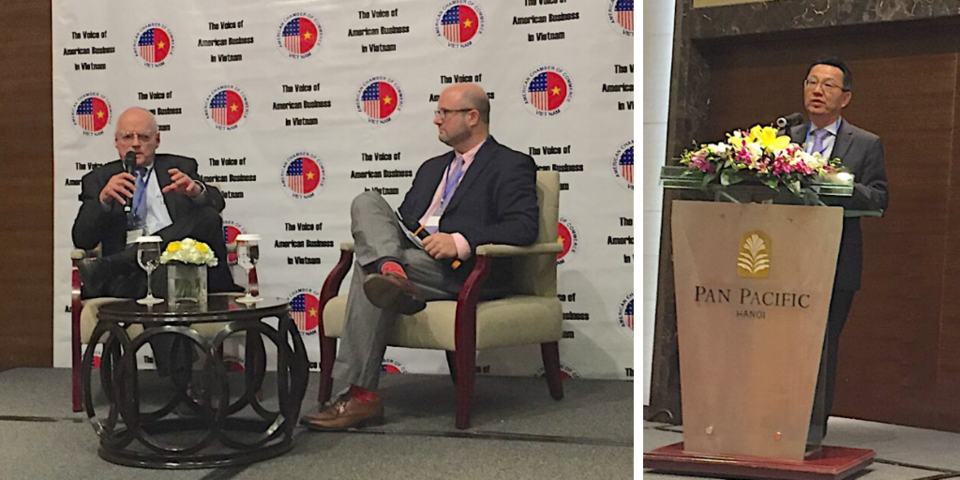
(Left) Donald Emmerson in conversation with Adam Sitkoff; (right) Gi-Wook Shin welcomes AmCham Hanoi members; December 10, 2019.
Moving to Bangkok, delegation members Shin, Eggleston, Emmerson, and Kim spoke on a panel for executives of the Charoen Pokphand Group (C.P. Group), one of Thailand’s largest private conglomerates, addressing some of the core issues that lie ahead for Southeast Asia in 2020 and beyond in the areas of geopolitics, innovation, and health.
Image
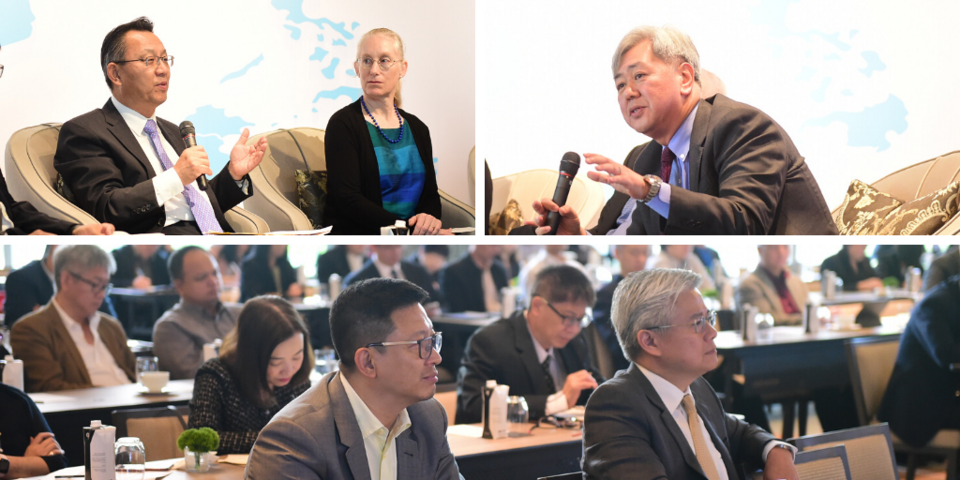
Top, from left to right: Gi-Wook Shin, Karen Eggleston, Andrew Kim; bottom: C.P. Group executive listening to the panel, December 12, 2019.
We also enjoyed a tour at True Digital Park, Thailand’s first startup and tech entrepreneur’s campus. Developed by the C.P. Group, True Digital Park aspires to be an open startup ecosystem that powers Thailand to become a global hub for digital innovation.
The following day, Shin and Emmerson participated in a public forum hosted by Chulalongkorn University’s Institute of Security and International Studies (ISIS Thailand), "Where Northeast Asia Meets Southeast Asia: The Great Powers, Global Disorder and Asia’s Future.” They were joined by ISIS Thailand Director Thitinan Pongsudhirak and Chulalongkorn University Faculty of Political Science Associate Dean for International Affairs and Graduate Studies Kasira Cheeppensook. The panel was moderated by Ms. Gwen Robinson, ISIS Thailand senior fellow and editor-at-large of the Nikkei Asian Review.
Image
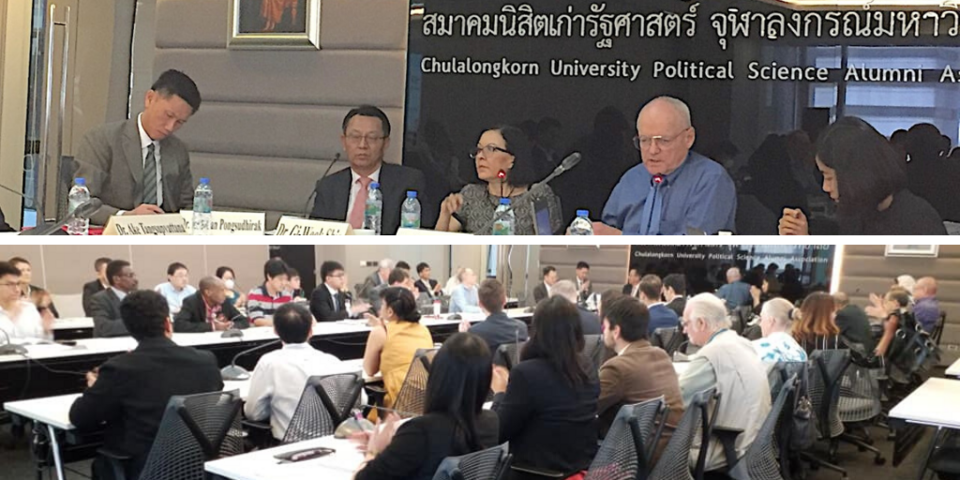
ISIS Thailand forum participants and panelists, from left: Pngsukdhirak, Shin, Robinson, Emmerson, Cheeppensook; December 13, 2019.
As part of that discussion, Emmerson speculated that – driven by deepening Chinese economic and migrational involvement in Southeast Asia’s northern tier – Cambodia and Laos, less conceivably Myanmar, and still less conceivably Thailand could become incorporated de facto into an economically integrated “greater China” that could eventually reduce ASEAN to a more-or-less maritime membership in the region’s southern tier. Emmerson’s speculation was made in the context of his critique of ASEAN’s emphasis on its own “centrality” to the neglect of its lack of the proactivity that would serve as evidence of centrality and of a desire not to be rendered peripheral by the growing centrality-cum-proactivity of China. The event was covered by the Bangkok Post (although that report’s headline and quote of Emmerson are inaccurate, as neither the panel nor Emmerson predicted the “break-up of ASEAN.”)
Our delegation visit in Bangkok concluded with a buffet dinner reception and panel discussion jointly with the Stanford Club of Thailand.
Image
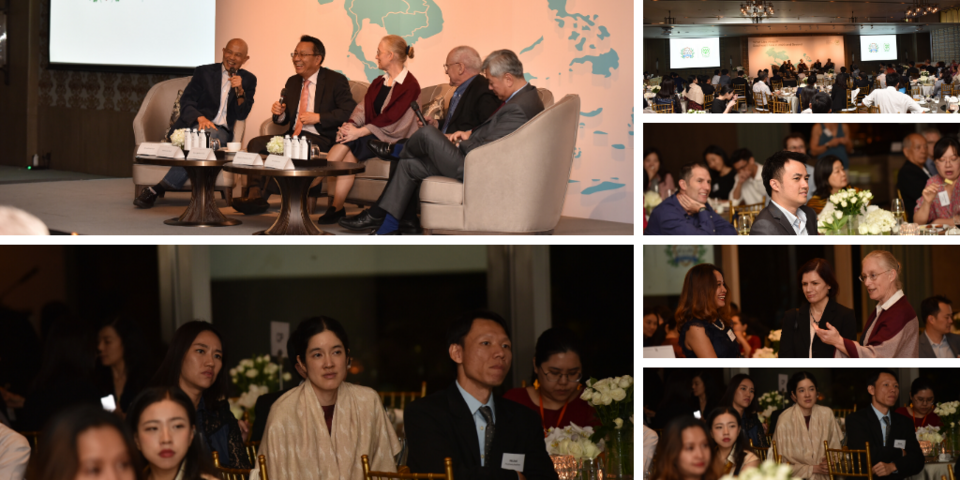
Stanford and IvyPlus alumni listening to the panel, December 13, 2019.
Moderated by Mr. Suthichai Yoon, a veteran journalist and founder of digital media outlet Kafedam Group, the conversation focused on the changing geopolitics of Southeast Asia, innovation and health in the region, and the opportunities and challenges facing Thailand-U.S. relations. It was a pleasure to meet many new and old friends from the Stanford and IvyPlus alumni communities.
APARC would like to thank our partners and hosts in Hanoi and Bangkok for their hospitality, collaboration, and the stimulating discussions throughout our visit. We look forward to keeping in touch!
Hero Image

All News button
1