International Relations

FSI researchers strive to understand how countries relate to one another, and what policies are needed to achieve global stability and prosperity. International relations experts focus on the challenging U.S.-Russian relationship, the alliance between the U.S. and Japan and the limitations of America’s counterinsurgency strategy in Afghanistan.

Foreign aid is also examined by scholars trying to understand whether money earmarked for health improvements reaches those who need it most. And FSI’s Walter H. Shorenstein Asia-Pacific Research Center has published on the need for strong South Korean leadership in dealing with its northern neighbor.

FSI researchers also look at the citizens who drive international relations, studying the effects of migration and how borders shape people’s lives. Meanwhile FSI students are very much involved in this area, working with the United Nations in Ethiopia to rethink refugee communities.

Trade is also a key component of international relations, with FSI approaching the topic from a slew of angles and states. The economy of trade is rife for study, with an APARC event on the implications of more open trade policies in Japan, and FSI researchers making sense of who would benefit from a free trade zone between the European Union and the United States.

Paragraphs

This article examines how different organizational structures in disaster aid delivery affect house aid quality. We analyze three waves of survey data on fishermen and fishing villages in Aceh, Indonesia, following the 2004 tsunami. We categorize four organizational structures based on whether and to whom donors contract aid implementation. Compared to bilateral contracting between donors and implementers, donors that vertically integrate and do their own implementation offer the highest-quality housing as rated by village heads and have fewer counts of faults, such as leaky roofs and cracked walls, as reported by fishermen. However, they shade in quality as they lose dominance as the leading aid agency in a village. Domestic implementers and the government agency that was responsible for significant portions of aid delivery provide significantly lower-quality aid. We also examine how the imposition of shared ownership, the primary social agenda for boat aid agencies, affects boat aid quality. We find that village and fishing leaders steer poor-quality boats toward those whom shared ownership was imposed upon, often lower-status fishermen.

All Publications button
1
Publication Type
Journal Articles
Publication Date
Journal Publisher
Economic Development and Cultural Change
Authors
Yong Suk Lee
Number
4
-
Critics of the Obama administration's North Korea policy charge flatly that it is a "failure." They argue that "time is not on our side," sanctions are counterproductive, and "strategic patience" means "doing nothing." They assert that the Obama administration is unwilling to negotiate with North Korea unless it first gives up its nuclear weapons program, that it is foolishly and fecklessly "outsourcing" its North Korea policy to Beijing while waiting for the North Korean regime to collapse, and that, out of incompetence or malevolence, it has irresponsibly refused to respond to North Korean proposals, such as for negotiations to replace the current armistice agreement with a peace treaty. David Straub, associate director of Shorenstein APARC's Korea Program, will explain why such criticisms are ill-founded and not constructive. He will outline the real-world parameters within which the Obama and previous U.S. administrations have formulated and implemented North Korea policy, assess how the strategic situation on the Korean Peninsula is evolving, and forecast how the next U.S. administration is likely to approach the North Korea problem.
 

Image
david straub cropped
David Straub has been associate director of the Korea Program at The Walter H. Shorenstein Asia-Pacific Research Center since 2008. In 2007-08, he was the Pantech Fellow in the Korea Program at Shorenstein APARC. He retired from the U.S. Department of State in 2006 as a Senior Foreign Service Officer after a thirty-year career focused on Northeast Asian affairs, including service as the director of the Department's office of Korean affairs and participation in "New York Channel" talks with the North Koreans as well as the first three rounds of the Six Party Talks. He also accompanied former President Bill Clinton to Pyongyang in 2009 for the return of two incarcerated American journalists. In addition to Stanford University, Straub has taught U.S. foreign policy at Seoul National University's Graduate School of International Studies and Johns Hopkins University's School of Advanced International Studies. 

Remarks as prepared for delivery
Download pdf

No longer in residence.

0
Associate Director of the Korea Program
david_straub_cropped.jpg

David Straub was named associate director of the Korea Program at the Walter H. Shorenstein Asia-Pacific Research Center (Shorenstein APARC) on July 1, 2008. Prior to that he was a 2007–08 Pantech Fellow at the Center. Straub is the author of the book, Anti-Americanism in Democratizing South Korea, published in 2015.

An educator and commentator on current Northeast Asian affairs, Straub retired in 2006 from his role as a U.S. Department of State senior foreign service officer after a 30-year career focused on Northeast Asian affairs. He worked over 12 years on Korean affairs, first arriving in Seoul in 1979.

Straub served as head of the political section at the U.S. embassy in Seoul from 1999 to 2002 during popular protests against the United States, and he played a key working-level role in the Six-Party Talks on North Korea's nuclear program as the State Department's Korea country desk director from 2002 to 2004. He also served eight years at the U.S. embassy in Japan. His final assignment was as the State Department's Japan country desk director from 2004 to 2006, when he was co-leader of the U.S. delegation to talks with Japan on the realignment of the U.S.-Japan alliance and of U.S. military bases in Japan.

After leaving the Department of State, Straub taught U.S.-Korean relations at the Johns Hopkins University's School of Advanced International Studies in the fall of 2006 and at the Graduate School of International Studies of Seoul National University in spring 2007. He has published a number of papers on U.S.-Korean relations. His foreign languages are Korean, Japanese, and German.

Associate Director, Korea Program
Authors
News Type
News
Date
Paragraphs

From atomic bombs to harsh military occupations in the World War II period, the past is very much the present in the Asia Pacific region.

Stanford scholars are striving to help heal these wounds from yesteryear. Helping old enemies better understand each other today is the aim of the Divided Memories and Reconciliation project, a multi-year comparative study of the formation of historical memory regarding the wartime period in countries such as China, Japan, South Korea, Taiwan and the United States.

Left unattended, misguided wartime narratives may exacerbate current disputes to the point of armed conflict, said Daniel Sneider, associate director of research at Stanford's Shorenstein Asia-Pacific Research Center. He leads the Divided Memories project along with Gi-Wook Shin, a Stanford sociology professor and the Shorenstein center director.

Sneider points out the critical importance of textbooks and what is taught in schools – especially given the rise of nationalism among youth in China, Japan, Taiwan and South Korea.

"Dialogue among youth of the different nations is needed, along with an appreciation for the diversity of views and the complexity of history," he said.

Shin said, "Each nation in northeast Asia and even the U.S. has selective or divided memories of the past, and does not really understand the views of the other side."

Education and history

Launched in 2006, the Divided Memories project has published research findings, issued recommendations and convened conferences. In the early days, the researchers examined high school history textbooks in China, Japan, Korea, Taiwan and America.

Image
divided memories 1
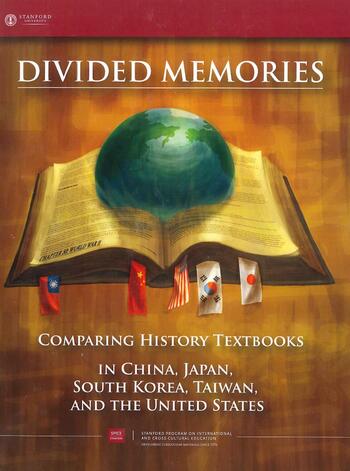
The outcome was the project's first book in 2011, History Textbooks and the Wars in Asia: Divided Memories, which suggests that an "introspective effort" to understand national narratives about WWII has the potential to bring about historical reconciliation in the region. Sneider describes it as the first comparative study of textbooks in the countries involved; it soon evolved into a classroom supplemental textbook published by the Stanford Program on International and Cross-Cultural Education.

"Formal education is a powerful force in shaping our historical understandings," Sneider noted. "We wanted to look at the textbooks that have the most impact and usage."

A 2014 book, Confronting Memories of World War II: European and Asian Legacies, which was co-edited by Shin, Sneider and Daniel Chirot, a sociologist with the University of Washington, compared successful European WWII reconciliations with lagging Asian efforts. Another book, Divided Lenses, published earlier this year, examined the impact of dramatic film and other forms of popular culture on wartime memory. A new book is due out this summer, Divergent Memories: Opinion Leaders and the Asia-Pacific War, which focuses on leaders in politics, the media and academia in Japan, China, South Korea and the U.S.

The Divided Memories project aims to generate discussions and collaborations among those who create "historical memories" – educators, policymakers and government leaders. One report that grew out of such dialogues included suggestions for reconciliation:

  • Create supplementary teaching materials on the issue. 
  • Launch dialogues among Asian, American and European historians. 
  • Offer educational forums for journalists, policymakers and students. 
  • Conduct museum exchanges and create new museums, such as one wholly dedicated to WWII reconciliation in Asia. 
  • Increase student exchanges among all the countries involved. 

History is reflected in today's geopolitics, as noted in the revived disputes by these nations over rival claims to islands in the South China Sea and elsewhere. Without resolution, these disagreements can flare up into military conflicts, Sneider wrote.

"The question of history taps into sensitive and deeply rooted issues of national identity," he noted.

Whether recounting Japanese atrocities in China, China's exaggerated account of its Communist fighters' role in World War II, or the U.S. decision to drop atomic bombs on Japan, no nation is immune to re-creating the past to further its own interests today, Sneider wrote.

For example, Divided Memories research on Chinese textbooks shows how the Chinese government in recent decades embarked on a "patriotic education" campaign to indoctrinate young people by exaggerating its role in Japan's WWII defeat. This narrative suits the nationalistic desires of a Chinese government no longer exclusively motivated by communist ideology, Sneider said.

One project of APARC and its Japan Program that was also an outgrowth of Divided Memories involved Stanford scholars urging Japanese Prime Minister Shinzo Abe to show "clear, heartfelt remorse" in a 2015 speech on the 70th anniversary of the end of WWII. A 15-page report featured hypothetical statements suggesting what Abe might say to make amends for Japanese actions in China and Korea.

"While we cannot claim to have directly influenced the prime minister, his statement did go further in the direction of an expression of remorse over the war and the need to continue to look clearly and honestly at the past than many expected," said Sneider.


Image
divided memories 2

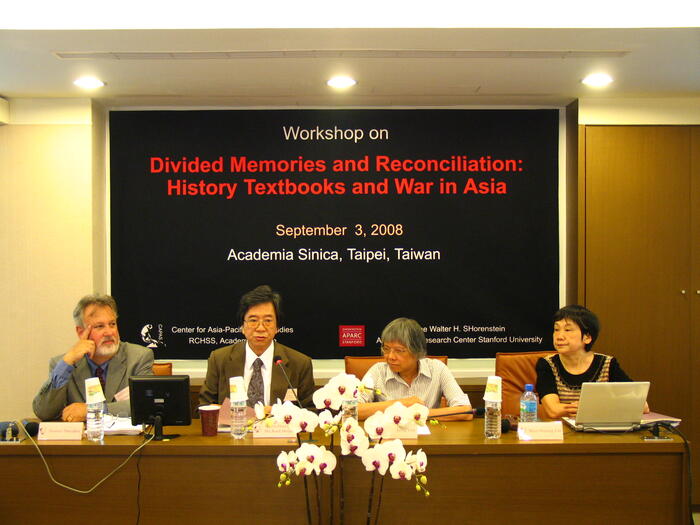
A workshop on history textbooks co-hosted by Shorenstein APARC and Academia Sinica's Center for Asia-Pacific Area Studies takes places in Taipei, Sept. 3, 2008.


Generations and grievances

Consciousness-raising on other fronts, however, is getting results, thanks to Stanford's Divided Memories project. A 2015 landmark agreement between Japan and South Korea over the WWII "comfort women" dispute was reached due to extensive U.S. involvement. Comfort women were women and girls who were forced into sexual slavery by the Imperial Japanese Army in occupied territories before and during World War II.

In an article, Sneider explained how the U.S. perceived that the dysfunctional relationship between South Korea and Japan over this issue, among others, threatened to undermine American strategic interests in Asia. 

Shin highlights the importance of U.S. involvement. "The U.S. is not just an outsider to historical and territorial disputes in the region," he said. "From a geopolitical perspective, the U.S. has done a wonderful job in reviving the devastated region into a prosperous one after 1945, but from a historical reconciliation perspective, the U.S. has done a poor job."

He suggests that America should "play a constructive role in promoting historical reconciliation" among the countries involved. And so, the Divided Memories project has included the United States in its efforts.

According to Sneider, Divided Memories is unique among all reconciliation projects for its emphasis on the inclusion of the U.S.; comparative analyses across countries; and real-world policy impacts. As part of the Shorenstein research center, it is housed within Stanford's Freeman Spogli Institute for International Studies.

"This project reflects what Stanford, our center and the Freeman Spogli Institute are all about – true interdisciplinary research and engagement," Sneider said.

Clifton Parker is a writer for the Stanford News Service.

Hero Image
divided memories reconciliation headline
Japanese soldiers in Shanghai, March 23, 1927 | A Stanford project encourages World War II reconciliation and historical accuracy about the conflict and its consequences in Japan, China, Korea, Taiwan and the United States. Progress has been made on classroom textbooks and scholarly discussions and exchanges.
Getty Images
All News button
1
Paragraphs

An analysis of the foundations and future of the trilateral relationship from a U.S. perspective, highlighting the critical role the United States has played in mediating tensions between the Republic of Korea and Japan.

The essay is also part of an expanded NBR Special Report with co-authors Yul Sohn and Yoshihide Soeya that offers insights into both the past and future of trilateral cooperation and provides recommendations for leaders in all three nations to move relations foward.

All Publications button
1
Publication Type
Policy Briefs
Publication Date
Journal Publisher
National Bureau of Asian Research (NBR)
Authors
-

The sixteenth session of the Strategic Forum brings together distinguished South Korean and U.S. West Coast-based American scholars, experts, and former officials to discuss the U.S.-South Korean alliance, North Korea, and regional dynamics in Northeast Asia. The session is hosted by the Korea Program in association with The Sejong Institute, a top South Korean think tank.

 
Conferences
News Type
News
Date
Paragraphs

Seventeen faculty members and researchers from Stanford’s Freeman Spogli Institute for International Studies were hosted at U.S. Pacific Command (USPACOM) Headquarters in Hawaii for an intensive orientation on Feb. 4-5. The visit aimed to advance collaboration and to offer a deeper understanding of USPACOM’s operations to Stanford scholars who study international security and Asia.

Admiral Harry B. Harris, Jr., Commander of USPACOM, together with his commanders and staff, welcomed the delegation. Harris’s meeting with Stanford faculty is the second in recent months. The USPACOM visit and earlier speech at Stanford Center at Peking University are part of a series of activities driven by the U.S.-Asia Security Initiative. Led by Ambassador Karl Eikenberry, the Initiative seeks to provide constructive interaction between academic and governmental experts on the many and diverse security challenges facing the Asia-Pacific region.

“Engaging deeply in conversations with those who are on the frontlines is incredibly valuable,” said trip participant Coit Blacker, FSI senior fellow and professor of international studies. “This is especially true for academics who focus much of their attention thinking about the prospects for international peace and security but not necessarily considering their direct application on a military-level.”


[[{"fid":"222122","view_mode":"crop_870xauto","fields":{"format":"crop_870xauto","field_file_image_description[und][0][value]":"","field_file_image_alt_text[und][0][value]":"","field_file_image_title_text[und][0][value]":"","field_credit[und][0][value]":"","field_caption[und][0][value]":"","field_related_image_aspect[und][0][value]":"","thumbnails":"crop_870xauto"},"type":"media","attributes":{"width":"870","style":"line-height: 1.538em;","class":"media-element file-crop-870xauto"}}]]

Image
pacom 3

Top: (Left) The Stanford delegation watches a demonstration of a 2-minute drill. / (Right) Karen Eggleston boards a UH-60 Blackhawk helpcopter enroute to the Lightning Academy with her colleagues. Bottom: The delegation takes a group photo on-site.


On the first day, FSI scholars spoke with military officers about the command’s strategies and challenges it faces, such as population aging and sovereignty disputes over the South China Sea. Discussions were followed with a tour of USS Michael Murphy, a guided missile destroyer which routinely conducts operations in the Western Pacific including the South China Sea.

Karen Eggleston, FSI senior fellow and director of the Asia Health Policy Program, was one of the discussants on the USPACOM trip. Her research focuses on health policy in Asia, specifically the effects of demographic change and urbanization.

“As a health economist, the visit yielded for me a behind-the-scenes sense of how members of the military respond to pandemics and humanitarian situations, and of the ongoing dialogue with their counterparts in Asian nations,” Eggleston said. “I think that kind of military-to-military engagement provides an area rich with questions and best practices that could in some ways be shared as a model among other nations.”

Other activities on the first day included a briefing by the U.S. Pacific Fleet command, informal presentations and dialogue between the Stanford participants and the USPACOM staff, and working with senior leaders of the U.S. Pacific Air Forces command.

On the second day, the group visited the U.S. Army’s installation at Schofield Barracks. There, they observed a command post simulation and field exercise including units of the 25th Infantry Division. Graduates from the U.S. Army’s jungle survival training school also shared their impressions of applying lessons in the field. Researchers from the Asia-Pacific Center for Strategic Studies (APCSS) joined the Stanford delegation later in the day. Both sides discussed research outcomes and avenues for future exchanges. The day concluded with an extensive tour of USS Mississippi, a Virginia-class attack submarine. FSI has long engaged military officers through a senior military fellows program. Started in 2009 by the Center for International Security and Cooperation, the program remains active today with five fellows conducting research at Stanford.

Lt. Col. Jose Sumangil, a 2015-16 U.S. Air Force Senior Military Fellow, participated in the Stanford delegation at USPACOM.

“The trip was an excellent opportunity to showcase how the U.S. ‘rebalance to Asia’ strategy is implemented on a day-to-day basis – for example, providing a look into the decision-making process that could occur should a situation arise in the South China Sea,” Sumangil said. “It’s incredibly important to build this kind of understanding among experts studying Asia, and I think we helped do that here.”

USPACOM is one of the largest U.S. military commands with four major service components (U.S. Pacific Fleet, U.S. Pacific Air Forces, U.S. Army Pacific, U.S. Marine Forces); it is tasked with protecting U.S. people and interests, and enhancing stability in the Asia-Pacific Region.

Hero Image
pacom headline
A Stanford delegation of 17 faculty members and researchers visited U.S. Pacific Command (USPACOM) Headquarters in Hawaii, Feb. 4-5, 2016.
All News button
1
News Type
Commentary
Date
Paragraphs

In a recent interview with Yonhap News, David Straub, associate director of the Korea Program, says "Although the United States and the PRC certainly have differences [in dealing with the North Korean nuclear issue], they pale in copmarison to U.S.-Soviet differences."

Yonhap News article in English (February 12, 2016)


Straub also offers, in an extended interview with South Korea's Segye Ilbo newspaper, his thoughts on Pyongyang's motivations for pursuing nuclear weapons. He argues that the appropriate policy response is to continue to increase pressure on the regime to convince it that nuclear weapons will bring more costs than benefits, while holding open the door to good-faith negotiations to resolve peninsular issues. 

Segye Ilbo article in Korean (January 8, 2016)


All News button
1
-

Image
van jackson event
How has North Korea managed to experience numerous foreign policy crises without escalation to war?  Why has North Korea been willing to repeatedly engage in small-scale attacks against the United States and its South Korean ally?  And why have U.S. officials in liberal and conservative presidential administrations only rarely taken North Korean threats seriously?  In this presentation of his newly released book, Rival Reputations: Coercion and Credibility in US-North Korea Relations, (Cambridge University Press), Dr. Van Jackson argues that these puzzles are best explained with reference to the weight of history in U.S. and North Korean foreign policy.  The book draws on the concept of reputation--the influence of past words and deeds on decision-making in the present--to explain patterns of hostile interactions in foreign policy between the United States and North Korea from 1960s through the present day.  The book's findings have major implications for the conduct of U.S. and South Korean foreign and defense policy toward North Korea.

Dr. Van Jackson is an associate professor in the College of Security Studies at the Daniel K. Inouye Asia-Pacific Center for Security Studies, specializing in East Asian security, U.S. foreign policy, defense strategy, historical institutionalism, and international relations theory. He is also an adjunct senior fellow at the Center for a New American Security (CNAS) in Washington, as well as a senior editor for the online defense daily, War on the Rocks. From 2009 to 2014, Dr. Jackson held positions in the Office of the Secretary of Defense as a strategist and policy adviser focused on the Asia-Pacific, senior country director for Korea, and working group chair of the U.S.–Republic of Korea Extended Deterrence Policy Committee. He has previously taught at Georgetown University and the Catholic University of America, and has held fellowships with the Council on Foreign Relations, CNAS, and Pacific Forum CSIS. He is also widely published in leading disciplinary and area studies journals.

Van Jackson <i>College of Security Studies, Daniel K. Inouye Asia-Pacific Center for Security Studies</i>
Seminars
Subscribe to International Relations