Military
News Type
Commentary
Date
Paragraphs

In the wake of this month’s G7 Summit in Japan, U.S. President Barack Obama has an opportunity to make a presidential visit to Hiroshima. Such a visit would reinforce his vision of a nuclear-free world and solidify an important legacy of his foreign policy, Shorenstein APARC Director Gi-Wook Shin and Associate Director for Research Daniel Sneider write in an editorial for The Diplomat. The co-authors argue that the visit be framed in a way that would contribute to historical reconciliation in Northeast Asia and not undermine progress made between Japan and South Korea. 

Sneider wrote in an earlier Toyo Keizei editorial that while the White House has not yet announced a decision, the momentum for such a visit exists. And while issues of divided historical memory cannot be ignored, the occasion would not include an apology. The editorial can be viewed online in English and Japanese.

Sneider also contributed to Public Radio International's podcast series "Whose Century Is It?" and two articles on the Huffington Post Japan website. The first article, written in Japanese, examines how the history of atomic bombings are taught in the United States, and the second article, written in English, explores the question of acceptability of President Obama's visit to Hiroshima by the Japanese people.

During the visit, Obama delivered a speech that outlined the threat of nuclear weapons and the need for a world free from them. Writing for Nippon.com, Sneider said the speech and overall visit was well-received by many, but also had its critics. "The best judgment of the impact of Obama's Hiroshima visit may be what follows in Northeast Asia, where the task of postwar reconciliation remains unfinished," he wrote. The editorial can be viewed online in English and Japanese.

Shin and Sneider lead a decade-long research project that examines historical reconciliation in Asia, and are co-authors of the forthcoming book, Divergent Memories, about elite opinion and wartime memory in Asia.

Hero Image
hiroshima visit
During a break in the G7 Ministerial Meetings in Japan, a delegation visits the Hiroshima Peace Memorial on April 11, 2016 with U.S. Secretary of State John Kerry.
Flickr/U.S. Department of State
All News button
1
Authors
News Type
News
Date
Paragraphs

From atomic bombs to harsh military occupations in the World War II period, the past is very much the present in the Asia Pacific region.

Stanford scholars are striving to help heal these wounds from yesteryear. Helping old enemies better understand each other today is the aim of the Divided Memories and Reconciliation project, a multi-year comparative study of the formation of historical memory regarding the wartime period in countries such as China, Japan, South Korea, Taiwan and the United States.

Left unattended, misguided wartime narratives may exacerbate current disputes to the point of armed conflict, said Daniel Sneider, associate director of research at Stanford's Shorenstein Asia-Pacific Research Center. He leads the Divided Memories project along with Gi-Wook Shin, a Stanford sociology professor and the Shorenstein center director.

Sneider points out the critical importance of textbooks and what is taught in schools – especially given the rise of nationalism among youth in China, Japan, Taiwan and South Korea.

"Dialogue among youth of the different nations is needed, along with an appreciation for the diversity of views and the complexity of history," he said.

Shin said, "Each nation in northeast Asia and even the U.S. has selective or divided memories of the past, and does not really understand the views of the other side."

Education and history

Launched in 2006, the Divided Memories project has published research findings, issued recommendations and convened conferences. In the early days, the researchers examined high school history textbooks in China, Japan, Korea, Taiwan and America.

Image
divided memories 1
The outcome was the project's first book in 2011, History Textbooks and the Wars in Asia: Divided Memories, which suggests that an "introspective effort" to understand national narratives about WWII has the potential to bring about historical reconciliation in the region. Sneider describes it as the first comparative study of textbooks in the countries involved; it soon evolved into a classroom supplemental textbook published by the Stanford Program on International and Cross-Cultural Education.

"Formal education is a powerful force in shaping our historical understandings," Sneider noted. "We wanted to look at the textbooks that have the most impact and usage."

A 2014 book, Confronting Memories of World War II: European and Asian Legacies, which was co-edited by Shin, Sneider and Daniel Chirot, a sociologist with the University of Washington, compared successful European WWII reconciliations with lagging Asian efforts. Another book, Divided Lenses, published earlier this year, examined the impact of dramatic film and other forms of popular culture on wartime memory. A new book is due out this summer, Divergent Memories: Opinion Leaders and the Asia-Pacific War, which focuses on leaders in politics, the media and academia in Japan, China, South Korea and the U.S.

The Divided Memories project aims to generate discussions and collaborations among those who create "historical memories" – educators, policymakers and government leaders. One report that grew out of such dialogues included suggestions for reconciliation:

  • Create supplementary teaching materials on the issue. 
  • Launch dialogues among Asian, American and European historians. 
  • Offer educational forums for journalists, policymakers and students. 
  • Conduct museum exchanges and create new museums, such as one wholly dedicated to WWII reconciliation in Asia. 
  • Increase student exchanges among all the countries involved. 

History is reflected in today's geopolitics, as noted in the revived disputes by these nations over rival claims to islands in the South China Sea and elsewhere. Without resolution, these disagreements can flare up into military conflicts, Sneider wrote.

"The question of history taps into sensitive and deeply rooted issues of national identity," he noted.

Whether recounting Japanese atrocities in China, China's exaggerated account of its Communist fighters' role in World War II, or the U.S. decision to drop atomic bombs on Japan, no nation is immune to re-creating the past to further its own interests today, Sneider wrote.

For example, Divided Memories research on Chinese textbooks shows how the Chinese government in recent decades embarked on a "patriotic education" campaign to indoctrinate young people by exaggerating its role in Japan's WWII defeat. This narrative suits the nationalistic desires of a Chinese government no longer exclusively motivated by communist ideology, Sneider said.

One project of APARC and its Japan Program that was also an outgrowth of Divided Memories involved Stanford scholars urging Japanese Prime Minister Shinzo Abe to show "clear, heartfelt remorse" in a 2015 speech on the 70th anniversary of the end of WWII. A 15-page report featured hypothetical statements suggesting what Abe might say to make amends for Japanese actions in China and Korea.

"While we cannot claim to have directly influenced the prime minister, his statement did go further in the direction of an expression of remorse over the war and the need to continue to look clearly and honestly at the past than many expected," said Sneider.


Image
divided memories 2

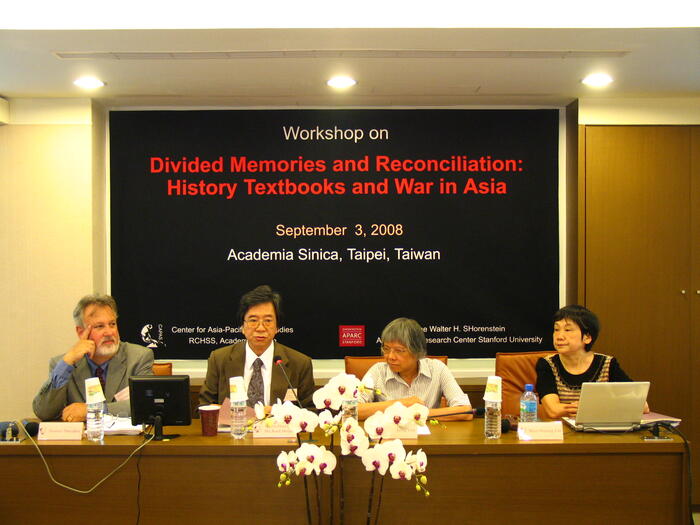
A workshop on history textbooks co-hosted by Shorenstein APARC and Academia Sinica's Center for Asia-Pacific Area Studies takes places in Taipei, Sept. 3, 2008.


Generations and grievances

Consciousness-raising on other fronts, however, is getting results, thanks to Stanford's Divided Memories project. A 2015 landmark agreement between Japan and South Korea over the WWII "comfort women" dispute was reached due to extensive U.S. involvement. Comfort women were women and girls who were forced into sexual slavery by the Imperial Japanese Army in occupied territories before and during World War II.

In an article, Sneider explained how the U.S. perceived that the dysfunctional relationship between South Korea and Japan over this issue, among others, threatened to undermine American strategic interests in Asia. 

Shin highlights the importance of U.S. involvement. "The U.S. is not just an outsider to historical and territorial disputes in the region," he said. "From a geopolitical perspective, the U.S. has done a wonderful job in reviving the devastated region into a prosperous one after 1945, but from a historical reconciliation perspective, the U.S. has done a poor job."

He suggests that America should "play a constructive role in promoting historical reconciliation" among the countries involved. And so, the Divided Memories project has included the United States in its efforts.

According to Sneider, Divided Memories is unique among all reconciliation projects for its emphasis on the inclusion of the U.S.; comparative analyses across countries; and real-world policy impacts. As part of the Shorenstein research center, it is housed within Stanford's Freeman Spogli Institute for International Studies.

"This project reflects what Stanford, our center and the Freeman Spogli Institute are all about – true interdisciplinary research and engagement," Sneider said.

Clifton Parker is a writer for the Stanford News Service.

Hero Image
divided memories reconciliation headline
Japanese soldiers in Shanghai, March 23, 1927 | A Stanford project encourages World War II reconciliation and historical accuracy about the conflict and its consequences in Japan, China, Korea, Taiwan and the United States. Progress has been made on classroom textbooks and scholarly discussions and exchanges.
Getty Images
All News button
1
News Type
News
Date
Paragraphs

Seventeen faculty members and researchers from Stanford’s Freeman Spogli Institute for International Studies were hosted at U.S. Pacific Command (USPACOM) Headquarters in Hawaii for an intensive orientation on Feb. 4-5. The visit aimed to advance collaboration and to offer a deeper understanding of USPACOM’s operations to Stanford scholars who study international security and Asia.

Admiral Harry B. Harris, Jr., Commander of USPACOM, together with his commanders and staff, welcomed the delegation. Harris’s meeting with Stanford faculty is the second in recent months. The USPACOM visit and earlier speech at Stanford Center at Peking University are part of a series of activities driven by the U.S.-Asia Security Initiative. Led by Ambassador Karl Eikenberry, the Initiative seeks to provide constructive interaction between academic and governmental experts on the many and diverse security challenges facing the Asia-Pacific region.

“Engaging deeply in conversations with those who are on the frontlines is incredibly valuable,” said trip participant Coit Blacker, FSI senior fellow and professor of international studies. “This is especially true for academics who focus much of their attention thinking about the prospects for international peace and security but not necessarily considering their direct application on a military-level.”


[[{"fid":"222122","view_mode":"crop_870xauto","fields":{"format":"crop_870xauto","field_file_image_description[und][0][value]":"","field_file_image_alt_text[und][0][value]":"","field_file_image_title_text[und][0][value]":"","field_credit[und][0][value]":"","field_caption[und][0][value]":"","field_related_image_aspect[und][0][value]":"","thumbnails":"crop_870xauto"},"type":"media","attributes":{"width":"870","style":"line-height: 1.538em;","class":"media-element file-crop-870xauto"}}]]

Image
pacom 3

Top: (Left) The Stanford delegation watches a demonstration of a 2-minute drill. / (Right) Karen Eggleston boards a UH-60 Blackhawk helpcopter enroute to the Lightning Academy with her colleagues. Bottom: The delegation takes a group photo on-site.


On the first day, FSI scholars spoke with military officers about the command’s strategies and challenges it faces, such as population aging and sovereignty disputes over the South China Sea. Discussions were followed with a tour of USS Michael Murphy, a guided missile destroyer which routinely conducts operations in the Western Pacific including the South China Sea.

Karen Eggleston, FSI senior fellow and director of the Asia Health Policy Program, was one of the discussants on the USPACOM trip. Her research focuses on health policy in Asia, specifically the effects of demographic change and urbanization.

“As a health economist, the visit yielded for me a behind-the-scenes sense of how members of the military respond to pandemics and humanitarian situations, and of the ongoing dialogue with their counterparts in Asian nations,” Eggleston said. “I think that kind of military-to-military engagement provides an area rich with questions and best practices that could in some ways be shared as a model among other nations.”

Other activities on the first day included a briefing by the U.S. Pacific Fleet command, informal presentations and dialogue between the Stanford participants and the USPACOM staff, and working with senior leaders of the U.S. Pacific Air Forces command.

On the second day, the group visited the U.S. Army’s installation at Schofield Barracks. There, they observed a command post simulation and field exercise including units of the 25th Infantry Division. Graduates from the U.S. Army’s jungle survival training school also shared their impressions of applying lessons in the field. Researchers from the Asia-Pacific Center for Strategic Studies (APCSS) joined the Stanford delegation later in the day. Both sides discussed research outcomes and avenues for future exchanges. The day concluded with an extensive tour of USS Mississippi, a Virginia-class attack submarine. FSI has long engaged military officers through a senior military fellows program. Started in 2009 by the Center for International Security and Cooperation, the program remains active today with five fellows conducting research at Stanford.

Lt. Col. Jose Sumangil, a 2015-16 U.S. Air Force Senior Military Fellow, participated in the Stanford delegation at USPACOM.

“The trip was an excellent opportunity to showcase how the U.S. ‘rebalance to Asia’ strategy is implemented on a day-to-day basis – for example, providing a look into the decision-making process that could occur should a situation arise in the South China Sea,” Sumangil said. “It’s incredibly important to build this kind of understanding among experts studying Asia, and I think we helped do that here.”

USPACOM is one of the largest U.S. military commands with four major service components (U.S. Pacific Fleet, U.S. Pacific Air Forces, U.S. Army Pacific, U.S. Marine Forces); it is tasked with protecting U.S. people and interests, and enhancing stability in the Asia-Pacific Region.

Hero Image
pacom headline
A Stanford delegation of 17 faculty members and researchers visited U.S. Pacific Command (USPACOM) Headquarters in Hawaii, Feb. 4-5, 2016.
All News button
1
Authors
News Type
News
Date
Paragraphs

Senior Military Fellow John Chu was promoted to the rank of colonel in the U.S. Army at Stanford last Friday, a position selectively afforded for distinguished service and leadership. Colleagues and Stanford affiliates attended the afternoon ceremony marking the occasion.

Lt. Gen. (Ret.) Karl Eikenberry led the proceedings and recognized Chu’s accomplishments in the Army and his tenure as a researcher at Stanford’s Freeman Spogli Institute for International Studies (FSI).

“We look over the course of John’s life and where he’s been, and it says so much good about him and the strengths of the United States of America,” Eikenberry said.

“As threats have changed, doctrine has changed and our national security has changed, John has continued to adapt. It says a great deal about him, our services and our country that he has been able to steadily make those shifts over the course of his career.”

Chu was born in Seoul, South Korea, and raised in the United States. He attended West Point and later achieved advanced degrees in environmental engineering and national security. Chu has had three tours of duty in Korea and served in Iraq as staff at the highest strategic level, among other posts.

At Stanford, Chu has been studying U.S. policy toward North Korea and strategic deterrence on the Korea Peninsula as a fellow at FSI’s Walter H. Shorenstein Asia-Pacific Research Center during the current academic year.

The fellowship program, supported by the U.S.-Asia Security Initiative and the Center for International Security and Cooperation, provides military officers an opportunity for self-directed study under the tutelage of Stanford scholars. The program started under former U.S. Secretary of Defense William Perry. Five fellows came to campus this year; their brief bios can be found here.

Chu thanked his wife of eighteen years, Tina, and expressed gratitude to everyone who guided him over the years.

“You are the real heroes – the people I’ve worked with throughout my career,” Chu said, addressing the audience. “It is you that really deserves all the recognition, for I would not be here today without the support of many.”

Chu expects to deploy to Afghanistan as his follow-on assignment.

Hero Image
csc 0152a
Senior Military Fellow John Chu (right) is promoted to colonel in the U.S. Army in a ceremony at Stanford on Dec. 11, 2015. Lt. Gen. (Ret.) Karl Eikenberry (left) led the proceedings.
All News button
1
News Type
News
Date
Paragraphs

South Korea must stand with the United States in the event of escalated tensions between China and the United States in the South China Sea, Stanford professor Gi-Wook Shin advised at a forum in Seoul on November 19th.

"Flexibility is necessary, but what's more important is…principle," said Shin, emphasizing the importance of South Korea’s alliance with the United States over its strategic partnership with China.

The full article (in English) may be viewed on the Yonhap News website.

Hero Image
14358811168 6d39e1f78a o
The U.S. and Philippine navies conduct a bilateral exercise in the South China Sea, June 2014.
Flickr/U.S. Navy
All News button
1
Authors
News Type
News
Date
Paragraphs

In a new book, David Straub explains why massive anti-American protests erupted across South Korea in 2002 and considers whether it could happen again.

South Korea is often seen as a pro-American ally, a model country that went from a poor, postwar nation into a maturing democracy in just four short decades.

But despite a historic alliance between South Korea and the United States, anti-Americanism flared throughout the Asian nation between 1999-2002 when a series of events and longstanding tensions aligned, according to Stanford researcher David Straub.

“It was a sort of venting of steam,” said Straub, an associate director at Stanford’s Walter H. Shorenstein Asia-Pacific Research Center.

“Many Koreans at the time were grossly overinterpreting issues and incidents involving the United States. And this was because they were viewing the U.S.-Korea relationship through a lens of historic victimization by other nations, including the United States,” he added.

Straub, who held a thirty-year diplomatic career in the State Department, headed the political section of the American embassy in Seoul during those years and was deeply involved in managing problems in the bilateral relationship.

Boiling point

Since the end of the Korean War, the United States Forces Korea (USFK) has been stationed in Seoul – now about 28,500 uniformed personnel.

In June 2002, a USFK vehicle struck two Korean students in a tragic accident. In December of that same year, after a U.S. court martial found the drivers of the vehicle not guilty of wrongdoing, hundreds of thousands of people protested in Seoul and other major Korean cities. Not only did activists partake but ordinary citizens too, he said.

Straub said the South Korean public had been “unintentionally primed” for such a reaction to the USFK traffic accident; it was the “spark that lit the firestorm” after years of escalation. A series of events led-up to the mass protests, they included:

  • A few months before the USFK traffic accident, a Korean athlete was disqualified at the Winter Olympics in Salt Lake City during a speed skating competition. American athlete Apolo Anton Ohno instead won gold after a disputed call.
  • A non-governmental organization in May 2000 revealed that USFK personnel dumped formaldehyde into a drain that ran into the Han River in Seoul.
  • In Sept. 1999, the Associated Press published its first investigative story examining the Nogun-ri incident of 1950, when hundreds of Korean refugees were killed in an alleged massacre by U.S. service members.

Asymmetry of attention

Straub said the shaping of Koreans’ views of Americans and fanning of tensions could be attributed in part to an “asymmetry of attention” on the part of the Korean and American publics to the U.S.-Korean relationship.

While the Korean public put tremendous focus on U.S.-Korean relations and the presence of U.S. military personnel in Korea, the American public was unaware of Korean attitudes and feelings, he said.

Similarly during the 1999-2002 period, Korean media reported hypercritical views of the United States and USFK, while the American media paid far less attention.

In negotiating with U.S. officials, South Korean officials would often allude to strong Korean public opinion and demand U.S. concessions. With no American public opinion on Korea issues to point to, U.S. officials were at a major disadvantage, Straub said.

U.S. officials would sometimes note opinions shared by members of Congress, he said, “however, for Korean officials, those claims weren’t as powerful as having a social movement literally on the front doorstep.”

In plain terms, the United States is much larger than South Korea. This very imbalance – which translates to military and economic power – added to Koreans’ assumption that they were “getting the worse end of the bargain,” he added.

“Most Koreans saw Korea as a victim of great powers,” Straub said. “It’s not just the media. It’s more than that, it was – and still is – a shared national narrative.”

Koreans’ sense of national vulnerability is magnified by their historic victimization to neighbors. South Koreans do not want to become a de facto tributary state of China or a colony of Japan again, he said.

Will anti-Americanism return?

USFK incidents were a main focus of Korean attention during the 1999-2002 period, and while there is always a possibility of problems arising, the intensity is gone now, Straub said.

“Some steam is under the lid again,” Straub said. “But I don’t think it’s nearly at the level like it was back then. I’m doubtful that we’d see an exact repeat.”

The media landscape in South Korea has improved and shifted away from its earlier position of “criticize the United States first and ask questions later,” Straub said.

Today, South Korea and the United States are in good standing at the government-level and among the people. President Obama and Korean President Park Geun-hye have an established rapport.   

What troubles Koreans now is North Korea, a Japan focused on collective defense, and the strategic rivalry between the United States and China and its possible implications for Korea, he said.

“South Korea being sandwiched between the United States and China – based on a perception that China is going to be the world’s dominant power – is a real worry for many Koreans,” Straub said, and a large number of Koreans – albeit still a minority – feel that their country must find a more equidistant ground between the two.

Most Koreans, however, still believe in the need for the continued presence of USFK personnel, at least for the time being, said Straub, and must be reassured of their strategic alliance with the United States.

Obama and Park are expected to meet in Washington in mid-October, and Straub said it will be used as an opportunity for both sides to reinforce the importance they attach to the alliance and to pressing North Korea to abandon its nuclear weapons and long-range missile programs.

Links to related articles

NK News: South Korean anti-Americanism dwindles, but roots remain: diplomat

NK News: South Korean anti-Americanism: a thing of the past?

Anti-Americanism in Democratizing South Korea, July 2015

Asia Times: American faces Seoul court over infamous unsolved murder

The Christian Science Monitor: South Korea: 20 years later, Californian son faces trial for Seoul murder

JoongAng Ilbo: Is anti-Americanism dead?

JoongAng Ilbo (Korean): 한미동맹은 빈틈없이 튼실한가 전 미국 국무부 한국과장의 진단

Hero Image
rtrpaj1
A South Korean protestor holds an American flag on which protesters left their footprints at a Seoul rally in June 2003.
Reuters/Lee Jae-Won
All News button
1
Paragraphs

The fourteenth session of the Korea-U.S. West Coast Strategic Forum, held Stanford University on June 25, 2015, convened senior South Korean and American policymakers, scholars and regional experts to discuss North Korea policy and recent developments on the Korean Peninsula. Hosted by the Korea Program at the Walter H. Shorenstein Asia-Pacific Research Center at Stanford University, the Forum is also supported by the Korea National Diplomatic Academy.

All Publications button
1
Publication Type
Policy Briefs
Publication Date
-

Image
david straub 2014
Americans think of South Korea as one of the most pro-American of countries, but in fact many Koreans hold harsh and conspiratorial views of the United States. If not, why did a single U.S. military traffic accident in 2002 cause hundreds of thousands of Koreans to take to the streets for weeks, shredding and burning American flags, cursing the United States, and harassing Americans? Why, too, the death threats against American athlete Apolo Ohno and massive cyberattacks against the United States for a sports call made at the Utah Winter Olympics by an Australian referee? These are just two of the incidents detailed in David Straub’s recently published book, Anti-Americanism in Democratizing South Korea, the story of an explosion of anti-Americanism in South Korea from 1999 to 2002.

Straub, a Korean-speaking senior American diplomat in Seoul at the time, reviews the complicated history of the United States’ relationship with Korea and offers case studies of Korean anti-American incidents during the period that make clear why the outburst occurred, how close it came to undermining the United States’ alliance with Korea, and whether it could happen again.

David Straub has been associate director of the Korea Program at Stanford University’s Walter H. Shorenstein Asia-Pacific Research Center (APARC) since 2008, following a thirty-year diplomatic career focused on U.S. relations with Korea and Japan.

For more information about this topic, click here.

No longer in residence.

0
Associate Director of the Korea Program
david_straub_cropped.jpg

David Straub was named associate director of the Korea Program at the Walter H. Shorenstein Asia-Pacific Research Center (Shorenstein APARC) on July 1, 2008. Prior to that he was a 2007–08 Pantech Fellow at the Center. Straub is the author of the book, Anti-Americanism in Democratizing South Korea, published in 2015.

An educator and commentator on current Northeast Asian affairs, Straub retired in 2006 from his role as a U.S. Department of State senior foreign service officer after a 30-year career focused on Northeast Asian affairs. He worked over 12 years on Korean affairs, first arriving in Seoul in 1979.

Straub served as head of the political section at the U.S. embassy in Seoul from 1999 to 2002 during popular protests against the United States, and he played a key working-level role in the Six-Party Talks on North Korea's nuclear program as the State Department's Korea country desk director from 2002 to 2004. He also served eight years at the U.S. embassy in Japan. His final assignment was as the State Department's Japan country desk director from 2004 to 2006, when he was co-leader of the U.S. delegation to talks with Japan on the realignment of the U.S.-Japan alliance and of U.S. military bases in Japan.

After leaving the Department of State, Straub taught U.S.-Korean relations at the Johns Hopkins University's School of Advanced International Studies in the fall of 2006 and at the Graduate School of International Studies of Seoul National University in spring 2007. He has published a number of papers on U.S.-Korean relations. His foreign languages are Korean, Japanese, and German.

Associate Director of Korea Program, APARC, Stanford University
Kathleen Stephens Panelist <i>Panelist</i>; former US ambassador to South Korea; William J. Perry Distinguished Fellow, APARC, Stanford University
Daniel Sneider Moderator <i>Moderator</i>; Associate Director for Research, APARC, Stanford University
Seminars
News Type
Commentary
Date
Paragraphs

North Korea today threatened military action against South Korea if it did not end its propaganda broadcasts along the Demilitarized Zone (DMZ) within 48 hours. The broadcasts against the North are being systematically blared by loudspeakers over the border.   

South Korea resumed the broadcasts earlier this week after an 11-year hiatus, in retaliation for North Korea’s planting landmines just outside a South Korean DMZ guard post that crippled two South Korean soldiers on Aug. 4.

David Straub, associate director of the Korea Program at the Walter H. Shorenstein Asia-Pacific Research Center and a former Korean affairs director at the U.S. Department of State, offers insights on the situation. Straub also spoke on PRI's "The World" radioshow on Aug. 20, the audioclip and summary can be accessed by clicking here.

What’s behind the current tensions on the Korean Peninsula?

Fundamentally, the current situation is just another symptom of the underlying problem, which is the division of Korea into two competing states, with one of them—North Korea—having a Stalinist totalitarian system and a Maoist-style cult of personality. Since North Korea can’t compete with the South economically and diplomatically, it uses the threat of force or the actual use of it to try to intimidate South Korea. The North Koreans know that South Korea tends to “blink first” and step back because it is democratic and its leaders are concerned about civilian casualties.

The current situation is also related to the leadership transition in North Korea, with leader Kim Jong Un succeeding his father Kim Jong Il three years ago. Kim Jong Un still feels insecure, which is clearly evidenced by his execution of his powerful uncle Jang Seong-taek in 2013 and many other leaders there as well. To solidify support for his rule, he also manufactures a South Korean threat to rally his people behind him.

What does North Korea want?

North Korea’s immediate demand is that South Korea stop its propaganda broadcasts across the DMZ. The South Korean broadcasts criticize the North Korean system and its leaders, which is something that the North, with its cult of personality, can’t accept. But the South resumed the broadcasts only because the North Koreans recently snuck into the South Korean side of the DMZ and viciously planted landmines just outside a South Korean guard post. These were clearly intended to maim South Korean soldiers. They did just that, blowing the legs off two young men.

The North Korean regime’s long-term aim is not just to survive but also to get the upper hand on South Korea, and eventually try again to reunify the peninsula on its own terms. That explains why North Korea behaves as it does, rather than reform its system and reconcile with the South.

The North also demands an end to all U.S. and South Korean military exercises on the peninsula—even though the North has a much larger military than the South and U.S. forces there combined and is developing nuclear weapons and other weapons of mass destruction. Ultimately, the North wants to end the U.S.-South Korean alliance and see U.S. forces withdrawn from the peninsula, in the belief that it will open the way to eventual victory over the South.

Why did the South resume the broadcasts? Was it a good idea?

South Korea resumed the loudspeaker broadcasts in retaliation for the maiming of two of its soldiers on August 4th. Rather than retaliate by attacking militarily, the South resumed the loudspeaker broadcasts because the South Korean military knows that North Korean leaders hate them.

The South Korean military believes that North Korean leaders hate the broadcasts because they are effective in educating young North Korean soldiers and civilians in earshot about the nature of the regime and its leaders. The South Korean military seems to assume that the broadcasts are effective in that regard because they anger the North Korean leaders so much. But I think the reason the broadcasts anger the North Korean leaders is due to the cult of personality. The North Korean system can’t accept the idea of its leaders being criticized.

So I don’t think it was necessarily a wise step on the part of the South Korean military to resume the broadcasts. On the other hand, politically, by crippling two South Korean soldiers, the North Koreans had left South Korea with no option but to respond in some way. After the North Koreans killed fifty South Koreans in two separate sneak attacks five years ago, the South Korean government warned that it was not going to sit back the next time. The resumption of the broadcasts has further raised tensions but, frankly, given the danger of war on the peninsula, the South doesn’t have a lot of good ways to respond to North Korean provocations.

How serious is the situation?

North Korea has now threatened military action in 48 hours if South Korea doesn’t end the propaganda broadcasts. The North often makes threats. Usually, it doesn’t carry them out, but sometimes it does.

The United States and South Korea are conducting an annual military exercise together in the South until the end of August—something else that the North Koreans are demanding an end to. Most experts feel that the North is unlikely to launch a major provocation while the American presence is bolstered and the U.S. and South Korean militaries are paying full attention. The North Korean leaders know they are weaker than our side, so they usually avoid frontal assaults and instead engage in sneak attacks, at times and places and in ways of their own choosing.

There is more uncertainty in recent years because of the aggressive and threatening behavior thus far of Kim Jong Un, who is young and inexperienced. He seems anxious about his position in the North and prepared to take risks to bolster it, including rallying the people behind him by raising tensions with the South. We also don’t know if the North feels freer to engage in major provocations because it has developed at least a handful of nuclear devices since its first nuclear test in 2006.

So I myself wouldn’t be afraid to visit Seoul now but the situation bears even closer watching than usual.

Hero Image
dmz flickr stephan
North Korean soldiers stand guard at the Demilitarized Zone, 2008.
Flickr/(stephan)
All News button
1
Subscribe to Military