This is the second event in a three-part series on North Korea Human Rights hosted by APARC's Korea Program in the spring quarter.
Book Launch for Patterns of Impunity: Human Rights in North Korea and the Role of the U.S. Special Envoy by Robert R. King
As U.S. Special Envoy for North Korean human rights issues from 2009 to 2017, Ambassador Robert King led efforts to ensure that human rights issues were an integral part of U.S. policy toward North Korea. In this book launch webinar, he will share his extensive experience as special envoy and insights into the U.S. role in addressing the North Korean human rights crisis. Ambassador King will be joined by Jung-Hoon Lee, Professor of International Relations at Yonsei University, who will talk about his role as Ambassador for North Korean Human Rights in the past. Professor Lee will remark on how the North Korean human rights issues have been impeded under the current government in South Korea.
Speakers:
Image
Robert R. King served as Special Envoy for North Korean Human Rights Issues with Rank of Ambassador at the U.S. Department of State (2009-2017). The position was established by Congress in the North Korea Human Rights Act with a mandate to “coordinate and promote efforts to improve respect for the fundamental human rights of the people of North Korea.” Since leaving the Department of State, he has been Senior Advisor to the Korea Chair at the Center for Strategic and International Studies, a Senior Fellow at the Korea Economic Institute, and a Board Member of the Committee for Human Rights in North Korea. He was a Koret Fellow in the Korea Program at Stanford’s Shorenstein Asia-Pacific Research Center for the fall term of the 2019-20 academic year. He received a PhD in International Relations from the Fletcher School of Law and Diplomacy, Tufts University.
Image
Jung-Hoon Lee is Dean and Professor of International Relations at the Graduate School of International Studies, Yonsei University. He served as South Korea's Ambassador for Human Rights as well as its inaugural Ambassador-at-Large for North Korean Human Rights. He has been a visiting professor at Keio University and a senior fellow at Harvard Kennedy School’s Carr Center for Human Rights Policy. He is currently a board member of the Committee for Human Rights in North Korea, an international patron of the Hong Kong Watch, and an advisory council member of the International Bar Association’s Human Rights Institute. He received his BA from Tufts University, MALD from the Fletcher School of Law & Diplomacy, and D.Phil. from the University of Oxford.
This is the second event in a three-part series on North Korea Human Rights hosted by APARC's Korea Program in the spring quarter.
Recently, Tomás Ojea Quintana, United Nations Special Rapporteur on the situation of human rights in DPRK, gave his report on the dire situation in North Korea to the UN Human Rights Council. In this public webinar, Mr. Quintana will focus on the issues reported in his latest report. He will be joined by Roberta Cohen, Co-Chair Emeritus of the Committee for Human Rights in North Korea, and Joon Oh, former South Korean Ambassador to the United Nations.
About the presenter:
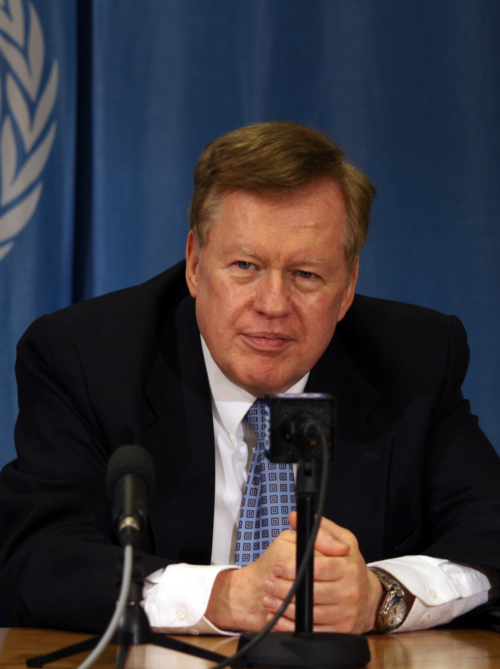
Tomas Ojea Quintana, Special Rapporteur on the situation of human rights in the Democratic People's Republic of Korea.
Tomás Ojea Quintana, United Nations Special Rapporteur on the situation of human rights in DPRK, was appointed to that position by the UN Human Rights Council in 2016. He is the third person to hold that post. He is a lawyer from Argentina working in the field of criminal law, human rights and public interest, representing NGOs and other groups in different cases, including child abduction by military regime, sexual abuses by members of the church, and business criminal liability for human rights abuses. Before the Human Rights Council designated him for the DPRK, he was the attorney of a universal jurisdiction case on the abuses against Rohingyas. He served earlier as the Special Rapporteur on the situation of human rights in Myanmar from 2008 to 2014, and previously as Consultant for the Office of the High Commissioner for Human Rights in Bolivia. He also worked as a lawyer at the Inter-American Commission of Human Rights (OAS). He is a consultant for the Parliament of Argentina, and has worked as an adviser to government agencies on human rights and security issues.
Discussants:
Image
Roberta Cohen, Co-Chair Emeritus of the Committee for Human Rights in North Korea (HRNK)
Cohen has a career spanning the United Nations, State Department, think tanks, NGOs and academia where she has been a specialist in human rights, humanitarian, and refugee issues. While at the Brookings Institution (1994-2016), she co-directed the Project on Internal Displacement, was a Senior Fellow, Senior Adviser to the Representative of the UN Secretary-General on Internally Displaced Persons, and co-winner of the Grawemeyer Award for Ideas Improving World Order. Earlier, she served as a Deputy Assistant Secretary of State for Human Rights in the State Department’s first human rights bureau and as Senior Adviser to US Delegations at the UN General Assembly and Commission on Human Rights. While co-chairing HRNK, she authored articles, provided testimony to Congressional hearings, testified before the UN Commission of Inquiry, and was a member of the Council on Foreign Relations Independent Task Force on U.S. policy toward North Korea. Cohen has an Honorary Doctorate in Law from the University of Bern (Switzerland), an MA with distinction from the Johns Hopkins School of Advanced International Studies, and a BA in History from Barnard College.
Image
Joon Oh, former South Korean Ambassador to the United Nations
Oh is an Eminent Scholar Professor of United Nations studies at Kyung Hee University in Seoul, Korea. He is also the Chair of Save the Children Korea and a board member of Save the Children International. Previously he served as Ambassador and Permanent Representative of the Republic of Korea (South Korea) to the United Nations in New York from 2013 to 2016. During that time, he also served as the 71st President of the Economic and Social Council (ECOSOC) and as President of the Conference of States Parties to the Convention on the Rights of Persons with Disabilities (CRPD) in 2015 and 2016. Ealier, he was Korean Ambassador to Singapore (2010-13) and Deputy Minister for Multilateral and Global Affairs in the Ministry of Foreign Affairs and Trade in Seoul (2008-10). He published his first book in Korean, For Mica, Who Contemplates Life, in 2015. He received a master’s degree in International Policy Studies from Stanford University in 1991.
Gi-Wook Shin, director of Shorenstein Asia-Pacific Research Center and the Korea Program, will moderate the discussion.
This event is made possible through the generous support of the Koret Foundation.
Few nations have maintained the level of isolation and control the Democratic People’s Republic of Korea has orchestrated for decades. The advent of COVID-19 has seen even more stringent restrictions put in place along the DPRK’s borders and a dire increase in economic and social strain on North Koreans living throughout the peninsula.
Tomás Ojea Quintana, the UN special rapporteur on the situation of human rights in the DPRK, reports in a June 9, 2020 statement that the closure of the border between the DPRK and China has “exacerbated the food crisis, devastating cross-border trade and sapping income from merchants.” In Seoul, the South Korean Unification Ministry roused ire when it announced plans to prosecute groups of North Korean defectors for distributing anti-Pyongyang leaflets across the border. The action followed the DPRK’s abrupt shutoff of communication with South Korea over the leaflets and threats of unrest along the border.
This dramatic escalation of tensions highlights the need for international attention to the ongoing humanitarian violations in the DPRK and for proactive, collective action to address the problem. This is the focus of the 2020 Koret Conference, which opens today, June 16. Each year, APARC’s Korea Program hosts the conference in partnership with the Koret Foundation. Held virtually this year due to COVID-19, the conference sessions aim to reestablish the human rights crisis in North Korea as an international priority.
Speaking to the importance of this topic in his welcome remarks, APARC Director Gi-Wook Shin states that, “human rights in North Korea have become a matter rivaling the nuclear issue in seriousness.” Michael Kirby, former chair of the Commission of Inquiry on Human Rights, echoes this view and warns that “the continuation of the present blindfolded approach [to human rights violations in North Korea] is perilous.”
The conference brings together international experts to discuss the intersections of multiple issues in addressing the North Korean human rights problem, such as inter-Korean relations, denuclearization, information flows to the DPRK, and international cooperation. Participants will discuss presentations released earlier this year and the conference proceedings will be collected into a forthcoming publication.
Read More
News
The Role of Human Rights in Policy Toward North Korea
Brightly colored ribbons tied to fences around Imjingak Village in the DMZ on the North Korean Border. The ribbons are often covered with messages of peace, prayers, and thoughts for family members living in the North. | Nigel Killeen, Getty Images
All News button
1
Subtitle
Amid escalating inter-Korean tension and increasing economic and social strain on North Koreans in the era of COVID-19, the importance of keeping international attention on the DRPK’s human rights violations is more urgent than ever.
This twelfth annual Koret Workshop had originally been scheduled to be held on March 13, 2020, but had to be cancelled due to COVID-19 pandemic. Now the workshop participants are able to convene virtually to discuss North Korea human rights issues in relation to policy toward North Korea. The conference will cover the following topics:
Day 1: The Role of U.N. in Generating Changes in North Korea
Day 2: Freedom of Information — How Access to Information is Changing North Korea
Day 3: Human Rights and Denuclearization of North Korea — Help or Hinderance?
Despite the coronavirus pandemic, North Korea continues to carry out weapons testing and to declare that not a single COVID-19 patient has emerged in the country. Analysts and medical experts, however, are highly skeptical of Pyongyang’s claims. A coronavirus outbreak would overwhelm the North’s weak healthcare system and would be devastating to its people, who suffer from relatively high levels of malnutrition and have no access to information about the pandemic.
North Korea is one of the worst human rights violators in modern history. In February 2014, the United Nations Human Rights Council published the landmark Report of the Commission of Inquiry (COI) on Human Rights in the Democratic People’s Republic of Korea, a comprehensive account of human rights abuses committed by the authoritarian country’s leadership against its people. It was seen as a major milestone in the effort to shine a light on the gravity and scope of the problem and to hold the perpetrators accountable by bringing them before the International Criminal Court for crimes against humanity.
Over the past three years, however, the momentum for action on the report’s recommendations has faded and the human rights issue has been largely viewed as less serious a concern than the regional and global security threat posed by the North Korean nuclear program and long-range missiles.
Coinciding with the sixth anniversary of the COI report, it was the goal of the Korea Program’s twelfth annual Koret Workshop to regenerate awareness of the role of human rights in policy toward North Korea by gathering experts at Stanford to discuss the topic and generate concrete recommendations for action. In this post, we share highlights from select presentations prepared for this workshop that was canceled due to the COVID-19 crisis.
As the Trump administration shifted from a “war of words” with North Korean leader Kim Jong Un to prioritizing summit diplomacy, the focus on the human rights problem receded and many stakeholders, both within and outside the administration, preferred to play it down so as not to jeopardize the negotiation over a denuclearization agreement.
Yet the irony, argues Asian affairs and security expert Victor Cha, is that the denuclearization and human rights agendas are inextricably intertwined. “Human rights is an integral and unavoidable component of a comprehensive North Korea strategy,” he says. Cha, professor of government and holder of the D.S. Song-KF Chair in Government and International Affairs at Georgetown University, joined APARC as the Koret Fellow in Korean Studies for the winter quarter of 2020.
Cha notes that revenues gained from forced labor exports and other human rights abuses help the Kim regime finance its proliferation activities. Furthermore, improvements in the country’s human rights condition would reflect the leadership’s commitment to reform and make a denuclearization commitment by the DPRK more credible. The United States, claims Cha, must take actionable steps to include the human rights issue in bilateral relations with Pyongyang: establish a rights-first approach in future negotiations, resume humanitarian assistance, and fill the position of a Special Envoy for Human Rights as mandated by the Congress.
Watch Professor Cha discuss these issues in our recent virtual Q&A:
Tae-Ung Baik, professor of Law and director of the Center for Korean Studies at the University of Hawaii at Manoa, calls for a step-by-step approach, advancing small, concrete changes that will have a cumulative effect toward better protection of the rights of the people of North Korea. For example, cooperation and consultation on human rights protection should be exerted to promote reform in specific areas such as the North Korean judicial and criminal justice systems.
Ambassador Robert King, who served as a special envoy for North Korean human rights issues at the U.S. Department of State in the Obama administration, also stresses that addressing the human rights problem is essential to making progress toward denuclearization and security goals. King argues that North Korea must accept international norms and standards for denuclearization, but its acceptance of international human rights standards is necessary if it is to win international legitimacy.
Although the human rights condition in North Korea has not improved, the information landscape in the country has changed significantly over the past quarter-century. Nat Kretchun, deputy director of the Open Technology Fund, describes the transformation as “trending up from an extremely low base toward greater openness and access before, more recently, retrenching.”
In the years following the famine of the mid-1990s, information flowed into the country like never before, exposing North Korean citizens to a range of new content via an array of non-networked technologies, including information from China, South Korean entertainment media, radio broadcasts from NGOs, and outside broadcasts by Voice of America and Radio Free Asia. As they regained some measure of economic stability, however, the North Korean authorities began to reestablish control over information flows. The recent available data demonstrates that access to information is falling off and the era of more socially normalized consumption of outside information is over, says Kretchun. “The government has begun implementing a far more technologically savvy information control strategy than it previously had the capacity to do […in an] effort to move communications and media consumption onto state-controlled networks via state-controlled devices.”
Indeed, Martyn Williams, a veteran watcher of North Korea’s information technology sector, shows that, while the digitization of media was the catalyst that led to the mass spread of foreign content across the country, so too has the same technology been employed to help the government combat it. For example, every Android tablet and smartphone in North Korea logs every page a person visits with the web browser and randomly takes screenshots during his/her use of the device. Users are allowed to see this database of collected screenshots but cannot delete them. “The system is sinister in its simplicity. It reminds users that everything they do on the device can be recorded and later viewed by officials […] it insidiously forces North Koreans to self-censor in fear of a device check that might never happen.”
Furthermore, the security software pre-loaded onto North Korean phones and computers cannot be replaced and the state’s digital certificate system makes mobile devices little more than consumption tools for state propaganda and personal memories. “While digital technology has created new pathways for foreign content, the increased networking of products could work against information freedom and eventually lead to the creation of an even more Orwellian society,” concludes Williams.
Minjung Kim, director of the South Korean NGO Save North Korea, emphasizes that a key to addressing the human rights problem in the country lies in discrediting the regime’s ideology in the minds of the North Korean people. It is, therefore, necessary to further produce and deliver content that educates citizens on how the regime shapes and manipulates ideology.
The Role of the United Nations
The Kim Jong Un regime responded to the 2014 COI report with outrage and denunciation, and Pyongyang has continued to refuse to cooperate with UN Special Rapporteurs.
For three consecutive years following the publication of the report, the UN Security Council returned to consider the North Korean human rights record. Since 2018, however, the issue has not been placed back on the Security Council agenda, while the U.S.-DPRK summit denuclearization diplomacy has not included a single statement regarding improving the lives of North Korea’s people.
The North Korean human rights problem has long been subject to political debates. Still, claims Joon Oh, former ambassador of South Korea to the UN and former president of the UN Economic and Social Council, future efforts can focus on helping the North Korean people realize economic and social rights, as these do not necessitate political reforms that threaten the regime. The challenge here, though, Oh recognizes, is that such efforts require technical cooperation and humanitarian assistance, which, in turn, have been narrowed down since the UN security council imposed sanctions on North Korea in 2017 for its nuclear and ballistic missile development.
Former Justice of the High Court of Australia Michael Kirby, the chair of the COI report, who has argued that there will never be peace on the Korean peninsula as long as there are grave human rights abuses occurring in North Korea, claims that “When a state is unwilling or unable to halt or avert [mass atrocity crimes], the wider international community has a collective responsibility to take whatever action is necessary. […] It is not acceptable simply to wring our hands and cry ‘never again.’ Action must be taken, however difficult and even dangerous is the path of pursuing such action can sometimes be.”
Granted, the international community must urgently reduce and eliminate the dangers posed by North Korea’s nuclear weapons and intercontinental missiles. However, says Kirby, turning a blind eye to human rights crimes because their mention will upset those who are alleged to have committed them or permitted them to be committed in their name is neither a rational nor a just response.
Kirby urges the international community to engage the large population of North Korean refugees within South Korea and to learn from their experience about the needs of the North Korean people. "Imagination and new strategies are sorely needed," he concludes. "But releasing the pressure of sanctions without assured dividends in the observance of human rights, dismantling of weaponry and achievement of security is not the way to go."
About the Koret Workshop
The Koret Workshop, hosted annually by Shorenstein APARC’s Korea Program at Stanford, gathers each year an international cohort of experts to discuss pressing challenges in contemporary Korean affairs and U.S.-Korean relations, with the broader aim of fostering greater understanding and closer ties between the two countries. The workshop and the Koret Fellowship in Korean Studies are made possible thanks to generous support from the Koret Foundation. The twelfth annual Koret workshop, which was scheduled for March 2020 and canceled due to the coronavirus pandemic, may be rescheduled to a later time.
Hero Image
Women work in Kim Jong Suk Silk Factory beneath a banner reading 'Lets Advance with Full-Scale Offensive' on August 21, 2018 in Pyongyang, North Korea. | Carl Court/ Getty Images
Over the last three years, the United States has done an about-face in terms of engaging North Korea on human rights. Some have argued that if we are to make progress on denuclearization with North Korea, we cannot press Pyongyang on human rights issues because we must develop a cooperative relationship. Raising human rights abuses will only make it more difficult to deal with security issues they argue. On the other hand, Ambassador King believes that human rights are not an issue that we raise after we have achieved our security goals. It is not just the right thing to do, it is an important and critical part of achieving real progress with North Korea on security issues and it is key to a better relationship between Washington and Pyongyang. Internal pressure from the North Korean elites and the public is necessary for positive change on security issues by the North, and this will only come about if there is progress on human rights. Furthermore, North Korea, like all UN member states, has agreed to observe UN human rights obligations. If the North fails to carry out its commitments on human rights, what assurance do we have that it will fulfill security obligations it accepts?
Image
Ambassador Robert King is former Special Envoy for North Korean human rights issues at the Department of State (2009-2017). Since leaving that position, he has been senior advisor to the Korea Chair at the Center for Strategic and International Studies (CSIS), a senior fellow at the Korea Economic Institute (KEI), and a board member of the Committee for Human Rights in North Korea (HRNK) in Washington, D.C. Previously, Ambassador King served for 25 years on Capitol Hill (1983-2008) as chief of staff to Congressman Tom Lantos (D-California), and staff director of the House Foreign Affairs Committee (2001-2008). Most recently, he was a 2019-20 Koret Fellow for the fall quarter at Stanford University.
The event is made possible through the generous support of the Koret Foundation.
Advisory on Novel Coronavirus (COVID-19)
In accordance with university guidelines, if you (or a spouse/housemate) have returned from travel to mainland China or South Korea in the last 14 days, we ask that you DO NOT come to campus until 14 days have passed since your return date and you remain symptom-free. For more information and updates, please refer to Stanford's Environmental Health & Safety website.
Robert R. King
Former Special Envoy for North Korean Human Right Issues
Around the world, democracy is in retreat. In its Freedom in the World 2019 report, the independent watchdog organization Freedom House records the 13th consecutive year of global declines in political rights and civil liberties. “More authoritarian powers are now banning opposition groups or jailing their leaders, dispensing with term limits, and tightening the screws on any independent media that remain,” and “even long-standing democracies have been shaken by populist political forces,” shows the annual study. Internet freedom, too, continues to decline globally amid the crisis of social media, unveils Freedom House’s newly released Freedom on the Net 2019 report. Social media platforms – once considered liberation technologies – have become a conduit for surveillance, disinformation, and electoral manipulation, and “are now tilting dangerously toward illiberalism, exposing citizens to an unprecedented crackdown on their fundamental freedoms.”
These troubling developments are also manifested throughout the Asia-Pacific, where continuous scaling back in U.S. engagement and leadership is raising doubts about American power and purpose in the region, thus empowering forces that undermine democratic norms and processes.
At Shorenstein APARC, we are committed to building a solid foundation of education, knowledge, and dialogue about the critical challenges facing Asian nations and U.S.-Asia relations. That’s why we are dedicating a major portion of our programming this fall quarter and throughout the entire year to elucidating the threats to rights and liberties in the Asia-Pacific region.
The Battle for Truth and Press Freedom in the Philippines
“This is an existential moment for global power structures, turned upside down by technology. When journalists globally are under attack, democracy is under attack.” With these words, the internationally-esteemed investigative journalist and press freedom champion Maria Ressa opened her keynote address upon receiving the 2019 Shorenstein Journalism Award.
As CEO and executive editor of Rappler, she has led the Philippine independent news platform in shining critical light on the Duterte administration's drug war and unprecedented number of killings in the country. President Duterte in turn has made no secret of his dislike for Ressa and Rappler, accusing the platform for carrying "fake news." Ressa has been arrested twice this year, accused of corporate tax evasion and of violating security laws, and slapped with charges of cyber libel for a report that was published before the libel law came into effect. Since Duterte’s election in summer 2016, the Philippine government has filed at least 11 cases and investigations against Ressa and Rappler. “And all because I’m a journalist,” she says.
Ressa detailed the devastating effects that disinformation has had on press freedom, democracy, and civic discourse in the Philippines. “Our dystopian present is your dystopian future if nothing significant is done,” she cautioned. She was joined on the 18th annual Journalism Award panel by Stanford’s Larry Diamond, senior fellow at FSI and the Hoover Institution, and Raju Narisetti, director of the Knight-Bagehot Fellowship in Economics and Business Journalism and professor of professional practice at Columbia Journalism School.
Watch Ressa’s keynote and the entire panel proceedings:
North Korea continues to be one of the world’s worst human rights violators, ranking at the bottom of Freedom House’s list of countries designated as Not Free with the worst aggregate scores for political rights and civil liberties. Although North Korea has experienced some degree of social and economic change in recent years, the Kim Jong Un regime continues to tightly control access to information, suppress all dissent, heavily surveil residents, and subject political prisoners to torture, forced labor, and other atrocities.
As momentum for U.S.-DPRK diplomatic negotiations has ebbed and flowed since summer 2018, all eyes have been on the questions surrounding the North Korean nuclear problem, while the human rights problem has received little attention. However, argues APARC’s Koret Fellow in Korean Studies Robert R. King, addressing the North Korean human rights problem is essential to moving the country on denuclearization and security issues.
Ambassador King, former special envoy for North Korean human rights issues at the Department of State, recently spoke at a seminar hosted by APARC’s Korea Program. Creating pressure on the North Korean government from within by its own people is the only way we’re going to make progress on the security front, he claimed. “If we can help generate greater interest on the part of the people in what is happening with their own government, we can create the kind of constraints that democracy imposes on its leadership […] and that is why we need to focus attention, as well as on negotiating with North Korea, on access to information and human rights.”
Listen to highlights from Ambassador King’s talk:
Hong Kong: City in Turmoil
In Hong Kong, millions of people have been protesting for months against rights violations and increasing interference by the Chinese government in local affairs. On October 1, while the People’s Republic of China celebrated its 70th anniversary with a massive National Day parade in Beijing, on the other side of the border, Hong Kong experienced one of its most violent and chaotic days.
With those contrasting images still fresh on everyone’s minds, APARC and the China Program, along with FSI And the Center for East Asian Studies, co-hosted an expert panel that explained the root causes of Hong Kong’s unremitting protests, examined the future of “one country, two systems,” and considered how the United States and the international community should best respond.
Former Chief Secretary for Administration of the Hong Kong Government (1993-2001), the Honorable Anson Chan, delivered a piercing keynote address, followed by a discussion featuring Harry Harding, Professor of Public Policy at the University of Virginia, David M. Lampton, APARC/FSI Oksenberg-Rohlen Fellow, and Professor Ming Sing of Hong Kong University of Science and Technology.
Since 1997, Chan asserted, Hong Kong SAR’s successive chief executives have progressively failed to reassure the Hong Kong people that they would do their utmost to uphold “one country, two systems” and to defend Hong Kong’s autonomy. Instead, she argued, they have increasingly come across as “mouthpieces of the central government, towing the Beijing line.” Chan also suggested that “some years back, Beijing began to both lose confidence in the judgment and competence of the Hong Kong administration and to fear that growing sense of people’s identity as ‘Hong Kongers’ rather than Chinese citizens could pose a threat to the long-term, successful integration of Hong Kong into the motherland.” She closed her speech urging the Beijing leadership “to act with greater confidence and to trust us more completely with stewardship of our own future by allowing us to elect our own leaders.”
China’s mass internment of Uighurs and other Muslims in “reeducation” camps and detention facilities and its deployment of high-tech surveillance and police tactics in Xinjiang Uyghur Autonomous Region have been interpreted as a superpower’s attempt to annihilate the distinct identities of minority groups. Approximately ten million Muslim minorities in the region are under tight control, and over one million Uyghurs and other Turkic Muslims have allegedly disappeared into internment camps. While Beijing characterizes the camps as vocational training centers and has claimed that most of the detainees have been released, evidence for these claims is difficult to verify, as information dissemination regarding the region to the outside world is closely guarded.
To shed light into the crisis in Xinjiang, APARC convened a multidisciplinary panel of experts who provided historical context and critical social scientific analysis of the events unfolding in the region.
Image
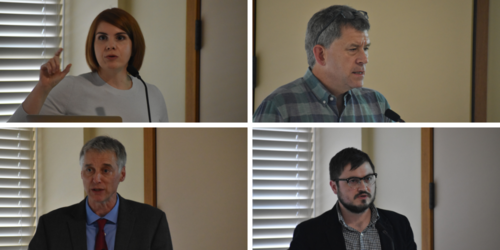
From top left, clockwise: Lauren Hansen Restrepo, James Millward,, Darren Byler and Gardner Bovingdon.
James Millward, professor of Inter-societal history at Georgetown University’s Walsh School of Foreign Service, reviewed the historical background for the PRC assault on non-Han or non-Chinese culture in Xinjiang. Beginning in the early 2000s, the assault has included the razing of old Kashgar; the discouraging and then illegalizing of Muslim symbols such as head gear, prayer, and fasting in Ramadan; the disappearance of Uyghur script; and the securitization of the province by using police patrol, surveillance technologies, facial recognition, and biodata monitoring. The PRC hasn’t applied a single, top-down ethnic policy in Xinjiang, said Millward, but rather has rolled out different tactics it experimented with on local levels in different areas.
Lauren Hansen Restrepo, assistant professor in growth and structure of cities at Bryn Mawr College and an expert on Chinese development planning and urbanization in Xinjiang, explained how we got to the current crisis in the region by connecting seemingly disparate phenomena. She described the shifts in state power in Xinjiang and how, since 2014, “regional planning has broken every logic of urban planning in China,” resulting in the isolation and subordination of Uyghur-dominated urban centers and in the ossification of cities, as control has been seized from local governments and given to socialist land masters.
Anthropologist Darren Byler, whose research focuses on Uyghur dispossession and "terror capitalism" in the city of Ürümchi, the capital of Xinjiang, explained how, amid mass migration of Han people into the resource-rich region, Uyghurs had mostly been excluded from the new economy and how their identity as contemporary Muslims supported a vibrant public sphere not controlled by the state. The Chinese state, in turn, has merged Islamism with radicalism extremism. From the Chinese state and industry perspective, Byler said, the repression of Xinjiang’s Muslims promises stability and the detention camps are used as carriers of economy and new sources of cheap labor.
Indiana University’s Gardner Bovingdon, whose research focuses on politics in contemporary Xinjiang and the region’s modern history, reverted to the question of how we got to the current crisis, which he characterized as “one of the great state-engineered human rights disasters of our time.” He argued that, in the case of Xinjiang, the Chinese party transported and exacerbated a set of policies that had previously been applied to dealing with the Tibet problem. These policies, Bovingdon suggested, “are signs of a flailing, terrified party that doesn’t know what to do with Uighurs, but also feels no constraints from the international community on its behavior. And so the biggest problem now is to find a way to put constraints on a system that has operated untrammeled with devastating consequences.”
The panel "Xinjiang’s Muslims and the PRC" was cosponsored with the Center for Democracy, Development and the Rule of Law.
Hero Image
Clockwise from upper left: Relatives of alleged extrajudicial killings wear veils as they take part in a protest versus the drug war killings outside the military and police headquarters on July 17, 2019 in Manila, Philippines (Photo credit: Ezra Acayan/Getty Image); Workers pass propaganda posters as they cycle through Hungnam Fertilizer Complex on February 4, 2019 in Hamhung, North Korea (Photo credit: Carl Court/Getty Images); Pro-democracy protesters react as police fire tear gas during a demonstration on October 20, 2019 in Hong Kong (photo credit: Anthony Kwan/Getty Images); A mix of ethnic Uyghur and Han shopkeepers hold large wooden sticks as they are trained in security measures on June 27, 2017 next to the old town of Kashgar, in the far western Xinjiang province, China (photo credit: Kevin Frayer/Getty Images).
Shorenstein APARCStanford UniversityEncina Hall E301Stanford, CA 94305-6055
0
Koret Fellow, 2019-20
Visiting Scholar at APARC
robert_king.png
Ph.D.
Robert R. King was a Visiting Scholar, Koret Fellow at the Walter H. Shorenstein Asia-Pacific Research Center (Shorenstein APARC) during the 2019 fall term. He is the former U.S. Special Envoy for North Korean Human Rights Issues at the U.S. Department of State (2009-2017). He is Special Advisor to the Korea Chair at the Center for Strategic and International Studies (CSIS), a non-resident Fellow at the Korea Economic Institute, and a member of the board of the Committee for Human Rights in North Korea.
Ambassador King’s research interests include North Korea human rights, Northeast Asia, U.S. foreign policy, and the Congressional role in U.S. foreign affairs. During his time at Shorenstein APARC, he researched the United States efforts to promote human rights in North Korea.
Before assuming his position at the Department of State, King was Staff Director and Minority Staff Director of the Foreign Affairs Committee of the U.S. House of Representatives (2001-2009). He served as Chief of Staff to Congressman Tom Lantos of California (1983-2008). He was a White House Fellow on the staff of the National Security Council (1977-1978), and Senior Analyst and Assistant Director of Research at Radio Free Europe in Munich, Germany (1970-1977).
King holds a PhD and an MALD in international relations from the Fletcher School of Law and Diplomacy and a BA in political Science from Brigham Young University.
President Trump has stopped even mentioning North Korea’s abysmal human rights record in order to secure meetings with Leader Kim Jong-un ostensibly to make progress on serious security issues with North Korea. After 18 months of White House effort and two and a half summits, however, there has been little progress on denuclearization. Ambassador King argues that we must push North Korea on human rights in order to encourage the government in Pyongyang to respond positively the wishes of its own citizens. Unless we do this, we are unlikely to see real progress on shifting North Korea’s focus from nuclear weapons and missiles to the wellbeing of its own people.
Image
Ambassador Robert R. King is former Special Envoy for North Korean human rights issues at the Department of State (2009-2017). Since leaving that position, he has been senior advisor to the Korea Chair at the Center for Strategic and International Studies (CSIS), a senior fellow at the Korea Economic Institute (KEI), and a board member of the Committee for Human Rights in North Korea (HRNK) in Washington, D.C. Previously, Ambassador King served for 25 years on Capitol Hill (1983-2008) as chief of staff to Congressman Tom Lantos (D-California), and staff director of the House Foreign Affairs Committee (2001-2008).
Robert R. King
<i>2019-20 Koret Fellow, Shorenstein APARC, Stanford University</i>
The Korea Program at the Walter H. Shorenstein Asia-Pacific Research Center is pleased to welcome Robert R. King and Victor Cha as Koret fellows in Korean studies during the 2019-20 academic year. Supported by the Koret Foundation, the Koret Fellowship brings leading professionals to Stanford to conduct research on contemporary Korean affairs with the broad aim of strengthening ties between the United States and Korea.
Image
Robert R. King will join the Korea Program as Koret Fellow during the fall quarter of 2019. King served as special envoy for North Korean human rights Issues, an ambassadorial ranked position at the Department of State (2009-2017). The role was established by Congress in the North Korea Human Rights Act with a mandate to “coordinate and promote efforts to improve respect for the fundamental human rights of the people of North Korea.” Since leaving the Department of State, Ambassador King has been senior advisor to the Korea chair at the Center for Strategic and International Studies (CSIS), a senior fellow at the Korea Economic Institute (KEI), and a board member of the Committee for Human Rights in North Korea (HRNK).
Earlier, Ambassador King served for 25 years (1983-2008) on Capitol Hill as chief of staff to Congressman Tom Lantos (D-California), and as staff director and minority staff director of the House Foreign Affairs Committee (2001-2008). King received a Ph.D. in International Relations from the Fletcher School of Law and Diplomacy, Tufts University and a B.A. from Brigham Young University.
Image
Victor Cha, professor of government and international affairs at Georgetown University, will join the Korea Program as the Koret Fellow through the winter quarter of 2020. He is the author of five books, including The Impossible State: North Korea, Past and Future (Haper Collins, 2012) and Powerplay: Origins of the American Alliance System in Asia (Princeton University Press, 2016). He holds Georgetown's Dean's Award for teaching for 2010, the Distinguished Research Award for 2011, and a Distinguished Principal Investigator Award for 2016.
Professor Cha left the White House in 2007 after serving since 2004 as Director for Asian Affairs at the National Security Council, where he was responsible for Japan, the Korean peninsula, Australia/New Zealand, and Pacific Island affairs. He serves as Senior Advisor at CSIS, and is a non-resident Fellow in Human Freedom at the George W. Bush Institute in Dallas, Texas. He received a Ph.D. from Columbia University, M.A. from the University of Oxford, and MIA and B.A. from Columbia University.

 As U.S. Special Envoy for North Korean human rights issues from 2009 to 2017, Ambassador Robert King led efforts to ensure that human rights issues were an integral part of U.S. policy toward North Korea. In this book launch webinar, he will share his extensive experience as special envoy and insights into the U.S. role in addressing the North Korean human rights crisis. Ambassador King will be joined by Jung-Hoon Lee, Professor of International Relations at Yonsei University, who will talk about his role as Ambassador for North Korean Human Rights in the past. Professor Lee will remark on how the North Korean human rights issues have been impeded under the current government in South Korea.

 Tomas Ojea Quintana, Special Rapporteur on the situation of human rights in the Democratic People's Republic of Korea.