Innovation
-
 

Technological advances have brought us to a potential tipping point in the delivery of financial services that will affect the individual, firm, the industry and the country. How important will this development be for potential growth in developed and developing countries? Will the changes occur without official intervention, or will they need the state’s guiding hand to ensure that they provide their benefits with minimal risk? What measures are needed from policy makers and regulatory authorities to clear the path for faster growth?

This seminar, co-sponsored by the Stanford Center for International Development and the Shorenstein Asia-Pacific Research Center, will look at how a group of companies, an industry and a country have effectively capitalized on conducive regulatory environment the opportunities offered by the technological advances and related disruptions. The talk will focus on the strategy of M-Pesa/Alibaba, Chinese Financial Sector and Singapore. The combination of Silicon Valley Technology and Smart Nation/City initiative may overcome some challenges of low productivity and low growth in many parts of the world especially in Asia and ASEAN.

David LEE Kuo Chuen is a visiting scholar at the Walter H. Shorenstein Asia-Pacific Research Center (APARC) for the fall of 2015.  He is currently the Director of Sim Kee Boon Institute for Financial Economics.  He holds the appointment of Practice Professor of Quantitative Finance, Lee Kong Chian School of Business, in Singapore Management University.  He is also the founder of Ferrell Asset Management Group. His research interests encompass digital and Internet finance, digital banking, Asia finance, impact investing, financial inclusion and asset allocation. During his time as a Fulbright Scholar at Shorenstein APARC, his research will focus on harnessing Silicon Valley technology for connectivity and financial inclusion in ASEAN and Singapore. David is also an Independent Director of two SGX-listed companies and sits on the Investment Committee and Council of two charitable organizations. He is the Vice President of the Economic Society of Singapore.  He was the Founding Vice Chairman of the Alternative Investment Management Association (Singapore Chapter), a member of the SGX Security Committee, and MAS Financial Research Council.  He was also the Group Managing Director of OUE Limited and Auric Pacific Limited, as well as the Non-Executive Chairman of MAP Technology Limited. David speaks frequently in international conferences with occasional appearances in Bloomberg, Reuters and Channel NewsAsia.  He has published in Financial Analyst Journal, Journal of Investing, Journal of Wealth Management, Journal of Statistical Computation and Simulation, Applied Financial Economics, and several books and chapters on Household Economics and Hedge Funds.  His two books on Asia Finance focus on Banking, Sovereign Wealth Funds, REITs, Financial Trading & Markets, and Fund Performance. His latest book is on Digital Currency. He graduated from the London School of Economics and Political Science with a BSc (Econs), MSc (Mathematical Economics and Econometrics) and a PhD in Econometrics and Mathematical Economics.

Smart Nation, Silicon Valley Technology and Asia Growth Strategy
Download pdf
Philippines Conference Room3rd floor, Encina Hall616 Serra StreetStanford, CA 94305
David LEE Kuo Chuen, Director of Sim Kee Boon Institute for Financial Economics and APARC Visiting Scholar
Seminars
Date Label
-
Image
Kan Suzuki
holds professorships at both the Graduate School of Public Policy at The University of Tokyo and the Graduate School of Media and Governance at Keio University. He has also served as a visiting researcher at the University of Sydney, part-time lecturer in policy studies at Chuo University and associate professor at Keio University’s Faculty of Environment and Information Studies.

Mr. Suzuki received his bachelor’s degree in law from The University of Tokyo in 1986 and worked at Japan’s Ministry of Economy, Trade and Industry (METI). After leaving METI, he was a member of Japan’s House of Councilors for 12 years. He served two terms as senior vice minister of Japan's Ministry of Education, Culture, Sports, Science and Technology (MEXT), and is currently an executive committee member of the Japan Football Association.

Mr. Suzuki’s publications include “Advice on Deliberation Processes” (2013), “Policy Formulation Process in Japan’s Central Government” (1999) and “The Birth of the Voluntary Economy” (1998).
 
 
RSVP Required


Agenda
4:15pm: Doors open
4:30pm-5:30pm: Lecture, followed by discussion
5:30pm-6:00pm: Networking


For more information about the Silicon Valley-New Japan Project please visit: http://www.stanford-svnj.org/


Philippines Conference RoomEncina Hall, 3rd Floor616 Serra StStanford, CA 94305
Kan Suzuki, Professor, University of Tokyo and Keio University
Seminars
News Type
News
Date
Paragraphs

Stanford students worked together to pitch marketing ideas to a major Japanese airline at an event last Tuesday. The event, called an “ideathon,” is part of a series of events seeking to strengthen the U.S.-Japan relationship through exchange of ideas.

The ideathon was the first of its kind at the Shorenstein Asia-Pacific Research Center, led by the Japan Program under the rubric of the Stanford Silicon Valley-New Japan Project (SV-NJ). The project is supported in part by All Nippon Airways (ANA), the Japanese airline featured at the event.

Nineteen students participated, from both undergraduate and graduate levels and across disciplines – including students from the Graduate School of Business, and other majors including economics, mathematics, computer science, philosophy and East Asian studies.

Placed on a team with others they had just met, students were encouraged to assemble quickly and generate solutions to the challenge: how can ANA strengthen its brand awareness in the United States?

ANA is seeking to double in size in the next three years, yet it faces a few obstacles in this endeavor, including a customer base that is mostly in Japan and low brand visibility internationally, according to a senior employee that presented at the event.

“Who had heard of ANA before this event?” asked Hiroyuki Miyagawa, a marketing executive at ANA. Few hands raised in the audience.

Organized into four teams, each student team was joined by an ANA employee who listened in and offered guidance and a chance to learn from a longtime practitioner.

One and a half hours later, with Post-it notes and scribbled diagrams sprinkled across tables, each team emerged ready to present their 3-minute pitch to a panel of judges. The panel included executives from ANA, the World Innovation Lab (WiL), a venture capital firm in Palo Alto, and bTrax, a San Francisco based design firm.

Below are a few pictures from the event.


Image
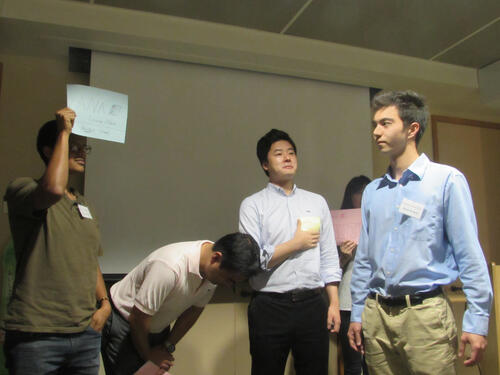
ideathon team three

Team Three acts out a skit.  |  They proposed that ANA establish lounges for the general public to gather in and purchase goods from Uniqlo and Muji, two Japanese lifestyle retailers. The lounges would offer a place to reinforce ANA's brand outside of the airport, they said.


Image
ideathon team four

Team Four puts their heads together to generate ideas.  |  In their pitch, the team noted that baseball is a popular sport among Americans and Japanese. They recommended baseball be a focus of the marketing campaign, and said television and social media would best reach the target audience.


Image
ideathon team five

Team Five explains their marketing approach.  |  Flying can lead to some unpleasant experiences, and a way ANA can set itself apart is to make those experiences manageable, and even enjoyable, they said. Their proposal was to bring new amenities to the in-flight experience such as a care package for people who sit in the middle seat.


Image
ideathon team one

Team One poses for a picture after their presentation.  |  In their pitch, they recommended using ANA’s association with Japan to differentiate from other global airlines. Their approach included creating a film that features an American celebrity traveling on ANA.


The winning team was Team One whose concept was to use a celebrity figure – Ellen DeGeneres – in their advertising. They said that the target audience could relate to DeGeneres, and her already-established following would be an advantage.

The judges commended Team One for the creativity of their idea and its level of feasibility. Team One consisted of students Yaqian Fan, Michael Hong, Sam Ide, Lu Li and Adelbert Tan.

Kenji Kushida, a Stanford alumnus and project leader of SV-NJ, said:

“When I was a student, I craved for an opportunity to brainstorm solutions to real-world challenges and to do it in an environment that provided instant feedback,” he said, “We were able to make that happen here with the support of ANA and WiL, and are thrilled with the outcome."

Hero Image
ideathon headline cropped
All News button
1
Paragraphs

This paper reexamines Japanese policy choices during its banking crisis in the 1990s and draws some lessons relevant for the United States and Europe in the aftermath of the global financial crisis of 2007–09. The paper focuses on two aspects of postcrisis economic policy of Japan: the delay in bank recapitalization and the lack of structural reforms. These two policy shortcomings retarded Japan’s recovery from the crisis and were responsible for its stagnant postcrisis growth. The paper also suggests some political economy factors that contributed to the Japanese policies. In France, Italy, and Spain bank recapitalization has been delayed and the structural reforms have been slow. Without drastic changes, they are likely to follow Japan’s path to long economic stagnation. The situation in Germany looks somewhat better mainly because the structural reform was undertaken before the crisis. Although the recovery has been slow in the United States as well, the problems are at least different from those faced by Japan then and many European countries now.

All Publications button
1
Publication Type
Journal Articles
Publication Date
Journal Publisher
IMF Economic Review
Authors
Takeo Hoshi
Authors
News Type
News
Date
Paragraphs

Japan must transform its economy in a way that mirrors the innovation ethos in places like Silicon Valley and Stanford University, Japanese Prime Minister Shinzo Abe said Thursday during a speech on campus.

As an example of how to encourage such creativity, Abe hailed a new partnership starting this fall with Stanford that will train the next generation of biomedical experts. In doing so, he urged a "fundamental change" in how Japanese society views the process of innovation, from how ideas originate to competition in the marketplace.

Japan Biodesign will be launched in collaboration with the Stanford Biodesign program and five higher education and research institutions in Japan. Faculty members will work together to create new interdisciplinary systems based on Stanford Biodesign. Stanford leaders will train and mentor their Japanese colleagues.

Abe, who is the first Japanese prime minister to visit Stanford, marveled at how the tech sector in the United States has "consistently evolved at top speed."

He said, "I want the best and brightest Japanese talent" to learn about Silicon Valley.

Image
The Japanese leader also announced more plans to connect Japanese companies, employees and networking events with Silicon Valley and places like Stanford. He said it was important for the participants to emerge "reborn" with a well-honed sense of how to succeed in a highly competitive global marketplace.

Abe shared the Bing Concert Hall stage with Stanford President John Hennessy and George Shultz, the former U.S. Secretary of State and distinguished fellow at the Hoover Institution. Abe's talk, titled "Innovation, Japan and Silicon Valley Symposium," included an introduction and remarks by Hennessy and Shultz. The event drew a full house of invited guests and members of the Stanford community.

"It is a great honor" to be at Stanford, Abe said in beginning his remarks.

He noted that Japan is revisiting its regulatory and tax systems in order to encourage more economic dynamism and competition. "The Japanese people will benefit from innovation," he said.

The challenge, he acknowledged, has been the slow pace of innovation in Japan. Today, however, the Internet economy and big data are creating "enormous changes" in his country's economic approach, he said. "We have to catch up, or otherwise Japan will lose vitality," Abe added.

Cultural connections

In his introduction of Abe, Hennessy chronicled Stanford's long history and friendship with Japan and its people.

Japan, he said, is home to more Stanford alumni than any other Asian country, and when the university's doors first opened in 1891, the pioneer class included a Japanese student. Currently, 139 students from Japan are enrolled at Stanford.

Hennessey described Abe as focused on revitalizing Japan's economy and stewarding it toward a greater global role.

Shultz, who knew Abe's parents, shared recollections of poignant moments between Abe's politically prominent family and his own.

Abe joined a roundtable discussion after his speech with Michael McFaul, director of the Freeman Spogli Institute for International Studies; Stanford Board of Trustees Chair Steve Denning; Stanford School of Medicine Dean Lloyd Minor; Stanford political science Professor Emeritus Daniel Okimoto; Yahoo co-founder Jerry Yang; and Twitter co-founder Jack Dorsey, among other scholars and dignitaries. He also met with Stanford students before leaving campus.

Afterward, McFaul wrote in an email, "I think it is fantastic that Prime Minister Abe came to Stanford and Silicon Valley after his very successful visit to Washington. He demonstrated that deepening U.S.-Japanese relations requires not only strong government-to-government ties, but also deepening ties between our societies, including educational institutions like Stanford."

Abe's state visit to the United States this week included the first address by a Japanese leader to a joint session of Congress. Abe served as prime minister of Japan in 2006-07 and returned to the position in 2012.

'Working together'

On Tuesday, U.S. President Barack Obama said after a meeting with Abe that the two countries had made progress in trade talks on a massive 12-nation trade deal that would open markets around the Pacific Rim to U.S. exports. Both nations face domestic political obstacles to concluding the Trans-Pacific Partnership agreement.

"This agreement would expand the coverage of the free trade agreements for both Japan and the U.S. substantially," said Stanford economist Takeo Hoshi, director of the Japan Program at the Shorenstein Asia-Pacific Research Center, in an interview. "The U.S. and Japan have been working together to maintain peace and sustain economic growth in the Pacific Asia."

Hoshi said that Abe's visit to the Silicon Valley confirms that Japan is serious about transforming its economy from one based on exports to one focused on innovations.

"Going forward, we can learn a lot from Japanese experience and their reform attempts," said Hoshi, who is also a senior fellow at the Freeman Spogli Institute.

Hoshi spoke with The Associated Press just before Abe’s arrival to California, citing Silicon Valley as the ideal place for Japan to learn about innovation. He also joined KQED’s Forum to discuss the current state of the U.S.-Japan alliance. Later, he was interviewed by BBC Business about Abe's visit to Stanford.

Stanford Biodesign

Founded in 2001, Stanford Biodesign has pioneered a new training methodology in which interdisciplinary teams of engineers and physicians go through a rigorous process of carefully characterizing unsolved clinical needs before jumping to technology solutions.

For the Japan Biodesign program, the bulk of the educational activities will take place at the campuses of the partner Japanese universities.

Clifton Parker is a writer for the Stanford News Service.

Hero Image
abe 6364
Japanese Prime Minister Shinzo Abe speaks at Stanford about innovation in Japan and Silicon Valley. He was also joined on stage by Stanford President John Hennessy and George Shultz, the former U.S. Secretary of State and a distinguished fellow at the Hoover Institution (below).
L.A. Cicero
All News button
1
-

The Stanford Silicon Valley-New Japan Project
Public Forum Series with Networking


Casey Wahl is the CEO and founder of Wahl & Case K.K., a Tokyo-based global recruitment firm with a focus on startups and cross border expansion.  Mr. Wahl has many years of experience in the Japan and is also the founder of Red Brick Ventures, an angel investment and incubation platform.  He recently published a book in Japanese (english version to come), containing the stories of several Japanese entrepreneurs, giving insights into the challenges they face and their journeys to success.  He will be discussion characteristics of the labor market for startups in Japan and how Japanese companies can best hire talent in Silicon Valley.


Thursday, May 14, 2015
4:15 – 5:30 pm Lecture
5:30pm - 6:00pm Networking
Cypress Semiconductor Auditorium (CISX Auditorium)

Public Welcome • Light Refreshments

The Silicon Valley - New Japan Project

Cypress Semiconductor Auditorium (CISX Auditorium)
Paul G. Allen Building, Stanford University
330 Serra Mall, Stanford CA 94305
**Entrance is the Serra Mall side of the building**
https://www.google.com/maps?q=CISX+Cypress+Semiconductor+Auditorium@37.4295793,-122.1748332

Casey Wahl CEO and founder of Wahl & Case K.K
Seminars
Paragraphs

Cloud computing is a revolution in computing architecture, transforming not only the “where” (location) of computing, but also the “how” (the manner in which software is produced and the tools available for the automation of business processes). Cloud computing emerged as we transitioned from an era in which underlying computing resources were both scarce and expensive to an era in which the same resources were cheap and abundant. There are many ways to implement cloud architectures, and most people are familiar with public cloud services such as Gmail or Facebook. However, much of the impact of cloud computing on the economy will be driven by how large enterprises implement cloud architectures. Cloud is also poised to disrupt the Information Technology (IT) industry, broadly conceived, with a new wave of commoditization. Offerings optimized for high performance in an era of computing resource scarcity are giving way to loosely coupled, elastically managed architectures making use of cheap, abundant computing resources today.

All Publications button
1
Publication Type
Journal Articles
Publication Date
Journal Publisher
Journal of Industry, Competition and Trade
Authors
Kenji E. Kushida
Paragraphs

The global Information and Communications Technologies (ICT) industry has experienced a rapid, radical reorganization of industry leaders and business models—most recently in mobile. New players Apple and Google abruptly redefined the industry, bringing a wave of commoditization to carriers and equipment manufacturers. Technologies, corporate strategies, and industry structures are usually the first places to look when explaining these industry disruptions, but this paper argues that it was actually a set of political bargains during initial phases of telecommunications liberalization, which differed across countries, that set the trajectories of development in motion. This paper shows how different sets of winners and losers of domestic and regional commoditization battles emerged in various ICT industries around the world. Carriers won in Japan, equipment manufacturers in Europe, and eventually, computer services industry actors rather than communications firms emerged as winners in the United States. These differences in industry winner outcomes was shaped by the relative political strength of incumbent communications monopolies and their will to remain industry leaders, given the political system and political dynamics they faced during initial liberalization. The U.S. computer services industry, which developed independently of its telecommunications sector due to antitrust and government policy, eventually commoditized all others, both domestically and abroad. This paper contends that a political economy approach, tracing how politics and regulatory processes shaped industry structures, allows for a better understanding of the underlying path dependent processes that shape rapidly changing global technological and industry outcomes, with implications beyond ICT.

All Publications button
1
Publication Type
Journal Articles
Publication Date
Journal Publisher
Journal of Industry, Competition and Trade
Authors
Kenji E. Kushida
Subscribe to Innovation