Governance

FSI's research on the origins, character and consequences of government institutions spans continents and academic disciplines. The institute’s senior fellows and their colleagues across Stanford examine the principles of public administration and implementation. Their work focuses on how maternal health care is delivered in rural China, how public action can create wealth and eliminate poverty, and why U.S. immigration reform keeps stalling. 

FSI’s work includes comparative studies of how institutions help resolve policy and societal issues. Scholars aim to clearly define and make sense of the rule of law, examining how it is invoked and applied around the world. 

FSI researchers also investigate government services – trying to understand and measure how they work, whom they serve and how good they are. They assess energy services aimed at helping the poorest people around the world and explore public opinion on torture policies. The Children in Crisis project addresses how child health interventions interact with political reform. Specific research on governance, organizations and security capitalizes on FSI's longstanding interests and looks at how governance and organizational issues affect a nation’s ability to address security and international cooperation.

Authors
News Type
News
Date
Paragraphs

Newly printed “no smoking” signs went up across China when the government rolled out a nationwide public indoor smoking ban in May 2011. A sticky gray layer of smoke residue now coats many signs, representing the challenges China’s growing tobacco-control movement faces against a multibillion-dollar government-run industry and deeply embedded social practices.

How has the cigarette become so integrated into the fabric of everyday life across the People’s Republic of China (PRC)?

To get to the heart of this question, historians, health policy specialists, sociologists, anthropologists, business scholars, and other experts met Mar. 26 and 27 in Beijing for a conference organized by Stanford’s Asia Health Policy Program. They examined connections intricately woven over the past 60 years between marketing and cigarette gifting, production and consumer demand, government policy and economic profit, and many other dimensions of China’s cigarette culture.

Anthropologist Matthew Kohrman, a specialist on tobacco in China, led the conference, which was held at the new Stanford Center at Peking University. In an interview, he spoke about the history of China’s cigarette industry, cigarettes and society, and the tobacco-control movement.

The early years

Tobacco first entered China through missionary contact in the 1600s, says Kohrman, but it was not until the early 20th century when cigarettes began gaining popularity. The first cigarette advertising was a “confused tapestry” of messages as marketers figured out what spoke to the public. “There were just as many images of neo-Confucian filial piety as there were of cosmopolitan ‘modern women,’” says Kohrman.

Through improved marketing and aggressive factory building, British American Tobacco and Nanyang Brothers, China’s two largest pre-war firms, helped increase the demand for cigarettes. The Sino-Japanese War (1937–1945) disrupted the cigarette supply, but their popularity had taken hold. Some cigarette firms shifted during the war to the relative safety of southwest China, where tobacco production has remained concentrated ever since.

Post-1949

After the founding of the PRC in 1949, the tobacco industry was nationalized and strong relationships between the central government and cigarette manufacturers in the provinces were formed. Cigarettes also began to be viewed as a part of everyday life. “Ration coupons for cigarettes were issued alongside grain, sugar, and bicycle coupons,” says Kohman. “The Maoist regime legitimized cigarettes as the right of every citizen."

During the Deng Xiaoping era (1978–1997), China’s cigarette industry really took off as manufacturers competed with one another for foreign currency to purchase cutting-edge European equipment and newer varieties of tobacco seed stock. Increased production and the return of full-scale advertising fueled greater consumer demand, and manufacturers began producing more and more varieties of cigarette. Vendors displayed glass cases filled with a colorful patchwork of cigarette packs bearing names like Panda, Double Happiness, and Red Pagoda.

The tobacco industry remained under government control as other industries privatized in the 1980s and 1990s. Party-state management of the cigarette became even more centralized in the early 1980s with the creation of the China Tobacco Monopoly Administration and its parallel external counterpart, the China Tobacco Corporation.

Since 1949, provincial protectionism has marked the cigarette market. It is now possible to purchase Beijing cigarettes in Kunming, Chengdu brands in Shanghai, and so on, but to distribute cigarettes in another province, a manufacturer must cut a deal with provincial government officials. Provincial administrations are loath to cut such deals because central government policy dictates that the portion of cigarette sales tax which does not go to the central government always is channeled to the finance bureau of the province of original production. China’s 2001 entry into the World Trade Organization opened the market ever so slightly to international brands like Marlboro and Kent, but domestic brands continue to dominate because of fierce protectionism.

...If it chooses to do so, China is in a position to lead and change the landscape in a very profound way.
-Matthew Kohrman, Professor of Anthropology, Stanford

A new era

In 2003, the World Health Organization established the first global health treaty, the Framework Convention on Tobacco Control (FCTC). Although the United States still has not yet ratified the FCTC, China signed the treaty in 2003 and ratified it in 2005. Kohrman says China’s tobacco industry giants fear competition from international cigarette brands more than they worry about tobacco-control measures related to the FCTC.

Nonetheless, the FCTC ushered in a new era of public health research about tobacco and has helped increase public awareness about the dangers of smoking. New restrictions have been imposed on print and television advertising for cigarettes, and international organizations, such as the Bloomberg Family Foundation, have begun funding anti-tobacco work in China.

A big challenge to tobacco-control campaigns, says Kohrman, is the sheer amount of money that tobacco companies have available for marketing. “In 2010, China’s tobacco industry posted profits in excess of U.S. $90 billion—that’s huge. Tobacco control research and advocacy now annually receive a few million dollars, and much of that is coming through outside funders, which have very specific projects in mind.”

China’s tobacco advertisers have adapted to the new restrictions that prevent them from openly promoting cigarettes in the media. They have instead moved to point-of-sale and soft-marketing tactics, including misinformation campaigns about the “dangers” of quitting smoking. “The actual expenditure on marketing probably hasn’t dropped very much,” says Kohrman.

Cigarettes and society

Strong marketing and the legitimization of cigarettes as a part of everyday life have led to the deep integration of cigarettes into Chinese society. While only 3 to 4 percent of women in China smoke, cigarettes are an important part of male identity and social mobility. The wide range of cigarette brands has led to the growth of high-end varieties favored by businessmen and politicians, with some brands costing as much as $50 a pack. The custom of cigarette gifting has existed in China for decades, and it is difficult for a young man to turn down a package of cigarettes from a senior colleague or supervisor.

There is also the fact that nicotine is highly addictive, and quitting is difficult in an environment where smoking cigarettes is socially sanctioned. Kohrman says, “When you take an incredibly addictive substance like nicotine and throw it into the mix of all of these norms and customs, it creates a pretty toxic brew.”

The future?

Tobacco control presents a formidable challenge in China, one that requires understanding the historical context and complex dimensions of the cigarette industry. “Cigarettes have been insinuated into so many aspects of daily life across China, and the market for this product has now become so closely enmeshed with matters of government finance and operations,” says Kohrman.

What happens in China could have implications for the entire world. “There’s a tobacco-induced human annihilation unfolding right now in almost every country and questions about how society and Big Tobacco are enmeshed, and how cigarette culture and government finance have become mutually supportive are pivotal,” says Kohrman. “Every country except Bhutan has legalized cigarette sales and is subject to many of the same general issues as China—only in China they’re on a much larger scale. But if it chooses to do so, China is in a position to lead and change the landscape in a very profound way.”   

Hero Image
PandaCigarettes NEWSFEED
Premium Chinese cigarette brand Panda for sale in a duty-free shop at Dubai's airport.
Flickr/Bernard Oh
All News button
1
News Type
Q&As
Date
Paragraphs

Chinese Vice President Xi Jinping recently visited the United States to meet with top officials and tour various cities. China experts followed the trip closely because Xi is anticipated to become China’s next president. Thomas Fingar spoke with the Shanghai Oriental Morning Post about the visit, and about the Obama administration’s Asia policy.

How will the Obama administration’s strategic adjustments towards the Asia-Pacific shape or influence Xi’s visit? Given the fast-changing environment and shift of power towards Asia, will there be any changes or differences in the United States’s treatment of China’s anticipated future leader?

The primary impact is likely to be on the discussions between Xi and his American interlocutors. I assume that U.S. officials will want to explain the announced strategic adjustments and that Xi will seek authoritative answers to questions that he and other Chinese leaders have about the objectives and implications of the adjustments.

Contrary to your question, I do not believe the environment is changing rapidly—shifts in the global system and the shift in dynamism and wealth toward Asia have been under way for decades. The United States has been and will remain a part of that transition. The U.S. goal is to ensure that the changes result in increased security and prosperity for all—a win-win situation not unlike what happened when first Japan and then the other “Asian tigers” preceded China on the path toward greater wealth and power. 

What interests Washington most about Vice President Xi? What expectations does the United States have for his visit?

Washington expects Xi to succeed Hu Jintao and understands that he will be first among equals in a collective leadership that constrains Xi’s ability to act independently. But U.S. officials also understand that Xi, like all leaders, brings personal preferences and agendas to the job and that dealing with him will be influenced by his personality, understanding of American culture, and goals for the relationship. Simply stated, the Americans Xi meets will want to get to know him and what he is like.

U.S. officials understand that he is here as China’s vice president and therefore is unlikely to be bringing new initiatives. They do expect him to have questions about U.S. and Obama administration positions on a wide range of global issues and to have questions about U.S. intentions in Asia.

Is the U.S. “pivot to Asia” strategy aimed at containing or encircling China? Almost all U.S. official statements try to clarify that the United States is not trying to contain China, but its policy focus and military deployments in the Asia-Pacific have made many Chinese scholars doubtful of U.S. intentions. What are your observations? Is U.S. rhetoric consistent with its actions?

I do not like the term “pivot to Asia” and am pleased that U.S. officials seem to have stopped using that term. The United States is not returning to Asia; we never left. I think the basic point of recent statements is that with the end of the U.S. role in the conflict in Iraq and plans to draw down in Afghanistan, the United States will be able to focus more attention on other parts of the world. Asia is, and has been, the most dynamic, fastest changing, and in many ways most-challenging region of the world for many years. The region is also very important to the United States and deserves more attention than it has received. The Asia-Pacific is a region of superlatives—biggest economies, largest militaries, most nuclear powers, largest military budgets, largest foreign exchange reserves, etc. It would be unwise and impossible not to pay attention to developments in and affecting the region and its relations with other parts of the global system.

I have been working on China for more than 45 years and working with Chinese counterparts for 40 years. I must say that I have just about abandoned efforts to persuade important groups in China that the United States is not attempting to surround, contain, or thwart China’s rise. They seem determined to believe that it is the case no matter what we say or do. It is impossible for me to look at the policies and actions of the last eight administrations and come to any conclusion except that the United States means what its leaders have said: that it is in the interest of the United States for China to be strong, secure, and prosperous. The record shows quite clearly that the United States has assisted China’s rise. It also shows that China’s rise has been beneficial to the United States. We are not poorer or weaker or more insecure because China’s people live better and China plays an increasingly important role on the world stage. 

Do you think the Obama administration has changed the direction of U.S. strategy toward China or Asia compared with the Bush administration?

The short answer is, “no. ” The Bush administration was preoccupied by terrorism, Iraq, and Afghanistan and devoted less time and attention to Asia. Obama is redressing the balance and better aligning attention with current interests. Arguably what has changed is the perception of China held by others in the region. A series of foreign policy blunders in 2010 undercut the success of China’s diplomacy and increased regional concern about China’s intentions. That prompted requests for reassurance that the United States would remain engaged in the region and that the Bush administration’s “neglect” of certain regional meetings was not a harbinger of a retreat from Asia. The Obama administration seeks to provide that assurance and to make clear that we are engaged in Asia because we are a Pacific power with great interests in the region. We are not there to contain or block anybody.

The United States is struggling with its economy and also cutting its defense budget. Do you think this strategy comes at the right time?

Downturns in the economy never come at a good time. The great recession has taken a heavy toll but we are recovering and will recover. We have been spending too much for too long and need to cut back. In my opinion, we also need to tax ourselves more to pay for modernization of infrastructure, better schools, and other requisites of continued prosperity. We are winding down two long and expensive wars and should reduce our defense budget. It will take time to replace worn out equipment and to reduce the large role that defense expenditures played in the U.S. economy during the Cold War, but we will get there eventually. More importantly, now is a good time to reduce defense expenditures and reorganize our military because we do not have any enemies and are not bent on conquering other nations.

Is the “pivot to Asia” strategy concrete or more of a “paper tiger” given the fact that other challenges, including Iran, are still occupying the United States?

As previously noted, the term “pivot to Asia” exaggerates the amount of change. The United States never left or lost interest in Asia, but is now able to devote more attention to the most dynamic, and in some respects most dangerous place in the world. Building a new security architecture that is inclusive—including China—and addresses concerns in and about North Korea is and should be a priority. Forging institutions to ensure continued stability and prosperity in the region despite paralysis at the global level and adjusting to changes in production and supply chains are among the long list of specific issues that need attention. The United States has a stake in the way these issues are addressed and must be engaged in the search for solutions.

Hero Image
BidenXi NEWSFEED
U.S. Vice President Joe Biden and Chinese Vice President Xi Jinping greet high school basketball players in Dujiangyan, China, Aug. 2011.
Official White House Photo/David Lienemann
All News button
1

Walter. H. Shorenstein
Asia-Pacific Research Center
616 Serra St C332
Stanford University
Stanford, CA 94305-6055

(650) 725-0938 (650) 723-6530
0
Visiting Associate Professor
YuanFangchen_WEB.jpg MA, PhD

Fangcheng Yuan joins the Walter H. Shorenstein Asia-Pacific Research Center (Shorenstein APARC) during the 2011–12 academic year from the Institute of Political Science at Central China Normal University where he serves as an associate professor.

His research interests encompass Sino-foreign local governance; current reforms and innovations in contemporary rural China; and a comparative study of rural governance in Mainland China and Taiwan. During his time at Shorenstein APARC, Yuan will conduct research on community reconstruction: current reforms and innovations in China’s rural primary-level management system. He will contribute to a forthcoming research report on the subject.

Yuan is an editor of the Journal of Socialist Research, and contributes articles regularly to publications including CASS Journal of Political Science and Journal of Public Administration. He is also the author of Making Service Work (2008); Breakthrough: Xian’an Reform and the Transformation of China's Rural Grass-roots Governance (2009); and Working in Grass-Roots: A Close Observation of the Reforming of Rural China (2011).

Yuan holds a PhD and an MA in Chinese and foreign political systems from the Institute of Political Science at Central China Normal University, and a BA in political science from Wuhan University.

Paragraphs
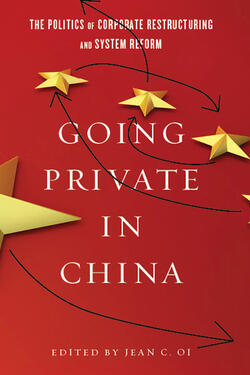
GoingPrivateinNEWSFEED1 0

As the Chinese Communist Party (CCP) set about reforming its centrally planned economy, it faced the thorny policy question of how to reform its state-owned enterprises (SOEs). Should it support a shift from public to private ownership of the means of production? Such a shift would challenge not only the CCP's socialist ideology but also its very legitimacy. Mixing the business of corporate restructuring with the politics of socialism presented nothing short of a policy nightmare.

With policy-relevant acuity, the contributors to this wide-ranging volume address the questions about reform programs that have plagued China—and East Asia more broadly—since the 1990s. While China, Japan, and South Korea have all been criticized for implementing reform too slowly or too selectively, this volume delves into the broader contexts underlying certain institutional decisions. The book seeks to show that seemingly different political economies actually share surprising similarities, and problems. While Going Private in China sheds new light on China's corporate restructuring, it also offers new perspectives on how we think about the process of institutional change.

Desk, examination, or review copies can be requested through Stanford University Press.

All Publications button
1
Publication Type
Books
Publication Date
Subtitle

The Politics of Corporate Restructuring and System Reform

Authors
Jean C. Oi
Book Publisher
Shorenstein APARC
Paragraphs

For the peasants in rural China, the harvest season is the occasion when several different worlds—the business world of large companies, the entrepreneurial world of middlemen, local elites and peasant households—are compressed into the same social space, thereby inducing intensive economic and social interactions and crystallizing social relations among villagers, local elites and markets. Based on ethnographic research on the autumn harvest in a township in northern China, this study sheds light on distinctive modes of market transactions across produces, and diverse interactions between markets and local institutions involving different co-ordination mechanisms, rhythms and social relationships. A more nuanced image of market transactions emerges from these observations, calling for a more refined conceptualization of markets and further research on their implications for institutional changes.

All Publications button
1
Publication Type
Journal Articles
Publication Date
Journal Publisher
The China Quarterly
Authors
Xueguang Zhou
-

**Due to space restrictions, this event has reached capacity and we will no longer be taking RSVPs. Everyone is still welcome to attend but please plan to arrive early as seating is on a first come, first serve basis.**

Under the Hu-Wen leadership, China announced a shift in its development policy from a policy program that mainly emphasizes economic growth to one that pursues a “harmonious society.” The harmonious society program was a response to rapid increases in inequality during the 1990s, and its aim has been to ensure that the benefits from growth are widely shared.    

In recent years have the benefits from growth been widely shared? Has income inequality increased or decreased during the Hu-Wen era?

Drawing on recent findings from the China Household Income Project, a collaborative survey research project monitoring changes in incomes and inequality, Professor Terry Sicular will discuss recent trends in inequality and poverty in China. 

Terry Sicular is professor of economics at the University of Western Ontario. She received her doctorate at Yale and has taught at Stanford and Harvard. She is a specialist on the Chinese economy, speaks Mandarin, and has been studying and travelling to China for more than 30 years. Her recent research examines incomes and inequality in China, as well as related topics such as educational attainment and its intergenerational transmission, and the impact of housing reforms on household income and wealth. She has published widely in scholarly journals and books, and is as a contributor to and co-editor of Inequality and Public Policy, published by Cambridge University Press (2008). She has served as a consultant to international donor organizations, and is a leader in the ongoing, China Household Income Project, a collaborative research project that conducts a nationwide household survey and monitors trends in China’s incomes and inequality.

This event is part of the China's Looming Challenges series

Philippines Conference Room

Terry Sicular Professor Speaker Department of Economics, University of Western Ontario
Seminars
Paragraphs

Drawing on insights from recent economic theories of incomplete contracts and property rights, we develop a theoretical model on authority relationships in the Chinese bureaucracy by conceptualizing the allocation of control rights in goal setting, inspection and incentive provision among the principal, supervisor and agent. Variations in the allocation of control rights give rise to different modes of governance and entail distinct behavioral implications among the parties involved. The proposed model provides a unified framework and a set of analytical concepts to examine different governance structures, varying authority relationships, and behavioral patterns in the Chinese bureaucracy. We illustrate the proposed model in a case study of the authority relationships and the ensuing behavioral patterns in the environmental protection arena over a 5-year policy cycle.

All Publications button
1
Publication Type
Working Papers
Publication Date
Authors
Xueguang Zhou
Paragraphs

Focusing on the episodes of the government’s Paved Road to Every Village (PREV) project in an agricultural township in northern China, this article examines two research issues: First, the role of state policies, government bureaucracies, and village cadres in the provision of public goods, especially the unintended consequences that led to huge collective debts and the erosion of the collective basis of governance and second, the role of local institutions and social relations in resource mobilization, problem solving, and response to crises, especially in the aftermath of the PREV project. The episodes provide an occasion to rethink the role of governments in economic development and the lessons learned from, to borrow an expression by James Scott, “seeing like a state.”

All Publications button
1
Publication Type
Journal Articles
Publication Date
Journal Publisher
Modern China
Authors
Xueguang Zhou

This project investigates the sources of stability and conflict in authoritarian regimes, especially regimes that have a unitary national government, apply threats and repression to their own officials, and lack an exit option for bureaucrats to move into careers in a separate private sector. It also seeks to develop theories about political movements in which bureaucrats are viewed as active participants in political processes that can rapidly undermine a government.

News Type
News
Date
Paragraphs
Recent reviews published in International Affairs and the China Quarterly hail Growing Pains: Tensions and Opportunity in China's Transformation, edited by Jean C. Oi, Scott Rozelle, and Xueguang Zhou, as successful in presenting a more balanced and thorough understanding of China's significant growth in the last three decades. International Affairs reviewer Kerry Brown highlights important chapters on wages, corruption, local elections, and family planning, while China Quarterly reviewer Scott Kennedy emphasizes, "Growing Pains deserves the attention of every scholar interested in contemporary China."
Hero Image
GrowingPainsNEWSFEED
All News button
1
Subscribe to Governance