Business
Paragraphs
GoingPrivateinNEWSFEED1 0

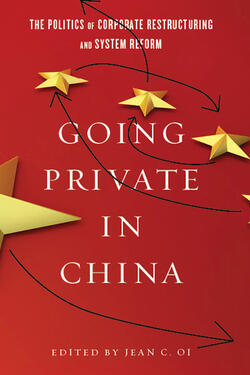
As the Chinese Communist Party (CCP) set about reforming its centrally planned economy, it faced the thorny policy question of how to reform its state-owned enterprises (SOEs). Should it support a shift from public to private ownership of the means of production? Such a shift would challenge not only the CCP's socialist ideology but also its very legitimacy. Mixing the business of corporate restructuring with the politics of socialism presented nothing short of a policy nightmare.

With policy-relevant acuity, the contributors to this wide-ranging volume address the questions about reform programs that have plagued China—and East Asia more broadly—since the 1990s. While China, Japan, and South Korea have all been criticized for implementing reform too slowly or too selectively, this volume delves into the broader contexts underlying certain institutional decisions. The book seeks to show that seemingly different political economies actually share surprising similarities, and problems. While Going Private in China sheds new light on China's corporate restructuring, it also offers new perspectives on how we think about the process of institutional change.

Desk, examination, or review copies can be requested through Stanford University Press.

All Publications button
1
Publication Type
Books
Publication Date
Subtitle

The Politics of Corporate Restructuring and System Reform

Authors
Jean C. Oi
Book Publisher
Shorenstein APARC
Paragraphs

For the peasants in rural China, the harvest season is the occasion when several different worlds—the business world of large companies, the entrepreneurial world of middlemen, local elites and peasant households—are compressed into the same social space, thereby inducing intensive economic and social interactions and crystallizing social relations among villagers, local elites and markets. Based on ethnographic research on the autumn harvest in a township in northern China, this study sheds light on distinctive modes of market transactions across produces, and diverse interactions between markets and local institutions involving different co-ordination mechanisms, rhythms and social relationships. A more nuanced image of market transactions emerges from these observations, calling for a more refined conceptualization of markets and further research on their implications for institutional changes.

All Publications button
1
Publication Type
Journal Articles
Publication Date
Journal Publisher
The China Quarterly
Authors
Xueguang Zhou
-

**Due to space restrictions, this event has reached capacity and we will no longer be taking RSVPs. Everyone is still welcome to attend but please plan to arrive early as seating is on a first come, first serve basis.**

Under the Hu-Wen leadership, China announced a shift in its development policy from a policy program that mainly emphasizes economic growth to one that pursues a “harmonious society.” The harmonious society program was a response to rapid increases in inequality during the 1990s, and its aim has been to ensure that the benefits from growth are widely shared.    

In recent years have the benefits from growth been widely shared? Has income inequality increased or decreased during the Hu-Wen era?

Drawing on recent findings from the China Household Income Project, a collaborative survey research project monitoring changes in incomes and inequality, Professor Terry Sicular will discuss recent trends in inequality and poverty in China. 

Terry Sicular is professor of economics at the University of Western Ontario. She received her doctorate at Yale and has taught at Stanford and Harvard. She is a specialist on the Chinese economy, speaks Mandarin, and has been studying and travelling to China for more than 30 years. Her recent research examines incomes and inequality in China, as well as related topics such as educational attainment and its intergenerational transmission, and the impact of housing reforms on household income and wealth. She has published widely in scholarly journals and books, and is as a contributor to and co-editor of Inequality and Public Policy, published by Cambridge University Press (2008). She has served as a consultant to international donor organizations, and is a leader in the ongoing, China Household Income Project, a collaborative research project that conducts a nationwide household survey and monitors trends in China’s incomes and inequality.

This event is part of the China's Looming Challenges series

Philippines Conference Room

Terry Sicular Professor Speaker Department of Economics, University of Western Ontario
Seminars
-

The team of leaders who will take the helm in China beginning next year—the so-called “Fifth Generation”—will be better educated, have greater exposure to the outside world, and extensive experience implementing policies that have facilitated sustained economic growth and growing international influence. They may view issues somewhat differently than their predecessors but have risen to the top by going along to get ahead and are unlikely to propose radical policy initiatives.  But they must confront a growing number of challenges fueled by China’s past success and recent behavior and will be constrained by structural features of the Chinese system and integration into the global market.

Thomas Fingar is the Oksenberg-Rohlen Distinguished Fellow at the Freeman Spogli Institute for International Studies (FSI). In 2009, he was the Payne Distinguished Lecturer at FSI. From May 2005 through December 2008, he served as the first deputy director of national intelligence for analysis and, concurrently, as chairman of the National Intelligence Council.

This event is part of the China's Looming Challenges series

Philippines Conference Room

Freeman Spogli Institute for International Studies
Stanford University
Encina Hall, C-327
Stanford, CA 94305-6055

(650) 723-9149 (650) 723-6530
0
Shorenstein APARC Fellow
Affiliated Scholar at the Stanford Center on China's Economy and Institutions
tom_fingar_vert.jpg PhD

Thomas Fingar is a Shorenstein APARC Fellow in the Freeman Spogli Institute for International Studies at Stanford University. He was the inaugural Oksenberg-Rohlen Distinguished Fellow from 2010 through 2015 and the Payne Distinguished Lecturer at Stanford in 2009.

From 2005 through 2008, he served as the first deputy director of national intelligence for analysis and, concurrently, as chairman of the National Intelligence Council. Fingar served previously as assistant secretary of the State Department’s Bureau of Intelligence and Research (2000-01 and 2004-05), principal deputy assistant secretary (2001-03), deputy assistant secretary for analysis (1994-2000), director of the Office of Analysis for East Asia and the Pacific (1989-94), and chief of the China Division (1986-89). Between 1975 and 1986 he held a number of positions at Stanford University, including senior research associate in the Center for International Security and Arms Control.

Fingar is a graduate of Cornell University (A.B. in Government and History, 1968), and Stanford University (M.A., 1969 and Ph.D., 1977 both in political science). His most recent books are From Mandate to Blueprint: Lessons from Intelligence Reform (Stanford University Press, 2021), Reducing Uncertainty: Intelligence Analysis and National Security (Stanford University Press, 2011), The New Great Game: China and South and Central Asia in the Era of Reform, editor (Stanford University Press, 2016), Uneasy Partnerships: China and Japan, the Koreas, and Russia in the Era of Reform (Stanford, 2017), and Fateful Decisions: Choices that will Shape China’s Future, co-edited with Jean Oi (Stanford, 2020). His most recent article is, "The Role of Intelligence in Countering Illicit Nuclear-Related Procurement,” in Matthew Bunn, Martin B. Malin, William C. Potter, and Leonard S Spector, eds., Preventing Black Market Trade in Nuclear Technology (Cambridge, 2018)."

Selected Multimedia

CV
Date Label
Thomas Fingar Oksenberg/Rohlen Distinguished Fellow Speaker FSI
Seminars
-

**Due to space restrictions, this event has reached capacity and we will no longer be taking RSVPs. Please plan to arrive early as seating is on a first come, first serve basis.**

Since 2008 China's banks have made loans that approach 30% of GDP each year. The central bank has used a broader measure of credit, total societal financing, that suggests credit extended in 2011 may exceed 40% of the country's GDP. It is inevitable that such profligate lending will result in significant amounts of problem loans.  The international market is well aware of this and Chinese bank shares have been hit hard for most of this year. How will these bad loans be managed? More importantly, why has the government once again used China's ostensibly commercial banks as if they were policy banks and what are the implications of this for China's economy going forward?

Carl E. Walter worked in China and its financial sector for the past 20 years and actively participated in many of the country’s financial reform efforts. While at Credit Suisse First Boston he played a major role in China’s groundbreaking first overseas IPO in 1992, as well as the first primary listing of a state-owned enterprise on the New York Stock Exchange in 1994. He was a member of senior management at China International Capital Corporation, China’s first and most successful joint venture investment bank where he supported a number of significant domestic and international stock and bond underwritings for major Chinese corporations. More recently at JPMorgan he was China Chief Operating Officer and Chief Executive Officer of its banking subsidiary. During this time Carl helped build a pioneering domestic security, risk and currency trading operation.

A long time resident of Beijing before his recent return to the United States, Carl is fluent in Mandarin and holds a PhD from Stanford University and a graduate certificate from Peking University. He is the co-author of Red Capitalism: the fragile financial foundations of China’s extraordinary rise as well as Privatizing China: inside China’s stock markets

This event is part of the China's Looming Challenges series

Philippines Conference Room

Shorenstein APARC Encina Hall Stanford University
1
Visiting Scholar at APARC, 2021-2022
Visiting Scholar at APARC, 2012-2013
WalterCarl_WEB.jpg

Carl Walter joined the Walter H. Shorenstein Asia-Pacific Research Center (Shorenstein APARC) as visiting scholar with the China Program for the 2021-2022 academic year. Prior to coming to APARC, he served as independent, non-executive Director at the China Construction Bank. He was also previously a visiting scholar with APARC during the winter and spring terms of the 2012–13 academic year after a career in banking spent largely in China. 

His research interests focus on China's financial system and its impact on financial and political organizations. During his time at Shorenstein APARC Walter will continue his book project on how fiscal reforms in China have impacted the banking system, the overall economy and the prospect for financial reform going forward.

Walter has contributed articles to publications including Caijing, the Wall Street Journal and the China Quarterly. He is also the co-author of Red Capitalism: The Fragile Financial Foundations of China's Extraordinary Rise (2012) and Privatizing China: Inside China's Stock Markets (2005).

Walter lived and worked in Beijing from 1991 to 2011, first as an investment banker involved in the earliest SOE restructurings and overseas public listings, then as chief operation officer of China's first joint venture investment bank, China International Capital Corporation. Over the last ten years he was JPMorgan's China chief operating officer as well as chief executive officer of its China banking subsidiary.

Walter holds a PhD in political science from Stanford University, a certificate of advanced study from Peking University and a BA in Russian Studies from Princeton University.

Carl Walter Former CEO Speaker JPMorgan Chase Bank China Co Ltd.
Seminars
News Type
News
Date
Paragraphs
The Shorenstein Asia Pacific Research Center and the Division of International, Comparative, and Area Studies are excited to offer highly qualified Stanford students an opportunity to extend classroom knowledge of East Asia to real-life working and cultural experiences through the East Asia Internship Program. Internship positions will cover a wide spectrum of business, non-profit, media, educational, medical, technology, and government activities.
Hero Image
HutongRoofDetail NEWSFEED
A roof detail in a Beijing hutong, Dec. 2007.
Flickr/Bridget Coila
All News button
1
-

Europe dominated the 19th century. The 20th century saw the rise of the United States. Will the 21st century be "the Chinese Century"? Using a series of Harvard Business School Cases, this lecture will explore production, consumption, and education for China's new middle class, and think about China's future, in the light of its past.

William C. Kirby is T. M. Chang Professor of China Studies at Harvard University and Spangler Family Professor of Business Administration at the Harvard Business School. He is a Harvard University Distinguished Service Professor. He serves as Director of the Fairbank Center for Chinese Studies and Chairman of the Harvard China Fund.

A historian of modern China, Professor Kirby's work examines China's business, economic, and political development in an international context. He has written on the evolution of modern Chinese business (state-owned and private); Chinese corporate law and company structure; the history of freedom in China; the international socialist economy of the 1950s; relations across the Taiwan Strait; and China's relations with Europe and America. His current projects include case studies of contemporary Chinese businesses and a comparative study of higher education in China, Europe, and the United States.

This talk is co-sponsored with the Center for East Asian Studies (CEAS).

Philippines Conference Room

William C. Kirby T. M. Chang Professor of China Studies at Harvard University and Spangler Family Professor of Business Administration Speaker Harvard Business School
Seminars
Authors
News Type
News
Date
Paragraphs
China's President Hu Jintao conducted a high-profile visit to the United States in late January 2011, during which he discussed economics, security, and climate change with President Barack Obama. Speaking with Radio Free Europe/Radio Liberty, Thomas Fingar stressed the importance of Washington and Beijing finding common ground for cooperation on crucial global issues.
Hero Image
HuObama2011Jan18SouzaPeteNEWSFEED
President Barack Obama and President Hu Jintao of China begin their working dinner in the Old Family Dining Room of the White House, Jan. 18, 2011.
Official White House photo by Pete Souza
All News button
1
Authors
News Type
News
Date
Paragraphs

In the wake of the global financial crisis, some have dubbed China and the United States the G2, signifying their centrality in global economics and politics. Even so, the relationship between China and the United States is rife with new tensions. Trade and currency challenges persist, complicated by domestic politics and differing approaches to security issues.

In its annual conference to honor the memory of eminent China scholar Michel Oksenberg, Stanford's Shorenstein Asia-Pacific Research Center gathered distinguished policymakers and analysts to examine colliding—and overlapping—interests in U.S.-China relations.

The conference was kicked off by Jeffrey Bader, special assistant to the president and senior director for East Asian Affairs at the National Security Council, who began by exploring the possibility of productive, stable relations amid values that appear to differ vastly. In support of this idea, Bader pointed to successive American presidents, going back to Richard Nixon, who found points of commonality with China. China poses a different challenge today, he argued, than even a decade ago, as its influence has grown alongside its commercial and economic presence. The Obama administration, Bader explained, has sought China's support on key issues and pursued partnership within the context of a broader Asian policy. He concluded by saying that China's rise is not intrinsically incompatible with American interest, but that does not preclude ongoing competition.

A panel chaired by Jean C. Oi, director of the Stanford China Program, next looked at competition and cooperation in the U.S.-China economic relationship. Despite the dangers of speculative bubbles and weakened export markets, the prospects for sustained economic growth in China remain very good, argued Nicholas Lardy, senior fellow at the Peterson Institute for International Economics. Robert Kapp, former president of the U.S.-China Business Council, explored growing challenges facing American business in China, exemplified by recent clashes over Internet censorship. Despite the U.S.-China clash at the Copenhagen global climate conference, Stanford Law Professor Thomas Heller contended that behind the scenes global consensus on this issue has advanced.

Points of tension in the security relationship were the focus of a panel chaired by Amb. Michael H. Armacost, the Shorenstein Distinguished Fellow. China-Taiwan tensions have improved, but Smith College's Steve Goldstein cautioned that Taiwan's policies could shift again, particularly if the promised economic benefits of improved ties do not materialize. China and the United States must likewise manage challenging allies in North Korea and Japan respectively, said Alan Romberg, director of the East Asia Program at the Henry L. Stimson Center. Finally, the United States and China have both congruent and conflicting interests at stake in dealing with the situations in Iran and Pakistan, Stanford's Thomas Fingar, the Oksenberg/Rohlen Distinguished Fellow at FSI, told the gathering.

Hero Image
SAPARCOiJeanScenery2
Jean Oi, Director of the Stanford China Program, chairs the session about U.S.-China economic competition and cooperation.
Debbie Warren
All News button
1
-

The Stanford China Program, in cooperation with the Center for East Asian Studies, will host a special series of seminars to examine China as a major political and economic actor on the world stage.  Over the course of the autumn and winter terms, leading scholars will examine China actions and policies in the new global political economy.  What is China's role in global governance?  What is the state of China's relations with its Asian neighbors?  Is China being more assertive both diplomatically as well as militarily?  Are economic interests shaping its foreign policies?  What role does China play amidst international conflicts? 

Seiichiro Takagi is a professor at the School of International Politics, Economics and Communication at the Aoyama Gakuin University in Tokyo, Japan and a Senior Visiting Fellow of the Japan Institute of International Affairs. He specializes in Chinese foreign relations and security issues in the Asia-Pacific region. Previously, he was the director of the Second Research Department, which was responsible for area studies, at the National Institute for Defense Studies in Tokyo. He also served on the Graduate School of Policy Science of Saitama University (which became the National Graduate Institute of Policy Studies) for over 20 years, and has been a guest scholar at The Brookings Institution and Beijing University. He serves on the Board of Directors of the Japan Association for International Security, and is a member of several other organizations, including the Japanese Committee, Council for Security Cooperation in Asia-Pacific (CSCAP); the Japan Association for International Relations; and the Japan Political Science Association. His recent publications in English include China Watching: Perspectives from Europe, Japan and the United States, 2007 and in Japanese The U.S.-China Relations: Structure and Dynamics in the Post-Cold War Era, 2007.. He earned a B.A. in international relations from the University of Tokyo, Japan, and an M.A. and Ph.D. from Stanford University, California.

This event is part of the China and the World series.

Philippines Conference Room

Seiichiro Takagi Professor Speaker School of International Politics, Economics, and Business, Aoyama Gakuin University, Tokyo
Seminars
Subscribe to Business