International Relations

FSI researchers strive to understand how countries relate to one another, and what policies are needed to achieve global stability and prosperity. International relations experts focus on the challenging U.S.-Russian relationship, the alliance between the U.S. and Japan and the limitations of America’s counterinsurgency strategy in Afghanistan.

Foreign aid is also examined by scholars trying to understand whether money earmarked for health improvements reaches those who need it most. And FSI’s Walter H. Shorenstein Asia-Pacific Research Center has published on the need for strong South Korean leadership in dealing with its northern neighbor.

FSI researchers also look at the citizens who drive international relations, studying the effects of migration and how borders shape people’s lives. Meanwhile FSI students are very much involved in this area, working with the United Nations in Ethiopia to rethink refugee communities.

Trade is also a key component of international relations, with FSI approaching the topic from a slew of angles and states. The economy of trade is rife for study, with an APARC event on the implications of more open trade policies in Japan, and FSI researchers making sense of who would benefit from a free trade zone between the European Union and the United States.

News Type
News
Date
Paragraphs

The Shorenstein Asia-Pacific Research Center (APARC), in pursuit of training the next generation of scholars on contemporary Asia, has selected two postdoctoral fellows for the 2017-18 academic year. The fellows will begin their year of academic study and research at Stanford this fall.

Shorenstein APARC has for more than a decade sponsored numerous junior scholars who come to the university to work closely with Stanford faculty, develop their dissertations for publication, participate in workshops and seminars, and present their research to the broader community.

The 2017-18 cohort includes two Shorenstein Postdoctoral Fellows; they carry a broad range of interests from labor migration policy in China to regional institutions in East Asia. Their bios and research plans are listed below:


Image
hyun seung cho
H. Seung Cho is completing his doctorate at Columbia University’s Department of Political Science. He researches U.S. and Chinese foreign policy toward East Asia’s regional institutions with a broader interest in U.S.-China relations, the political economy of East Asia and qualitative research methods. His dissertation probes the popular narrative that United States and China are competing over East Asia’s regional architecture, arguing that mutual misperception and security dilemma dynamics also play out in the politics of regional institution building. To explore this phenomenon, Seung has conducted extensive fieldwork in Beijing, Jakarta, Seoul and Washington, D.C. At Shorenstein APARC, Seung will be developing his dissertation into a book manuscript while looking to further examine the relationship between the politics of East Asia’s multilateral security institutions and their perceived lack of effectiveness. Previously, Seung was a predoctoral fellow at Peking University’s School of International Studies from 2014-16. Prior to starting his doctoral studies, he also served in South Korean military intelligence as part of the two-year national service. Seung holds a Bachelor of Science in government and economics and Master of Science in international relations from the London School of Economics and Political Science (LSE).


Image
samantha vortherms
Samantha Vortherms is a doctoral candidate in the University of Wisconsin – Madison Department of Political Science. Her research focuses on comparative political economy, development, social welfare and research methodology. Her dissertation examines subnational variation in access to citizenship rights in China through the household registration system. Her research has been supported by the National Science Foundation, the U.S. Department of Education through the Fulbright-Hays Doctoral Dissertation Research Abroad and the Social Science Research Council's Dissertation Proposal Development Fellowship, among others. At Shorenstein APARC, Sam will work on converting her dissertation to a book manuscript and advance her post-dissertation project on the role of the firm in labor migration policies. Before going to Wisconsin, Sam received her Master of Arts in international relations at the University of Chicago, Artium Magister in public policy from University of Chicago's Harris School of Public Policy, and a Bachelor of Arts from the University of Richmond. From 2014-16, she was a visiting research fellow at the National School of Development's China Center for Health Economics Research at Peking University.

Hero Image
encina hall
All News button
1
Paragraphs

Scholars at Stanford's Shorenstein Asia-Pacific Research Center in the Freeman Spogli Institute for International Studies assess the strategic situation in East Asia to be unsettled, unstable, and drifting in ways unfavorable for American interests. These developments are worrisome to countries in the region, most of which want the United States to reduce uncertainty about American intentions by taking early and effective steps to clarify and solidify U.S. engagement. In the absence of such steps, they will seek to reduce uncertainty and protect their own interests in ways that reduce U.S. influence and ability to shape regional institutions. This 23-page report entitled “President Trump’s Asia Inbox” suggests specific steps to achieve American economic and security interests.

All Publications button
1
Publication Type
Policy Briefs
Publication Date
Journal Publisher
Shorenstein Asia-Pacific Research Center
Authors
Thomas Fingar
News Type
News
Date
Paragraphs

Scholars at Stanford's Shorenstein Asia-Pacific Research Center in the Freeman Spogli Institute for International Studies assess the strategic situation in East Asia to be unsettled, unstable, and drifting in ways unfavorable for American interests. These developments are worrisome to countries in the region, most of which want the United States to reduce uncertainty about American intentions by taking early and effective steps to clarify and solidify U.S. engagement. In the absence of such steps, they will seek to reduce uncertainty and protect their own interests in ways that reduce U.S. influence and ability to shape regional institutions. The recommendations summarized below, and elaborated in a 23-page report entitled “President Trump’s Asia Inbox,” suggest specific steps to achieve American economic and security interests.


» Key Recommendations

» Full Report with Preface from Director Gi-Wook Shin and Introduction by Amb. Michael H. Armacost

» About the Contributors

» Information for Press

» Press Coverage


Key Recommendations. 


Trade and Economic Relations

The dynamic economies of East Asian countries are increasingly integrated and interdependent. The United States is an important market and source of investment and technology, but this is no longer sufficient to ensure that future arrangements and rules will protect American interests. The region is moving toward more formal, rule-based arrangements and the United States must be an active shaper of those institutions.

Most in the region want the United States to play a leading role in the establishment and enforcement of free and fair international economic transactions, and want the rules and mechanisms governing trade to be multilateral ones. If we do not play such a role, China, and possibly others, will seek arrangements that disadvantage American firms.

  • The replacement for the Trans-Pacific Partnership (TPP) should build on what was achieved in those negotiations, especially those that would assure market access for U.S. firms and protect intellectual property rights, enforce labor standards, and ensure environmental protection. A single multilateral agreement would be best, but much could be achieved through interlocking and consistent bilateral agreements.
  • The administration should adopt policy measures to increase employability and create jobs for the Americans who have been disadvantaged by globalization.

Defense and Security

China’s military buildup and North Korea’s growing arsenal of missiles and nuclear weapons have fueled concerns about U.S. will and ability to honor its security commitments in the region. No one wants a regional arms race or tit-for-tat moves that increase the danger of accidental conflict or escalation, but many believe concrete steps are needed to check perceptions that the United States is becoming less willing to maintain the peace and stability that undergirds regional prosperity.

  • While reaffirming the need for a forward presence in the region, reconfigure it along the lines of an “active denial” strategy. “Active denial” means maintaining a forward presence in East Asia that is designed to deny an opponent the benefits of military aggression, especially the prospect of a quick victory. The first component of such a strategy is a resilient force posture, which can be achieved by exploiting the size and depth of the region to distribute units in more locations. The second component is an emphasis on planning to conduct military operations against an adversary’s offensive strike or maneuver forces, not targets deep inside an adversary’s homeland territory and not by carrying out preemptive strikes.
  • Strengthen U.S. military capabilities by developing and fielding stealthier air and maritime platforms, increase submarine and anti-submarine assets, and provide forward deployed forces with better active defenses, such as rail guns and lasers. At the same time, the United States should assist those neighbors of the PRC who feel threatened by Chinese assertiveness to develop asymmetric coercive capabilities that can put at risk forward-deployed PLA forces. The United States can use elements of such assistance programs as points of negotiating leverage in our attempts to limit militarization on both sides.
  • Continue to promote U.S.-China military relations, emphasizing accident avoidance and crisis management, sustained dialogues on national strategies and doctrines, and cooperative endeavors, such as training exercises and combined operations, where and when feasible and mutually beneficial.

China

People in the region worry about China’s actions and intentions but they worry more about the prospect of confrontation and conflict between the United States and the People’s Republic. They look to the United States as a counterbalance to China but fear that Washington will overreact or underreact to actions by Beijing, or take provocative actions that jeopardize their own interests. The U.S. should:

  • Respond to Chinese actions inimical to American interests in ways that protect our interests, achieve U.S. goals shared by others in the region, and avoid both the reality and the appearance of being “anti-China.”
  • Reaffirm American commitments to allies and partners including China and Taiwan.
  • Tighten enforcement of import restrictions on products produced by firms that have stolen intellectual property from U.S. companies.

Korean Peninsula

North Korea is threatening an ICBM test in 2017, possibly in the next few weeks or months. There is a political vacuum in South Korea, and Seoul is being pressured and punished by Beijing to reverse its decision to accept the deployment of a U.S. THAAD missile defense in South Korea. Under these circumstances, these are our priority recommendations for the administration

  • It should work to dissuade North Korea from an ICBM test. Publicly, the new administration should reaffirm that the U.S. would use military means against an ICBM that appeared to threaten the U.S. or one of our allies. Regular spring ROK-U.S. joint military exercises should be held, but calibrated and conducted to avoid giving Pyongyang extra pretext for a test. The Trump administration should appoint a senior envoy empowered to go to Pyongyang to convey openness to renewed diplomacy, while at the same time being clear about the consequences of an ICBM test. China will share this goal, and the new Trump administration should establish a dialogue with China on North Korea based on this shared interest rather than linked to other issues in the U.S.-China relationship, such as bilateral trade. The Trump administration should not negotiate the THAAD issue with Beijing but rather stick to the principle that this is a Seoul-Washington issue.
  • The U.S.-ROK relationship will need early and special attention in 2017. Secretary of Defense Mattis’ early visit to the ROK was a wise move. With names already announced for Beijing and Tokyo, a new American ambassador for Seoul should be nominated soon. Despite the political leadership vacuum in Seoul, the Trump administration should strive for the closest possible diplomatic, political, and military coordination on North Korea with our South Korean allies. Trade and burden-sharing issues should not be front-burner issues during South Korea’s political transition. U.S. neutrality in the South Korean election, along with demonstrated respect for South Korea’s democracy, will be carefully monitored, and is essential, as is strengthening U.S. contacts and outreach across the political spectrum in South Korea.

Japan

The Abe administration is the most stable government Japan has had for many years. The prime minister wants to work with Washington, is prepared to deepen defense cooperation with the United States and others in the region, and is eager to lock in the commitments and arrangements negotiated in the TPP. There is a real opportunity to secure access for U.S. firms greater than achieved by any previous administration.

  • Build upon arrangements negotiated in TPP to secure a U.S.-Japan free-trade agreement (FTA) that increases access for U.S. firms and locks in economic reforms initiated by the Abe government.
  • Propose annual head of state level trilateral cooperation summits with Japan and South Korea and seek greater trilateral cooperation, particularly in the area of security cooperation. Caution Tokyo against steps backward on historical reconciliation.

Southeast Asia and the South China Sea

Southeast Asia is most vulnerable to and concerned about China’s actions and intentions. Countries in the region want the United States to counterbalance and constrain China but worry equally that the United States is unreliable and unequal to the challenge of protecting their interests while preserving American interests vis-à-vis China. Unless given a better option, they will lean toward China for economic and security reasons.

  • The United States should anchor U.S. policy on the South China Sea (SCS) to an explicit commitment that no single country—not the US, not China, nor anyone else—should seek or enjoy a monopoly of ownership and control over that body of water. To underscore that commitment, the United States should execute freedom of navigation operations (FONOPs) in waters between and around the Spratly islands. These and other operations in the SCS should be conducted in conformity with the authoritative ruling on the status of its waters and land features issued in 2016 by the arbitral court convened for that purpose under the UN Convention on the Law of the Sea.
  • The United States should also try, in concert with its allies and partners, to bring the SCS under international protection and management by a combination of claimant and user states, including the United States and China, based on international law. The Southeast Asia Maritime Security Initiative should be enlarged and upgraded to serve this purpose. If China declines to join, a chair at the table should remain empty should Beijing change its mind.

The U.S. should remain engaged with the process of regional and trans-Pacific institution building, including but not limited to the Association of Southeast Asian Nations (ASEAN) annual meetings, the East Asian Summit, and the Asia Pacific Economic Cooperation (APEC) forum, which will be hosted by Vietnam in 2017.


Full Report with Preface from Gi-Wook Shin and Introduction by Amb. Michael H. Armacost.


The policy recommendations published above are a summary included in the beginning of a 23-page report entitled “President Trump’s Asia Inbox.” You may view the full report here.


About the Contributors

Michael H. Armacost is a Shorenstein APARC Fellow and former U.S. ambassador to Japan and the Philippines.

Karl Eikenberry is the Oksenberg-Rohlen Fellow at Shorenstein APARC; director of the U.S.-Asia Security Initiative; former U.S. ambassador to Afghanistan, and Lieutenant General (Ret.), U.S. Army.

Donald K. Emmerson is a senior fellow emeritus at FSI; director of the Southeast Asia Program at Shorenstein APARC; and affiliated with FSI’s Abbasi Program in Islamic Studies.

Thomas Fingar is a Shorenstein APARC Fellow and has served as former first deputy director of national intelligence for analysis and chairman of the National Intelligence Council, among other positions.

Takeo Hoshi is the Henri H. and Tomoye Takahashi Senior Fellow in Japanese Studies and director of the Japan Program.

Gi-Wook Shin is the director of the Walter H. Shorenstein Asia-Pacific Research Center; senior fellow at the Freeman Spogli Institute for International Studies; director of the Korea Program; and the Tong Yang, Korea Foundation, and Korea Stanford Alumni Chair of Korean Studies, all at Stanford.

Daniel C. Sneider is the associate director for research at Shorenstein APARC, co-director of the Divided Memories and Reconciliation project and a former foreign correspondent.

Kathleen Stephens is the William J. Perry Fellow in the Korea Program at Shorenstein APARC and former U.S. ambassador to the Republic of Korea.


Information for Press.


The contributors are open to comment, interview and provide background information on the contents of the report, “President Trump’s Asia Inbox.” To inquire about availability, please contact Lisa Griswold, Shorenstein APARC Communications and Outreach Coordinator, at lisagris@stanford.edu or (650) 736-0656.


Related Press Coverage


Stanford report offers policy insights for the Trump administration, Caixin Media (in Chinese), Feb. 13, 2017

"Trump, do not bring up KORUS FTA and US forces cost-sharing until S. Korea's next presidential election," Yonhap News and various other outlets (in Korean), Feb. 13, 2017

China looks to US to resolve N. Korea nuclear issue, The Straits Times (in English), Feb. 15, 2017

Stanford experts offer policy proposals, insights on US-Asia relations, Stanford News Service (in English), Feb. 15, 2017

Unsettled, unstable and drifting: Today's US-East Asia relationship, Medium (in English), Feb. 16, 2017

Why Japan will also be "convenient" for the Trump administration, Tokyo Business Today (in Japanese), Feb. 18, 2017

Study: Managing China relationship most consequential to US, China Daily USA (in English), Feb. 21, 2017

How the Trump administration should address China, Tokyo Business Today (in Japanese), Feb. 23, 2017

Fears of Trump giving China free reign in Asia misplaced, Asia Times (in English), Feb. 24, 2017


Hero Image
white house night gettyimages
The White House at dusk.
Mandel Ngan/AFP/Getty Images
All News button
1
-

Brunei, China, Indonesia, Malaysia, the Philippines, Taiwan, and Vietnam have made ambiguous, intransigent, and overlapping claims of “sovereignty” and “rights” in the South

China Sea. China has enlarged and weaponized “its” land features and denounced and ignored the July 2016 decision by the International Tribunal for the Law of the Sea that denied China’s claims of “rights” within its vastly encompassing “nine-dash line.” The court also disallowed claims to sea space in excess of twelve nautical miles around land features in the Spratlys. China’s refusal to negotiate with ASEAN as a group and its use of yuan diplomacy have worsened the disunity of member states. Chinese procrastination and intra-Southeast Asian rivalry have stalled implementation of an existing but routinely violated Declaration on Conduct and prevented agreement on a meaningful and enforceable Code of Conduct. American policy toward China appears to have shifted from objection to provocation. The question is urgent:  What can and should be done?

Image
don emmerson 2

Donald K. Emmerson is the Director of the Southeast Asia Program, Shorenstein APARC; Senior Fellow at FSI, Emeritus; Affiliated Faculty of CDDRL; and Affiliated Scholar, Abbasi Program in Islamic Studies, all at Stanford University. In 2010 the National Bureau of Asian Research and the Woodrow Wilson International Center for Scholars awarded Dr. Emmerson a two-year Research Associateship given to “top scholars from across the United States” who “have successfully bridged the gap between the academy and policy.”

Dr. Emmerson’s policy concerns run from specific issues such as sovereignty disputes in the South China Sea to broad questions involving China-Southeast Asia relations, the American “rebalance” toward Asia, and the future of the Association of Southeast Asian Nations (ASEAN).

Dr. Emmerson’s recent publications include: “Facts, Minds, and Formats: Scholarship and Political Change in Indonesia” in Indonesian Studies: The State of the Field (2013); “Is Indonesia Rising? It Depends” in Indonesia Rising (2012); “Southeast Asia: Minding the Gap between Democracy and Governance,” Journal of Democracy (April 2012); “The Problem and Promise of Focality in World Affairs,” Strategic Review (August 2011); An American Place at an Asian Table? Regionalism and Its Reasons (2011); and Asian Regionalism and US Policy: The Case for Creative Adaptation (2010).

This event is co-sponsored by the Shorenstein APARC's China Program and The Forum for American/Chinese Exchange at Stanford (FACES).

This event is part of the winter colloquia series entitled "China: Going Global" sponsored by Shorenstein APARC's China Program.

Image

China: Going Global

Beijing’s new Silk Road initiative links old trade corridors from Asia to Africa and Europe. Many perceive that President Xi Jinping’s “One Belt, One Road” initiative as well as China’s many other trade, investment and finance projects transcend their economic calculus and reflect Beijing’s geopolitical ambitions to reposition China’s standing on the global stage. The China Program brings leading experts to explore the drivers and motivators of China’s international initiatives, their reach and scope as well as the implications of China’s increasing activism on the world stage.

http://aparc.fsi.stanford.edu/research/china-going-global

<i>Director, Southeast Asia Program, Shorenstein APARC, Senior Fellow, Emeritus,</i> FSI, Stanford University
Seminars
-

In the two decades since the countries of Central Asia declared independence, China has become one of their main partners, eclipsing many other actors. This has impacted the international relations of the new states, and structured their economic development. China's influence in the region has, however, raised many questions, ranging from issues of national integrity to economic stability and geopolitical policies.

In terms of economics, hydrocarbons and trade are at the forefront of Chinese activity in the region. Beijing has become a key positive element in the development of a service economy and new technologies, while China's geographical proximity has supported regional development and the insertion of Central Asian countries into world markets. However, Beijing also has played a negative role by using the local economies as mere sources for raw materials and by destroying, through dominating competition, the already very fragile post-Soviet industrial fabric.

On the geopolitical level, how does Central Asia handle its relations with a diverse array of international actors and thus competing interests in order to achieve a positive balance? Central Asian governments have been playing a careful balancing game between the two main actors, Beijing and Moscow. However, many Central Asians argue for countering what they see as an impasse in their countries' partnerships with Russia and China by developing relations with other actors, particularly Muslim countries (such as Turkey, Iran or the UAE) and Western countries. This presentation will address questions at both the economic and geopolitical levels, where Beijing has made it possible to act as a catalyst for political debates about the choices made by Central Asia governments. 


Image
Peyrouse

Sebastien Peyrouse is the Research Professor of International Affairs at the Elliott School of International Affairs of The George Washington University. He was a doctoral and postdoctoral Fellow at the French Institute for Central Asia Studies in Tashkent (1998-2000 and 2002-2005), a Research Fellow at the Slavic Research Center, Hokkaido University in Sapporo (2006), and a Research Fellow at the Woodrow Wilson International Center for Scholars in Washington (2006-2007). In 2008-2012, he was a Senior Research Fellow with the Central Asia-Caucasus Institute & Silk Road Studies Program (SAIS, Johns Hopkins University, Washington D.C.) and with the Institute for Security and Development Policy (Stockholm). He is an Associated Scholar with the Institute for International and Strategic Relations (IRIS, Paris), and with the Fundación para las Relaciones Internacionales y el Diálogo Exterior (FRIDE, Madrid) and a member of the Brussels-based EUCAM (Europe-Central Asia Monitoring). 

p.p1 {margin: 0.0px 0.0px 0.0px 0.0px; font: 16.0px Garamond; -webkit-text-stroke: #000000} span.s1 {font-kerning: none}

Dr. Peyrouse is the author of Turkmenistan. Strategies of Power, Dilemmas of Development (M. E. Sharpe, 2011), and the co-author of The 'Chinese Question' in Central Asia. Domestic Order, Social Changes, and the Chinese Factor (Hurst, Columbia University Press, 2012) and of Globalizing Central Asia. Geopolitics and the Challenges of Economic Development (M.E. Sharpe, 2012). He has also co-edited China and India in Central Asia. A new "Great Game"? (Palgrave Macmillan, 2010), and Mapping Central Asia: Indian Perceptions and Strategies (Ashgate, 2011). His articles have appeared in Europe Asia Studies, Problems of Post-Communism, Nationalities Papers, China Perspectives, Religion, State & Society, Journal of Church and State. He has authored or co-authored seven books on Central Asia in French.


This event is co-sponsored by the Shorenstein APARC's China Program and The Forum for American/Chinese Exchange at Stanford (FACES).

This event is part of the winter colloquia series entitled "China: Going Global" sponsored by Shorenstein APARC's China Program.

Image

China: Going Global

Beijing’s new Silk Road initiative links old trade corridors from Asia to Africa and Europe. Many perceive that President Xi Jinping’s “One Belt, One Road” initiative as well as China’s many other trade, investment and finance projects transcend their economic calculus and reflect Beijing’s geopolitical ambitions to reposition China’s standing on the global stage. The China Program brings leading experts to explore the drivers and motivators of China’s international initiatives, their reach and scope as well as the implications of China’s increasing activism on the world stage.

http://aparc.fsi.stanford.edu/research/china-going-global

Sebastien Peyrouse <i>Research Professor of International Affairs, Elliott School of International Affairs, The George Washington University</i>
Seminars
News Type
News
Date
Paragraphs

Karen Eggleston has been named deputy director of Stanford’s Shorenstein Asia-Pacific Research Center (APARC) in the Freeman Spogli Institute for International Studies (FSI), effective Jan. 9, 2017.

Eggleston, an FSI senior fellow and director of the Asia Health Policy Program, studies comparative health policy and the economics of demographic transition in Asia, with a focus on China.

“Karen’s record of scholarship and astute ability to work across research, teaching and administration will support Shorenstein APARC as it continues to grow. We’re very fortunate to have someone of her caliber ready to help oversee the center’s operations,” Shorenstein APARC Director Gi-Wook Shin said.

Eggleston first came to Stanford as a center fellow in 2007 to lead the Asia Health Policy Program and was promoted to senior fellow in 2015. Now in its 10th year, the program maintains a robust research agenda, supports an annual postdoctoral fellowship, and convenes conferences in the United States and Asia.

Eggleston teaches students through the East Asia studies program on-campus, and has published over 50 peer-reviewed articles in economics, medicine, demography and health policy journals such as Journal of Economic Perspectives, Journal of Health Economics, Population Studies, Lancet and Health Affairs. She has also written and edited several books, most recently Policy Challenges from Demographic Change in China and India (2016), part of Shorenstein APARC’s publishing program.

“I am honored to serve Shorenstein APARC in this new capacity and look forward to working with Professor Shin and my colleagues to find innovative ways to strengthen the center and promote our intertwined missions of research, education and policy engagement,” said Eggleston, who is also a faculty research fellow at the National Bureau of Economic Research.

The deputy director position was created to accommodate the increasing size and scope of the center. The deputy director works closely with the director on strategic vision and objectives.

Hero Image
Portrait of Karen Eggleston Rod Searcey
All News button
1
-

WE HAVE REACHED VENUE CAPACITY AND ARE NO LONGER ACCEPTING RSVPS


PLEASE NOTE VENUE CHANGE TO ENCINA HALL,

BECHTEL CONFERENCE CENTER, 1ST FLOOR

The election of Donald Trump has introduced a big question mark into America’s relations with China. Will the new president start a trade war with the world’s second biggest economy? Will Trump attempt to refashion America’s relations with Taiwan and thus infuriate Beijing? Will Trump’s vow to build more U.S. naval vessels place the United States and China on a path to conflict in the South China Sea? How will Trump handle the prospects of a North Korea armed with nuclear weapons and an intercontinental ballistic missile with which to deliver them? As for China, how will it react to this new administration, which espouses a decidedly different view of China than the one that predominated in Washington over the past several decades? Will China adopt the role of “responsible [global] stakeholder” in contrast to Trump’s “America first” ideology? Or will China join the United States in a race to the bottom, precipitating further ideological, economic and geostrategic competition that pulls the world down with it?

A book signing will follow. Copies of Mr. John Pomfret’s book will be available for purchase 


Image
pomfret
John Pomfret is the author of the recently-published The Beautiful Country and the Middle Kingdom: America and China from 1776 to the Present (2016). He is also the author of the best-seller Chinese Lessons: Five Classmates and the Story of the New China (2007) and an award-winning journalist who spent decades as a foreign correspondent with The Washington Post. He has lived in China for 20 years since the early 1980s and has also covered U.S.-China relations from Washington, DC. As The New York Times said of The Beautiful Country, “Donald Trump (or his next secretary of state) would be well advised to read this timely and comprehensively informative book.”


This event is co-sponsored by Shorenstein APARC's China Program and the Center for East Asian Studies

 
John Pomfret former foreign correspondent for <i>The Washington Post</i>; author of <i>The Beautiful Country and the Middle Kingdom: America and China from 1776 to the Present</i>
Seminars

Beijing’s new Silk Road initiative links old trade corridors from Asia to Africa and Europe. Many perceive that President Xi Jinping’s “One Belt, One Road” initiative as well as its many other trade, investment and finance projects transcend their economic calculus and reflect Beijing’s geopolitical ambitions to reposition China’s standing on the global stage. The China Program brings leading experts to explore the drivers and motivators of China’s international initiatives, their reach and scope as well as the implications of China’s increasing activism on the world stage.

-

Latin American trade with China has grown exponentially since 2000. From insignificant amounts, trade with China now constitutes 13 percent of Latin America’s total global trade. Major loans and investments also add to China’s growing role in the region’s economy. China has become an important alternative for capital, trade and technology for Latin America, but without the policy conditionality that regional governments have traditionally experienced in relations with developed countries. China’s growing economic role has been welcomed by Latin America’s political classes, and China has advocated for a ‘comprehensive and cooperative relationship.’ However, some critics observe that economic relations with China have only benefited Latin America’s commodity exporters while its manufacturers have struggled to compete. Others have raised concerns that China may use its growing role to press Latin American states to roll back gains made on labor, environmental, and human rights to favor Chinese investors. Yet others have suggested that China enables some political leaders in the region to pursue policies that undermine democracy and contribute to political instability. As part of a project on China-Latin American relations at the Brookings Institution, Harold Trinkunas assesses how China’s growing economic relations actually influence politics and policies across the region. Trinkunas will be joined in conversation with Shorenstein APARC Fellow Thomas Fingar.


Image
Harold Trinkunas
Harold Trinkunas joined FSI’s Center for International Security and Cooperation (CISAC) in the concomitant role of Senior Research Scholar and Associate Director for Research. Trinkunas comes to CISAC from the Brookings Institution, where he was the Charles W. Robinson Chair and Senior Fellow as well as Director of the Latin America Initiative. Previously, he served as Chair of the National Security Affairs Department at the Naval Postgraduate School, where he was also an Associate Professor. One of the nation's leading Latin America specialists, Trinkunas' work has examined civil-military relations, ungoverned spaces, terrorist financing, emerging power dynamics, and global governance. His newest book, Aspirational Power: Brazil's Long Road to Global Influence, co-authored with David Mares of UCSD, was published this summer by Brookings Institution Press. Born and raised in Venezuela, Trinkunas earned his doctorate in political science from Stanford University in 1999 and has been a predoctoral fellow and later a visiting professor at CISAC.

Image
Headshot of Thomas Fingar
Thomas Fingar is the Shorenstein APARC Fellow in the Freeman Spogli Institute for International Studies at Stanford University. From 2005 to 2008, he served concurrently as the first deputy director of national intelligence for analysis and as chairman of the National Intelligence Council. He served previously as assistant secretary of the State Department’s Bureau of Intelligence and Research (2004–2005), principal deputy assistant secretary (2001–2003), deputy assistant secretary for analysis (1994–2000), director of the Office of Analysis for East Asia and the Pacific (1989–1994), and chief of the China Division (1986–1989). Fingar’s most recent books are The New Great Game: China and South and Central Asia in the Era of Reform (Stanford University Press, 2016); and Uneasy Partnership: China and Japan, the Koreas, and Russia in the Age of Reform (Stanford University Press, 2017, forthcoming).


This event is part of the winter colloquia series entitled "China: Going Global" sponsored by Shorenstein APARC's China Program.

[[{"fid":"224946","view_mode":"crop_870xauto","fields":{"format":"crop_870xauto","field_file_image_description[und][0][value]":"","field_file_image_alt_text[und][0][value]":false,"field_file_image_title_text[und][0][value]":false,"field_credit[und][0][value]":"Economist.com","field_caption[und][0][value]":"","field_related_image_aspect[und][0][value]":"","thumbnails":"crop_870xauto"},"type":"media","field_deltas":{"1":{"format":"crop_870xauto","field_file_image_description[und][0][value]":"","field_file_image_alt_text[und][0][value]":false,"field_file_image_title_text[und][0][value]":false,"field_credit[und][0][value]":"Economist.com","field_caption[und][0][value]":"","field_related_image_aspect[und][0][value]":"","thumbnails":"crop_870xauto"}},"link_text":null,"attributes":{"width":"870","style":"margin-left: 0px; margin-right: 15px; padding: 5px; float: left; width: 350px; height: 194px;","class":"media-element file-crop-870xauto","data-delta":"1"}}]]China: Going Global

Beijing’s new Silk Road initiative links old trade corridors from Asia to Africa and Europe. Many perceive that President Xi Jinping’s “One Belt, One Road” initiative as well as China’s many other trade, investment and finance projects transcend their economic calculus and reflect Beijing’s geopolitical ambitions to reposition China’s standing on the global stage. The China Program brings leading experts to explore the drivers and motivators of China’s international initiatives, their reach and scope as well as the implications of China’s increasing activism on the world stage.

http://aparc.fsi.stanford.edu/research/china-going-global


Related Links:

Colloquium summary

Harold Trinkunas <i>Associate Director for Research and Senior Research Scholar</i>, CISAC, FSI, Stanford University
Thomas Fingar <i>Shorenstein APARC Fellow</i>, FSI, Stanford University</i>
Seminars
-

What is the logic of China’s foreign policy decision-making? Thomas Fingar explores how security and economic development have driven China’s foreign policy stance over the last 35 years. Even as the scope and scale of China’s engagement with the world has undergone a sea change, China’s calculus has remained consistent: How will a particular foreign policy choice cost or contribute to China’s economic growth and national security?


Multimedia for this event.


Image
Thomas Fingar is the Shorenstein APARC Fellow in the Freeman Spogli Institute for International Studies at Stanford University. From 2005 to 2008, he served concurrently as the first deputy director of national intelligence for analysis and as chairman of the National Intelligence Council. He served previously as assistant secretary of the State Department’s Bureau of Intelligence and Research (2004–2005), principal deputy assistant secretary (2001–2003), deputy assistant secretary for analysis (1994–2000), director of the Office of Analysis for East Asia and the Pacific (1989–1994), and chief of the China Division (1986–1989). Fingar’s most recent books are The New Great Game: China and South and Central Asia in the Era of Reform (Stanford University Press, 2016); and Uneasy Partnership: China and Japan, the Koreas, and Russia in the Age of Reform (Stanford University Press, 2017, forthcoming).


This event is part of the winter colloquia series entitled "China: Going Global" sponsored by Shorenstein APARC's China Program.

[[{"fid":"224946","view_mode":"crop_870xauto","fields":{"format":"crop_870xauto","field_file_image_description[und][0][value]":"","field_file_image_alt_text[und][0][value]":false,"field_file_image_title_text[und][0][value]":false,"field_credit[und][0][value]":"Economist.com","field_caption[und][0][value]":"","field_related_image_aspect[und][0][value]":"","thumbnails":"crop_870xauto"},"type":"media","field_deltas":{"1":{"format":"crop_870xauto","field_file_image_description[und][0][value]":"","field_file_image_alt_text[und][0][value]":false,"field_file_image_title_text[und][0][value]":false,"field_credit[und][0][value]":"Economist.com","field_caption[und][0][value]":"","field_related_image_aspect[und][0][value]":"","thumbnails":"crop_870xauto"}},"link_text":null,"attributes":{"width":"870","style":"margin-left: 0px; margin-right: 15px; padding: 5px; float: left; width: 350px; height: 194px;","class":"media-element file-crop-870xauto","data-delta":"1"}}]]China: Going Global

Beijing’s new Silk Road initiative links old trade corridors from Asia to Africa and Europe. Many perceive that President Xi Jinping’s “One Belt, One Road” initiative as well as China’s many other trade, investment and finance projects transcend their economic calculus and reflect Beijing’s geopolitical ambitions to reposition China’s standing on the global stage. The China Program brings leading experts to explore the drivers and motivators of China’s international initiatives, their reach and scope as well as the implications of China’s increasing activism on the world stage.

http://aparc.fsi.stanford.edu/research/china-going-global

Freeman Spogli Institute for International Studies
Stanford University
Encina Hall, C-327
Stanford, CA 94305-6055

(650) 723-9149 (650) 723-6530
0
Shorenstein APARC Fellow
Affiliated Scholar at the Stanford Center on China's Economy and Institutions
tom_fingar_vert.jpg PhD

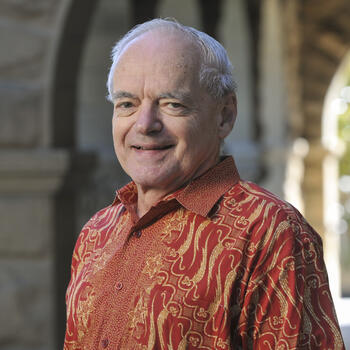
Thomas Fingar is a Shorenstein APARC Fellow in the Freeman Spogli Institute for International Studies at Stanford University. He was the inaugural Oksenberg-Rohlen Distinguished Fellow from 2010 through 2015 and the Payne Distinguished Lecturer at Stanford in 2009.

From 2005 through 2008, he served as the first deputy director of national intelligence for analysis and, concurrently, as chairman of the National Intelligence Council. Fingar served previously as assistant secretary of the State Department’s Bureau of Intelligence and Research (2000-01 and 2004-05), principal deputy assistant secretary (2001-03), deputy assistant secretary for analysis (1994-2000), director of the Office of Analysis for East Asia and the Pacific (1989-94), and chief of the China Division (1986-89). Between 1975 and 1986 he held a number of positions at Stanford University, including senior research associate in the Center for International Security and Arms Control.

Fingar is a graduate of Cornell University (A.B. in Government and History, 1968), and Stanford University (M.A., 1969 and Ph.D., 1977 both in political science). His most recent books are From Mandate to Blueprint: Lessons from Intelligence Reform (Stanford University Press, 2021), Reducing Uncertainty: Intelligence Analysis and National Security (Stanford University Press, 2011), The New Great Game: China and South and Central Asia in the Era of Reform, editor (Stanford University Press, 2016), Uneasy Partnerships: China and Japan, the Koreas, and Russia in the Era of Reform (Stanford, 2017), and Fateful Decisions: Choices that will Shape China’s Future, co-edited with Jean Oi (Stanford, 2020). His most recent article is, "The Role of Intelligence in Countering Illicit Nuclear-Related Procurement,” in Matthew Bunn, Martin B. Malin, William C. Potter, and Leonard S Spector, eds., Preventing Black Market Trade in Nuclear Technology (Cambridge, 2018)."

Selected Multimedia

CV
Date Label
<i>Shorenstein APARC Fellow</i>, FSI, Stanford University
Seminars
Subscribe to International Relations