Society

FSI researchers work to understand continuity and change in societies as they confront their problems and opportunities. This includes the implications of migration and human trafficking. What happens to a society when young girls exit the sex trade? How do groups moving between locations impact societies, economies, self-identity and citizenship? What are the ethnic challenges faced by an increasingly diverse European Union? From a policy perspective, scholars also work to investigate the consequences of security-related measures for society and its values.

The Europe Center reflects much of FSI’s agenda of investigating societies, serving as a forum for experts to research the cultures, religions and people of Europe. The Center sponsors several seminars and lectures, as well as visiting scholars.

Societal research also addresses issues of demography and aging, such as the social and economic challenges of providing health care for an aging population. How do older adults make decisions, and what societal tools need to be in place to ensure the resulting decisions are well-informed? FSI regularly brings in international scholars to look at these issues. They discuss how adults care for their older parents in rural China as well as the economic aspects of aging populations in China and India.

-

Asia Health Policy Program (AHPP) 2021-22 Colloquium series "Aligning Incentives for Better Health and More Resilient Health Systems in Asia”

Friday, November 12, 2021, 7:30am - 8:30am (Jakarta time)

Dr. Alatas will discuss her research on promoting vaccination in Indonesia and the impact of the pandemic on Indonesia’s society and economy more generally, including on poverty, human capital, and development.

Image
Vivi Alatas 4X4
Vivi Alatas is an  economist with passion for evidence-based solutions.  She is CEO of Asakreativita, a consulting and Edtech company that she established in 2020. Formerly she was a Lead Economist of the World Bank, where she led a team of seasoned local and international economists in producing several flagship reports for national and global audiences, including ‘Targeting Poor and Vulnerable Households in Indonesia’, ‘Making Poverty Work in Indonesia’ , ‘Indonesia’s Rising Divide’, ‘Indonesia Jobs Report’ and “Aspiring Indonesia – Expanding the Middle Class”. She has presented various of these research findings to the President, Vice President, Ministers and Deputy Ministers. She also has written several journal articles on poverty, inequality and labour issues. Some of the papers were written in collaboration with Nobel Laureates Abhijit Banerjee and Angus Deaton (who was also her advisor at Princeton).

Via Zoom Webinar
Register: https://bit.ly/3FmTUTp

Vivi Alatas CEO, Asakreativita
Seminars
-

This event is part of the Asia Health Policy Program's 2021-22 Colloquium series "Aligning Incentives for Better Health and More Resilient Health Systems in Asia”

Three prominent demographers discuss China's demographic change with insights from the seventh national census. Topics include the pace of urbanization, the more balanced sex ratio, increasing educational attainment, population aging, potential impacts of the pandemic, and recently announced changes in family planning and retirement policies.

Image
Wang Feng 2018 - 4X4
Wang Feng is professor of sociology at the University of California, Irvine, and an adjunct professor of sociology and demography at Fudan University in Shanghai, China. He has done extensive research on global social and demographic changes, comparative population and social history, and social inequality, with a focus on China. He is the author of multiple books, and his research articles have been published in venues including Population and Development Review, Demography, Science, The Journal of the Economics of Aging, The Journal of Asian Studies, The China Journal, and International Migration Review. He has served on expert panels for the United Nations, the World Economic Forum, and as a senior fellow and the director of the Brookings-Tsinghua Center for Public Policy. His work and views have appeared in media outlets, including The New York Times, The Washington Post, Financial Times, The Guardian, Economist, NPR, CNN, BBC, and others.

Image
Cai Yong Photo
Cai Yong's research focuses on China's one-child policy and its implications for fertility and social policies. The one-child policy, engineered to control China's population growth by restricting fertility to one child per couple, has been controversial for many reasons, including the policy's questionable demographic and economic assumptions, the ethical concerns regarding direct state intrusion into family matters, and its negative social and demographic impacts. Cai's work has contributed to an emerging consensus on China's fertility change and the impact of the one-child policy. Specifically, his work shows that: China's fertility has dropped to a level well below the replacement; the demographic impact of the one-child policy was modest, much less than the government's claim of 400 million averted births; socioeconomic development played a critical role in driving China's fertility decline; and the socioeconomic impacts of low fertility and population aging are substantial. The consensus on these issues, to which Cai contributed, provided the empirical and scientific foundation that persuaded the Chinese government to end the three-decade-long policy.

Cai continues to monitor China's fertility in the post-one-child era, but with a new focus on international comparisons on sustained low fertility and population aging, both from a micro perspective about individual responses and family dynamics and from a macro perspective about social welfare regimes and public transfers.

Image
Li Shuzhuo 102121
Li Shuzhuo is currently University Distinguished Professor of Population and Development Policy Studies, Honorary Director of the Institute for Population and Development Studies, School of Public Policy and Administration, Xi’an Jiaotong University, and consulting professor at the Morrison Institute for Population and Resource Studies, Stanford University. He is a member of the Social Sciences Committee of the Ministry of Education of China. His research is focused on population and social development as well as public policies in contemporary China, including population policies and development, gender imbalance and sustainable social development, aging and health, migration and integration.

Via Zoom Webinar
Register: https://bit.ly/3ACP6GF

Wang Feng Professor, School of Social Sciences, University of California, Irvine
Cai Yong Associate Professor, Sociology, University of North Carolina, Chapel Hill
Li Shuzhuo Director and Professor, Institute for Population and Development Studies School of Public Policy and Administration, Xi’an Jiaotong University
Seminars
-

Asia Health Policy Program (AHPP) 2021-22 Colloquium series "Aligning Incentives for Better Health and More Resilient Health Systems in Asia”

Friday, October 29, 2021, 8:30am - 9:30am (Beijing time)

This paper investigates the impact of China’s reform of the system for medical payments from traditional fee-for-service to prospective payment in the form of diagnosis-related group. The paper explores comprehensive aspects of the reform, taking advantage of a large-scale administrative data set from a pilot city in China. It finds that medical expenditure per admission dropped by 7.3 percent, with greater impact on patients who spent a larger amount. To better understand the changes, further decompositions find that the expenditure reduction is fully explained by reduction in the quantity of services instead of using cheaper ones, and by reduction in the use of drugs but not reduction in other types of services, including examination, treatment, and nursing care. In addition, no evidence is found on quality deterioration or behavioral responses, including upcoding and cream skimming. Hospitals maintained their revenue through attracting more patients to contend with cost containment induced by the payment reform.

Image
Julie Shi 4X4
Julie Shi is Associate Professor of Health Economics in the School of Economics and the School of Global Health Development at Peking University. Dr. Shi’s research focuses on the design and impact of health care payment systems, the economics of health insurance coverage, drug regulations, and the trend of medical expenditures. Shi’s work has contributed to the theory and practice of China’s payment system reform. Her research on health insurance includes the impact of insurance on medical utilization. She has conducted academic and policy research on government regulations on prescription drugs. She also works on the trend of expenditures for patients with catastrophic diseases.

Dr. Shi’s undergraduate degree is from Tsinghua university and her PhD is from Boston University, both in economics. Before joining Peking University, she was a post-doctoral fellow at Harvard Medical School. Her work has published on leading academic journals including Journal of Public Economics, Journal of Health Economics, and Health Economics. She received awards for paper of the year in 2014 from the National Institute of Health Care Management (NIHCM) in the United States. She has conducted multiple projects for central and local governments in China for policy recommendation.


Via Zoom Webinar
Register: https://bit.ly/2YXJwkl

Julie Shi Associate Professor of Health Economics in the School of Economics and the School of Global Health Development, Peking University
Seminars
Authors
News Type
News
Date
Paragraphs

Does the new wave of digital technologies portend a future in which robots and automation increasingly replace workers and destroy livelihoods? In one of the first studies of service sector robots, APARC experts find evidence to offset dystopian predictions of robot job replacement.

The researchers — Asia Health Policy Program Director Karen Eggleston, SK Center Fellow Yong Suk Lee, and University of Tokyo health economist Toshiaki Iizuka, our former visiting scholar — set out to examine how robots affect labor, productivity, and quality of care in Japan’s nursing homes. Their findings indicate that robot adoption may not be detrimental to labor and may help address the challenges of rapidly aging societies.

Eggleston recently joined the Future Health podcast, an initiative of the New South Wales Ministry of Health, to discuss the study and its implications. The program is available both as a video and audio podcast. Watch and listen below:

Sign up for APARC newsletters to receive the latest updates from our scholars.


Published by the National Bureau of Economic Research, the study suggests that robot adoption has increased employment opportunities for non-regular care workers, helped mitigate the turnover problem that plagues nursing homes, and provided greater flexibility for workers. It is also published in AHPP's working paper series and is part of a broader research project by Eggleston, Lee, and Iizuka, that explores the impact of robots on nursing home care in Japan and the implications of robotic technologies adoption in aging societies.

The study has attracted media attention. The Financial Times Magazine, in a feature story and podcast, called it “groundbreaking in several ways but perhaps most clearly for setting its sights not on manufacturing but on the services sector, where robots are only just beginning to make their mark.” The Freakonomics Radio podcast also hosted Eggleston and Lee for a conversation about their research as part of an episode on collaborative robots and the future of work.

Read More

Autonomous caregiver robot is holding a insulin syringe, giving it to an senior adult woman, concept ambient assisted living
News

The Unfolding Relationship Between Human Workers and Robots in an Aging World

On the Freakonomics Radio podcast, Karen Eggleston and Yong Suk Lee discuss their research into the effects of robots on staffing in Japanese nursing homes.
The Unfolding Relationship Between Human Workers and Robots in an Aging World
A Japanese robot prototype lifts a dummy patient
News

Robot Adoption Brings Benefits to Japan’s Aging Society

In one of the first studies of service sector robotics, APARC scholars examine the impacts of robots on nursing homes in Japan. They find that robot adoption may not be detrimental to labor and may help address the challenges of rapidly aging societies.
Robot Adoption Brings Benefits to Japan’s Aging Society
A woman walks past a mural referring to the Covid-19 coronavirus painted on a wall on December 10, 2020 in New Delhi, India.
News

How COVID-19 Disproportionately Impacts People with Chronic Conditions in India

A collaborative study by a group of researchers including APARC’s Karen Eggleston documents the adverse effects of COVID-19 on people with chronic conditions in India, particularly among poor, rural, and marginalized populations. The pandemic’s impacts extend beyond health disparities to encompass psychosocial and economic consequences, the study shows.
How COVID-19 Disproportionately Impacts People with Chronic Conditions in India
Hero Image
Logo of the New South Wales Ministry of Health's podcast Future Health
All News button
1
Subtitle

On the Future Health podcast, Karen Eggleston discusses the findings and implications of her collaborative research into the effects of robot adoption on staffing in Japanese nursing homes.

Authors
News Type
News
Date
Paragraphs

China and the United States are usually cast as fierce rivals, but there are broad areas of society where the two nations share profound similarities. As they confront growing demands to provide their citizens with goods and services such as healthcare, education, housing, and transportation, both the Chinese and U.S. governments engage the private sector in the pursuit of public value, although they do so in different ways.

This type of engagement, in which the government calls on the private sector to meet public goals, is known as collaborative governance and it is becoming an increasing share of the economy in both China and the United States. A new book, The Dragon, the Eagle, and the Private Sector (Cambridge University Press), analyzes the application of collaborative governance in a wide range of policy arenas in China and the United States.

The book itself is the result of collaborative research by three co-authors: APARC Deputy Director Karen Eggleston, Harvard Kennedy School Raymond Vernon Senior Lecturer in Public Policy John Donahue, and Harvard Kennedy School’s Frank P. Ramsey Professor of Political Economy Richard Zeckhauser. On March 5, 2021, the three co-authors gathered for a virtual book launch, an event co-sponsored by Shorenstein APARC and the Mossavar-Rahmani Center for Business and Government at the Harvard Kennedy School.

[Sign up for APARC newsletters to receive the latest updates from our experts.]

Introducing the new book, Lawrence H. Summers, president emeritus of Harvard University and the Charles W. Eliot University Professor at the Kennedy School, called the co-authors’ analysis of collaborative governance “micro microeconomics” that shows how particular tasks and particular commitments of resources, once decided on, are going to be best accomplished. This work, Summers noted, sheds light on situations involving both cooperation and competition — aspects that affect almost any complex problem yet are rarely considered by economists.

A key element of collaborative governance, noted Zeckhauser, is the sharing of discretion. Rather than contracting at one pole and complete laissez-faire at the opposite pole, in a collaborative governance process, the two parties involved play a role in determining what is produced and how it is produced. It is a process that calls on the best capabilities of both the private and public sectors and that grants each of them an element of control. Sometimes that process results in triumphs, sometimes in tragedies, and other times in outcomes that are “in-between.” The book analyses cases of this entire gamut. “We hope that this volume provides guidance on how the triumphs can become more common, the tragedies more scarce, and the in-between outcomes improved,” said Zeckhauser.

This book provides a key to understanding how to achieve [...] quality-public-private collaboration, done right. Delving deep into two very different societies, the US and China, the authors provide lessons that illuminate and should inform scholars and policymakers alike.
Fareed Zakaria
Journalist and Author

Collaborative Governance in the Time of COVID-19

The unfolding of the COVID-19 pandemic provides dramatic current illustrations of collaborative governance. The urgent need for an effective vaccine created the conditions for a successful partnership between the U.S. government and the pharmaceutical sector, with the former offering both regulatory processes and significant financing, the latter its innovation. Consider the Moderna vaccine, which, based on evidence from clinical trials, is over 90% effective at preventing laboratory-confirmed COVID-19 illness. The vaccine was created within less than a year using a new approach, based on Messenger RNA technology, by a company that had never before produced a commercial product. “This is a triumph of collaborative governance,” said Zeckhauser.

The vaccine distribution process in the United States, however, has proved to be challenging and chaotic. Zeckhauser contrasted this experience with China’s activation of technology giant Tencent, which is using its ubiquitous WeChat application to allow individuals to easily find where the vaccine is distributed and sign up for vaccination appointments. “There is probably a lesson here in the way these two outcomes came about. We hope that individuals in both China and the United States will examine the lessons in this volume to see how they can achieve outcomes for their citizens that produce public benefits more effectively.”

A Spectrum of Policy Domains

The book details how China and the United States grapple with the complexity of producing the goods and services they need to meet a broad array of public goals. Eggleston surveyed the five broad policy domains she and her co-authors examine in the book through detailed historical legacies and case studies of the application of collaborative governance in both countries.

These domains include the railroads that build the nation historically in both countries and China’s high-speed rail network; real estate's intricate tangle of public and private partnerships; hosting the Olympic Games and the experience of the public and private sectors in that endeavor in both countries; education provision; and state and market in population health and health care in both countries. The book spotlights the different ways in which both countries produce public goods and services in these broad policy domains.

It is crucial for China to embrace the transparency imperative because the evil twin of collaborative governance is cronyism or corruption.
John Donahue
Harvard University

East and West

Professor Yijia Jing of Fudan University, an expert on privatization, governance, and collaborative service delivery, participated in the discussion with the book co-authors and shared insights on public-private relationships in China. Collaborative governance in the country, he said, has undergone a gradual process of institutionalization. He observed that Chinese local governments apply different strategies in collaborating with private companies. For example, local governments like Guangdong and Shanghai partner in different ways with digital giants Tencent and Alibaba to build up their digital capacities — collaborations through which they have been learning how to balance their multiple roles as partners, policymakers, and market regulators.

Jing noted that China uses collaborative governance not only in domestic arenas but also in areas of international development, through entities such as the BRICS Development Bank and the Asian Infrastructure Investment Bank. China is also promoting collaborative governance as part of its Belt and Road initiative.

A Call for Transparency

The Dragon, the Eagle, and the Private Sector helps decision-makers apply the principles of collaborative governance to effectively serve the public. The book's overarching conclusion is that transparency is the key to the legitimate growth of collaborative governance. In the United States, said Donahue, the principle of governmental transparency is widely accepted as a broad-spectrum accountability device. He recognized that he and his co-authors do not expect China to adopt the U.S. approach to transparency, but expressed their hope to see more transparency “with Chinese characteristics.” “It is crucial for China to embrace the transparency imperative because the evil twin of collaborative governance is cronyism or corruption,” Donahue argued.

In many countries and policy arenas, collaborative governance could effectively increase innovation but is not available because the populace is convinced that any interaction between the public and private sectors amounts to corruption on the part of elites against the public interest. The potential in China to create public value through interaction between its public and private sectors is enormous, concluded Donahue. ”It would be a shame to squander that.”

Read More

Demographics and Innovation in the Asia-Pacific
News

New Book Explores the Intersection of Demographic Shifts and Innovation, Offering Lessons from Asian Nations

Contributing authors to the new volume 'Demographics and Innovation in the Asia-Pacific' convened for a virtual book launch and discussion of the challenges facing aging societies in East Asia and the roles technology and innovation may play in rebalancing them.
New Book Explores the Intersection of Demographic Shifts and Innovation, Offering Lessons from Asian Nations
[Left] A nurse assists an elderly woman in a wheel chair; [Right] Oliver Hart
News

Public-Private Partnerships for Effective Healthcare: Theory and Practice

In its 2020-21 colloquium series, the Asia Health Policy Program weighs the balance, benefits, and considerations in providing health services through national governments and contracting with private organizations.
Public-Private Partnerships for Effective Healthcare: Theory and Practice
A Japanese robot prototype lifts a dummy patient
News

Robot Adoption Brings Benefits to Japan’s Aging Society

In one of the first studies of service sector robotics, APARC scholars examine the impacts of robots on nursing homes in Japan. They find that robot adoption may not be detrimental to labor and may help address the challenges of rapidly aging societies.
Robot Adoption Brings Benefits to Japan’s Aging Society
Hero Image
3D mockup of the book 'The Dragon, the Eagle, and the Private Sector'
All News button
1
Subtitle

In their new book, APARC Deputy Director Karen Eggleston and co-authors John Donahue and Richard Zeckhauser of Harvard University seek to empower decision-makers to more wisely engage the private sector in the pursuit of public value by analyzing how China and the United States use collaborative governance strategies to meet growing demands for public services.

Authors
News Type
News
Date
Paragraphs

Of the many issues that the COVID-19 pandemic has brought into focus, foremost in the spotlight is the vital role that healthcare systems play in societal wellbeing and security. Around the world, health systems of all types have had to rapidly adapt, reassess, and react to constantly changing needs.

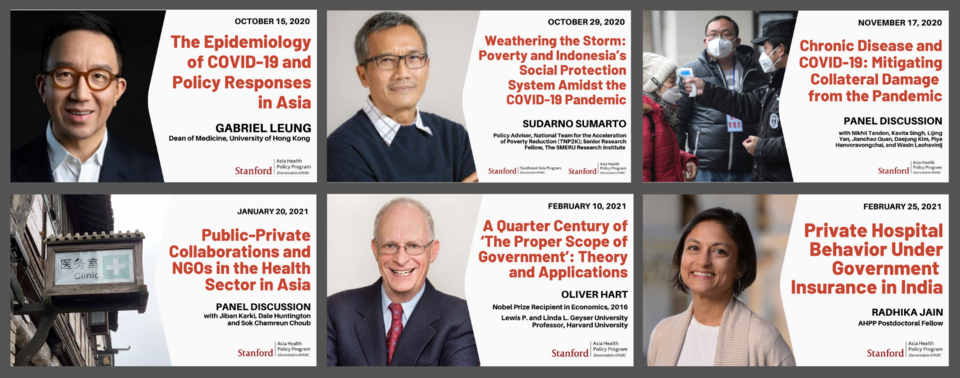
The 2020-21 Asia Health Policy Program (AHPP) colloquium series, “Health, Medicine, and Longevity: Exploring Public and Private Roles,” brings together academics, theorists, on-the-ground NGO leaders, and government advisors to explore how partnerships between public providers and private organizations affect the quality and access to healthcare the world over.

The series recently featured a keynote address by Harvard economist Oliver Hart, the 2016 co-recipient of the Nobel Prize in Economics for his work on contract theory — a framework known as ‘The Proper Scope of Government.’ Hart joined AHPP Director and APARC Deputy Director Karen Eggleston to reflect on the impact his theory has had across disciplines in the 25 years since its publication and on the future of research into contract theory. Watch the conversation with Hart below.

[Subscribe to our newsletters to stay informed on research happening at APARC.]

Oliver Hart and the ‘Proper Scope of Government’

Hart’s seminal economic theory, ‘The Proper Scope of Government,” underpins much of the research into public-private partnerships in healthcare. Hart developed this touchstone framework jointly with Andrei Shleifer and Robert W. Vishny to better evaluate when a government should provide a service itself and when it should contract with a private provider for support and execution of services.

The model outlined in Hart, Shleifer, and Vishny’s original 1996 working paper is designed to help providers and contractors consider the costs and benefits of a proposed contractual service agreement. While this model was originally applied to the case of prison privatization, the framework has served as an invaluable tool for researchers in multiple sectors including health policy and provision.

Reflections and Updates to the Theory

In reflecting on ‘The Proper Scope of Government,’ there are things Hart would like to see more fully incorporated into the theory to enrich its real-world applicability. Chiefly among these is better accounting for contractual incompleteness or the reality that a contract cannot anticipate and outline every possible unforeseen event or area of ambiguity. However, modeling contractual incompleteness is notoriously difficult given the almost-limitless factors of variability.

Some of Hart’s recent work on guiding principles responds to this challenge. Rather than trying to predict every aspect of a contractual relationship within the framing and language of a standard contract model, Hart argues that mutually agreed-upon guiding principles —such as equity, loyalty, and honesty — can serve as a foundation for navigating inevitable areas of ambiguity and potential conflict that a contract does not specifically state or that the original theory does not fully account for.

These guiding principles also help preserve space for renegotiation and innovation, which are necessary in an era of rapid technological advances and explosion of measurable data. In this context, Hart cautions against the mentality of ‘more is more:’

“If you put more and more things into the contract and then something happens that wasn’t in the contract, the fact that you put so much more in may make it more difficult to negotiate about the thing that you didn’t put in.”

 Applying ‘The Proper Scope of Government’

Hart shared a prime example of his theory at work in health systems in a case study of the Vancouver Island Health Authority. Traditionally, family physicians would continue as the primary care provider for their patients even if a patient needed hospitalization. But a change of law in 2006 required all specialized in-hospital care be contracted to hospitalists with little to no crossover with care provided by family practice physicians.

The result was a rise in caseload and stress levels amongst hospital specialists and repeated failed negotiations of the standard contract. The addition of guiding principles to the contract, however, provided avenues where reasonable solutions and additional communications could happen beyond the limits of the formal contract.

This is just one case of innumerable where Hart’s work has helped inform and contextualize how policymakers consider relationships between the public and private spheres of healthcare. Responding to the praise and input from fellow economists presented in a tribute documentary to the impact of his framework, Hart remarked:

“I hadn't realized how many people have been influenced by this paper and how they've been using it in different contexts. I knew some of the applications, but there were others I didn't, and it’s been truly amazing to see that.”

Looking Toward the Future

The tradeoffs between public and private partnerships in healthcare systems across the world will continue to be a dynamic and evolving area of research that will rely on theories such as ‘The Proper Scope of Government’ for framing and application. Looking towards the future, Hart was hopeful but cautious about the vitality of the kind of theoretical tradition which allowed for the development of his original theory. He recognizes that specialties such as contract theory and contractual incompleteness are inherently “messy” and somewhat out of vogue with current trends in economics which tend to favor theories that are “impressive, clever, and non-obvious,” regardless of whether they address important questions.

As he iterated in his Nobel Prize lecture, the incomplete world of contracts nonetheless “underlies numerous significant phenomena, some of which have great policy relevance,” and therefore fully deserving of upcoming economists’ time and efforts.

Further Research into Public-Private Partnerships

The Asia Health Policy Program’s 2020-21 colloquium series focuses on the roles and impacts of public-private partnerships in healthcare and the tradeoffs in equity, accessibility, and cost that come with contracted agreements in health systems. All of the events from the colloquium series are available on our YouTube channel. Click the thumbnails below to start exploring.

Collaborative governance — that is, relationships involving both the private and public sectors in the pursuit of public value — is part of ongoing research by Karen Eggleston. Her forthcoming book, The Dragon, the Eagle, and the Private Sector (Cambridge University Press), co-authored with Harvard’s John D. Donahue and Richard J. Zeckhauser, examines the ways in which collaborative governance works across a wide range of policy arenas in China and the United States, with the goal of empowering public decisionmakers to more wisely engage the private sector. Join us for the book launch event, which will be held jointly with the Harvard Kennedy School on March 5 


Image
Thumbnail images for the webinar events in the AHPP's 2020-21 colloquium series, "Health, Medicine, and Longevity: Exploring Public and Private Roles."

Read More

Male Japanese doctor showing senior patient records on a clipboard
News

Health Signals Increase Preventive Care, Improve Health Outcomes for Individuals at High Risk of Diabetes, Evidence from Japan Shows

Among the general population, however, researchers including Asia Health Policy Program Director Karen Eggleston find no evidence that additional care improves health outcomes.
Health Signals Increase Preventive Care, Improve Health Outcomes for Individuals at High Risk of Diabetes, Evidence from Japan Shows
An elderly individual travels in a cart up a street.
News

Researchers Develop New Method for Projecting Future Wellness of Aging Populations

Asia Health Policy Director Karen Eggleston and her colleagues unveil a multistate transition microsimulation model that produces rigorous projections of the health and functional status of older people from widely available datasets.
Researchers Develop New Method for Projecting Future Wellness of Aging Populations
A communications robot named Pepper by Softbank
Q&As

Robots May Be the Right Prescription for Struggling Nursing Homes

Karen Eggleston and Yong Suk Lee speak to the Oliver Wyman Forum on how robotics and advancing technologies are helping staff in Japanese nursing homes provide better and safer care to their patients.
Robots May Be the Right Prescription for Struggling Nursing Homes
Hero Image
[Left] A nurse assists an elderly woman in a wheel chair; [Right] Oliver Hart
The AHPP 2020-21 colloquium series explores the roles of the public and private sectors in providing equitable and accessible health services. The keynote address was given by Nobel laureate Oliver Hart.
Getty Images
All News button
1
Subtitle

In its 2020-21 colloquium series, the Asia Health Policy Program weighs the balance, benefits, and considerations in providing health services through national governments and contracting with private organizations.

Authors
News Type
News
Date
Paragraphs

The Walter H. Shorenstein Asia-Pacific Research Center (APARC) has broadened its fellowship and funding opportunities to support Stanford students working in the area of contemporary Asia. The Center introduced these expanded offerings in response to the harsh impacts of the COVID-19 pandemic on student’s academic careers and their access to future jobs and valuable work experience, and in recognition of the critical need to make the field of Asian Studies more diverse and inclusive.

APARC’s diversity grant aims to encourage Stanford students from underrepresented minorities (URM) to engage in the study and research of topics related to contemporary Asia and U.S.-Asia relations, including economic, health, foreign policy, social, political, and security issues. The grant, which was first announced in June 2020, is now an ongoing offering. APARC will award a maximum of $10,000 per grant. Current  Stanford undergraduate and graduate students in the URM category from any major or discipline are eligible and encourage to apply.

APARC also invites Stanford Ph.D. candidates specializing in topics related to contemporary Asia to apply for its 2021-22 predoctoral fellowship. Up to three fellowships are available and the application deadline is May 1, 2021.

In addition, APARC continues to offer an expanded array of research assistant internships. The Center is currently seeking highly motivated Stanford undergraduate- and graduate-level students to join our team as paid research assistant interns for the spring and summer quarters of 2021. Applications for spring 2021 research assistant assignments are due on February 22, for summer 2021 assignments on March 8.

Read More

Hero Image
Stanford campus, main quad with cloudy sky
All News button
1
Subtitle

The Center has launched a suite of offerings including a predoctoral fellowship, a diversity grant, and research assistant internships to support Stanford students interested in the area of contemporary Asia.

-

This event is part of the Asia Health Policy Program (AHPP) 2020-21 Colloquium series "Health, medicine, and longevity: Exploring public and private roles"

A quarter century ago in a seminal paper, Hart, Shleifer and Vishny (NBER1996, QJE1997) developed a theory of the ‘Proper Scope of Government.’ In this webinar, Oliver Hart, 2016 Nobel Laureate, reflects on that framework and its place in economics, as well as the inspiration for his more recent work on norms and guiding principles, contracts as reference points, maximizing shareholder welfare, and exit versus voice. In discussion with Karen Eggleston, Hart answers questions posed by economists who have built upon that paper and offers insights on how the theory applies to understanding public and private roles in healthcare, education, and other publicly-financed services. With China, India, and many other emerging markets engaged in decades-long controversies about public and private roles in their health sectors, and international focus on public-private partnerships for COVID-19 response and harnessing innovation to address other global challenges, this is an opportune time to discuss how conceptually rigorous thinking can inform a sometimes divisive and ideological debate with vital implications for human welfare.


Image
Oliver Hart 021021
Oliver Hart is currently the Lewis P. and Linda L. Geyser University Professor at Harvard University, where he has taught since 1993. He is the 2016 co-recipient of the Sveriges Riksbank Prize in Economic Sciences in Memory of Alfred Nobel, a Fellow of the Econometric Society, the American Academy of Arts and Sciences, the British Academy, and the American Finance Association, a member of the National Academy of Sciences, a Distinguished Fellow of the American Economic Association, and has several honorary degrees. Hart works mainly on contract theory, the theory of the firm, corporate finance, and law and economics. His research centers on the roles that ownership structure and contractual arrangements play in the governance and boundaries of corporations. He has published a book (Firms, Contracts, and Financial Structure, Oxford University Press, 1995) and numerous journal articles. He has used his theoretical work on firms and contracts in several legal cases. He has been president of the American Law and Economics Association and a vice president of the American Economic Association.

This keynote is part of the Stanford Asia Health Policy Program colloquium series entitled:  Health, medicine, and longevity: Exploring public and private roles

Governmental agencies and non-state actors interact within health systems in complicated and sometimes controversial ways that are vital for health and well-being. These run the gamut from developing and distributing vaccines and therapeutics for COVID-19 and mitigating the social and economic impact of the pandemic, to achieving and sustaining universal health coverage, addressing the social determinants of health, mitigating disparities, and encouraging innovations for healthy longevity, to name but a few. From the conceptual foundations to the daily reality of practitioners, this colloquium series will explore the evidence and experience of the public-private nexus in health sectors across Asia, in comparative global perspective. With colloquia throughout the academic year, the series features a keynote on February 10, 2021 from Nobel Laureate Oliver Hart, “A quarter century of ‘The Proper Scope of Government’: Theory and Applications” (dating from the 1996 NBER working paper subsequently published in the Quarterly Journal of Economics, QJE).

https://www.youtube.com/watch?v=g9JRhGpXC2Y&feature=emb_title

Via Zoom Webinar.
Register https://bit.ly/3jAvFFQ

Oliver Hart Lewis P. and Linda L. Geyser University Professor, Harvard University
Seminars
-

This event is part of the Asia Health Policy Program (AHPP) 2020-21 Colloquium series "Health, medicine, and longevity: Exploring public and private roles"

Co-sponsored by the Asia Health Policy Program and the Southeast Asia Program

Jakarta time: Friday, October 30, 2020, 7:30am - 9:00am

Apart from the 1998 Asian Financial Crisis (AFC), the current COVID-19 economic crisis is Indonesia’s most serious economic calamity in half a century with adverse impact. In March 2020, Indonesia’s poverty rate increased from 9.41% to 9.78% year on year, the equivalent of 1.28 million new people entering poverty.  By the end of 2020, it is expected that poverty rates will increase above 10%, wiping out two years of Indonesia’s poverty alleviation achievements. Social protection is key for crisis recovery. Indonesia’s social protection system has continually become stronger since the AFC. Over the past two decades, Indonesia has significantly expanded its social protection programs and coverage buttressed by a robust social registry that covers the poorest 40% of the population. The COVID-19 crisis is pushing the system to its limits. Insufficient data on Indonesians vulnerable to falling into poverty (and above the poorest 40%), coupled with response programs with complicated delivery and eligibility mechanisms, has made it challenging to deliver response-focused social protection. Dr. Sumarto will discuss whether the current social protection system is strong enough to weather the storm, especially to protect those working in the informal sector and marginal groups. Today, Indonesian policymakers have the choice to keep on following the same path and continue investing on the same social protection system, or take a radical move to reform it and make it better equipped to face future challenges.

Image
Sudarno Sumarto 102920
Sudarno Sumarto is an economist specializing in poverty reduction, social protection, labor, health, education and political economy of public policy implementation. Before joining the TNP2K, he was previously a visiting scholar at the Shorenstein Asia Pacific Research Center (APARC) at Stanford University as well as Founder and Executive Director of The SMERU Research Institute. Well-versed in leading large-scale research projects, Sudarno also provides intellectual leadership to Indonesia’s RISE country team. His research has been widely published in high-impact journals such as the Journal of Political Economy, Journal of Development Economics, and World Bank Economic Review, and has extensively contributed to policy-making by the Government of Indonesia. Sudarno earned his doctoral and master’s degrees in economics from Vanderbilt University.


Via Zoom Webinar.
Register https://bit.ly/30vi2jJ

Sudarno Sumarto Policy Adviser, National Team for the Acceleration of Poverty Reduction (TNP2K), Senior Research Fellow, The SMERU Research Institute.
Seminars
-

This event is part of the Asia Health Policy Program (AHPP) 2020-21 Colloquium series "Health, medicine, and longevity: Exploring public and private roles"

Hong Kong time: Friday, October 16, 2020, 8:00am - 9:15am

Gabriel Leung, one of Asia’s leading epidemiologists and Dean of Medicine at the University of Hong Kong, provides an update on the global pandemic and policy responses in Asia. Leung’s presentation draws on his deep experience in research and policy, including research that defined the epidemiology of three novel viral epidemics, namely SARS in 2003, influenza A(H7N9) in 2013 and most recently COVID-19. Leung also served as Hong Kong's first Under Secretary for Food and Health (2008-11) and fifth Director of the Chief Executive's Office (2011-2).

Image
Gabriel Leung 101520
Gabriel Leung is the fortieth Dean of Medicine (2013-), inaugural Helen and Francis Zimmern Professor in Population Health and holds the Chair of Public Health Medicine at the University of Hong Kong (HKU). He was the last Head of Community Medicine (2012-3) at the University as well as Hong Kong's first Under Secretary for Food and Health (2008-11) and fifth Director of the Chief Executive's Office (2011-2) in government.

Leung is one of Asia's leading epidemiologists and global health exponents, having authored more than 500 scholarly papers with an h-index of 66 (Scopus). His research defined the epidemiology of three novel viral epidemics, namely SARS in 2003, influenza A(H7N9) in 2013 and most recently COVID-19. He led Hong Kong government's efforts against pandemic A(H1N1) in 2009. He was founding co-director of HKU's World Health Organisation (WHO) Collaborating Centre for Infectious Disease Epidemiology and Control (2014-8) and currently directs the Laboratory of Data Discovery for Health at the Hong Kong Science and Technology Park (2020-).

Leung regularly advises national and international agencies including the World Health Organisation, World Bank, Asian Development Bank, Boao Forum for Asia, Institut Pasteur, Japan Center for International Exchange and China Centers for Disease Control and Prevention. He is an Adjunct Professor of Peking Union Medical College Hospital and Adjunct Professorial Researcher of the China National Health Development Research Center.

He edited the Journal of Public Health (2007-14), was inaugural co-editor of Epidemics, associate editor of Health Policy and is founding deputy editor-in-chief of China CDC Weekly. He currently serves on the editorial boards of seven journals, including the British Medical Journal.    

He is an elected member of the US National Academy of Medicine.

Via Zoom Webinar

Register at https://bit.ly/33jLhGO

Gabriel Leung Dean of Medicine, University of Hong Kong
Seminars
Subscribe to Society