Health policy
Authors
News Type
Q&As
Date
Paragraphs

This is the first installment in a series leading up to the publication of Fateful Decisions.

China has tremendous resources, both human and financial, but it may now be facing a perfect storm of challenges. Its future is neither inevitable nor immutable, and its further evolution will be highly contingent on the content and efficacy of complex policy choices.

Image
Fateful Decisions: Choices That Will Shape China's Future
This is the core argument in a new volume, Fateful Decisions: Choices that Will Shape China’s Future, edited by Shorenstein APARC Fellow Thomas Fingar and China Program Director Jean Oi. Forthcoming in May 2020 as part of Stanford University Press monograph series with APARC, this volume combines the expertise of researchers from across the disciplines of sociology, history, economics, health policy, and political science, who examine the factors and constraints that are likely to determine how Chinese actors will manage the daunting challenges they now face.

One of these challenges — how China must soon achieve economic growth as it grapples with the realities of a rapidly aging population and a shrinking workforce — is the subject of a chapter authored by Karen Eggleston, the deputy director of APARC and director of the Center’s Asia Health Policy Program. In the following interview, Eggleston shares perspectives from her chapter, “Demographic Challenges.”

[To get more stories like this delivered to your inbox, sign up for our newsletters]


Q: What are some of the fateful decisions China is facing regarding the responsibilities of caring for a large, aging population?

A: China has achieved impressive improvements in health and longevity. It has implemented universal health coverage and is experimenting with financial support for long-term care for older adults. Yet significant gaps between the most- and least-privileged Chinese citizens persist, and in some cases are growing. As I have written elsewhere, it is not surprising that there are wide disparities in health and healthcare between different population subgroups in a country as populous, expansive, and diverse as China. How effectively and efficiently China meets these and other health- and aging-related issues will have a major impact on its ability to manage other social and economic challenges.

In the chapter I contributed to the volume Fateful Decisions, I note that China’s current population and demographic trends — including relatively rapid aging — reflect the success of earlier investments in infectious disease control, public health measures, and other contributors to mortality reduction. The lingering effects of family planning policies, historic preferences for sons, and rapid economic development are also major considerations. Together, these factors have produced a shrinking working-age population, a growing number of elderly, a gender imbalance, and hurdles for inclusive urbanization. An urgent question for China’s future is to what extent policies will ameliorate disparities in health, healthcare use, and the burden of medical spending.

The unfolding COVID-2019 outbreak is a powerful illustration of just how fateful decisions about health systems can be. Compared to the SARS outbreak almost two decades ago, China has been better prepared for this situation. SARS raised health system reform to the top of the political agenda and, many argue, played a direct role in China’s achieving universal health coverage and vastly strengthening the public health system.

But as China has become a middle-income global economic powerhouse in the years since SARS and the ensuing wave of health policy reforms, the expectations of its citizens about their health system have also risen. Has the health system, including public health and medical care, been strengthened to the same degree as other parts of the economy and public services? The impact of and lasting response to COVID-2019 may prove a litmus test.

Q: Why do these decisions about health carry such importance for China’s future development?

Through the last four decades, China has benefitted from a demographic dividend caused by the large bulge in the working-age population. But to achieve future economic growth and productivity, investments in human capital particularly in health and education —need to be made. This higher productivity will, in turn, be the means by which a smaller workforce can support China’s large and growing cohort of retirees.

As we’ve already seen, health expenditures have increased rapidly as China has developed its system of universal health coverage. Double-digit health spending growth surpassed the rate of economic growth, and as a result, health spending absorbs an increasingly larger share of the total economy. China needs to make sure additional spending on health and elderly care is efficient and effective, while also addressing the nonmedical determinants of health and promoting healthy aging. The health system needs to be reengineered to emphasize prevention, provide coordinated health care for people with multiple chronic diseases, assure equitable access to rapidly changing medical technologies, and ensure long-term care for frail elderly, all without unsustainable increases in opportunity costs for China’s future generations.

Q: What is the Chinese government doing to improve healthcare quality and delivery, and what more could it do to affect meaningful change in its systems?

China’s current policies seek to balance individual responsibility, community support, and taxpayer redistribution through safety-net coverage funded by central and local governments. Like many countries, China would benefit from improved coordination across multiple agencies and structure incentives to avoid or mitigate unintended consequences that undermine the goals of its health system. Recent governance reforms, such as the creation of the National Healthcare Security Administration, aim to address these challenges.

China’s achievements and remaining challenges can be illustrated with the Healthcare Access and Quality Index (HAQ), which measures premature mortality from causes that should not occur if the individual had access to high-quality healthcare: among 195 countries and territories, China achieved the highest absolute increase in the HAQ Index from 2000 to 2016. However, the 43-point regional disparity in HAQ within China is the equivalent of the difference between Iceland (the highest HAQ in the world) and North Korea.

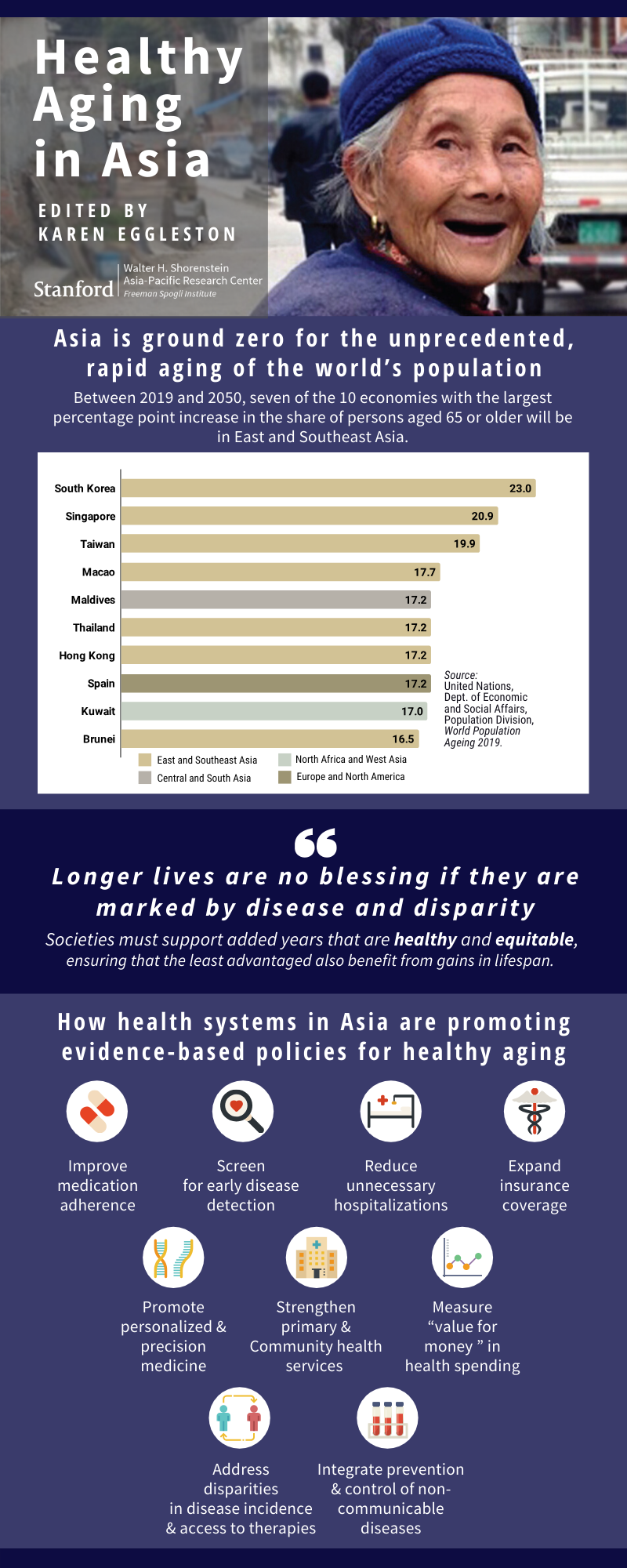
Q: The subject of your chapter, China’s demographic challenges, is one of the issues you investigate in your upcoming book, Healthy Aging in Asia. As you show in this volume, challenges at the intersection of aging, economics, demographic transition, and healthcare policy are not unique to China. How are other countries in Asia responding to them and what lessons could benefit China?

 As I note in the introduction of Healthy Aging in Asia, the demographic transition from high to low fertility and mortality has been more rapid in much of Asia than in Europe and North America. That means social institutions, such as retirement, living arrangements, and intergenerational support, have to adapt quickly. For example, extending work-lives (as is happening in Japan) will be necessary but feasible only if the added years are healthy ones and equitable only if the least advantaged also benefit from healthy aging. The blessings of longevity dim when clouded by pain, disability, and loss of dignity.

 Investment strategies in insurance and managing chronic conditions are also important considerations. Japan and Korea have adopted insurance systems for financing long-term care for frail elderly, while places like Hong Kong have good empirical research on chronic condition management.

 No country or system has a “magic pill” to address these challenges, but the empirical evidence and rich policy experience documented in Healthy Aging from health systems as diverse as those in the cities of Singapore and Hong Kong to large economies such as Japan, India, and China can certainly be instructive.

Hero Image
Elderly Chinese citizens sit together on a park bench. Getty Images
All News button
1
Authors
News Type
Q&As
Date
Paragraphs

Updated January 24
Millions of residents in China are under lockdown measures as the number of reported deaths from the coronavirus outbreak rises to 26. In the United States, dozens of people are being monitored for the virus. The World Health Organization on January 23 said at a press conference the outbreak did not yet constitute a global public health emergency.


The outbreak of a novel coronavirus that began in December 2019 in Wuhan, China “is evolving and complex,” said the head of the World Health Organization (WHO) after its emergency committee convened on Wednesday, January 22, and decided that more information was needed before the WHO declares whether or not the outbreak is a public health emergency of international concern. The new virus, known as 2019-nCoV, causes respiratory illness and continues to spread across China. Chinese health authorities, reports the Washington Post, announced that at least 17 people have now died as a result of infection and confirmed cases have been reported in Japan, Thailand, South Korea, Hong Kong, and Macao, with one travel-related case detected in the United States, in the State of Washington. The WHO decision was made as the city of Wuhan shut down all air and train traffic to try to contain the spread of the virus.

With concern over and coverage of the situation rapidly developing, Karen Eggleston, APARC Deputy Director and the Asia Health Policy Program Director at the Shorenstein Asia-Pacific Research Center, offered her insights on the outbreak and its impact on both Asian and international healthcare systems.

Q: Why has this outbreak raised so much concern in China and internationally, and how worried should people be about it?

Infectious disease outbreaks can challenge any health system. Events such as SARS, Ebola, and MERS outbreaks, and even the devastating flu pandemic a century ago, remind us of the frightening power that infectious diseases with high-case fatality can have. The global burden of mortality and morbidity is mostly from non-communicable chronic diseases, but no country or society is immune to old, newly emerging, and re-emerging infectious diseases. And although health systems are generally stronger now and have more technologies to trace and contain outbreaks, there are also deep and complicated challenges that make swift, coordinated disease response difficult even in the modern era.

Any government leadership or healthcare responders who have tried to manage an outbreak situation before are hyper-aware of the need to prepare for and manage future incidents, but we are living in a moment of very complicated social dynamics surrounding public health and healthcare. Distrust in drug companies and government agencies, controversies over vaccines, and increasing skepticism in science, even if only from vocal minorities, all make it more difficult to manage a cohesive international response to an outbreak situation and protect vulnerable people.

Q: As you’ve mentioned, many people looking at this situation with the memory of outbreaks such as SARS or H1N1 in mind. How is the Chinese government addressing this crisis and how does its reaction compare with China’s history of emergency health responses?

China’s health system is much more prepared now, compared to the SARS crisis 17 years ago. More training and investment in primary health care, disease surveillance and technology systems for tracking and monitoring outbreaks, and the achievement of universal health coverage with improving catastrophic coverage even for the rural population, all suggest a health system that is much better prepared to handle a situation like this. Top-level leadership in China had already begun to publicly address the situation within days of the outbreak to assure the public that strict prevention measures will be taken and to urge local officials to take responsibility and share full information. Until more information is gained and more is understood about the nature of this virus, it’s been categorized as a “Grade B infectious disease” but will be managed as if it is a "Grade A infectious disease," which requires the strictest prevention and control measures, including mandatory quarantine of patients and medical observation for those who have had close contact with patients, according to the commission. China currently only classifies two other diseases as Grade A infection diseases—bubonic plague and cholera—and so that tells you something about how seriously this is being treated by those in leadership positions.

Q: And what about the response from the international health communities?

As with any major healthcare crisis, health systems around the globe must also respond with alacrity and integrity, including effective surveillance, monitoring, and infection control. Individuals also play a crucial role in supporting the instructions and recommendations made by established healthcare professionals. For example, the individual with the confirmed case in Washington State proactively told medical personnel about his recent visit to the Wuhan area. His medical providers then exercised appropriate levels of caution, given the unknown nature of the virus, and isolated him while his symptoms developed. He is currently combatting an infection similar in severity to that of mild pneumonia, and so far no other cases have been reported in the United States, though some may arise in the coming days and weeks.

There is always a fine balance between safeguarding public health while still respecting individual rights, civil liberties, and undertaking a prudent, scientific response. The aim is to remain clear and transparent in communications and actions without reverting to disproportionate or overly aggressive responses which lead to panic, distortion, and misinformation about the situation. Some countries, like the Democratic People’s Republic of Korea, may choose to seal their international borders until more is understood about the nature of this virus, but most nations will use tried-and-tested methods of monitoring travelers and alerting population health systems so that information about cases is widely available to health authorities and medical researchers trying to understand the cause and develop a potential cure.

Q: As this situation continues to develop, and with inevitable future disease outbreaks around the globe, what would you hope people keep in mind about the role we all play in healthcare crises and in public health?

One issue this outbreak reminds us of in a visceral and intimate way is how closely people are linked together across the world. Globalization and air travel almost instantaneously link continents, countries, and regions. The timing of this outbreak is particularly fraught, because it’s the beginning of the Lunar New Year, when there is a vast migration of people both within China, throughout greater Asia, and across the globe as massive populations go home to celebrate the holidays with family. The potential for a contagious disease to spread easily through crowds and across borders in circumstances like this is very high, and highlights the need for the international communities to share information, scientific expertise, and understanding.

We need to remember that this is not just a problem in a remote part of the world that has no impact on those of us who live in relative comfort in high-income countries. Rather, this is something that could easily impact anyone. Perhaps this latest outbreak and response will showcase how vital additional, ongoing investments in both domestic and international healthcare systems, technologies, and people are.

Hero Image
Security personnel check the temperature of passengers in the Wharf at the Yangtze River on January 22, 2020 in Wuhan, Hubei province, China.
Getty Images
All News button
1
Shorenstein APARCStanford UniversityEncina Hall E301Stanford, CA 94305-6055
0
Visiting Scholar at APARC
Winter 2020
Ph.D.

Kavita Singh joined the Walter H. Shorenstein Asia-Pacific Research Center (APARC) for the winter quarter of 2020 as a visiting scholar from the Public Health Foundation of India, where she serves as a research scientist at the Centre for Chronic Conditions and Injuries.  At APARC, she will be working with Dr. Karen Eggleston conducting research on diabetes management and health economics in South Asia.

Paragraphs

In Live Long and Prosper?, a new eBook edited by David Bloom, AHPP director Karen Eggleston contributes the chapter "Understanding 'Value for Money' in Healthy Ageing," in which she advocates for and explains the concept of "net value of medical care," a metric that helps quantify the social value of spending on healthcare. Understanding value for money, Eggleston writes, is a way of "determining which services and technologies are unnecessary and which are of high value," a determination that is of increasing importance for aging societies, in which "spending for chronic diseases represents a large and increasing part of public and private budgets." 

All Publications button
1
Publication Type
Books
Publication Date
Authors
News Type
News
Date
Paragraphs

Southeast Asia, home to over 640 million people across 10 countries, is one of the world’s most dynamic and fastest growing regions. APARC just concluded the year 2019 with a Center delegation visit to two Southeast Asian capital cities, Hanoi and Bangkok, where we spent an engaging week with stakeholders in the academic, policy, business, and Stanford alumni communities.

Led by APARC Director Gi-Wook Shin, the delegation included APARC Deputy Director and Asia Health Policy Program Director Karen Eggleston, Southeast Asia Program Director Donald Emmerson, and APARC Associate Director for Communications and External Relations Noa Ronkin. Visiting Scholar Andrew Kim joined the delegation in Bangkok.

With a focus on health policy, our first day in Hanoi included a visit to Thai Nguyen University, a meeting with government representatives at the Vietnam Ministry of Health, and a seminar on healthy aging and innovation jointly with Hanoi Medical University.

Image
Collage of four images showing participants at a roundtable held at Hanoi Medical University with APARC delegation members

Karen Eggleston and participants at the roundtable held at Hanoi Medical University, December 9, 2019.

Throughout the day, Eggleston presented some of her collaborative research that is part of two projects involving international research teams: one that assesses public-private roles and institutional innovation for healthy aging and another that examines the economics of caring for patients with chronic diseases across diverse health systems in Asia and other parts of the world. We appreciated learning from our counterparts about the health care system and health care delivery in Vietnam.

Shifting focus to international relations and regional security, day 2 in Hanoi opened with a roundtable, “The Rise of the Indo-Pacific and Vietnam-U.S. Relations,” held jointly with the East Sea Institute (ESI) of the Diplomatic Academy of Vietnam (DAV). Following a welcome by ESI Director General Nguyen Hung Son, the program continued with remarks by Shin, Emmerson, ESI Deputy Director General To Anh Tuan, and Assistant Director General Do Thanh Hai.

Image
Participants at a roundtable held at the Diplomatic Academy of Vietnam with APARC delegation members

Roundtable at the Diplomatic Academy of Vietnam, December 10, 2019.

The long-ranging conversation with DAV members included issues such as the future of the international order in Asia; the U.S. withdrawal from multilateralism; the concern about a lack of U.S. engagement in Southeast Asia, sparked by President Trump’s absence from the November 2019 summit of the Association of Southeast Asian Nations (ASEAN) at a time when China is bolstering its influence in the region and when ASEAN hopes to set a code of conduct with China regarding disputed waters in the South China Sea; the priorities for Vietnam as it assumes the role of ASEAN chair in 2020; and the challenges for the Vietnam-U.S. bilateral relationship amid the changing strategic environment in Southeast Asia.

In the afternoon we were joined by members of the American Chamber of Commerce in Hanoi at an AmCham-hosted Lunch ‘n’ Learn session on Vietnam's challenges and opportunities amid the U.S.-China rivalry. The event featured Emmerson in conversation with AmCham Hanoi Executive Director Adam Sitkoff.

Image
Two men in conversation seated on stage and a man speaking at a podium

(Left) Donald Emmerson in conversation with Adam Sitkoff; (right) Gi-Wook Shin welcomes AmCham Hanoi members; December 10, 2019. 

Moving to Bangkok, delegation members Shin, Eggleston, Emmerson, and Kim spoke on a panel for executives of the Charoen Pokphand Group (C.P. Group), one of Thailand’s largest private conglomerates, addressing some of the core issues that lie ahead for Southeast Asia in 2020 and beyond in the areas of geopolitics, innovation, and health.

Image
Participants at a panel discussion with APARC delegation hosted by the C.P. Group, Thailand

Top, from left to right: Gi-Wook Shin, Karen Eggleston, Andrew Kim; bottom: C.P. Group executive listening to the panel, December 12, 2019.

We also enjoyed a tour at True Digital Park, Thailand’s first startup and tech entrepreneur’s campus. Developed by the C.P. Group, True Digital Park aspires to be an open startup ecosystem that powers Thailand to become a global hub for digital innovation.

The following day, Shin and Emmerson participated in a public forum hosted by Chulalongkorn University’s Institute of Security and International Studies (ISIS Thailand), "Where Northeast Asia Meets Southeast Asia: The Great Powers, Global Disorder and Asia’s Future.” They were joined by ISIS Thailand Director Thitinan Pongsudhirak and Chulalongkorn University Faculty of Political Science Associate Dean for International Affairs and Graduate Studies Kasira Cheeppensook. The panel was moderated by Ms. Gwen Robinson, ISIS Thailand senior fellow and editor-at-large of the Nikkei Asian Review.

Image
Panelists and participants at a public forum held at Chulalongkorn University

ISIS Thailand forum participants and panelists, from left: Pngsukdhirak, Shin, Robinson, Emmerson, Cheeppensook; December 13, 2019.

As part of that discussion, Emmerson speculated that – driven by deepening Chinese economic and migrational involvement in Southeast Asia’s northern tier – Cambodia and Laos, less conceivably Myanmar, and still less conceivably Thailand could become incorporated de facto into an economically integrated “greater China” that could eventually reduce ASEAN to a more-or-less maritime membership in the region’s southern tier. Emmerson’s speculation was made in the context of his critique of ASEAN’s emphasis on its own “centrality” to the neglect of its lack of the proactivity that would serve as evidence of centrality and of a desire not to be rendered peripheral by the growing centrality-cum-proactivity of China. The event was covered by the Bangkok Post (although that report’s headline and quote of Emmerson are inaccurate, as neither the panel nor Emmerson predicted the “break-up of ASEAN.”)

Our delegation visit in Bangkok concluded with a buffet dinner reception and panel discussion jointly with the Stanford Club of Thailand.

Image
alumni event

Stanford and IvyPlus alumni listening to the panel, December 13, 2019.

Moderated by Mr. Suthichai Yoon, a veteran journalist and founder of digital media outlet Kafedam Group, the conversation focused on the changing geopolitics of Southeast Asia, innovation and health in the region, and the opportunities and challenges facing Thailand-U.S. relations. It was a pleasure to meet many new and old friends from the Stanford and IvyPlus alumni communities.

APARC would like to thank our partners and hosts in Hanoi and Bangkok for their hospitality, collaboration, and the stimulating discussions throughout our visit. We look forward to keeping in touch!

Hero Image
APARC delegation speaking to Stanford and IvyPlus alumni, Bangkok
All News button
1
Authors
Lisa Lee
News Type
News
Date
Paragraphs

Jointly with partners throughout Asia, the Asia Health Policy Program (AHPP) at Shorenstein APARC has developed comparative research on health care use, medical spending, and clinical outcomes for patients with diabetes in the region and other parts of the world as a lens for understanding the economics of chronic disease management. Karen Eggleston, AHPP director and APARC deputy director, recently traveled to South Korea, where she led three project-related events.

On November 29, a workshop on Net Value Diabetes Management was held at Seoul National University (SNU) School of Medicine. This was the third such workshop convened through the project, following two previous ones held in Beijing at the Stanford Center at Peking University. Another workshop, on diabetes modeling, hosted by the Mt. Hood Diabetes Challenge Network, was held at Chung Ang University on December 1. Finally, on December 5, Eggleston held an information session, titled Comparative Economics Research on Diabetes, during the 2019 International Diabetes Federation (IDF) at BEXCO in Busan. These events were also made available through video conferencing to enable remote participation by collaborators who were unable to travel to Korea.

[Learn more about AHPP’s Net Value in Diabetes Management research project]

Diabetes Net Value Workshop

The workshop brought together team members from multiple health systems — including South Korea, Japan, Taiwan, Hong Kong, Thailand, India, the Netherlands, and the United States — to discuss comparative research on the economics of diabetes control. Eggleston shared the results of a study outlined in a working paper on the net value of diabetes management in Japan, the Netherlands, Taiwan, and Hong Kong. This research is part of a broader series of studies aimed to help address the policy challenge of finding the best strategies to improve health through cost effective prevention and healthcare productivity in chronic disease management.

The key to this research was to measure changes in quality or health outcomes over time by predicting mortality risk using blood pressure, blood sugar, and other factors amenable to patient and provider control and improvement (controlling for age and duration of diabetes diagnosis). The research seeks to understand how we can control cost and eliminate waste without cutting out the things that are valuable and improving people’s quality of life. Further studies probe determinants of relative net value of a pay-for-performance program in Taiwan, adherence to medications and vertical integration in Japan, and net value based on a randomized controlled trial in India.

Image
Two women and three men talking with each other in a conference room

Karen Eggleston (left) with workshop participants.

Young Kyung Do of SNU reported that according to his evaluation project for diabetes care, the quality of care and treatment in South Korea has improved and is similar to Hong Kong and Singapore. The goal of the program is to provide more comprehensive care to diabetes patients.

Talitha Feestra of the Netherlands net value team presented her proposal for joint research to develop new prediction models for specific populations as a core component of health economics decision models in Diabetes. Feestra will take the lead to develop the plan and time frame for the continuation of this research in 2020.

Several additional comparative studies were proposed and discussed. Participants who attended the workshop and contributed to discussion included Junfeng Wang from the Netherlands net value team; Jianchao Quan and Carmen Ng from Hong Kong University; Daejung Kim from the Korea Institute for Health and Social Affairs (KIHASA); Taehoon Lee, Eun Sil Yoon, and Hongsoo Kim from SNU; Piya Hanvoravongchai from Chulalongkorn University; and Gregory Ang from National University of Singapore. Remote participants included Vismanathan Baskar from Madras Diabetes Research Foundation; Wasin Laohavinij from Chulalongkorn University (visiting Stanford University autumn quarter); and Rachel Lu from Chang Gung University.

Mt. Hood Diabetes Challenge Workshop on Diabetes Modeling

Philip Clarke from the Health Economics Research Center, University of Oxford, presented the history of insulin as a cure for diabetes and discussed in detail methods for economic modeling of diabetes, including quality of life and diabetes cost, drawing from his rich experience developing the UK Prospective Diabetes Study outcomes model. The second presenter was Andrew Palmer of University of Tasmania, Australia. His presentation included many additional economic modeling pointers, especially regarding drawing in the literature for building models.

Image
Collage of three photos showing people posing to the camera and seated in a lecture hall

Karen Eggleston with participants at the Mt. Hood Diabetes Challenge Workshop; (right hand side) from left to right: Andrew Palmer, Karen Eggleston, Philip Clarke.

We are grateful to Professors Clarke and Palmer for graciously allowing the AHPP network researchers to join the workshop both in person and remotely, adding to their chronic disease modeling skills, and for inviting Karen Eggleston to present a keynote at the Mt Hood conference that took place before the modeling workshop.

Information Session: Comparative Economics Research on Diabetes

The third and final component of the diabetes research events was held on December 5 as part of the International Diabetes Federation congress in Busan, Korea, and presented the network to clinicians and public health researchers. Participants from China, India, and Australia attended. They shared updates on their individual projects and discussed methods and ideas for future collaboration.

Hero Image
A group of people posing to the camera
All News button
1
Authors
News Type
News
Date
Paragraphs

Using a dynamic microsimulation model, a research team, including APARC Deputy Director and Asia Health Policy Program Director Karen Eggleston, shows that there are differentially positive health gains of smoking reduction among subgroups of smokers in South Korea, Singapore, and the United States.

Tobacco use is responsible for the death of approximately eight million people worldwide, estimates the World Health Organization, and countries are increasingly making tobacco control a priority. Indeed the relationship between smoking and the burden of chronic diseases such as cancer, lung disease, and heart disease, and, in turn, premature mortality, is well documented. Yet little is known about the health effects of smoking interventions among subgroups of smokers.

Do interventions targeted at heavy smokers relative to light smokers lead to disproportionately larger improvements in life expectancy and prevalence of chronic diseases? And how do these effects vary across populations? In today’s rapidly aging world, it is crucial to understand the potential health gains resulting from interventions to reduce smoking, a leading preventable risk factor for healthy aging.

That’s why a research team, including APARC Deputy Director and Asia Health Policy Program Director Karen Eggleston as well as Stanford Health Policy faculty member Jay Bhattacharya, set out to examine the health effects of smoking reduction. To do so, the team simulated an elimination of smoking among subgroups of smokers in South Korea, Singapore, and the United States.

[To receive more stories like this directly to your inbox subscribe to our newsletters.]

The team’s findings, discussed in a new paper published by the journal Health Economics, show that smoking reduction can achieve significant improvements in lifetime health as measured by survival while also reducing the prevalence of major chronic diseases, though the effects are heterogeneous. Whereas interventions in both subgroups and in all three countries led to an increased life expectancy and decreased prevalence of chronic diseases, the life-extension benefits were greatest – 2.5 to 3.7 years – for those who would otherwise have been heavy smokers, compared with gains of 0.2 to 1.5 years among light smokers.

The team developed a dynamic microsimulation model to estimate the health gains of reducing smoking among heavy smokers and light smokers. Microsimulation models are powerful tools for assessing the value of health promotion: they model individual health trajectories while accounting for competing risks, thus providing valuable information about the impact of interventions and how they may interact with the changing demographics and socioeconomic profile of a population to determine future health. The team’s study applied microsimulation models tailored to the demographic and epidemiological context in the three countries, then compared the gains in survival and reduction in chronic disease prevalence from a given reduction in smoking and how these impacts vary depending on initial smoking intensity.

The team’s findings indicate that there are differentially positive health effects from smoking reduction. The life‐year gain among heavy smokers quitting well exceeds that of light smokers quitting in each country, but the magnitudes differ substantially: 11.2 times for South Korea, 6.8 times for Singapore, and 1.7 times for the United States. The lower life expectancy among Americans is related to the greater extent in which they suffer from risk factors, such as obesity, relative to the Asian counterparts in the study.

The findings illustrate how smoking interventions may have significant economic and social benefits, especially for life extension, that vary across countries. They are particularly important for aging societies that are concerned about the sustainability of their health insurance systems in the face of increasing burden of chronic disease.

Hero Image
A man smokes in the street in Seoul, South Korea. Chung Sung-Jun/ Getty Images
All News button
1
Paragraphs

In the 2019 fourth quarter edition of the Milken Institute Review, Asia Health Policy Program director Karen Eggleston discusses the progress China has made since the 2009 reforms to its healthcare, which brought basic coverage to all and reduced patients' share of costs, and explains the many challenges that remain, including increasing the system's efficiency to ensure its sustainability and addressing the disparities in healthcare that echo the "yawning gap in living standards between China's rising middle class and its poorest citizens."

All Publications button
1
Publication Type
Journal Articles
Publication Date
Journal Publisher
Milken Institute Review
Authors
News Type
News
Date
Paragraphs

Understanding the value of chronic disease care is critical to confronting the challenges of aging societies. In a new ebook published by the Centre for Economic Policy Research, APARC Deputy Director and Asia Health Policy Program Director Karen Eggleston provides a framework for assessing the social value of health spending.

The world population is aging faster than ever before and governments must confront the increasing burden of healthcare spending on their economies. At a time when the economics of aging is inseparable from the economics of healthcare, successful adaptations to older population age structures necessitate better understanding of the value of medical care. Policymakers, in particular, must incorporate value into considerations of healthcare cost growth, so they can determine the extent to which average health improvements offset added cost, reduce cases in which health spending rises without sufficient corresponding health outcomes, and reward those in which “we are getting what we pay for.”

A new book chapter, authored by APARC Deputy Director and Asia Health Policy Program Director Karen Eggleston, provides a framework for assessing the social value of health spending. Titled “Understanding ‘value for money’ in healthy aging,” the chapter is part of an ebook, Live Long and Prosper? The Economics of Ageing, published by the Centre for Economic Policy Research (CEPR).

[To receive more stories like this directly to your inbox subscribe to our newsletters.]

Quality-Adjusted Cost of Care

How do health economists incorporate value into measurements of health spending and how do they measure the social value of medical care? First they assume each additional year of life brings a given monetary value. Then they measure the growth in value to patients as monetized gains in “quality-adjusted life-years,” a metric that includes increases in life expectancy and quality of life. The difference between the change in health spending and the change in monetized gains on improved survival is the net change in quality-adjusted health spending or the net value of medical care.

Understanding the value of chronic disease care is especially critical in aging societies, as governments must transform their health systems to support patients who will live with chronic diseases for decades. Health benefits of medical care, however, are difficult to aggregate across disparate services and diseases, and hence focusing on management of a single important chronic disease allows researchers to develop metrics of quality improvement and value that are linked to rigorous clinical studies. Eggleston describes a recent international research collaboration, which she was part of, that did just that. The researchers studied quality adjustment for one disease of growing global prevalence, type 2 diabetes, in four different health systems: one in Europe (the Netherlands) and three in East Asia (Japan, Hong Kong, and Taiwan).

Results of the study suggest that, in each health system, the value of improved survival outweighs the increase in health spending. For example, in the case of Japan, Eggleston and her colleagues found a positive value net of $2,595 for $100,000 value of a life-year. They also compared net value across the four health systems and different patient samples, finding mean net value that ranged between $600 and $10,000 for a $100,000 value of a life-year. Moreover, net value was positive for all age groups and remains positive and significant for individuals well beyond traditional retirement ages. These results, says Eggleston, indicate “the importance of continuing investments in medical treatments and services that deliver health outcomes of commensurate or higher value.”

Policy Implications

Confronting the challenges of aging societies requires careful thinking about the value of investments in new technologies for managing chronic conditions. To promote healthy aging governments must be “resiliently persistent in measuring the value of innovations for healthy aging and rewarding those that deliver high net value,” argues Eggleston. The goal should be improving the “value for money” of medical care rather than applying largescale cost controls that might stifle important breakthroughs.

The four-system study by Eggleston and her colleagues provides a framework for developing methods for assessing quality improvement and the net value of chronic disease spending and, more broadly, for measuring the value of healthy aging.


Download Eggleston’s chapter as part of the entire ebook >>

Learn more about Dr. Karen Eggleston’s research agenda seeking to assess net value in diabetes management and to identify and analyze innovation for healthy aging.

Hero Image
Closeup on a hand of an old man.
All News button
1
Authors
News Type
News
Date
Paragraphs

In a new article published by the Milken Institute Review, APARC Deputy Director and Asia Health Policy Program Director Karen Eggleston offers an overview of the successes of China’s health reforms and the challenges ahead if the country is to increase the efficiency of health care delivery as it expands quality and usage.

Creating a high-quality universal health care system is an immense challenge anywhere, let alone in a country as large and diverse as China. But equal access to care will become ever more important as China converges on higher incomes, slower economic growth, population aging, and dependence on a skilled workforce to approach OECD living standards. With its health reforms over the past two decades, its growing technological prowess, and its application of innovative business models, China has made significant progress towards supporting higher-quality and more convenient health care for its 1.4 billion people. However, it is yet to deal with a host of challenges.

In a new article, Healing One-Fifth of Humanity, published in fall quarter 2019 of the Milken Institute Review, APARC Deputy Director and Asia Health Policy Program Director Karen Eggleston offers a progress report on China’s efforts to provide decent health care to all of its citizens, detailing how the reforms are working and what is left to do.

[To get more stories like this delivered directly to your inbox sign up to receive our newsletters.]

A Tale of Two Chinas

One complex challenge China faces is addressing the gap in living standards between its rising middle class and its poorest citizens. Eggleston’s research shows stark gaps between urban and rural China in multiple measures, including life expectancy (almost 10 years differences as of 2013), infant mortality, and under-age-5 mortality. Health outcomes differ along other dimensions, too — between urban regions with higher and lower per capita income and among individuals with more or fewer years of schooling.

There are also striking inequalities in the burden of chronic disease and in health care and risk protection. For example, diabetes is associated with greater excess mortality in rural China, although prevalence is higher in urban areas. Moreover, although China has attained universal health coverage and put in place policies to enhance access while decreasing households’ out-of-pocket spending burden, the coverage of rural insurance is less generous than coverage for urbanites. Therefore, the prospect of catastrophic medical spending on delayed care remains substantially higher for rural than urban residents.

Additional challenges abound in multiple other areas, from addressing patient-provider tensions and trust, to changing provider incentives to promote value rather than volume, to deciding which new medical therapies qualify as basic. In broad terms, argues Eggleston, “China must build an infrastructure that increases the efficiency of health care delivery as it expands quality and usage.”

An important issue is the extent to which leveling public policy will ameliorate disparities, even as an array of social and economic forces push to widen disparities in health, health care use and burden of medical spending over a lifetime. The good news, says Eggleston, is that the process of catching up on one critical component of social justice, that is, universal health care, has begun, and there is evidence suggesting “that health investments can narrow the gaps in outcomes by compensating for health disadvantages.” There is also good reason to believe that policies that go beyond direct medical intervention – notably, investments in the quantity and quality of schooling – can have even greater influence on health and survival than access to medical care.

“The challenge now,” concludes Eggleston, “is to persist in an endeavor that requires flexibility, sensitivity to competing interests — and lots and lots of money.”


Hero Image
Young patients receive treatment at Chongqing Children's Hospital in Chongqing Municipality, China.
China Photos / Getty Images
All News button
1
Subscribe to Health policy