FSI researchers strive to understand how countries relate to one another, and what policies are needed to achieve global stability and prosperity. International relations experts focus on the challenging U.S.-Russian relationship, the alliance between the U.S. and Japan and the limitations of America’s counterinsurgency strategy in Afghanistan.
Foreign aid is also examined by scholars trying to understand whether money earmarked for health improvements reaches those who need it most. And FSI’s Walter H. Shorenstein Asia-Pacific Research Center has published on the need for strong South Korean leadership in dealing with its northern neighbor.
FSI researchers also look at the citizens who drive international relations, studying the effects of migration and how borders shape people’s lives. Meanwhile FSI students are very much involved in this area, working with the United Nations in Ethiopia to rethink refugee communities.
Trade is also a key component of international relations, with FSI approaching the topic from a slew of angles and states. The economy of trade is rife for study, with an APARC event on the implications of more open trade policies in Japan, and FSI researchers making sense of who would benefit from a free trade zone between the European Union and the United States.
Writing recently for the Center for Strategic International Studies (CSIS), Stanford scholar Donald Emmerson analyzed China’s stance on the South China Sea in the context of remarks given by Chinese State Councilor Yang Jiechi at a bilateral dialogue in Washington, D.C. on June 24.
In the past year, China has unsettled many countries with its island-building campaign in the disputed South China Sea, an area that has multiple claimants and whose waters are heavily used for international trade and commerce. Johnson South Reef, for example, is being enlarged and turned into what could be a military base. At the same time, China’s leaders continue to disregard rising demands to clarify their intentions in the South China Sea.
In the CSIS article, Emmerson offered an “edited" version of Yang’s statement to provide one reading of its “useful ambiguity” for China.
Emmerson said China’s participation is inevitably required to resolve the maritime disputes. But his reading of Yang’s remarks is not encouraging in that respect, as China behaves more and more as if it were part of the problem not the solution.
U.S. Secretary of State John Kerry listens as Chinese State Councilor Yang Jiechi delivers remarks at the Strategic Track Oceans Meeting in Washington, D.C., on June 24, 2015. | Flickr/U.S. Department of State
The United Nations has thus far fulfilled its charter to prevent a third world war, but with 60 million refugees, continued bloodshed with unresolved civil conflicts and terrorism spreading like cancer, the world's leading peacekeeping organization must spearhead global action, U.N. Secretary-General Ban Ki-moon said Friday at Stanford on the 70th anniversary of the international organization.
Ban, the U.N.'s eighth secretary-general, did not rest on any laurels during his speech at a public event sponsored by the Walter H. Shorenstein Asia-Pacific Research Center (APARC). "I humbly accept criticism that the U.N. is not doing enough," he said.
However, the situation could have been worse if not for the United Nations, he continued. "Without peacekeepers, or without the U.N.'s continued humanitarian assistance and advocacy of human rights, I'm afraid to tell you that this world would have been poorer, more dangerous and even bloodier without the United Nations."
Ban's visit to Stanford – his second to the university in less than three years – was part of a trip to the Bay Area to commemorate the signing of the U.N. charter. In 1945, representatives from 50 nations gathered in San Francisco to create the United Nations – an international organization aimed at saving future generations from the "scourge of war."
Today, the United Nations has grown to 193 member nations. Its challenges – from climate change and poverty to civil wars and terrorism – have never been greater, Ban said.
"This is a critical year; 2015 is a year of global action," he said. "The U.N. cannot do it alone. We need strong solidarity among government, business communities and civil societies, from each and every citizen."
The fact that so many young people around the globe are drawn to violent narratives is worrisome, Ban said. "Violent terrorism is spreading like cancer around the world."
The rise in terrorist activities stems from "a failure of leadership," he said. That's why the United Nations needs to develop a comprehensive plan of action to address extremism, he maintained.
The U.N.'s 70th anniversary coincidentally fell on a momentous day of tragedy and celebration around the world. Dozens were killed when terrorists launched horrific attacks across three continents – in France, Tunisia and Kuwait – fueling anger, sadness and fear of more violence.
But in the United States, celebrations rang out in response to a landmark U.S. Supreme Court ruling that legalizes same-sex marriages nationwide.
Ban, who has long advocated for equality and last year pushed the United Nations to recognize same-sex marriages of its staff, drew a round of applause when he heralded the court ruling as "a great step forward for human rights."
As people around the world look to support earthquake relief efforts in Nepal, scholars from Stanford and the London School of Economics and Political Science offer new research that can help donors make better decisions about where and how to contribute their money.
“NGO reports tend to focus on quantity in delivery, such as numbers of homes and people served—but not on quality,” write Yong Suk Lee (Stanford) and J. Vernon Henderson (LSE).
In a forthcoming paper, the coauthors evaluate reconstruction efforts in Indonesia following the 2004 earthquake and tsunami, and find two trends: aid agencies that directly execute their services—point-to-point—perform the highest quality work. And, when agencies contract their services, higher quality work is performed when a global, not domestic, implementer completes the work.
Knowing this reality, and with improved disclosure of outcomes, the coauthors hope that donors would be able to make more informed choices.
Fishing village survey
Figure 1. A map details the survival rate of the population and flood damage within northern Indonesia in 2004. Darker shaded areas show a higher survival rate, lighter shaded areas show a lower survival rate. Striped areas denote flooding, largely on the northeastern border. Boundaries marked with thicker lines are ‘kabupaten,’ or county divisions, and lightly colored lines are ‘kecamatan,’ or sub-county units larger than a village alone. (Courtesy of Yong Lee).
Through fieldwork and three rounds of surveys – in 2005, 2007 and 2009 – Henderson and Lee investigated aid work in Aceh, an area of coastal villages in northern Indonesia (Figure 1).
Humanitarian efforts there focused on “hard aid” such as construction of houses and fishing boats. Total aid delivered amounted to $7.7 billion and was implemented by international and domestic aid agencies—some directly and some as contractors—as well as the Indonesian government.
First, Henderson and Lee conducted a pilot survey, and then with a cohort of surveyors from the University of Indonesia, held interviews with village leaders and fishing families. Participants were asked to rate their housing accommodation, and if applicable, how their fishing activity compared to before the disaster.
“Mostly, we sat with villagers to see how willing they were to talk about aspects of aid,” Lee said. “Since it was several years after the tsunami hit, people were pretty open throughout the process.”
Data from those surveys was combined with information from the Recovery Aceh-Nias relief project database maintained by the government and the U.N., as well as demographic information provided by participants.
Delivering aid: Global v. local
Empirical analysis revealed that aid agencies such as the Red Cross and Catholic Relief Services reflected higher quality aid delivery (at a mean quality near 3.00), while agencies such as Save the Children and Concern Worldwide reflected lower quality (at a mean quality between 1.0-1.5).
“What’s surprising is that reputation didn’t really line up with what was expected,” Lee said, citing a few renowned agencies that didn’t receive high marks.
Lee said this could be explained by the fact that aid agencies that specialize in disaster recovery are better equipped, while a learning curve might exist for agencies with wider missions.
Global aid agencies are more likely to have logistical experience given their reach across multiple disaster situations. And while all NGOs face reputational costs for their results, global aid agencies are greater exposed to criticism because, by size, they’re more visible.
Yet, while global aid agencies and implementers may have the raw skills, local implementers have the cultural know-how.
“Local implementers might not have the most experience – like how to construct a house or manufacture a fishing boat – but they will likely know what’s actually desired,” Lee said. “So, there are obvious tradeoffs at play.”
For example, villagers reported bad ventilation in houses. This was because some aid agencies used small windows and concrete instead of wood material more traditionally used in Indonesia. Some boats were impossible to use because of improper design; they sank upon first use or fell apart after a few months.
Image
Collection of photos from fieldwork in Aceh, Indonesia, provided courtesy of Yong Lee. Upper left: A house built in an aid project village shows windows retrofitted after initial construction. Upper right: Boats constructed by aid agencies for fishing activity are refashioned to serve as water taxis for people and cars. Lower: Fishing boats sit unused on the side of the road many of them impossible to use, according to villagers surveyed.
Upper left: A house built in an aid project village shows windows retrofitted after initial construction. Upper right: Boats constructed by aid agencies for fishing activity are refashioned to taxi people and cars. Lower: Fishing boats sit unused on the side of the road many of them impossible to operate, according to villagers surveyed. (Courtesy of Yong Lee).
Logistics and oversight
Aid delivery depends in many ways on the location and scale of the disaster. But, a few main aspects can determine if an aid agency doing its own work or operating as an implementer meets or exceeds expectations.
Henderson and Lee suggest that agencies that were highly supervisory had greater positive outcomes from their workers. In the case of Aceh, better monitoring and insistence on quality by leadership is a likely corollary between construction of better quality homes and boats.
“Rather than just give money, NGOs need to really oversee the projects. Organization and management are essential facets,” Lee said. “And that requires a lot of additional effort on their part.”
Oversight is especially relevant in disaster situations because of the often-overwhelming need for reconstruction. A flood of less-skilled workers enters the market to fill this gap, and on average the quality of work degrades.
“It’s much more difficult to impose quality control at this point,” Lee said. “So the implication that comes out of it is how does the implementer effectively utilize less-skilled workers.”
Getting to know the implementers and evaluating their work in-progress would help ensure quality on behalf of the aid agency. And, better dissemination of information about aid outcomes would help assure donors that their monies are being applied in the best possible way.
Future study
Most “hard aid” delivered to Aceh’s villages had finished by 2010, but “soft aid” such as democracy promotion and women’s empowerment stayed longer.
Henderson and Lee conducted one final survey in 2011. The data has been offered as open source material for researchers along with the larger data set.
Noting this, Lee said, “We’re thrilled that people are looking into the data further. It’s exactly what we wanted.”
Research projects applying the data include the impact of the tsunami on Aceh’s local economies and health effects on the population, among other areas.
Hero Image
A United Nations Humanitarian Air Service helicopter offloads relief supplies from the World Food Programme in Gorkha District, Nepal. Villagers help distribute tents and food. | WFP/Angeli Mendoza
Co sponsored by the Center on Democracy, Development, and the Rule of Law
In Hanoi on November 2, 2010, a member of the Vietnam Communist Party (VCP) stood before the National Assembly (VNA) and on live television called for a vote of confidence in the prime minister—a sitting member of the Politburo. The speech immediately gained national attention, and the delegate’s face graced the front page of at least one prominent state-run news media outlet. Considering the docility of other communist legislatures, such as China’s, is the VNA unique in its influence? If so, how did it acquire such prominence?
Prof. Schuler will challenge existing theories on legislative institutionalization under authoritarian rule that emphasize the co-optation of opposition groups and the stabilization of internal power-sharing arrangements. He will argue instead that legislative institutionalization in this case was designed to professionalize the legislature to generate a more coherent legal code. In doing so, rather than providing more routinized avenues for participation among existing political forces, as existing theories suggest, the institutionalization of the VNA empowered a new, and sometimes unpredictable, set of actors. In his talk he will also pursue this insight comparatively in relation to China among other authoritarian polities.
Paul Schuler will be an assistant professor in government and public policy at the University of Arizona starting this fall. His publications have appeared in the American Political Science Review, the Legislative Studies Quarterly, and the Journal of East Asian Studies among other places. His researches focuses on institutions, elite politics, and public opinion in authoritarian regimes, particularly Vietnam. His 2014 PhD in political science is from the University of California, San Diego.
Increasingly in scholarly descriptions of state responses to power ascendancy, the classic distinction between “balancing” and “bandwagoning” has been superseded by the less dichotomous term “hedging” as a name for what is really going on. Few, however, have tried to clarify what distinguishes hedging from other strategies, what causes weaker states to hedge, and why they hedge in different ways.
Prof. Kuik will focus on Southeast Asian states’ responses to China. Hedging occurs, he will argue, when one country pursues contradictory policies toward two or more competing powers in order to prepare a fallback position should circumstances change. Hedging is likely when two conditions are present: when threats are neither immediate nor straightforward, and when sources of vital support are uncertain. At the domestic level, hedging is often the most viable approach because its contradictory attributes allow ruling elites to optimize multiple policy tradeoffs and thereby to enhance their legitimacy at home. The hedging behaviors of ruling elites are a function of their respective strategies of legitimation.
Image
Cheng-Chwee Kuik is a co-convener of the East Asia and International Relations Forum at the National University of Malaysia and an associate member of the Institute of China Studies at the University of Malaya. From September 2013 until July 2014, he was a postdoctoral research associate in the Princeton-Harvard China and the World Program at Princeton University. His writings in English and Chinese have appeared in The Asan Forum (2014), Asian Security (2013), the Chinese Journal of International Politics (2013), Asian Politics and Policy (2012), Contemporary Southeast Asia (2008 & 2005), Shijie Jingji yu Zhengzhi (2004), and various edited books. His essay “The Essence of Hedging: Malaysia and Singapore's Response to a Rising China” was awarded the biennial 2009 Michael Leifer Memorial Prize by the Institute of Southeast Asian Studies for the best article published in any of its three journals.
Philippines Conference Room
Encina Hall 3rd Floor Central
616 Serra Street,
Stanford, CA 94305
Cheng-Chwee Kuik
Associate Professor of International Relations, National University of Malaysia
This article draws attention to the transformation of statehood under globalisation as a crucial dynamic shaping the emergence and conduct of ‘rising powers’. That states are becoming increasingly fragmented, decentralised and internationalised is noted by some international political economy and global governance scholars, but is neglected in International Relations treatments of rising powers. This article critiques this neglect, demonstrating the importance of state transformation in understanding emerging powers’ foreign and security policies, and their attempts to manage their increasingly transnational interests by promoting state transformation elsewhere, particularly in their near-abroad. It demonstrates the argument using the case of China, typically understood as a classical ‘Westphalian’ state. In reality, the Chinese state’s substantial disaggregation profoundly shapes its external conduct in overseas development assistance and conflict zones like the South China Sea, and in its promotion of extraterritorial governance arrangements in spaces like the Greater Mekong Subregion.
Rising Powers and State Transformation: The Case of China
Much of the world today is preoccupied with threats to non-traditional security (NTS): border-spanning challenges such as terrorism, pandemic disease, and environmental damage that defy traditional approaches to security focused on military conflicts between states. Despite their arguable gravity, NTS threats elicit a baffling array of policy responses, ranging from full-scale securitization and institutionalized management to no response at all. Despite their scope, NTS problems are rarely managed holistically through regional organizations. Instead they are addressed mainly by efforts to alter and enlarge—“rescale”—the authority of the apparatus of the national state to cover specific NTS issues in a variety of locations. The resulting process of state expansion if not transformation is promoted and resisted by domestically competing coalitions of socioeconomic and political forces. Regionalist theory and rhetoric notwithstanding, it is the intra-national struggles among such groups that dictate how these nascent modes of NTS-focused governance operate in practice. Prof. Jones will illustrate his argument with particular reference to Southeast Asia.
Lee Jones is a senior lecturer in international politics at Queen Mary, University of London, and a research associate at the Asia Research Centre, Murdoch University, Perth, Australia. His work features the interaction between social conflict, state transformation, and international relations, with a focus on Southeast Asia. His many publications include Governing Borderless Threats: Non-Traditional Security and the Politics of State Transformation (co-authored) and Societies Under Siege: Exploring How International Economic Sanctions (Do Not) Work (both forthcoming in 2015). Earlier work includes ASEAN, Sovereignty and Intervention in Southeast Asia (2012). He has advised governmental and non-governmental agencies in Europe and Asia and regularly appears in British and international media. His DPhil and MPhil are from Oxford. His website is www.leejones.tk and he tweets @DrLeeJones.
In China’s and Vietnam’s latest party congresses, the candidates for promotion with the highest public profiles failed to advance. In China, neither the “populist” Bo Xilai nor the “liberal” Wang Yang won a seat in the Politburo Standing Committee. In Vietnam, the charismatic Da Nang party secretary Nguyen Ba Thanh also failed to win a new position. Dr. Schuler will present a theory with evidence showing that the link between these candidates’ visibility and non-promotion was not accidental. His finding that the public profile of a candidate has an independent effect on his or her chance of advancement improves an analytic debate hitherto focused mainly on loyalty and performance.
Paul Schuler will be an assistant professor in government and public policy at the University of Arizona starting this fall. His publications have appeared in the American Political Science Review, the Legislative Studies Quarterly, and the Journal of East Asian Studies among other places. His researches focuses on institutions, elite politics, and public opinion in authoritarian regimes, particularly Vietnam. His 2014 PhD in political science is from the University of California, San Diego.
The nationwide massacres of 1965-66 in Indonesia must have numbered in the thousands, yet historians lack detailed information on particular killings. The scholarly literature on the killings of communist party members and sympathizers typically conveys broad generalizations based on a limited range of sources. In Indonesia today, many people remain confused as to the identity of the perpetrators. Were the massacres carried out by civilians or by army personnel? Were the killings spontaneous or were they officially planned? In addressing such questions, Prof. Roosa will draw upon the latest research on the politicide and his own oral history interviews in Java and Bali. He will argue that the army high command under General Suharto's leadership pushed regional and district commanders to organize the disappearances of detainees, that army officers called upon particular groups of civilians to assist them, and that the army personnel and civilians carried out the massacres in a semi-clandestine manner, ensuring that public knowledge of their dirty work would remain fragmented and confused.
John Roosa has been researching the mysterious events of 1965-66 for the past fifteen years. His book Pretext for Mass Murder: The September 30th Movement and Suharto's Coup d'État in Indonesia (2006) was called "the leading book about the 1965 massacres" by the New York Times. The book that he is currently writing presents case studies of specific massacres and explores the difficulties of interpreting memories of violence.
Philippines Conference Room
3rd Floor Encina Hall Central.
616 Serra Street,
Stanford, CA 94305
John Roosa
Associate Professor
Department of History, University of British Columbia

 FSI researchers strive to understand how countries relate to one another, and what policies are needed to achieve global stability and prosperity. International relations experts focus on the challenging U.S.-Russian relationship, the alliance between the U.S. and Japan and the limitations of America’s counterinsurgency strategy in Afghanistan.


 Figure 1. A map details the survival rate of the population and flood damage within northern Indonesia in 2004. Darker shaded areas show a higher survival rate, lighter shaded areas show a lower survival rate. Striped areas denote flooding, largely on the northeastern border. Boundaries marked with thicker lines are ‘kabupaten,’ or county divisions, and lightly colored lines are ‘kecamatan,’ or sub-county units larger than a village alone. (Courtesy of Yong Lee).
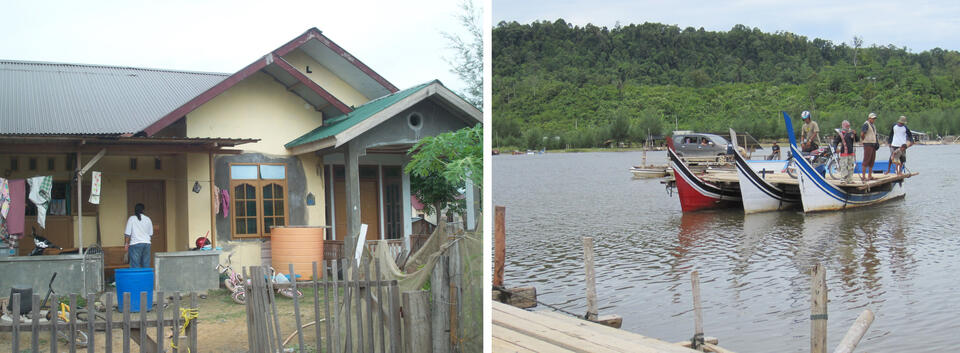
 Collection of photos from fieldwork in Aceh, Indonesia, provided courtesy of Yong Lee. Upper left: A house built in an aid project village shows windows retrofitted after initial construction. Upper right: Boats constructed by aid agencies for fishing activity are refashioned to serve as water taxis for people and cars. Lower: Fishing boats sit unused on the side of the road many of them impossible to use, according to villagers surveyed.

