FSI researchers work to understand continuity and change in societies as they confront their problems and opportunities. This includes the implications of migration and human trafficking. What happens to a society when young girls exit the sex trade? How do groups moving between locations impact societies, economies, self-identity and citizenship? What are the ethnic challenges faced by an increasingly diverse European Union? From a policy perspective, scholars also work to investigate the consequences of security-related measures for society and its values.
The Europe Center reflects much of FSI’s agenda of investigating societies, serving as a forum for experts to research the cultures, religions and people of Europe. The Center sponsors several seminars and lectures, as well as visiting scholars.
Societal research also addresses issues of demography and aging, such as the social and economic challenges of providing health care for an aging population. How do older adults make decisions, and what societal tools need to be in place to ensure the resulting decisions are well-informed? FSI regularly brings in international scholars to look at these issues. They discuss how adults care for their older parents in rural China as well as the economic aspects of aging populations in China and India.
Shorenstein APARC
Encina Hall
616 Jane Stanford way
Stanford, CA 94305-6055
(650) 723-2408
0
teru@stanford.edu
Senior Fellow at the Freeman Spogli Institute for International Studies
Professor of Sociology
Henri H. and Tomoye Takahashi Professor and Senior Fellow in Japanese Studies at the Shorenstein Asia-Pacific Research Center
Kiyo Tsutsui1_0.jpg
PhD
Kiyoteru Tsutsui is the Henri H. and Tomoye Takahashi Professor and Senior Fellow in Japanese Studies at the Walter H. Shorenstein Asia-Pacific Research Center (APARC), the director of APARC and of the Japan Program at APARC, co-director of the Southeast Asia Program at APARC, executive director of the Inter-University Center for Japanese Language Studies, co-director of the Center for Human Rights and International Justice, senior fellow at the Freeman Spogli Institute for International Studies, and professor of sociology, all at Stanford University.
Prior to his appointment at Stanford in July 2020, Tsutsui was professor of sociology, director of the Center for Japanese Studies, and director of the Donia Human Rights Center at the University of Michigan, Ann Arbor.
Tsutsui’s research interests lie in political/comparative sociology, social movements, globalization, human rights, and Japanese society. More specifically, he has conducted (1) cross-national quantitative analyses on how human rights ideas and instruments have expanded globally and impacted local politics and (2) qualitative case studies of the impact of global human rights on Japanese politics. His current projects examine (a) changing conceptions of nationhood and minority rights in national constitutions and in practice, (b) populism and the future of democracy, (c) experimental surveys on public understanding about human rights, (d) campus policies and practices around human rights, (e) global expansion of corporate social responsibility and its impact on corporate behavior, and (f) Japan’s public diplomacy and perceptions about Japan in the world.
His research on the globalization of human rights and its impact on local politics has appeared in American Sociological Review, American Journal of Sociology, Social Forces, Social Problems, Journal of Peace Research, Journal of Conflict Resolution, and other social science journals. His book publications include Rights Make Might: Global Human Rights and Minority Social Movements in Japan (Oxford University Press 2018), and two co-edited volumes Corporate Social Responsibility in a Globalizing World (with Alwyn Lim, Cambridge University Press 2015) and The Courteous Power: Japan and Southeast Asia in the Indo-Pacific Era (with John Ciorciari, University of Michigan Press forthcoming). He has been a recipient of National Endowment for the Humanities Fellowship, National Science Foundation grants, the SSRC/CGP Abe Fellowship, Stanford Japan Studies Postdoctoral Fellowship, and other grants as well as awards from American Sociological Association sections on Global and Transnational Sociology (2010, 2013, 2019), Human Rights (2017, 2019), Asia and Asian America (2018, 2019), Collective Behavior and Social Movements (2018), and Political Sociology (2019).
Tsutsui received his bachelor’s and master’s degrees from Kyoto University and earned an additional master’s degree and Ph.D. from Stanford’s sociology department in 2002.
Director, Shorenstein Asia-Pacific Research Center (APARC)
Director, Japan Program at Shorenstein APARC
Co-Director, Southeast Asia Program at Shorenstein APARC
Executive Director, Inter-University Center for Japanese Language Studies
Co-Director, Center for Human Rights and International Justice
The Walter H. Shorenstein Asia-Pacific Research Center (APARC) condemns the systemic nature and brutal expression of racism in the United States, and we stand in full support of protestors and civil rights organizations in their calls for social justice, equal access to basic rights, and accountability. Beyond reaffirming our commitment to these values, we recognize the imperative to do better as an institution and the urgent need to take concrete action to build a more inclusive community here at our Stanford home. We have joined our colleagues at the Freeman Spogli Institute for International Studies in developing specific steps towards that goal. But we also want to take initial, immediate action in moving from protest to progress.
That’s why we are announcing today a new diversity grant to support Stanford students from underrepresented minorities with an interest in studying issues related to contemporary Asia. The field of Asian studies suffers from an extreme paucity of students, scholars, and experts who self-identify as Black/African American or as affiliated with other underrepresented minority groups. “The path towards a more diverse and inclusive field isn’t easy or straightforward, but we must get on it,” says APARC Director and FSI Senior Fellow Gi-Wook Shin. “We believe that we can tackle the existing disparity if relevant stakeholders across institutes of higher learning all work together. APARC is looking to start this change at Stanford.”
Lowering Barriers to Diversity in Asian Studies
The purpose of the APARC Diversity Grant is to encourage Stanford students from underrepresented minorities (URM) to engage in study and research of topics related to contemporary Asia and U.S.-Asia relations, including economic, health, foreign policy, social, political, and security issues. We follow the University’s definition of the URM category as encompassing “all U.S. citizens and permanent residents who have self-identified as American Indian/Alaska Native, Black/African American, Hispanic/Latino, Native Hawaiian/Other Pacific Islander.” This grant opportunity is open to current Stanford undergraduate and graduate students in the URM category from any major or discipline. “This is just a small step to start lowering disciplinary, cultural, and funding barriers that hinder broader student participation in Asian studies,” notes Shin.
APARC will award a maximum of $10,000 per grant to support a wide range of research expenses such as travel to/from research sites, academic conferences, and workshops (dependent on COVID-19 restrictions); conference registration fees; professional development training programs; purchase of physical and digital books or other required materials; and access to relevant online resources. APARC will review grant applications for projects taking place in winter/spring 2021 on a rolling basis starting on September 1, 2020. Reviews of the second round of applications, for projects taking place in summer/fall 2021, will begin on April 1, 2021.
Examples of research topics, in addition to those that Asia scholars typically study, could include China’s growing activities in Africa; understanding the evolving relations between Asian Americans and African Americans in the United States; and comparative examinations of issues such as the treatment of minorities in Asia and the United States or policies that promote anti-discriminatory practices in schools, the workplace, and other settings in Asian countries and the United States.
Application Guidelines
Complete the application form and submit it along with these three (3) attachments:
A statement (no more than three pages) describing the proposed research activity or project;
A current CV;
An itemized budget request explaining research expense needs.
Arrange for a letter of recommendation from a faculty to be sent directly to APARC. Please note: the faculty members should email their letters directly to Kristen Lee at kllee@stanford.edu.
We will consider only applications that include all supporting documents.
Read More
Hero Image
All News button
1
Subtitle
To encourage Stanford students from underrepresented minorities to engage in study and research of topics related to contemporary Asia, the Shorenstein Asia-Pacific Research Center is offering a new Diversity Grant opportunity. Application reviews begin on September 1, 2020.
To support Stanford students working in the area of contemporary Asia, the Shorenstein Asia-Pacific Research Center is offering up to ten research assistant internships for summer 2020 and up to three predoctoral fellowships for the 2020-21 academic year. The Center will review applications starting April 15 and expects to fill the positions by April 30, 2020.
Amid the fallout of the COVID-19 pandemic, students are facing summer internship cancelations and hiring freezes. They are left wondering about the long-term implications of the current crisis for their academic careers and their access to future jobs and valuable work experience.
At Shorenstein APARC, we want to do all we can to support Stanford students. That’s why we are announcing new internship and fellowship opportunities for current students working in the area of contemporary Asia: research assistant internships for the summer quarter of 2020 and predoctoral fellowships for the 2020-21 academic year.
The summer internships are all remote: research assistants will work as telecommuters. Regarding the predoctoral fellowships, we hope we can all have a normal 2020-21 academic year, in which case we expect the fellows to be in residence, but we will reassess the evolving COVID-19 situation closer to the appointment start dates and shift to flexible, online options as needed.
APARC will review applications for both opportunities on a rolling basis starting April 15, 2020. The Center will select up to ten research assistants and up to three predoctoral fellows by April 30, 2020.
Read on to learn more about these offerings and the application requirements, and follow the guidelines below to submit your candidacy.
Summer 2020 APARC Research Assistant Internships
Shorenstein APARC is seeking highly motivated and dedicated undergraduate and graduate students to join our team as paid research assistant interns for the summer quarter of 2020. Research assistants will work with assigned APARC faculty members on projects focused on contemporary Asia, studying varied issues related to the politics, economies, populations, security, foreign policies, and international relations of the countries of the Asia-Pacific region.
All positions will be for eight weeks starting late June or early July 2020. The hourly pay rate is $17 for undergraduate students, $25 for graduate students.
Research assistant positions are open to current Stanford students only. Undergraduate- and graduate-level students are eligible to apply.
Arrange for a letter of recommendation from a faculty to be sent directly to APARC. Please note: the faculty members should email their letters directly to Kristen Lee at kllee@stanford.edu.
We will consider only complete applications that include all the abovementioned supporting documents.
2020-21 Shorenstein APARC Predoctoral Fellowships
APARC is inviting applications from current Stanford students for the 2020-21 Shorenstein APARC Predoctoral Fellowship. The fellowship supports predoctoral students working within a broad range of topics related to contemporary Asia.
Up to three fellowships are available to Ph.D. candidates who have completed all fieldwork and are nearing the completion of their dissertation. The Center will give priority to candidates who are prepared to finish their degree by the end of the 2020-21 academic year.
Shorenstein APARC offers a stipend of $36,075 for the 2020-21 academic year, plus Stanford's Terminal Graduate Registration (TGR) fee for three quarters. We expect fellows to remain in residence at the Center throughout the year and to participate in Center activities.
A cover letter including a brief description of your dissertation (up to 5 double-spaced pages);
A copy of your transcripts. Transcripts should cover all graduate work and include evidence of recently-completed work.
Arrange for two (2) letters of recommendation from members of your dissertation committee to be sent directly to Shorenstein APARC. Please note: the faculty/advisors should email their letters directly to Kristen Lee at kllee@stanford.edu.
We will consider only complete applications that include all the abovementioned supporting documents.
The hit movie Crazy Rich Asians shone a light on the extreme wealth of Southeast Asia's ethnically Chinese ultra-wealthy, who have long topped billionaire rankings and dominated stock-markets around the region. Sometimes dubbed “the Asian godfathers,” these successful tycoons are famed both their sharp commercial savvy and their association with chronic crony capitalism. In this talk, however, author James Crabtree will suggest that role of the region's mega-wealthy industrialists is now changing in interesting ways, notably due to the economic rise of China itself, which presents major business opportunities but also tricky political challenges for Southeast Asia's commercial titans.
Image
James Crabtree is a Singapore-based author and journalist, a columnist for Nikkei Asian Review, and a fellow in the Asia-Pacific Programme at Chatham House in London. His best-selling 2018 book, The Billionaire Raj: A Journey Through India’s New Gilded Age, was short-listed for the Financial Times and McKinsey Business Book of the Year award. Prior to his position at NUS, James worked for the FT, most recently as its bureau chief in Mumbai, India. Publications for which he has written include The New York Times, The Economist, Wired, and Foreign Policy. Before becoming a journalist, he was an advisor in the UK Prime Minister’s Strategy Unit under Tony Blair and Gordon Brown, worked for think tanks in London and Washington DC, and was a Fulbright Scholar at Harvard’s Kennedy School of Government.
Southeast Asia, home to over 640 million people across 10 countries, is one of the world’s most dynamic and fastest growing regions. APARC just concluded the year 2019 with a Center delegation visit to two Southeast Asian capital cities, Hanoi and Bangkok, where we spent an engaging week with stakeholders in the academic, policy, business, and Stanford alumni communities.
Led by APARC Director Gi-Wook Shin, the delegation included APARC Deputy Director and Asia Health Policy Program Director Karen Eggleston, Southeast Asia Program Director Donald Emmerson, and APARC Associate Director for Communications and External Relations Noa Ronkin. Visiting Scholar Andrew Kim joined the delegation in Bangkok.
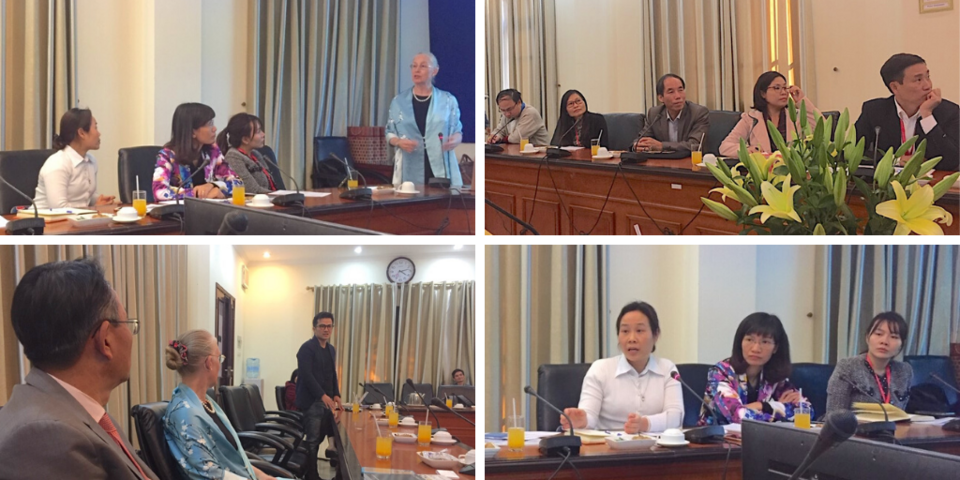
Karen Eggleston and participants at the roundtable held at Hanoi Medical University, December 9, 2019.
Throughout the day, Eggleston presented some of her collaborative research that is part of two projects involving international research teams: one that assesses public-private roles and institutional innovation for healthy aging and another that examines the economics of caring for patients with chronic diseases across diverse health systems in Asia and other parts of the world. We appreciated learning from our counterparts about the health care system and health care delivery in Vietnam.
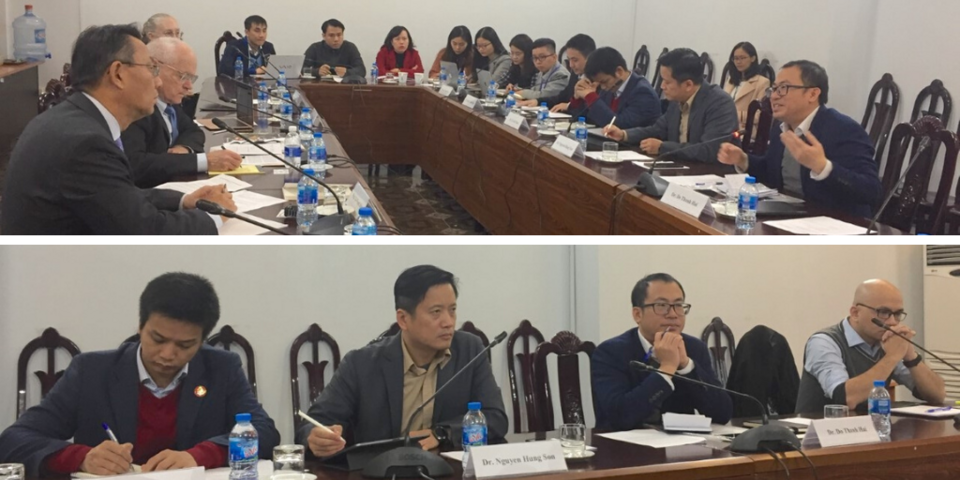
Shifting focus to international relations and regional security, day 2 in Hanoi opened with a roundtable, “The Rise of the Indo-Pacific and Vietnam-U.S. Relations,” held jointly with the East Sea Institute (ESI) of the Diplomatic Academy of Vietnam (DAV). Following a welcome by ESI Director General Nguyen Hung Son, the program continued with remarks by Shin, Emmerson, ESI Deputy Director General To Anh Tuan, and Assistant Director General Do Thanh Hai.
Image
Roundtable at the Diplomatic Academy of Vietnam, December 10, 2019.
The long-ranging conversation with DAV members included issues such as the future of the international order in Asia; the U.S. withdrawal from multilateralism; the concern about a lack of U.S. engagement in Southeast Asia, sparked by President Trump’s absence from the November 2019 summit of the Association of Southeast Asian Nations (ASEAN) at a time when China is bolstering its influence in the region and when ASEAN hopes to set a code of conduct with China regarding disputed waters in the South China Sea; the priorities for Vietnam as it assumes the role of ASEAN chair in 2020; and the challenges for the Vietnam-U.S. bilateral relationship amid the changing strategic environment in Southeast Asia.
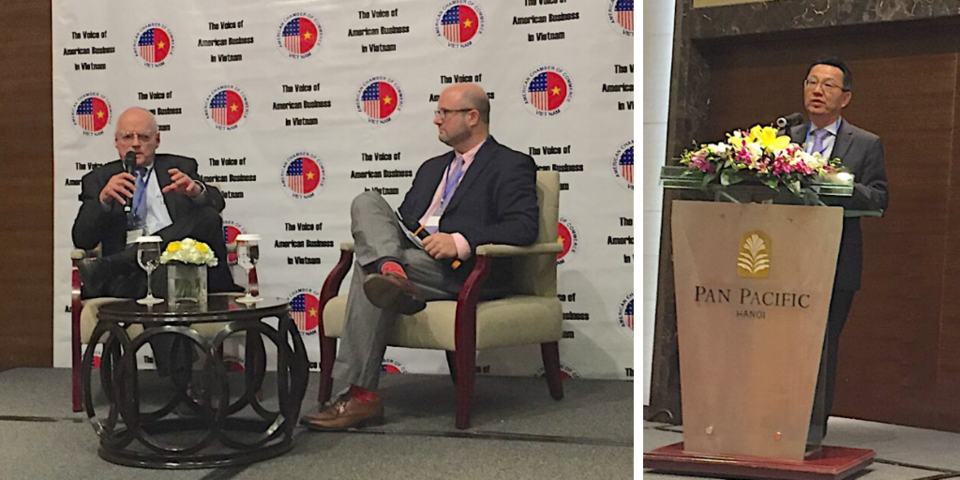
In the afternoon we were joined by members of the American Chamber of Commerce in Hanoi at an AmCham-hosted Lunch ‘n’ Learn session on Vietnam's challenges and opportunities amid the U.S.-China rivalry. The event featured Emmerson in conversation with AmCham Hanoi Executive Director Adam Sitkoff.
Image
(Left) Donald Emmerson in conversation with Adam Sitkoff; (right) Gi-Wook Shin welcomes AmCham Hanoi members; December 10, 2019.
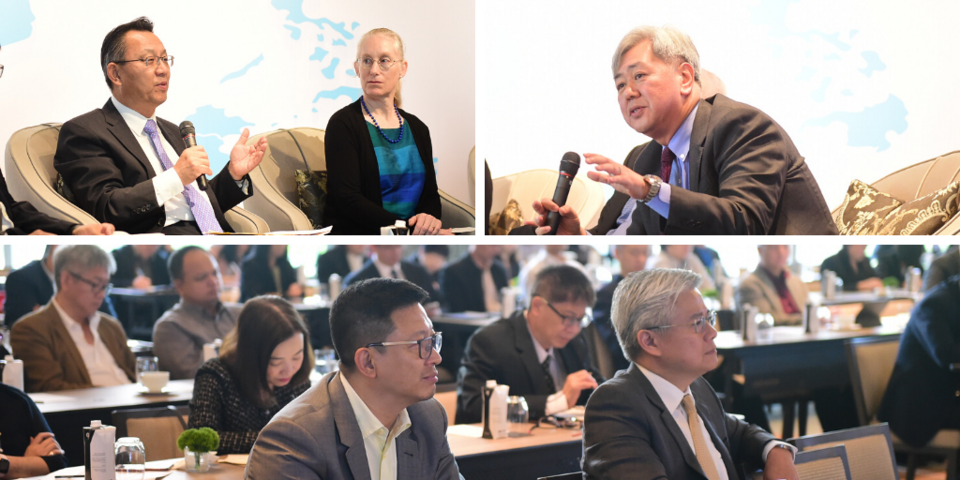
Moving to Bangkok, delegation members Shin, Eggleston, Emmerson, and Kim spoke on a panel for executives of the Charoen Pokphand Group (C.P. Group), one of Thailand’s largest private conglomerates, addressing some of the core issues that lie ahead for Southeast Asia in 2020 and beyond in the areas of geopolitics, innovation, and health.
Image
Top, from left to right: Gi-Wook Shin, Karen Eggleston, Andrew Kim; bottom: C.P. Group executive listening to the panel, December 12, 2019.
We also enjoyed a tour at True Digital Park, Thailand’s first startup and tech entrepreneur’s campus. Developed by the C.P. Group, True Digital Park aspires to be an open startup ecosystem that powers Thailand to become a global hub for digital innovation.
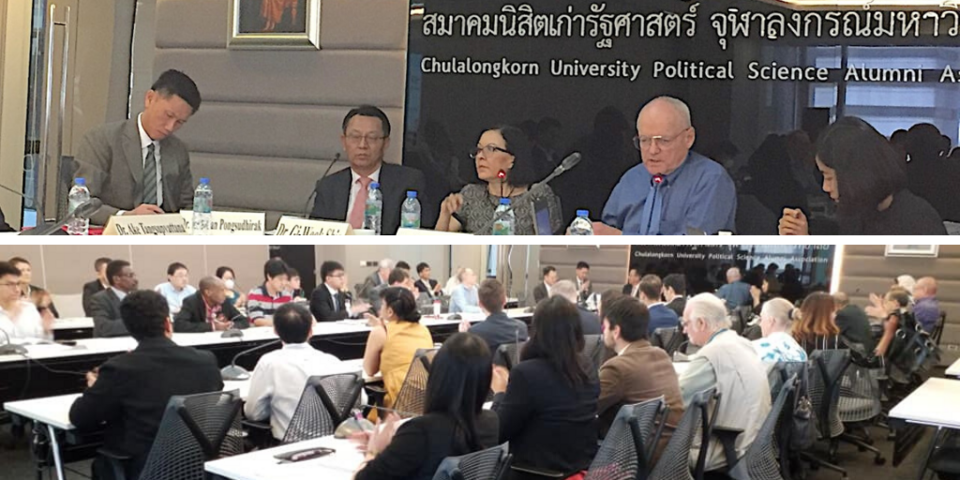
The following day, Shin and Emmerson participated in a public forum hosted by Chulalongkorn University’s Institute of Security and International Studies (ISIS Thailand), "Where Northeast Asia Meets Southeast Asia: The Great Powers, Global Disorder and Asia’s Future.” They were joined by ISIS Thailand Director Thitinan Pongsudhirak and Chulalongkorn University Faculty of Political Science Associate Dean for International Affairs and Graduate Studies Kasira Cheeppensook. The panel was moderated by Ms. Gwen Robinson, ISIS Thailand senior fellow and editor-at-large of the Nikkei Asian Review.
Image
ISIS Thailand forum participants and panelists, from left: Pngsukdhirak, Shin, Robinson, Emmerson, Cheeppensook; December 13, 2019.
As part of that discussion, Emmerson speculated that – driven by deepening Chinese economic and migrational involvement in Southeast Asia’s northern tier – Cambodia and Laos, less conceivably Myanmar, and still less conceivably Thailand could become incorporated de facto into an economically integrated “greater China” that could eventually reduce ASEAN to a more-or-less maritime membership in the region’s southern tier. Emmerson’s speculation was made in the context of his critique of ASEAN’s emphasis on its own “centrality” to the neglect of its lack of the proactivity that would serve as evidence of centrality and of a desire not to be rendered peripheral by the growing centrality-cum-proactivity of China. The event was covered by the Bangkok Post (although that report’s headline and quote of Emmerson are inaccurate, as neither the panel nor Emmerson predicted the “break-up of ASEAN.”)
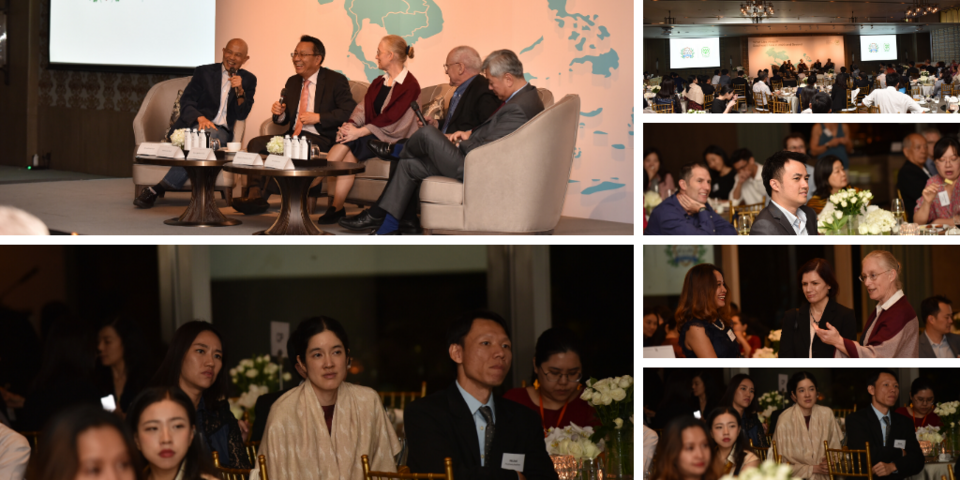
Stanford and IvyPlus alumni listening to the panel, December 13, 2019.
Moderated by Mr. Suthichai Yoon, a veteran journalist and founder of digital media outlet Kafedam Group, the conversation focused on the changing geopolitics of Southeast Asia, innovation and health in the region, and the opportunities and challenges facing Thailand-U.S. relations. It was a pleasure to meet many new and old friends from the Stanford and IvyPlus alumni communities.
APARC would like to thank our partners and hosts in Hanoi and Bangkok for their hospitality, collaboration, and the stimulating discussions throughout our visit. We look forward to keeping in touch!
The pontianak, or female vampire, is one of the most significant supernatural creatures, or hantu, in Malay cinema. A series of pontianak films were among the most successful made in the studio system in Singapore between 1957 and the city-state’s independence in 1965. Although the pontianak appeals to discourses of Malay cultural identity in particular, the films achieved something rare: they were popular across different races in late-colonial Singapore. In the 21st century, the pontianak genre has regained popularity in film and television by returning to the racialized politics of belonging in Malaysia and Singapore. The pontianak registers intersecting anxieties about femininity and modernity, race and nation, local and transnational cultural influences, and Islam in relation to indigenous beliefs. Prof. Galt’s talk will analyze the pontianak in recent Malaysian and Singaporean cinema and explore what the figure tells us about the role of film culture in shaping and contesting ideas of postcolonial Malay identity.
Image
Rosalind Galt is Professor of Film Studies at King’s College London. She studies how geopolitics, cinematic style, history, and sexuality interact. She is the co-author with Karl Schoonover of Queer Cinema in the World (2016); the author of Pretty: Film and the Decorative Image (2010) and The New European Cinema: Redrawing the Map (2006); and co-editor of Global Art Cinema: New Theories and Histories (2010). Her advanced degrees are from Brown University (PhD) and the University of Glasgow (MA with Honours).
Rosalind Galt
2019-2020 NUS-Stanford Lee Kong Chian Fellow on Contemporary Southeast Asia
“Our dystopian present is your dystopian future if nothing significant is done,” cautioned Ressa, urging the Stanford community to pressure technology platforms and social media to stop disinformation spread.
“This is an existential moment for global power structures, turned upside down by technology. When journalists globally are under attack, democracy is under attack.” With these words, the internationally-esteemed investigative journalist and press freedom champion Maria Ressa, winner of the 2019 Shorenstein Journalism Award, opened her keynote address at a lunchtime ceremony, held at Stanford on October 21.
Ressa knows first-hand the terrifying reality of continuously being subject to online attacks and politically motivated attempts by the government to silence and intimidate. As CEO and executive editor of Rappler, she has led the Philippine independent news platform in shining critical light on the Duterte administration's policies and actions. President Duterte in turn has made no secret of his dislike for Ressa and Rappler, accusing the platform for carrying "fake news." Ressa has been arrested twice this year, accused of corporate tax evasion and of violating security laws, and slapped with charges of cyber libel for a report that was published before the libel law came into effect. Since Duterte’s election in summer 2016, the Philippine government has filed at least 11 cases and investigations against Ressa and Rappler.
“And all because I’m a journalist,” she says.
Speaking at the Shorenstein Award’s eighteenth annual panel discussion, Ressa detailed the devastating effects that disinformation has had on democracy and societal cohesion in the Philippines. She vividly explained why each and every one of us should be gravely concerned about the breaking down of the information ecosystem in a country halfway around the world. The Philippines, she said, is a case study of how attacks on truth and facts rip the heart out of civic engagement and gradually kill democracy, “a death by a thousand cuts.”
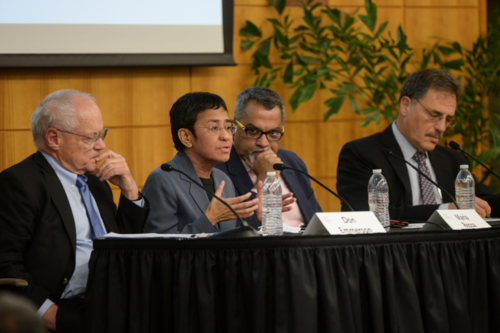
Ressa was joined on the panel by Stanford’s Larry Diamond, senior fellow at the Hoover Institution and the Freeman Spogli Institute for International Studies, and Raju Narisetti, director of the Knight-Bagehot Fellowship in Economics and Business Journalism and professor of professional practice at Columbia Journalism School, who also serves on the selection committee for the Shorenstein Journalism Award. Shorenstein APARC’s Southeast Asia Program Director Donald K. Emmerson chaired the discussion.
Modern authoritarians follow a familiar playbook, noted Ressa, for they know well that “If you can make people believe lies are the facts, then you can control them.” Their first step is to lie all the time. The second is to argue their opponents and the journalists are the ones who lie. Then finally everyone looks around and says, "What's truth?" And when there is no truth resistance is impossible.
Ressa went on to describe detailed examples of patriotic trolling in the Philippines, that is, how state-sponsored online hate and harassment campaigns silence and intimidate journalists and others who voice criticism of the Duterte administration. Instead of censoring, she said, state agents now flood the information ecosystem with lies, blurring the line between fact and fiction. These information operations are conducted through the weaponization of technology and social media platforms, first and foremost Facebook. Ressa’s team at Rappler uses network analysis methods to unveil the flow and spread of online disinformation and harassment campaigns on Facebook and from there to other platforms as well as traditional and state media.
Ressa urged the packed audience of campus and community members to remember that “Without facts you cannot have truth, without truth you cannot have trust, and without any of these three democracy as we know it is dead. The public sphere is dead […] our Philippine dystopian present is your dystopian future, if nothing significant is done.”
She closed her keynote by pleading: “Please push tech platforms and social media to do something to stop the lies from spreading. Lies laced with anger and hate spread faster than facts. Fight for your rights.”
Watch Ressa’s keynote and the entire panel proceedings here or on our YouTube channel. You can also listen to Ressa’s keynote below and on our SoundCloud channel. A transcript of the keynote address is available below.
No Ministry of Truth
Is the attack on truth a technological problem, and can it have a technological solution? It's naïve, said Diamond, to think that there is a purely technological solution or that we can rein in the alarming developments in the Philippines and elsewhere without addressing their technological elements and the economic incentives underlying these elements. “There has to be a macro political element of response,” argued Diamond, “which obviously has to involve advanced liberal democracies condemning and drawing boundaries around the murderous authoritarianism of Rodrigo Duterte.”
Image
Left to right: Donald K. Emmerson, Maria Ressa, Raju Narisetti, Larry Diamond.
Narisetti emphasized the need to look at the problem and its potential solutions holistically and bear in mind that solutions must come from multiple areas. “We must remember that technology has value, but it has no values. It's a matter of who is using it and how they're using it.” And while we certainly don't want Facebook to be the Ministry of Truth, continued Narisetti, by no means do we want Congress to take on that role. He pointed to specific possible regulatory solutions, such as insisting Facebook enable its users to port their complete data outside of the platform if they wish to do so, or establishing a system of data and privacy courts.
Commitment to Journalism that Courageously Seeks Accuracy
The Shorenstein Journalism Award, which is sponsored by APARC, was presented to Ressa at a private evening ceremony. “You would be hard pressed to find a person whose work more fully embodies the ideals that define journalism than Maria Ressa,” said James Hamilton, Stanford’s Hearst Professor of Communication, Chair of the Department of Communication, Director of the Stanford Journalism Program, who also serves on the selection committee for the award. Shorenstein APARC Director Gi-Wook Shin joined Hamilton in co-presenting Ressa the award.
The Shorenstein Award, which carries a cash prize of $10,000, recognizes accomplished journalists committed to critical reporting on and exploring the complexities of Asia through their writing. It alternates between honoring recipients from the West, who mainly address American audiences, and recipients from Asia, who often work on the frontline of the battle for freedom of the press in their countries. Established in 2002, the award honors the legacy of APARC benefactor Mr. Walter H. Shorenstein, who was passionate about promoting both excellence in journalism and a deeper understanding of Asia.
Co-sponsored by the Southeast Asia Program and the Abbasi Program in Islamic Studies
Transnational Islam lacks the centralized leadership and institutions associated with Catholicism. Yet hierarchical and authoritative bodies do make decisions regarding Islam in various contemporary settings, including within the institutional frameworks of states. What happens when Muslim faith and practice are adapted to the terms and procedures of bureaucracy and the modern nation-state?
Dr. Müller will present an original conceptual framework for studying the bureaucratization of Islam. He will apply it to five Southeast Asian cases—Brunei, Indonesia, Malaysia, the Philippines, and Singapore. State bureaucracies in these countries vary widely, but generally they aim to influence or control trends and meanings in local Islamic discourse. Drawing on current debates in the anthropology of the state, with particular reference to Brunei and Singapore, Müller will offer an original analytic framework to explain similarities and differences in bureaucratized Islam in Southeast Asia. Possible implications beyond the region will also be explored.
Dominik Müller
Image
heads the Max Planck Institute for Social Anthropology’s Research Group on the Bureaucratization of Islam and Its Socio-Legal Dimensions in Southeast Asia. He is also a non-resident fellow in the Centre for Asian Legal Studies at the National University of Singapore (NUS). Prior positions include visitorships at NUS (2016), the University of Oxford (2015), the University of Brunei Darussalam (2014), and Stanford University (APARC, 2013). His doctorate in anthropology is from Goethe University Frankfurt (2012).His latest publication is an article on “Hybrid Pathways to Orthodoxy” in Brunei in the April-May 2018 Journal of Current Southeast Asian Affairs, a special issue on bureaucratized Islam that he also guest-edited.
Shorenstein APARC
Stanford University
Encina Hall, Room C331
Stanford, CA 94305-6055
(650) 724-5656
(650) 723-6530
0
dominikm@stanford.edu
Visiting Scholar
MullerDominik.jpg
PhD
Dominik Müller joins the Walter H. Shorenstein Asia-Pacific Research Center (Shorenstein APARC) from February until May 2013 from the Department of Anthropology at Goethe-University Frankfurt where he serves as a postdoctoral research associate.
His research interests encompass Islam and popular culture in contemporary Southeast Asia, Malaysian domestic politics, and socio-legal change in the Malay world.
During his time at the Shorenstein APARC, Müller will conduct research on the religious bureaucracy of Malaysia. His research project at Stanford is funded by the German Academic Exchange Service (DAAD).
Müller obtained his PhD summa cum laude in 2012 in cultural anthropology from the Cluster of Excellence the “Formation of Normative Orders” at Frankfurt University. He previously studied anthropology, philosophy, and law in Frankfurt and at Leiden University. His dissertation on Islam, Politics, and Youth in Malaysia received the Frobenius Society’s Research Award 2012 and will be published in 2013.
Visiting Fellow, Islamic Legal Studies Program on Law and Social Change, Harvard University
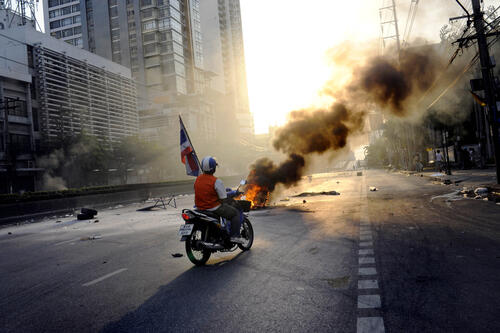
After the Cold War, Thailand became a poster child of democratizing processes in Southeast Asia. Student protests, farmers’ activism, a thriving civil society, and an expanding middle class suggested a model of successful democratic transition. In the last decades, however, many of the forces that supported that process turned sour on electoral politics. Dr. Sopranzetti’s book will explore how that happened—new class alliances, discourses of corruption and morality, questions of law. In this context, he will portray Thailand as an experimental space for a new model of authoritarianism, inspired by Beijing and now spreading throughout the region. The book, Owners of the Maps: Motorcycle Taxi Drivers, Mobility, and Politics in Bangkok, will be available for sale at the talk.
Claudio Sopranzetti is a Postdoctoral Research Fellow at All Souls College at the University of Oxford. He is the author of Owners of the Maps: Motorcycle Taxi Drivers, Mobility, and Politics in Bangkok and he is currently working on Awakened, an anthropological graphic novel on Thai politics.
Claudio Sopranzetti
Postdoctoral Research Fellow, All Souls College, Oxford University
Asia’s transformation presents both challenges and opportunities at international, regional, and domestic levels. One key to a peaceful, prosperous Asia in the 21st century is good relations between the United States and China. But other challenges exist: nuclear proliferation, maritime security, violent conflict, environmental degradation, natural disasters, food security, cyber-security, and social and gender inequality, among others. Social transformation is outpacing political and institutional reform in many Asian countries, and the widening gap between state and society is a potent force for change. How will Asians address these challenges over the next one to two decades? What role will Asian women play in this transformation? How should the United States respond? The panelists and the discussant have contributed answers to these and other questions regarding Asia’s future in the latest iteration of The Asia Foundation’s quadrennial investigation and dissemination of Asian views of America’s role in Asia, including policy recommendations for the Trump administration. Stanford’s Southeast Asia Program director Don Emmerson will chair the session.
Chheang Vannarith
Image
is a co-founder and vice-chairman of the Cambodian Institute for Strategic Studies and an adjunct senior fellow and member of the board at the Cambodia Institute for Cooperation and Peace. He was a visiting fellow at ISEAS-Yusof Ishak Institute in Singapore, China Institute of International Studies in China, IDE-JETRO in Japan, and East-West Center in the US. He was a lecturer in Asia-Pacific Studies at the University of Leeds, and he served as executive director of the Cambodian Institute for Cooperation and Peace from 2009 to 2013. His research interests include Asia-Pacific international politics, regionalism, governance, social innovation, and social entrepreneurship. Chheang earned a bachelor’s degree in International Relations from the Diplomatic Academy of Vietnam in 2002, a master’s degree in International Relations from the International University of Japan in 2006, the Graduate Certificate in Leadership from the East-West Center in the United States in 2008, and a doctoral degree in Asia-Pacific Studies from the Ritsumeikan Asia Pacific University in 2009. He was honored as Young Global Leader by the World Economic Forum in 2013.
Image
Sylvia Mishra is a researcher with Observer Research Foundation New Delhi and is presently with the James Martin Center for Nonproliferation Studies (CNS), Monterey, California. Her current research is focused on South Asian security issues and nuclear dynamics, India’s foreign policy, defence and security cooperation with the United States and disruptive technologies. She is a former CNS Visiting Fellow and Center for Strategic and International Studies (CSIS) Project on Nuclear Issues scholar. She has presented papers and delivered talks at national and international conferences and at platforms like the Comprehensive Nuclear Test Ban Treaty Organization, the United States Strategic Command, Air Force Technical Applications Center Patrick Air Force Base (Florida), Asia-Pacific Center for Security Studies and The Asia Foundation, among others. She has a number of publications to her credit, including chapters in books, articles in journals such as the Indian Foreign Affairs Journal, Global Policy, and commentaries/opinion pieces for CSIS, RUSI, The Fletcher Forum of World Affairs, Crawford School of Public Policy ANU, CNS, Stimson, The Diplomat, Hindustan Times and several other publications. She holds a master’s degree in History of International Relations from London School of Economics and has received a Certificate for completing a course on ‘International Safeguards Policy and Information Analysis’ from Lawrence Livermore National Laboratory.
Image
Duyeon Kim is a visiting senior fellow at the Korean Peninsula Future Forum, a non-partisan think tank in Seoul, and a columnist for the Bulletin of the Atomic Scientists. Her specialties include East Asian security, the two Koreas, nuclear nonproliferation, and arms control. She has been an associate on nuclear policy and Asia at the Carnegie Endowment for International Peace and, earlier, a senior fellow and deputy director at the Center for Arms Control and Non-Proliferation in Washington, DC. Kim has written in leading publications including Foreign Affairs, Foreign Policy, and the National Interest. Previously, as a correspondent for South Korea’s Arirang TV News, she covered the Six-Party Talks, inter-Korean relations, and U.S. foreign policy, among other topics. Her degrees are from the Georgetown University School of Foreign Service (MS) and Syracuse University (BA).
Image
John Brandon is the Senior Director of International Relations Programs in The Asia Foundation’s Washington, DC office. He has been responsible for many of the Foundation’s publications including Asian Views on America’s Role in Asia (2016). Trained as a Southeast Asianist, he lectures and publishes widely on US-Asian relations. Publications he has co-authored, edited, or contributed to include three books on Burma/Myanmar and one on US-Southeast Asia relations. His MA in political science and Southeast Asian studies is from Northern Illinois University.
This panel discussion is co-sponsored by The Asia Pacific Research Center and The Asia Foundation with support from The Carnegie Corporation of New York
Chheang Vannarith
Senior Fellow and Member of the Board, Cambodian Institute for Cooperation and Peace
Sylvia Mishra
Researcher, Observer Research Foundation, Researcher, James Martin Center for Nonproliferation Studies, Middlebury Institute of International Studies at Monterey
Duyeon Kim
Visiting Senior Fellow at the Korean Peninsula Future Forum, a non-partisan think tank in Seoul
John Brandon
Senior Director, International Relations Programs, The Asia Foundation