Society

FSI researchers work to understand continuity and change in societies as they confront their problems and opportunities. This includes the implications of migration and human trafficking. What happens to a society when young girls exit the sex trade? How do groups moving between locations impact societies, economies, self-identity and citizenship? What are the ethnic challenges faced by an increasingly diverse European Union? From a policy perspective, scholars also work to investigate the consequences of security-related measures for society and its values.

The Europe Center reflects much of FSI’s agenda of investigating societies, serving as a forum for experts to research the cultures, religions and people of Europe. The Center sponsors several seminars and lectures, as well as visiting scholars.

Societal research also addresses issues of demography and aging, such as the social and economic challenges of providing health care for an aging population. How do older adults make decisions, and what societal tools need to be in place to ensure the resulting decisions are well-informed? FSI regularly brings in international scholars to look at these issues. They discuss how adults care for their older parents in rural China as well as the economic aspects of aging populations in China and India.

-

North Carolina time: 19 October, 2021, 8:00-9:30 pm; Singapore time: 20 October, 2021, 8:00-9:30am

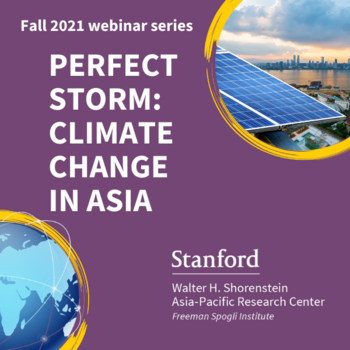
Viewed alongside other world regions, Southeast Asia is uniquely vulnerable to major damage by global warming. Its coastlines are lengthy and subject to searise. Its urban centers of economic and political gravity are mainly riverine or deltaic. Its agriculture requires optimal levels and rhythms of waterflow, as do its polluted main veins, the Mekong and the Irrawaddy.  In already tropical conditions, heatwaves are especially enervating.  Nor has the region escaped extreme weather events.  The ten most afflicted countries worldwide in that regard include Myanmar, the Philippines, Thailand, and Vietnam.  With this background in mind, Angel Hsu and Melissa Low, two scholars with deep regional and policy knowledge will consider questions such as:  What has been and is being done, by whom, and with what chances of success?  Can currently worsening trends be reversed?  Mitigated?  Or is adaptation the sole plausible recourse?  Who will represent the interests of the unborn generations who will suffer the long-term consequences of present-day indifference and delay?  Will effective policy require authoritarian politics?  Given that the largest current and historical emitters of greenhouse gases are, respectively, China and the US, what roles should and will they play?  And how, if at all, will global versions of these questions be addressed and answered in November in Glasgow at COP26?

Image
Hsu, Angel
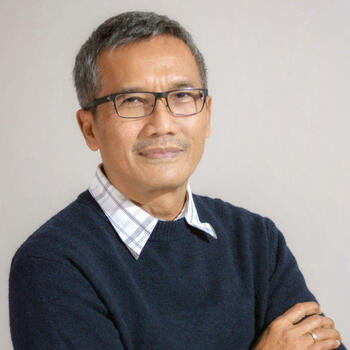
Angel Hsu founded and heads the University of North Carolina-Chapel Hill’s Data-Driven EnviroLab, an interdisciplinary research group that innovates quantitative approaches to pressing environmental issues.  Her research into the causes and consequences of climate change explores the interfacing of science and policy.  Her many publications include coverage of Malaysia, Viet Nam, and especially China.  In February 2021 she spoke on global climate trends before the US Senate Committee on Energy and Natural Resources, having addressed US-China climate relations at the University of Pennsylvania in 2020.  Illustrating Prof. Hsu’s commitment to public outreach was her selection as a TED 2018 Age of Amazement Speaker and earlier as an inaugural member of the Grist 50, an annual list of “emerging leaders” working on “fresh, real-world solutions” to the world’s “biggest challenges,” global warming included.  She holds a PhD in Environmental Policy from Yale University.

Image
Low, Melissa
Melissa Low has published, presented, and advised on climate change in multiple forums.  She is currently researching the relative transparency of climate action and reporting in Southeast Asia.  She provides policy analyses and conducts workshops to improve understanding of the Paris Agreement and track whether countries are keeping their promises.  For that work, in 2021, she received Singapore’s EcoFriend Award and its Public Service Medal.  Having taken part in the UN Framework Convention on Climate Change (UNFCCC) Conference of Parties for many years, she is now on the steering committee that coordinates NGOs under the UNFCCC. She holds a University of Strathclyde LLM (with distinction) in Climate Change Law and Policy and an MSc in Environmental Management at the National University of Singapore, where is pursuing a PhD in geography.  Her master’s thesis on the run-up to the Paris Agreement won NUS’s Shell Best Dissertation Award.

Image
CC-SeAP
This event is part of the 2021 Fall webinar series, Perfect Storm: Climate Change in Asia, sponsored by the Walter H. Shorenstein Asia-Pacific Research Center.

Via Zoom Webinar
Register: https://bit.ly/3ulj9jV

Angel Hsu Assistant Professor of Public Policy and the Environment, University of North Carolina at Chapel Hill
Melissa Low Research Fellow, Energy Studies Institute, National University of Singapore
Seminars
-

Jakarta time: Friday, October 8, 2021 07:00 - 08:30 AM

Students often ask themselves: Do I want to be a specialist or a generalist? A hedgehog digging deeper or a fox ranging wider? The answer embedded in Gita Wirjawan’s life so far is unequivocal: Go broad. Think big. And be optimistic. For his weekly virtual podcast Endgame, Gita has interviewed many people, including Stanford’s Southeast Asia Program director Don Emmerson.  Don will turn the tables and interview Gita in this event. Gita will highlight life lessons from his international childhood and consider questions such as these: How well or poorly is Indonesia coping with corrupted governance, religious extremism, Covidian infection, and climate change? How should it respond to worsening US-China relations? To China’s efforts to control the South China Sea? To America’s exit from Afghanistan? To Myanmar’s brutal junta and ASEAN’s apparent impotence? Worldwide, looking forward, is eco-suicide avoidable? Will surveillance technology doom liberal democracy? If there is a global endgame to be played, how should concerned actors play it? Have present perils made Gita’s proactive optimism all the more necessary? Or all the more naïve? Attend the event and find out.

Image
photo_gita_wirjawan_4X4.jpg
Gita Wirjawan is the founding chairman of the Ancora Group of private-equity investors and wealth managers in Indonesia. He has held leadership positions in Citibank, JP Morgan, and other such firms. His philanthropy sustains the Ancora Foundation, which seeks to improve access to quality education in Indonesia across a range of endeavors—from funding the training of kindergarten teachers to endowing scholarships for students to attend universities around the world including Stanford. His passion for sports led Gita to chair Indonesia’s badminton association (2012-16). His public service career has included heading Indonesia’s trade ministry (2011-14) and investment coordinating board (2009-2011). A jazz pianist, he has performed in concerts and composed and played pieces in more than a dozen albums. His degrees include masters in business administration (Baylor) and public policy (Harvard). Indonesia’s School of Government and Public Policy sponsors his wide-ranging podcast “Endgame with Gita Wirjawan.”

Via Zoom Webinar
Register: https://bit.ly/3z7hM9b

Gita Wirjawan Indonesian businessman, philanthropist, educationist, musician, former minister of trade, badminton advocate, and popular talk-show host
Seminars
Authors
Donald K. Emmerson
News Type
Commentary
Date
Paragraphs

This piece was originally published in The Jakarta Post.


Congratulations, Indonesia! What a thrill it was to open my daily copy of The New York Times on Aug. 3 and see a nearly half-page color photo of the jubilant faces and raised fists of Greysia Polii and Apriyani Rahayu as they celebrated their and their country’s Olympic gold medal in women’s- doubles badminton.

Their first-place finish could not have been more timely. Indonesia needs good news. Bloomberg has combined 12 variables to determine where the COVID-19 pandemic is being most-to- least effectively managed.

From April to July, by that measure, Indonesia fell steadily to last place among the 53 countries covered. Such a bad review cannot be explained by domestic underperformance alone. The ferocity of the now ubiquitous Delta variant has played a role. So has vaccine nationalism—the limited and late availability of effective jabs from abroad. Not to mention less well-established variables such as the relative potency of Chinese vaccines. Whatever the reasons, there is little to celebrate regarding the risk to the health of Indonesians.

In this downbeat context, however, and far less well known than Indonesia’s “goodminton” victory in Tokyo, is an upbeat development on Indonesia’s academic front that also deserves Indonesian pride: the five-day inaugural Conference on Indonesian Studies (CIS) held online on June 24-27 Jakarta time. The American Institute for Indonesian Studies and Michigan State University sponsored the meeting with the participation and cooperation of hundreds of students, academics, and educational institutions in Indonesia and the United States. As a long-time would-be Indonesianist, I was happy to attend.

Researchers have more questions than answers. Nationalists reverse the ratio. The scholarly ideal—gathering evidence, testing assertions, birthing, sharing, and comparing ideas— transcends borders. But nationality has long shaped Indonesian studies.

During Dutch rule over the East Indies from 1816 to 1941, with rare exceptions, the archipelago’s past was largely interpreted by Europeans with colonial access. Indonesian studies were dramatically expanded and diversified following World War II. But the birth and growth of “area studies” in Western universities continued to incubate mainly Western scholarly careers.

The recent CIS was doubly important, as an affirmation and a stimulus. Its 326 presentations in 65 different sessions served to remind the roughly 500 attendees from Indonesia and 22 other countries of the breadth and vitality of Indonesian studies and thereby motivate further research.

Included on the program were a first-rate keynote speech by Prof. Aquarini Priyatna of Padjadjaran University on feminist voices in Indonesian literature; the premiere reading in English of Oh by Indonesia’s renowned novelist and playwright Putu Wijaya, whose work I remember applauding at Taman Ismail Marzuki decades ago; and a rousing performance of the wayang lakon (Javanese puppet show) Ciptoning by Ki Purbo Asmoro, ably and simultaneously rendered in English by Kathryn Emerson (no relation).

The conference also conveyed what was on the minds of the more than 300 mainly young and Indonesian panelists who wrote papers and made presentations about their country. Although the topics were diverse, some were more popular than others. A comparison may offer clues as to the subjects for research that are attracting the next generation of Indonesian scholars as they begin to shape the future and focus of Indonesian studies.

The distribution of themes is informative. Nearly half of all the CIS sessions were about culture. Culture in the sense of identity was by far the most popular topic at the conference, including religious and especially Muslim identity, with lesser attention to language and gender. Three genres of performed culture — art, music, and literature—were featured in roughly a fourth of the sessions. Five different sessions took up the blood-shedding watershed of 1965, encouragingly in the light of past silence on the subject. Only three panels focused on the economy, merely three were on climate change, and just two featured foreign policy.


It is tempting to view this evidence for the popularity of cultural identity in Indonesian studies as a local instance of two trends that some scholars have noted: a greater emphasis on identity in political discourse around the world and a related decline in the salience of ideology, including democracy.

Of the 65 conference panels, only two featured democracy, despite the alarm bell that some established Australian and Indonesian scholars had rung in 2020 in a book entitled Democracy in Indonesia; From Stagnation to Regression? Yet human rights and civil liberties in Indonesia were highlighted at the event, including the freedom of creative expression embodied in literature and the arts. A case in point was a session on “Islam Nusantara” featuring scholars from the University o Nahdlatul Ulama Indonesia.


Not even a five-day-long gathering could have dealt with everything. The relative neglect of economics and foreign policy was unfortunate nevertheless. Five days after the conference ended, the World Bank reclassified Indonesia as a lower-middle-income country, down one level from the upper-middle-income status it had previously briefly held. Also basically ignored at the CIS was a key reason for that slippage: COVID-19.

In fairness, these omissions are not unique to Indonesia. Among scholars in area studies worldwide, economists are scarce and health policy experts still harder to find. In my own conversations with foreign advisors in Indonesia during the Soeharto years, some of the number-crunching economists were inclined to dismiss the interpretation-minded anthropologists. Some of the latter reciprocated the disregard. A joke in circulation at the time held that the sole requirement that a development economist needed to meet in order to be a consultant in Indonesia was to have flown over the country once in daylight.

That disciplinary rift may very well be obsolete. But if it isn’t, it should be. Climate-friendly economic development and improved health policies are vital to Indonesia’s future and therefore to the future agenda of Indonesian studies.


As for Indonesian foreign policy, the paucity of CIS panels on that topic has to an extent been compensated for by the laudable efforts of Dino Patti Djalal’s Foreign Policy Community of Indonesia to stimulate and reward the interest and involvement of the younger generation in their country’s future role in the world.

The challenge now is to build on the success of the inaugural CIS to the larger and ongoing benefit of Indonesia’s capacity to navigate these difficult times.


View Emmerson's keynote address at the CIS conference,"Scholarship, Autonomy, and Purpose: Issues in Indonesian Studies" >>

Read More

Flags of Asian states and text "Symposium: The Stakes in Asia"
Commentary

Talking Democracy: A Symposium on Asia

On a panel discussion hosted by the political quarterly 'Democracy,' Donald K. Emmerson joins experts to assess how the Biden administration is navigating the U.S. relationships in Asia.
Talking Democracy: A Symposium on Asia
  American Institute for Indonesian Studies (AIFIS) and Michigan State University (MSU) Asian Studies Center's inaugural Conference on Indonesian Studies, June 23-26, 2021.
Commentary

Scholarship, Autonomy, and Purpose: Issues in Indonesian Studies

Southeast Asia Program Director Donald K. Emmerson delivers a keynote address at the American Institute for Indonesian Studies–Michigan State University Conference on Indonesian Studies.
Scholarship, Autonomy, and Purpose: Issues in Indonesian Studies
Protesters against the military coup in Myanmar hold banners.
Commentary

Southeast Asia: China’s Long Shadow

Chinese foreign policy in Southeast Asia affects, and is affected by, the more despotic character of ASEAN’s mainland compared with its maritime member states. But the destiny of even the already undemocratic mainland portion of Southeast Asia is not—not yet at least—made in Beijing.
Southeast Asia: China’s Long Shadow
Hero Image
Silhouettes carrying a flag of Indonesia with a sunset or sunrise in the background Hasyir Anshori / Unsplash
All News button
1
Authors
News Type
Q&As
Date
Paragraphs

Vietnam and China are frequently referred to as 'authoritarian regimes,' but in history, political practice, and social governance these two countries are starkly different. This is particularly true of how each government responds to social pressure and civil unrest. Nhu Truong, one of APARC's 2020-21 Shorenstein Postdoctoral Fellows, is researching the root causes of these differences, what they reveal about the specific contexts of each nation's political trajectory, and how they can inform academic discussions of authoritarianism.

Nhu Truong’s dissertation explains how and why the two most similar communist, authoritarian regimes of China and Vietnam differ in their responsiveness to mounting unrest caused by government land seizures. Despite their many similarities, Vietnam has exhibited greater institutionalized responsiveness, whereas China has been relatively more reactive. While at APARC, Nhu has been refining 16 months of fieldwork into a book manuscript. Following her tenure as a Shorenstein Fellow at APARC, she will join the Council for Southeast Asian Studies and the Council for East Asian Studies at Yale University as a postdoctoral associate and has accepted a position as an assistant professor at Denison University starting in 2022.

Nhu sat down to talk more about her research and how the ongoing pandemic has heightened the need to better understand the ways in which different governments implement policy and address social issues. She also shares how she's stayed grounded and positive during an unusual year of change and being a long-distance fellow.

1. Can you give us an overview of your research and the topics you’re investigating?

My research addresses the following question: Why are some authoritarian regimes more responsive to social unrest than others? While it might seem counterintuitive to think of authoritarian regimes in this light, repression and responsiveness often occur in tandem under authoritarian rule. Centered on a comparison between Vietnam and China, I document the steps that each has taken to address social discontent fueled by pervasive government seizures of rural land. In response to societal input between 2003 and 2017, Vietnam enacted comprehensive and programmatic reforms to reduce the permissible scope for government land expropriation whereas those enacted by China were relatively marginal and piecemeal. At the subnational level, this difference has had important implications for land rights and the security of villagers in both countries. In summary, despite their many similarities, the manner and degree of their responsiveness have varied. My research then traces the historical origins that undergird the political development and institutional character of Vietnam and China’s divergent responsiveness to social unrest. 

2. How did you first become interested in these topics?

My interest in the repressive-responsive character of authoritarian regimes stems from my preoccupation with questions of political legitimacy, societal resistance, and institutional dynamics in authoritarian contexts. One particular experience that stoked my interest was my visit to Wukan, Guangdong in 2016. Wukan was once hailed as an emblematic case of grassroots democracy and accommodation by the Chinese state, when villagers’ outcries against the local government’s seizure of their land resulted in the re-election of the village committee in 2012. Yet, when I visited in 2016, villagers expressed that nothing had changed, and that “everything that could be done has already been done.” This experience led me to question what responsiveness means in authoritarian contexts.

3. During the last year, the world has changed significantly because of the pandemic and fluctuating politics in many nations. Have these changing global situations given you any new insights into your research?

The pandemic has underscored the need for a nuanced and contextual understanding of democracies and non-democracies. For instance, the variation in state responses to COVID-19 suggests that there is no clear correlation between responsiveness or the effectiveness of government responses to COVID-19 and regime types. Consider Vietnam’s proactive approach and success at containing the pandemic as opposed to the US. Other recent developments such as the crackdowns on pro-democracy protests in Thailand and mass protests against the recent military coup in Myanmar showcase how quickly state responsiveness to social demands can erode, even in multi-party states.

4. What has your experience as one of our Shorenstein Fellows been like during this unusual period of time when we haven’t physically been together at APARC?

My fellowship has been remote, and I have therefore needed to be much more proactive to stay as engaged as possible. I have consulted with my mentor often over Zoom, and reached out to other scholars for their feedback and advice on my research. I have also especially appreciated the chance to participate in the China Social Science Workshop, where I've shared my work and learned from other presenters. Other postdoctoral fellows at APARC and I have also gotten together virtually to exchange stories and to share our experiences from this unusual year.  

5. What are some of the things you've done during this past year to give yourself a break from work and have some fun?

Due to the pandemic, I have been living back home to Austin, Texas, since March of last year. The last time that I was home for this long must have been after I graduated from college. So, for the first time in a long time, I've planted tomatoes, eggplants, and sunflowers in our garden, and I've really enjoyed watching them bloom and ripen. With everything growing, it feels like I've spent most of my break in our backyard defending our flowers, fruits, and vegetables from squirrels and bunnies! But luckily I also have our two dogs, Wishie and Sushi, to help me!

6. As the state of the pandemic changes and things in academia and our communities, what are some things you are looking forward to both professionally and personally?

I'm certainly looking forward to having conferences in person again! I'm also still not sure when it will be possible and safe for me to visit Asia again, especially Vietnam and China, but I have missed these places. I'm also learning Khmer this summer, and I'm excited to eventually visit Cambodia to pursue my research there.

Read More

Hero Image
Postdoc Spotlight on Nhu Truong, 2020-21 Shorenstein Fellow
All News button
1
Subtitle

2020-21 Shorenstein Postdoctoral Fellow Nhu Truong, who studies how authoritarian regimes like China and Vietnam respond to social pressure, explains why understanding differences in governance is crucial in an era of fluctuating politics and pandemic.

Authors
Donald K. Emmerson
News Type
Commentary
Date
Paragraphs

This op-ed by Donald K. Emmerson first appeared in The Jakarta Post.

Above all, Trump wanted to be a winner. History granted his wish. He is the first president in the 245-year life of his country to have been impeached twice. By that standard, he won the title of America’s Worst President (AWP)—worse than any of the 44 presidents who preceded him.

AWP rhymes with 'gawp,' and that’s what he also wanted: to be stared at, talked about, catered to, the center of fawning attention, unforgettably present, dominating the news, astride the world in which the news is made. He wanted applause. His ravenous insecurity—narcissism—inflated his ego to continental size. In effect, in his authoritarian imagination, the “extremely stable genius” that he called himself deserved to be the indispensable “me” in “America,” without which the country’s name and the country itself would crumble.

The roars and chants of Trump’s crowds slaked his thirst for veneration. But they imprisoned him in his “base.” By satisfying his craving to be idolized, they gave him no reason to convince the unimpressed. How much more gratifying it must have been for him to bask in mass flattery at rallies than to engage in the difficult business of persuading the uncommitted. That would have taken assets he lacked: empathy, knowledge, intelligence, and a willingness not to lie.

[Subscribe to APARC's newsletters to get regular updates on our scholars.]

So how could Americans have elected such a demagogue? Trump was corrupt but charismatic. He broke the rules. He said whatever was on his mind. He appealed to the streak of individualism in American culture. He ran his campaign and his presidency as a mass entertainment featuring a lone patriot fighting a “deep state” controlled by globalist elites. Especially in rural areas between Silicon Valley and the Boston-to-Washington corridor, millions of white Americans felt threatened by the transfer of jobs from physical toward mental labor in a computerized society whose racial make-up was increasingly non-white. Globalization fed those anxieties. Trump stoked them. He promised to end them and “make America great again.”

Joe Biden defeated Trump in both the popular vote and the Electoral College—respectively by 4.4 and 13.7 percent. Biden’s margins were narrower than one might have wished, given the blatant flaws in Trump’s character, including the 30,573 false or misleading claims that he made during his presidency as tracked and noted by The Washington Post . The egregiousness of his behavior is, however, a double testament to America’s democratic system: to its failure to select a less despicable leader, yes, but also to its success in providing the lawful framework within which his desperate effort to stage what in Latin America would be called an autogolpe or “self-coup” could be and was overcome.

On 1 February 2021, watching television at his 126-room estate in Palm Beach, Florida, ex-president Trump would have learned of the coup in Myanmar and might have envied Senior General Min Aung Hlaing. Both men had been banned by Facebook for inciting violence in their respective countries—Trump in 2021, the general in 2018. Both had suffered defeats in elections held just five days apart in 2020—3 November in the US, 8 November in Myanmar. Both had rejected the voters’ verdict, claiming fraud. But whereas Trump’s frantic and deadly effort to subvert the US election and retain power failed, Min Aung Hlaing’s self-coup has succeeded, at least for now. The general quickly seized full power despite his party’s massive embarrassment at the polls in November, Aung San Suu Kyi’s party having won 83 percent of the available seats. In contrast, Trump could not reverse his exit from power despite a far slimmer margin of electoral defeat. To the extent that the ex-president was even aware of the difference, it could have fanned what angry envy of the general he may have felt.

Trump failed mainly due to the checks and balances that generally call government to account in America. Min Aung Hlaing succeeded in no small part thanks to the checks and balances in the bank accounts of the generals who have compromised Myanmar’s transition to democracy and helped make it the second most corrupted country in Southeast Asia (after Cambodia) as measured by the Corruption Perceptions Index.

Among the many reactions to the Burmese coup, several stand out for their courage and creativity. UN Secretary General António Guterres was unequivocal. "It's absolutely unacceptable,” he said, “to reverse the result of the elections and the will of the people.” Presumably speaking on behalf of the UN, its secretariat, or himself, or all three, he went further: "We'll do everything we can to mobilize all the key actors of the international community to put enough pressure on Myanmar to make sure that this coup fails." 

This notable response came from Indonesia’s former foreign minister Marty Natalegawa: “Deafening silence in the face of assaults against democratic principles [has] increasingly become the norm,” he said. He urged ASEAN to “demonstrate its relevance: It must speak urgently for the respect of constitutional process and rule of law in Myanmar, and call for the immediate release of those unlawfully detained.”

In the days immediately following the coup, ASEAN’s Bruneian secretary general said nothing about it, preferring to remain, in the Indonesian expression, “silent in a thousand tongues.” Speaking for ASEAN as its current chair, however, Brunei’s government did at least encourage a “return to normalcy in accordance with the will and interests of the people of Myanmar,” noting that the group charter’s called for adherence to “democracy, the rule of law” and “human rights and fundamental freedoms.”

As for ASEAN’s next chair, Cambodia, its strongman Hun Sen did speak, but only to say that "Cambodia does not comment on the internal affairs of any country at all.” Hun Sen’s restraint made historical sense. Had Cambodia’s old despot chosen to criticize Myanmar’s new despot, observers could have noted that Min Aung Hlaing had only done what Hun Sen himself had bloodily accomplished in 1997 by seizing full control over Cambodia in a self-coup of his own that had enabled him to become the longest-serving prime minister in the world.

Critical Southeast Asian voices, unconstrained by look-the-other-way diplomacy, have been heard. The chairman of the ASEAN Parliamentarians for Human Rights, Charles Santiago, has urged ASEAN to send a high-level delegation to Myanmar to tell Min Aung Hlaing that his coup “violates ASEAN principles and the ASEAN charter” and is “not acceptable.” “If Myanmar does not turn around,” he added, “there should be proceedings to expel Myanmar out of ASEAN.”

Who is better positioned to deal with this crisis than ASEAN’s largest and debatably least authoritarian member country? It was Indonesia’s Natalegawa who patched up ASEAN’s consensus after Hun Sen damaged it on China’s behalf in 2012. And it is Natalagewa who believes, with the Myanmar coup in mind, that “at this critical juncture for the region, Indonesia must demonstrate its leadership within ASEAN.”

Indonesia’s president Jokowi, rather than trying to rally the region against the coup, will likely continue to focus on domestic economic growth. Not to mention the existential priority that COVID-19 also warrants on his agenda.

So why not task Natalegawa with a damage-control trip around the region comparable the one he took with some success in 2012? He could start with fact-finding in Myanmar. He could then explore an intra-ASEAN understanding that would reassert the core democratic values in the ASEAN Charter while lessening, if possible, the chance that Myanmar will revert to entrenched and fully authoritarian rule. That may be a lost cause. But nothing ventured, nothing gained.

Although Donald Trump is no longer in office, America is still not safe from Trumpism. But America’s system—democracy—is working as it should. Is ASEAN really a dictators’ club? Or does it, too, when threatened from within, have a system that can at least manage and minimize the damage that is, in Myanmar as I write this, being done?

Read More

Protesters opposing the February 1 coup in Myanmar
Q&As

The Myanmar Coup Is a Major Setback, but the Story of Myanmar's Struggle for Democracy Is Not Over

According to Scot Marciel, former U.S. ambassador to Myanmar and Stanford visiting scholar at APARC, building a democracy is a difficult process that can be upended, particularly when the military is politicized and has its own agenda.
The Myanmar Coup Is a Major Setback, but the Story of Myanmar's Struggle for Democracy Is Not Over
President Biden walks past a row of Chinese and American flags.
News

APARC Experts on the Outlook for U.S.-Asia Policy Under the Biden Administration

Ahead of President-elect Biden’s inauguration and on the heels of the attack on the U.S. Capitol by a pro-Trump mob that has left America shaken, an APARC-wide expert panel provides a region-by-region analysis of what’s next for U.S. policy towards Asia and recommendations for the new administration.
APARC Experts on the Outlook for U.S.-Asia Policy Under the Biden Administration
Barack Obama addresses a crowd of young leaders from ASEAN nations.
Commentary

A Global Town Hall Welcomes America Back

Despite the reversals of the Trump era, a flurry of online diplomacy served as a reminder that the U.S. is welcome in Southeast Asia writes Donald K. Emmerson in The Diplomat.
A Global Town Hall Welcomes America Back
Hero Image
Protesters in Myanmar stand on a picture of General Min Aung Hlaing
Chung Sung-Jun, Getty Images
All News button
1
Subtitle

Southeast Asia Program Director Donald K. Emmerson compares responses across Southeast Asia to the February coup in Myanmar and reflects on the parallels and differences between the state of democracy there and in the United States.

Authors
News Type
Q&As
Date
Paragraphs

This article was originally written by Melissa De Witte on behalf of Stanford News.

As Monday’s coup in Myanmar demonstrates, democracy is often fragile and subject to setbacks, says former U.S. ambassador to Myanmar and Stanford visiting scholar, Scot Marciel.

Here, Marciel discusses how in a country like Myanmar (formerly Burma), which was under military rule from 1962 to 2011, establishing a democracy takes time. Despite democratic reforms over the past decade, the military in Myanmar has held onto a considerable amount of power, said Marciel, noting that it is difficult to build not only a representative parliament but other democratic institutions including an independent judicial system, a fair police force and a free press.

While Monday’s coup is a major setback in Myanmar’s fight for democracy, Marciel said that there are many people in the country who will do what they can to restore their elected government and build the foundations of democracy.

Marciel is a visiting scholar at the Walter H. Shorenstein Asia-Pacific Research Center (APARC), Stanford’s hub for interdisciplinary research, education and engagement on contemporary Asia that is run under the auspices of the Freeman Spogli Institute for International Studies. Marciel served as U.S. Ambassador to Myanmar from March 2016 through May 2020. From 2010 to 2013, Scot Marciel served as U.S. Ambassador to Indonesia.

[Subscribe to APARC's newsletters to get the latest updates from our scholars.]


What do people who have not spent extensive time studying or living in Myanmar need to know about its history to better understand Monday’s coup?

A couple of things. First, as historian Thant Myint-U has written, Myanmar is an unfinished nation, in the sense that the diverse communities that make up the country have never truly solidified as a unified nation. The country has been in near-constant conflict, mostly between the majority Bamar ethnic group and the many ethnic minority communities that inhabit much of Myanmar’s border areas. Second, the military staged a coup in 1962 and ran the country for nearly 50 years before allowing some movement toward representative democracy beginning in 2011-2012. So the military has long been a dominant force in the country, and – even after the reforms of the past decade – retained substantial power.

Is there anything that is often misunderstood about its history and its people?

In the West, many people have tended to view Myanmar mostly through the prism of a struggle for democracy between the military and the civilian opposition, led by Aung San Suu Kyi. That is a critically important part of the story, for sure. Perhaps equally important, however, has been the struggle of the many ethnic minority communities for equality, a degree of autonomy, and respect for their own histories, cultures and languages. This struggle has produced widespread conflict, significant human rights abuses, and large numbers of refugees and displaced people for decades.

What are some of the difficulties in establishing, and maintaining, democratic rule in a country like Myanmar?

First, persuading the military to give up power, depart from politics, and play a more appropriate role in the country. Second, it is very difficult to build the institutions of democracy, including not only parliament, but also a strong, independent judicial system, an effective and fair police force, and respect for the critical role of civil society and the independent media. In Myanmar, another essential aspect is to shift from historically centralized rule to a federal structure that would allow the various communities across the country to have more of a say in how they are governed.

As ambassador to Myanmar, what was it like working with not only the country’s policymakers but also its people? What did you learn from them about how democracy is established? And how did those experiences shape your perspective?

In Myanmar, I met so many people, all over the country, from many different walks of life, who had sacrificed and continued to sacrifice to try to build democracy and respect for human rights. Some operated at the national level, others at the local level. It was a good reminder that democracy isn’t just imposed from the top; it requires careful building at the community and state level, with intensive involvement by the various communities. It also takes time and, as we have seen this week, is often fragile and subject to setbacks. In other words, it is a long-term effort that requires persistence, courage, and participation by large numbers of people. Establishing a democracy is a lengthy, painstaking effort that can be upended, particularly if the armed forces are politicized and pursue their own agenda.

Is there anything else you would like to add? 

This week’s military takeover constitutes a major setback, but the story of Myanmar’s struggle for democracy is not over. Many people there will continue to do what they can to restore elected government and build, brick by brick, the foundations of democracy.

Read More

Portrait of Paul Schuler and the cover of his book, 'United Front'
Q&As

A Balance of Power: The Role of Vietnam’s Electoral and Legislative Institutions

As the 13th National Congress of Vietnam's Communist Party is selecting a new leadership team that will set the country’s course for the next five years, Vietnamese politics expert Paul Schuler discusses his new book on the state’s single-party legislature.
A Balance of Power: The Role of Vietnam’s Electoral and Legislative Institutions
President Biden walks past a row of Chinese and American flags.
News

APARC Experts on the Outlook for U.S.-Asia Policy Under the Biden Administration

Ahead of President-elect Biden’s inauguration and on the heels of the attack on the U.S. Capitol by a pro-Trump mob that has left America shaken, an APARC-wide expert panel provides a region-by-region analysis of what’s next for U.S. policy towards Asia and recommendations for the new administration.
APARC Experts on the Outlook for U.S.-Asia Policy Under the Biden Administration
Stanford campus, main quad with cloudy sky
News

APARC Offers Fellowship and Funding Opportunities to Support, Diversify Stanford Student Participation in Contemporary Asia Research

The Center has launched a suite of offerings including a predoctoral fellowship, a diversity grant, and research assistant internships to support Stanford students interested in the area of contemporary Asia.
APARC Offers Fellowship and Funding Opportunities to Support, Diversify Stanford Student Participation in Contemporary Asia Research
Hero Image
Protesters opposing the February 1 coup in Myanmar
People protest the February 1 coup in Myanmar outside the Myanmar embassy in Bangkok, Thailand.
Lauren DeCicca, Getty
All News button
1
Subtitle

According to Scot Marciel, former U.S. ambassador to Myanmar and Stanford visiting scholar at APARC, building a democracy is a difficult process that can be upended, particularly when the military is politicized and has its own agenda.

Authors
News Type
News
Date
Paragraphs

The Walter H. Shorenstein Asia-Pacific Research Center (APARC) has broadened its fellowship and funding opportunities to support Stanford students working in the area of contemporary Asia. The Center introduced these expanded offerings in response to the harsh impacts of the COVID-19 pandemic on student’s academic careers and their access to future jobs and valuable work experience, and in recognition of the critical need to make the field of Asian Studies more diverse and inclusive.

APARC’s diversity grant aims to encourage Stanford students from underrepresented minorities (URM) to engage in the study and research of topics related to contemporary Asia and U.S.-Asia relations, including economic, health, foreign policy, social, political, and security issues. The grant, which was first announced in June 2020, is now an ongoing offering. APARC will award a maximum of $10,000 per grant. Current  Stanford undergraduate and graduate students in the URM category from any major or discipline are eligible and encourage to apply.

APARC also invites Stanford Ph.D. candidates specializing in topics related to contemporary Asia to apply for its 2021-22 predoctoral fellowship. Up to three fellowships are available and the application deadline is May 1, 2021.

In addition, APARC continues to offer an expanded array of research assistant internships. The Center is currently seeking highly motivated Stanford undergraduate- and graduate-level students to join our team as paid research assistant interns for the spring and summer quarters of 2021. Applications for spring 2021 research assistant assignments are due on February 22, for summer 2021 assignments on March 8.

Read More

President Biden walks past a row of Chinese and American flags.
News

APARC Experts on the Outlook for U.S.-Asia Policy Under the Biden Administration

Ahead of President-elect Biden’s inauguration and on the heels of the attack on the U.S. Capitol by a pro-Trump mob that has left America shaken, an APARC-wide expert panel provides a region-by-region analysis of what’s next for U.S. policy towards Asia and recommendations for the new administration.
APARC Experts on the Outlook for U.S.-Asia Policy Under the Biden Administration
Hero Image
Stanford campus, main quad with cloudy sky
All News button
1
Subtitle

The Center has launched a suite of offerings including a predoctoral fellowship, a diversity grant, and research assistant internships to support Stanford students interested in the area of contemporary Asia.

-

This event is part of the Asia Health Policy Program (AHPP) 2020-21 Colloquium series "Health, medicine, and longevity: Exploring public and private roles"

Co-sponsored by the Asia Health Policy Program and the Southeast Asia Program

Jakarta time: Friday, October 30, 2020, 7:30am - 9:00am

Apart from the 1998 Asian Financial Crisis (AFC), the current COVID-19 economic crisis is Indonesia’s most serious economic calamity in half a century with adverse impact. In March 2020, Indonesia’s poverty rate increased from 9.41% to 9.78% year on year, the equivalent of 1.28 million new people entering poverty.  By the end of 2020, it is expected that poverty rates will increase above 10%, wiping out two years of Indonesia’s poverty alleviation achievements. Social protection is key for crisis recovery. Indonesia’s social protection system has continually become stronger since the AFC. Over the past two decades, Indonesia has significantly expanded its social protection programs and coverage buttressed by a robust social registry that covers the poorest 40% of the population. The COVID-19 crisis is pushing the system to its limits. Insufficient data on Indonesians vulnerable to falling into poverty (and above the poorest 40%), coupled with response programs with complicated delivery and eligibility mechanisms, has made it challenging to deliver response-focused social protection. Dr. Sumarto will discuss whether the current social protection system is strong enough to weather the storm, especially to protect those working in the informal sector and marginal groups. Today, Indonesian policymakers have the choice to keep on following the same path and continue investing on the same social protection system, or take a radical move to reform it and make it better equipped to face future challenges.

Image
Sudarno Sumarto 102920
Sudarno Sumarto is an economist specializing in poverty reduction, social protection, labor, health, education and political economy of public policy implementation. Before joining the TNP2K, he was previously a visiting scholar at the Shorenstein Asia Pacific Research Center (APARC) at Stanford University as well as Founder and Executive Director of The SMERU Research Institute. Well-versed in leading large-scale research projects, Sudarno also provides intellectual leadership to Indonesia’s RISE country team. His research has been widely published in high-impact journals such as the Journal of Political Economy, Journal of Development Economics, and World Bank Economic Review, and has extensively contributed to policy-making by the Government of Indonesia. Sudarno earned his doctoral and master’s degrees in economics from Vanderbilt University.


Via Zoom Webinar.
Register https://bit.ly/30vi2jJ

Sudarno Sumarto Policy Adviser, National Team for the Acceleration of Poverty Reduction (TNP2K), Senior Research Fellow, The SMERU Research Institute.
Seminars
Authors
News Type
News
Date
Paragraphs

The Walter H. Shorenstein Asia-Pacific Research Center (APARC) invites applications for three types of postdoctoral fellowship in contemporary Asia studies for the 2021-22 academic year. Appointments for all three fellowship offerings are for one year beginning in fall quarter 2021.

APARC is committed to supporting junior scholars in the field of Asia studies to the greatest extent possible and that has become even more important during COVID-19, as graduate students are especially vulnerable to the adverse impacts of the pandemic, facing the loss of funding opportunities and access to field research.

The Center offers postdoctoral fellowships that promote multidisciplinary research on contemporary Japan, contemporary Korea, and contemporary Asia broadly defined. Learn more about each fellowship and its eligibility and specific application requirements:

Postdoctoral Fellowship on Contemporary Japan

The fellowship supports multidisciplinary research on contemporary Japan in a broad range of disciplines including political science, economics, sociology, law, policy studies, and international relations. The application deadline is January 4, 2021.

Korea Foundation-APARC Korea Program Postdoctoral Fellowship

The fellowship supports rising Korea scholars in the humanities and social sciences. The application deadline is January 20, 2021.

Shorenstein Postdoctoral Fellowship on Contemporary Asia

APARC offers two postdoctoral fellowship positions to junior scholars for research and writing on contemporary Asia. The primary research areas focus on political, economic, or social change in the Asia-Pacific region (including Northeast, Southeast, and South Asia), or international relations and international political economy in the region. The application deadline is January 4, 2021.

Read More

Hero Image
Encina Hall
All News button
1
Subtitle

The Center’s commitment to supporting young Asia scholars remains strong during the COVID-19 crisis.

News Type
News
Date
Paragraphs

As the COVID-19 pandemic continues to take massive tolls on lives and livelihoods at home and abroad, students have been thrown into turmoil and are facing uncertainties about funding, graduation, research opportunities, and career choices. At Shorenstein APARC, we are committed to supporting Stanford students as best we can. We are therefore announcing today new quarter-long research assistantships for current undergraduate and graduate students working in the area of contemporary Asia. These opportunities are in addition to our recent internship and fellowship offerings.

Guidelines

Shorenstein APARC is seeking to hire motivated and dedicated undergraduate and graduate students as paid research assistants who will work with assigned APARC faculty members on projects focused on contemporary Asia, studying varied issues related to the politics, economies, populations, security, foreign policies, and international relations of the countries of the Asia-Pacific region.

2020-21 research assistant positions will be offered in the fall, winter, spring, and summer quarters. We expect to hire up to 10 research assistants per quarter.

Application Cycles
Students should submit their applications by the following deadlines:

  • Applications for fall 2020 by September 1, 2020;
  • Applications for winter 2020 by December 1, 2020;
  • Applications for spring 2021 by March 1, 2021.
     

The positions are open to current Stanford students only. Undergraduate- and graduate-level students are eligible to apply.

All positions will be up to 15 hours per week for undergraduate students and up to 20 hours per week for graduate students (minimum of 10 hours per week). The hourly pay rate is $17 for undergraduate students, $25 for graduate students.

Hiring is contingent upon verification of employment eligibility documentation.

The fall-quarter employment start date is September 16, 2020.

Successful candidates may request appointment renewal for a consecutive quarter.

Apply Now

  • Complete the application form and submit it along with these 3 required attachments:
  • Arrange for a letter of recommendation from a faculty to be sent directly to APARC. Please note: the faculty members should email their letters directly to Kristen Lee at kllee@stanford.edu.
     

We will consider only applications that include all supporting documents.

Read More

Hero Image
Encina Courtyard Rod Searcey
All News button
1
Subtitle

To support Stanford students working in the area of contemporary Asia, the Shorenstein Asia-Pacific Center is offering research assistant positions for the fall, winter, and spring quarters of the 2020-21 academic year.

Subscribe to Society