Governance

FSI's research on the origins, character and consequences of government institutions spans continents and academic disciplines. The institute’s senior fellows and their colleagues across Stanford examine the principles of public administration and implementation. Their work focuses on how maternal health care is delivered in rural China, how public action can create wealth and eliminate poverty, and why U.S. immigration reform keeps stalling. 

FSI’s work includes comparative studies of how institutions help resolve policy and societal issues. Scholars aim to clearly define and make sense of the rule of law, examining how it is invoked and applied around the world. 

FSI researchers also investigate government services – trying to understand and measure how they work, whom they serve and how good they are. They assess energy services aimed at helping the poorest people around the world and explore public opinion on torture policies. The Children in Crisis project addresses how child health interventions interact with political reform. Specific research on governance, organizations and security capitalizes on FSI's longstanding interests and looks at how governance and organizational issues affect a nation’s ability to address security and international cooperation.

Paragraphs

Highly readable yet deeply researched, this book serves as an essential guide to the many ways in which Japan has risen to become one of the world's most creative and innovative societies.


• Challenges conventional views of Japan as mired in two unproductive "lost decades" by documenting the myriad ways in which the nation has embraced creativity and innovation

• Describes the ways in which Japan has transformed our lives and explains the guiding principles of one of the world's least understood, most vibrantly creative societies

• Explains how Japan, as the world's first non-Western developed nation, can inspire other nations at a time when America's economic and social models are being challenged as never before

• Argues that, in a world that seems to have lost its direction in the face of threats ranging from terrorism to angry populism, Japan can assume greater leadership in preserving global peace and prosperity

Chapter 4 of this book, Departing from Silicon Valley: Japan's New Startup Ecosystem, was written by Shorenstein APARC Research Scholar Kenji Kushida.

All Publications button
1
Publication Type
Books
Publication Date
Authors
Kenji E. Kushida
Paragraphs

Japan is known to have an exceptionally low level of inward foreign direct investment (FDI). The promotion of inward FDI is one of the policy goals of Abenomics structural reforms. This present paper studies the accumulation of Japan's inward FDI stock during the first 3 years of Abenomics (2012–2015), and finds no evidence that Japan's inward FDI stock increased more than the trend before Abenomics started would have predicted. A comparison of the main policies for promoting inward FDI that have been implemented to the real and perceived impediments to inward FDI reveals that it may be advisable to shift the emphasis of the policy to address more regulatory and administrative issues and to reduce the cost of doing business in Japan.

All Publications button
1
Publication Type
Journal Articles
Publication Date
Journal Publisher
Asian Economic Policy Review
Authors
Takeo Hoshi
Number
1
Paragraphs

Using a unique dataset on all major corporate restructuring events in Japan between 1981 and 2010, we assess changes in the role of the main bank in guiding corporate turarounds, and the economic consequences of these changes for distressed firms. We identify firms in distress among all listed firms based on accounting data, and we separately identify firms undergoing corporate restructuring based on a newspaper search for the Japanese term “saiken”. Even though the ratio of distressed firms has not declined, the incidence of saiken restructuring by such firms has become less frequent after the 1990s, indicating a decline in the governance and rescue role of the main bank. When firms undergo saiken, they adopt real adjustments in terms of labor, assets and finance. While the intensity of these adjustments has also declined over time, saiken firms make more significant adjustments than distressed firms that do not undergo restructuring. The role of saiken was an important part of corporate renewal in Japan, and it has declined. In line with existing research, these findings underscore changes in Japanese corporate governance, in particular regarding the decline of the monitoring and restructuring function of the main bank.

All Publications button
1
Publication Type
Journal Articles
Publication Date
Journal Publisher
Journal of the Japanese and International Economies
Authors
Takeo Hoshi
Number
47
-

Modern-day markets do not arise spontaneously or evolve naturally. Rather they are crafted by individuals, firms, and most of all, by governments. Thus "marketcraft" represents a core function of government comparable to statecraft and requires considerable artistry to govern markets effectively. Just as real-world statecraft can be masterful or muddled, so it is with marketcraft. 

In his new book, Steven Vogel builds his argument upon the recognition that all markets are crafted then systematically explores the implications for analysis and policy. In modern societies, there is no such thing as a free market. Markets are institutions, and contemporary markets are all heavily regulated. The "free market revolution" that began in the 1980s did not see a deregulation of markets, but rather a re-regulation. Vogel looks at a wide range of policy issues to support this concept, focusing in particular on the US and Japan. He examines how the US, the "freest" market economy, is actually among the most heavily regulated advanced economies, while Japan's effort to liberalize its economy counterintuitively expanded the government's role in practice. 

Marketcraft demonstrates that market institutions need government to function, and in increasingly complex economies, governance itself must feature equally complex policy tools if it is to meet the task. In our era-and despite what anti-government ideologues contend-governmental officials, regardless of party affiliation, should be trained in marketcraft just as much as in statecraft.

SPEAKER

Image
42

Steven K. Vogel, Il Han New Professor of Asian Studies and a Professor of Political Science at the University of California, Berkeley

BIO

Steven K. Vogel is the Il Han New Professor of Asian Studies and a Professor of Political Science at the University of California, Berkeley. He specializes in the political economy of the advanced industrialized nations, especially Japan. He recently completed a book, entitled Marketcraft: How Governments Make Markets Work (Oxford, 2018), which argues that markets do not arise spontaneously but rather are crafted by individuals, firms, and most of all by governments.  Thus “marketcraft” represents a core function of government comparable to statecraft.  The book systematically reviews the implications of this argument, critiquing prevalent schools of thought and presenting lessons for policy.  Vogel is also the author of Japan Remodeled: How Government and Industry Are Reforming Japanese Capitalism (Cornell, 2006) and co-editor (with Naazneen Barma) of The Political Economy Reader: Markets as Institutions (Routledge, 2008). His first book, Freer Markets, More Rules: Regulatory Reform in Advanced Industrial Countries  (Cornell, 1996), won the Masayoshi Ohira Memorial Prize. He edited his mother’s book, Suzanne Hall Vogel, The Japanese Family in Transition: From the Professional Housewife Ideal to the Dilemmas of Choice(Rowman & Littlefield, 2013), and a volume on U.S.-Japan Relations in a Changing World(Brookings, 2002).  He won the Northern California Association of Phi Beta Kappa Teaching Excellence Award in 2002, and the UC Berkeley Faculty Award for Outstanding Mentorship of Graduate Student Instructors in 2005.  He has been a columnist for Newsweek-Japan and the Asahi Shimbun, and he has written extensively for the popular press.  He has worked as a reporter for the Japan Times in Tokyo and as a freelance journalist in France. He has taught previously at the University of California, Irvine and Harvard University. He has a B.A. from Princeton University and a Ph.D. in Political Science from the University of California, Berkeley.

Steven K. Vogel, Il Han New Professor of Asian Studies and a Professor of Political Science at the University of California, Berkeley
Seminars
-

The event is jointly sponsored by the Japan Program at the Shorenstein Asia-Pacific Research Center and the Japan Foundation Center for Global Partnership.


Japan is one of the world’s most prominent military space powers around. With the inescapable ambiguity of dual-use, Japan has acquired its impressive capabilities in full view of a pacifist public and under constitutional constraints. At this stage, as the country races to keep abreast of the latest space technology trends, its national security trajectories are openly and officially sanctioned in both law and policy. These realities are not well understood by Japan’s allies or rivals, which limits our appreciation about where Japan is headed in its own national interest in the region, the world, and beyond.  


Image
ds1 0550
Saadia M. Pekkanen works on outer space security, law, and policy. Her regional expertise is in the international relations of Japan/Asia. She earned Master’s degrees from Columbia University and Yale Law School, and a doctorate from Harvard University in political science. She holds the Job and Gertrud Tamaki Professorship at the University of Washington (UW). She has published a half-dozen books on space technology and geopolitics, and is working now on The Age of Newspace. She serves as Co-Chair of the U.S. Japan Space Forum, directs both the Space Security Initiative (SSI) and the project on Emerging Frontiers in Space at UW, and is the founding co-director of the Space Policy and Research Center (SPARC) at UW. She is passionate about contributing to the educational ecosystem for fostering the space sector through bridge-the-gap activities, and is a member of the Washington State Space Coalition (WSSC). She is also a contributor for Forbes on the space industry (https://www.forbes.com/sites/saadiampekkanen/#5897783f7d3f).

Saadia Pekkanen, Professor, University of Washington
Seminars
-
The event is jointly sponsored by the Japan Program at the Shorenstein Asia-Pacific Research Center and the Japan Foundation Center for Global Partnership.
 
 
Since Frey and Osborne showed that 47% of US job would be substituted by AI, the penetration of AI into labor markets has been discussed in every country. In Japan, Benjamin David estimates 55% of jobs will vanish by the introduction of AI. However, these estimates are based only on the technological upper bound. We have to condifer of the economic mechanism behind it, especially the specificity of Japanese labor markets. In this seminar, I will summrize the characteristics of Japanese labor markets from the view point of task distribution, which reflects the technological aspect of them. Then, comparing with US data, I will discuss the role of economic institutions/circumstances and the future direction.
 
Image
kambayashi 2
Ryo Kambayashi is a Professor at Institute of Economic Research, Hitotsubashi University in Japan.  His field of research include labor economics, Japanese economy, economic history, and law and economics.  Based on the methodology of standard labor economics, Kambayashi's research interest is centered on the empirical investigations on the economic mechanism of current Japanese labor markets. Through several papers on wage and employment, he has found that the current transition of Japanese labor markets since 1990s has two aspects; that is, the changing part where so called non-standard workers have rapidly increased and the unchanged part where so called Japanese Employment System remains firmly. This disparity in labor markets does not come from the legal assignment surrounding the labor markets but from a spontaneous evolution, just because the Japanese Labor Law has strongly respected the mutual agreement between workers and employer which can officially create exemptions from legal regulations. Then, I am expanding my research agenda into the associations of labor markets with other parts of Japanese economy, such as trade, productivity, self-employment, to understand the whole of Japanese society. I am also gradually expanding the research into historical developments of institutions to find the evidence of spontaneous evolution of labor market institutions, e.g. the network of public employment agency was constructed by absorbing those of private agencies.  Kambayashi holds a PhD, an MA, and a BA in economics, all from University of Tokyo. 
Ryo Kambayashi, Professor, Institute of Economic Research, Hitotsubashi University
Seminars
-

The event is jointly sponsored by the Japan Program at the Shorenstein Asia-Pacific Research Center and the Japan Foundation Center for Global Partnership.


Image
dekle photo
Through previously unexamined data from Japan, Professor Robert Dekle presents results from a preliminary study shoing the impact of robotics on Japanese labor between 1980 and 2012.

Robert Dekle is a Professor at the Department of Economics, University of Southern California. His field of research include international finance, open-economy and development, macroeconomics and the economies of Japan and East Asia.    He obtained his Ph.D in economics at Yale University and B.A in economics at the University of California, Berkeley. 

Robert Dekle, Professor of Economics, University of Southern California
Seminars
-

Symposium on "History of US-Japan Relations"

March 6, 2018

Philippines Conference Room

Shorenstein Asia Pacific Research Center (Stanford University)


Program

9:00am     Registration and Breakfast
 

9:30am     Welcome Remark
                 Takeo Hoshi (Stanford University)
 

9:40am  Session 1: From Perry to the War with China

Presenter:
Kaoru Iokibe (University of Tokyo)

Discussant:
Peter Duus (Stanford University)
 

10:40am  Break
 

11:00am  Session 2: Pacific War and Occupation

Presenter:
Fumiaki Kubo (University of Tokyo)

Discussant:
Kenji Kushida (Stanford University)


12:00pm  Lunch
 

1:00pm   Session 3: Pax Americana and Japan's Postwar Resurgence

Presenter:
Makoto Iokibe (Prefectural University of Kumamoto and Hyogo)

Discussant:
Tsuneo Akaha (Middlebury Institute of International Studies at Monterey)


2:00pm   Session 4: Neoliberalism and Redefinition of the US-Japan Alliance

Presenter:
Masayuki Tadokoro (Keio University)

Discussant:
Michael Armacost (Stanford University)


3:00pm  Break
 

3:20pm   Session 5: US-Japan Leadership Today

Presenter:
Koji Murata (Doshisha University)

Discussant:
Phillip Lipscy (Stanford University)


4:20pm   Closing Remark
              
Makoto Iokibe (Prefectural University of Kumamoto and Hyogo)


Symposiums
-

Stanford Conference on "The Political Economy of Japan under the Abe Government"

February 8 - February 9, 2018

Philippines Conference Room

Sponsored by: Japan Society for Promotion of Science, Freeman Spogli Institute for International Studies (Stanford University), and Shorenstein Asia Pacific Research Center (Stanford University)

Organizers: Takeo Hoshi and Phillip Lipscy


Program

2/8/2018

8:30am     Breakfast
 

9:15am     Welcome remarks
                 Gi-Wook Shin (Stanford University)
                Toru Tamiya (Japan Society for Promotion of Science)


9:30am  "Transformation of the Japanese Political System: Expansion of the Power of the Japanese Prime Minister", Harukata Takenaka (National Graduate Institute for Policy Studies)

Discussant:
Saori Katada (University of Southern California)
 

10:30am  Break
 

10:50am  "Constitutional Revision Under the Abe Administration", Kenneth McElwain (University of Tokyo)

Discussant:
Yu Jin Woo (Stanford University)


11:50am  Lunch
 

1:00pm    "Do election results reflect voters' policy preferences? Evidence from the 2017 Japanese general election", Yusaku Horiuchi (Dartmouth College), Shiro Kuriwaki (Ph.D, Harvard University), Daniel Smith (Harvard University)

Discussant:
Rob Weiner (Naval Postgraduate School)


2:00pm   "Japan's Security Policy in 'the Abe Era': Radical Transformation or Evolutionary Shift?", Adam Liff (Indiana University)

Discussant:
Ashten Seung Cho (Stanford University)


3:00pm  Break
 

3:20pm   "Abenergynomics: The Politics of Energy and Climate Change under Abe", Trevor Incerti (Yale University) and Phillip Lipscy (Stanford University)

Discussant:
Kent Calder (Johns Hopkins SAIS)


4:20pm   "Innovation Policy", Kenji Kushida (Stanford University)

Discussant:
John Zysman (University of California, Berkeley)
 

5:20pm     Adjourn
 

6:30pm     Group Dinner


2/9/2018

9:00am   Breakfast
 

9:30am   "Abenomics, Monetary Policy, and Consumption", Joshua Hausman (University of Michigan), Takashi Unayama (Hitotsubashi University), and Johannes Wieland (University of California, San Diego)

Discussant:
Huiyu Li (Federal Reserve Bank of San Francisco)
 

10:30am  Break

10:50am "The Great Disconnect: The Decoupling of Wage and Price Inflation in Japan", Takeo Hoshi (Stanford University) and Anil Kashyap (University of Chicago)

Discussants:
Joshua Hausman (University of Michigan)
Johannes Wieland (University of California, San Diego)


11:50pm  Lunch
 

1:00pm  "Corporate Governance Reform", Hideaki Miyajima (Waseda University)

Discussant:
Curtis Milhaupt (Stanford University)
 

2:00pm   "Womenomics", Nobuko Nagase (Ochanomizu University)

Discussant:
Steve Vogel (University of California, Berkeley)
 

3:00pm  Break
 

3:20pm  "Japanese Agricultural Reform Under Abe Shinzo: Two Steps Forward, A Half-Step Back?", Patricia Maclachlan (University of Texas at Austin) and Kay Shimizu (University of Pittsburgh)

Discussant:
Takatoshi Ito (Columbia University and National Graduate Institute for Policy Studies)
 

4:20pm   "Yen Depreciation and Competitiveness of Japanese Firms", Kyoji Fukao (Hitotsubashi University) and Shuichiro Nishioka (West Virginia University)

Discussant:
Katheryn Russ (University of California, Davis)
 

5:20pm  "Next Step", Takeo Hoshi (Stanford University) and Phillip Lipscy (Stanford University)
 

5:50pm  Adjourn

Conferences
-

Confronting a declining population and increased aging, the government of Japan currently implements measures for Regional Revitalization (chiho sosei), a policy to vitalize local economies by shaping “a social framework more amenable to bearing and raising children.” One of the most important policy issues to shape such a framework is to secure employment opportunities in regional economies, and establishment of new firms, or startups, plays a significant role in providing new employment opportunities.

For the success of startups, money (fund raising) is the chief obstacle because startups are rarely creditworthy and have significant asymmetry of information on its repayment ability with lenders. Such firms have difficulty in raising funds, or financial constraint, and cannot help but depend on internal funds from their CEOs or families. Whether and to what extent do startups confront with financial constraint? How does finance matter for the performance of startups? And first of all, how do various types of startups raise funds?

To answer these questions, Uchida currently leads a research project on startup finance in Japan with support from a large-scale research grant in Japan (JSPS Kakenhi). In this seminar, he reports findings from this ongoing project. He presents an overview of, and some empirical results on, the current statu of startups firms and startup finance in Japan using publicly available data and data from original surveys that his research team has conducted. He also provides some findings from international comparisons with findings from the U.S., which he currently undertakes as a visiting scholar at APARC (with support from Abe Fellowship).


Image
hirofumi uchida   rsd17 080 0070a copy
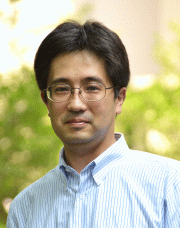
Hirofumi Uchida joins the Walter H. Shorenstein Asia-Pacific Research Center (Shorenstein APARC) during the 2017-2018 academic year from the Kobe University’s Graduate School of Business Administration where he serves as a professor of Banking and Finance.

Uchida’s research interests focus on banking, financial institutions, and financial system architecture. During his stay at Shorenstein APARC, Uchida will conduct research on startup finance in the U.S. from the perspective of an international comparison with Japan. For this research, he receives Abe Fellowship (Social Science Research Council).

Uchida's research has been published in International Economic Review, Journal of Money, Credit and Banking, Journal of Financial Intermediation, Economica, and Journal of Banking and Finance, among others. He is also an associate editor of Journal of Money, Credit, and Banking, and a member of the Study Group for Earthquake and Enterprise Dynamics (SEEDs) and the Money & Finance Research Group (MoFiR). 

Uchida received his M.A. in Economics in 1995 and his Ph.D. in Economics in 1999, both from Osaka University. Prior to joining Kobe University in 2009, Uchida was with the Kyoto Institute for Economic Research at Kyoto University, and the Faculty of Economics at Wakayama University. He was also a visiting scholar at the Kelley School of Business, Indiana University as a 2003 Fulbright Scholar.


616 Serra StreetEncina Hall E301Stanford, CA94305-6055
0
hirofumi_uchida Ph.D.

Hirofumi Uchida joins the Walter H. Shorenstein Asia-Pacific Research Center (Shorenstein APARC) during the 2017-2018 academic year from the Kobe University’s Graduate School of Business Administration where he serves as a professor of Banking and Finance.

Uchida’s research interests focus on banking, financial institutions, and financial system architecture. During his stay at Shorenstein APARC, Uchida will conduct research on startup finance in the U.S. from the perspective of an international comparison with Japan. For this research, he receives Abe Fellowship (Social Science Research Council).

Uchida's research has been published in International Economic Review, Journal of Money, Credit and Banking, Journal of Financial Intermediation, Economica, and Journal of Banking and Finance, among others. He is also an associate editor of Journal of Money, Credit, and Banking, and a member of the Study Group for Earthquake and Enterprise Dynamics (SEEDs) and the Money & Finance Research Group (MoFiR). 

Uchida received his M.A. in Economics in 1995 and his Ph.D. in Economics in 1999, both from Osaka University. Prior to joining Kobe University in 2009, Uchida was with the Kyoto Institute for Economic Research at Kyoto University, and the Faculty of Economics at Wakayama University. He was also a visiting scholar at the Kelley School of Business, Indiana University as a 2003 Fulbright Scholar.

Visiting Scholar
Seminars
Subscribe to Governance