Business
-

This event is co-sponsored by NHK WORLD, Global Agenda, and the Center on Democracy, Development, and the Rule of Law.

About NHK and Global Agenda

NHK WORLD is NHK's international broadcast service. NHK is Japan’s national public broadcasting corporation and operates international television, radio, and internet services; together, they are known as NHK WORLD.

The aims of NHK WORLD are:

  • To provide both domestic and international news to the world accurately and promptly
  • To present information on Asia from various perspectives, making the best use of NHK's global network
  • To serve as a vital information lifeline in the event of major accidents and natural disasters
  • To present broadcasts with great accuracy and speed on many aspects of Japanese culture and lifestyles, recent developments in society and politics, the latest scientific and industrial trends, and Japan's role and opinions regarding important global issues
  • To foster mutual understanding between Japan and other countries and promote friendship and cultural exchange

Global Agenda” is a new program within NHK WORLD TV where world opinion leaders discuss various issues facing Japan and the rest of the world today.

Symposium Overview

Innovation is essential for economic growth, especially in advanced economies. As the catch-up phase of economic growth is ending or has ended for many Asian economies, they face the challenge of transforming their economic systems to ones that encourage innovations and use those as the most important source for growth. The panel will discuss various issues surrounding the economic system that is favorable for innovations. Silicon Valley, where Stanford University is located, has an ecosystem that is conducive to innovations. The panel will pay special attention to implications for Japan and other Asian economies.

Panelists

William Barnnett, Professor of Business Leadership, Strategy, and Organizations, Stanford Graduate School of Business

Francis Fukuyama, Director, Center on Democracy, Development, and the Rule of Law, Freeman Spogli Insititute for International Studies

Takeo Hoshi, Director, Japan Program, Shorenstein Asia-Pacific Research Center

Kenji Kushida, Research Associate, Japan Program, Shorenstein Asia-Pacific Research Center

Note

This event will be recorded and broadcast worldwide. By registering to attend you hereby grant Stanford University and NHK World permission to use encode, digitize, copy, edit, excerpt, transmit, and display the audio or videotape of your participation in this event as well as use your name, voice, likeness, biographic information, and ancillary material in connection with such audio or videotape. You understand that this event will be broadcast worldwide, which will be available to the general public. This event may also be webcast over one or more websites. By registering to attend you grant, without limitations, perpetual rights for the use and transmission and display of audio or videotape of this event. This permission is irrevocable and royalty free, and you understand that the University and NHK will act in reliance on this permission.

RSVP

RSVP for this event is mandatory as seating is limited. Doors will open at 3:00pm and the event will begin promptly at 3:30pm. Since the event is being recorded, we ask that participants arrive on time.

William Barnnett Professor of Business Leadership, Strategy, and Organizations- Graduate School of Business
Francis Fukuyama Director, Center on Democracy, Development, and the Rule of Law- FSI
Takeo Hoshi Director, Japan Program- Shorenstein APARC
Kenji Kushida Research Associate, Japan Program- Shorenstein APARC
Symposiums
Paragraphs

This paper is examines the evolution of Japan’s capital markets and the related regulatory reforms after the Global Financial Crisis. We start by looking at the importance of capital markets in the Japanese financial system. We study how the size of financial flows through capital markets relative to those through the banking sector changed since the 1980s in Section 2. Then, in Section 3, we look at how Japan’s financial system responded to the Global Financial Crisis. We find that the disruption of the financial system in Japan was small. Section 4 then surveys the financial regulatory changes in Japan since the Global Financial Crisis. While the Japanese regulators tightened the regulation to improve the financial stability as the regulators in the U.S. and Europe did, they also continued the efforts to develop capital markets in Japan. The efforts continue and receive strong endorsement from Abenomics, which put an emphasis on economic structural reform to restore growth in Japan. We examine the capital market policies in Abenomics in Section 5. Section 6 concludes.

All Publications button
1
Publication Type
Journal Articles
Publication Date
Journal Publisher
World Scientific in International Economics
Authors
Takeo Hoshi
-


Image
Joseph Z. Perkins, a partner in Orrick's Silicon Valley office, is a member of the Technology Companies Group, which advises emerging companies and venture capital firms. Mr. Perkins focuses his practice on providing private venture financing and merger and acquisition services to Internet, high tech, and clean technology companies in the United States and Japan.


Some of Mr. Perkins's current and former clients include the following:
• Bleacher Report (Sports media; acquired by Turner Broadcasting)
• Doki Doki (stealth)
• FOVE (Virtual reality hardware)
• Getaround (Car sharing community)
• Instagram (Photo social media; acquired by Facebook)
• iSpace (Robotics)
• Life360 (Family connectivity and safety)
• Orchestra - aka Mailbox (e-mail management; acquired by Dropbox)
• Ooma (VoiP hardware)
• Pinterest (Social Media)
• Say Media - fka VideoEgg (Advertising)
• Social Finance (social lending)
• UniversityNow (Online education)
• WHILL (Personal Mobility)

Prior to receiving his Juris Doctor from Harvard Law School, Mr. Perkins spent four years as an officer of a company that provides language and travel services to Japanese travelers.

Seminar Description

The idea of raising money through venture capital can be daunting if you’ve never gone through that process before.  In this presentation, we will discuss various aspects of the fundraise process, including how to choose your investor and prepare for a term sheet, key terms to look for in the financing, and how to get to close as quickly as possible.  Learn about different types of investors, what they look for in their potential investments, and what they bring to the table in accelerating a startup’s growth.  We’ll also review specific scenarios and how various liquidation preferences can impact your company’s exit.

 
RSVP Required

NOTE: The date for this seminar has changed to February 23, 2016.

Agenda
4:15pm: Doors open
4:30pm-5:30pm: Lecture, followed by discussion
5:30pm-6:00pm: Networking

For more information about the Silicon Valley-New Japan Project please visit: http://www.stanford-svnj.org/

Philippines Conference RoomEncina Hall, 3rd Floor616 Serra SteetStanford, CA 94305
Joseph Z. Perkins, Partner, Technology Companies Group, Orrick, Herrington & Sutcliffe LLP
Seminars
Authors
News Type
News
Date
Paragraphs

A conference that honored the life and scholarly contributions of Stanford economist Masahiko Aoki was held at Stanford. Dozens of friends, family and community members paid tribute to Aoki, the Henri and Tomoye Takahashi Professor of Japanese Studies and Professor of Economics, emeritus, who died in July at the age of 77.

Eleven renowned economists and social scientists gave talks on Aoki’s extensive fields of research in economic theory, institutional analysis, corporate governance, and the Japanese and Chinese economies at the Dec. 4 conference, which was followed by a memorial ceremony the next day.

“When we contacted people to speak at this conference, few people turned us down,” said Stanford professor Takeo Hoshi. “The reason for this is Masa. It shows how much Masa was respected and how much his work is valued.”

The events were hosted by the Japan Program at the Walter H. Shorenstein Asia-Pacific Research Center, the Freeman Spogli Institute for International Studies (FSI), Graduate School of Business, Department of Economics and the Stanford Institute for Economic Policy Research (SIEPR).

Image
aoki colleagues

Aoki came to Stanford in 1967 as an assistant professor, held faculty appointments at Kyoto University and Harvard, and returned to Stanford in 1984. He retired to emeritus status at Stanford in 2005.

Throughout the conference, Aoki was described as an astute professor and colleague, valuable mentor and loyal friend by the many speakers and participants who shared works, stories and multimedia featuring their interactions with Aoki.

Aoki pioneered the field of comparative institutional analysis (CIA) with a team of scholars at Stanford: Avner Greif, John Litwack, Paul Milgrom and Yingyi Qian, among others. CIA analyzes and compares different institutions that evolve to regulate different societies.

Masahiko Aoki (far left) is pictured with colleagues on the Stanford campus in the late 1960s.

“Masa had a good background in looking at the economy as a whole, financial institutions as a whole – not just how numbers or actors economically interact – but also the people who interact within a given institutional framework,” said Koichi Hamada, a professor emeritus at Yale University. 

“Masa had a good background in looking at the economy as a whole, financial institutions as a whole – not just how numbers or actors economically interact…”

-Koichi Hamada, Yale University

Aoki applied a systematic lens to everything he studied, a “take society as a total entity” approach, Hamada said.

Aoki grew up in Japan, and developed a deep interest in Japanese politics at an early age. He was actively involved in student movements in the early 1960s, at the heart of which was a campaign against a controversial U.S.-Japan security treaty. China became another great interest of his as the country began to undergo economic transformation and modernization.

Throughout his career, Aoki traveled to Japan and China often, and sought to better inform policy debates by engaging scholars, government leaders and journalists there.

He believed in sharing lessons learned from his own scholarly analyses on what constitute institutions, particularly the “people” aspects – the employees, their cognitive abilities and levels of participation.

[Continues below]


aoki conference spread 700px Caption TBD.

rsd15 090 0063a Caption TBD.

Top left to right: Yingyi Qian of Tsinghau University talks with Avner Greif of Stanford University and Hugh Patrick of Columbia University. / Koichi Hamada of Yale University delivers his remarks titled "Masahiko Aoki: A Social Scientist." Bottom: Reiko Aoki, the wife of Masahiko Aoki, listens in to Kenneth Arrow, a professor emeritus at Stanford University. Credit: Rod Searcey


Aoki was not only a scholar of institutions but also a builder of them.

In 2005, Aoki helped oversee the development of the Center for Industrial Development and Environmental Governance at Tsinghua University in Beijing, which held numerous roundtables in its first decade of existence, and continues to this day.

“Amid a time of diplomatic tensions between China and Japan…Masa was able to bring Japanese, Chinese and American economists together to study and do research,” said Yingyi Qian, dean and professor at the school of economics and management at Tsinghua.

At Stanford, Aoki played a leading role in the creation of the Stanford Japan Center and a multi-day conference that convened annually in Kyoto on issues of mutual concern between Asia-Pacific countries and the United States.

Masa Aoki’s legacy will serve as an integral guidepost for many years to come. May his soul rest in peace.

-Kotaro Suzumura, Hitotsubashi University

Earlier this year, Aoki was hospitalized for lung disease. Even at that stage, he worked tirelessly to revise a paper that examines the institutional development of China and Japan in the late 19th to early 20th centuries.

That paper titled, “Three-person game of institutional resilience versus transition: A model and China-Japan comparative history,” was presented at the conference by Jiahua Che, one of two scholars that Aoki asked to finish and publish the work.

Aoki was also fondly remembered for his mentorship of students at Stanford and other universities he taught at.

“He was an original and unique professor – quite different from others that I’ve met in many respects. He was generous with his time, not hierarchical,” said Miguel Angel Garcia Cestona, who studied for a doctorate at Stanford and now teaches at the Universitat Autonoma de Barcelona.

Garcia Cestona, among other former students, spoke of Aoki as a friend and shared memories of their former professor hosting them at his home.


Image
aoki overlook

Masahiko Aoki in Northern California, 2014.


Related Links:

Conference agenda

Stanford obituary

Hero Image
rsd15 090 0016b
Stanford professor Takeo Hoshi opens a day-long conference at Stanford celebrating the life and scholarly work of Masahiko Aoki, Dec. 4, 2015.
Rod Searcey
All News button
1
-

Kenji Kushida will provide an overview of canonical works of Silicon Valley, including work of Martin Kenney and his classic co-edited volume "Understanding Silicon Valley" and other more recent work drawn from the Stanford Silicon Valley - New Japan project’s "Top Ten Reading List of Silicon Valley." He will also share insights from a recent report co-authored with Richard Dasher, Nobuyuki Harada, Takeo Hoshi, and Tetsuji Okazaki entitled "Institutional Foundations for Growth" which partially draws from research on Silicon Valley.   

Kanetaka Maki will present his new research from a paper entitled "Milestones to University-Based Startup Success: What Is the Impact of Academic Inventor Involvement?” Based on the data analysis of 533 University of California startups, he will explain the impact of inventor involvement in the growth and success of university-based startups.

RSVP Required


Agenda
4:15pm: Doors open
4:30pm-5:30pm: Lecture, followed by discussion
5:30pm-6:00pm: Networking


For more information about the Silicon Valley-New Japan Project please visit: http://www.stanford-svnj.org/

Philippines Conference RoomEncina Hall, 3rd Floor616 Serra StStanford, CA 94305
Kenji Kushida, Research Associate, Shorenstein APARC Japan Program and Stanford Silicon Valley - New Japan Project leader
Kanetaka Maki, Research Associate, Shorenstein APARC Japan Program
Seminars
-

Image
Mathias Hoffmann is Professor of Economics at the University of Zurich. His research focuses on the macroeconomic aspects of international financial integration and on the link between financial markets and the macro-economy more generally. His recent published articles include papers on the determinants of international capital flows and imbalances, the international transmission of business cycles, on international risk sharing and banking regulation. Prior to arriving in Zurich, he was Professor at the University of Dortmund in Germany and a Lecturer at Southampton University (UK). He holds a PhD in Economics from the European University Institute in Florence and obtained his undergraduate education in economics and mathematics at WHU School of Management, Brandeis University and the University of Bonn.

Mathias Hoffmann is a fellow of CESifo Munich and has held visiting positions, at the University of California at Berkeley, the Deutsche Bundesbank, the Hong Kong Monetary Authority and Keio University.

http://www.voxeu.org/person/mathias-hoffmann

http://www.econ.uzh.ch/faculty/hoffmann.html

Philippines Conference Room3rd floor, Encina Hall616 Serra StreetStanford, CA 94305
Mathias Hoffmann, Professor of International Trade and Finance, University of Zurich
Seminars
News Type
News
Date
Paragraphs

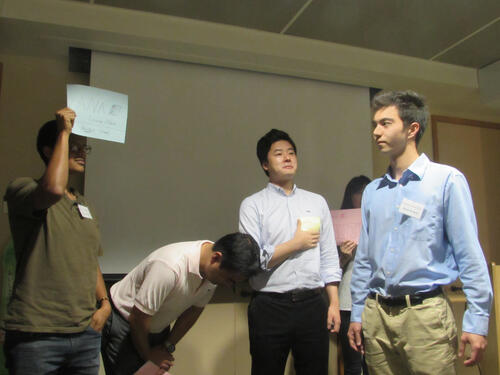
Stanford students worked together to pitch marketing ideas to a major Japanese airline at an event last Tuesday. The event, called an “ideathon,” is part of a series of events seeking to strengthen the U.S.-Japan relationship through exchange of ideas.

The ideathon was the first of its kind at the Shorenstein Asia-Pacific Research Center, led by the Japan Program under the rubric of the Stanford Silicon Valley-New Japan Project (SV-NJ). The project is supported in part by All Nippon Airways (ANA), the Japanese airline featured at the event.

Nineteen students participated, from both undergraduate and graduate levels and across disciplines – including students from the Graduate School of Business, and other majors including economics, mathematics, computer science, philosophy and East Asian studies.

Placed on a team with others they had just met, students were encouraged to assemble quickly and generate solutions to the challenge: how can ANA strengthen its brand awareness in the United States?

ANA is seeking to double in size in the next three years, yet it faces a few obstacles in this endeavor, including a customer base that is mostly in Japan and low brand visibility internationally, according to a senior employee that presented at the event.

“Who had heard of ANA before this event?” asked Hiroyuki Miyagawa, a marketing executive at ANA. Few hands raised in the audience.

Organized into four teams, each student team was joined by an ANA employee who listened in and offered guidance and a chance to learn from a longtime practitioner.

One and a half hours later, with Post-it notes and scribbled diagrams sprinkled across tables, each team emerged ready to present their 3-minute pitch to a panel of judges. The panel included executives from ANA, the World Innovation Lab (WiL), a venture capital firm in Palo Alto, and bTrax, a San Francisco based design firm.

Below are a few pictures from the event.


Image
ideathon team three

Team Three acts out a skit.  |  They proposed that ANA establish lounges for the general public to gather in and purchase goods from Uniqlo and Muji, two Japanese lifestyle retailers. The lounges would offer a place to reinforce ANA's brand outside of the airport, they said.


Image
ideathon team four

Team Four puts their heads together to generate ideas.  |  In their pitch, the team noted that baseball is a popular sport among Americans and Japanese. They recommended baseball be a focus of the marketing campaign, and said television and social media would best reach the target audience.


Image
ideathon team five

Team Five explains their marketing approach.  |  Flying can lead to some unpleasant experiences, and a way ANA can set itself apart is to make those experiences manageable, and even enjoyable, they said. Their proposal was to bring new amenities to the in-flight experience such as a care package for people who sit in the middle seat.


Image
ideathon team one

Team One poses for a picture after their presentation.  |  In their pitch, they recommended using ANA’s association with Japan to differentiate from other global airlines. Their approach included creating a film that features an American celebrity traveling on ANA.


The winning team was Team One whose concept was to use a celebrity figure – Ellen DeGeneres – in their advertising. They said that the target audience could relate to DeGeneres, and her already-established following would be an advantage.

The judges commended Team One for the creativity of their idea and its level of feasibility. Team One consisted of students Yaqian Fan, Michael Hong, Sam Ide, Lu Li and Adelbert Tan.

Kenji Kushida, a Stanford alumnus and project leader of SV-NJ, said:

“When I was a student, I craved for an opportunity to brainstorm solutions to real-world challenges and to do it in an environment that provided instant feedback,” he said, “We were able to make that happen here with the support of ANA and WiL, and are thrilled with the outcome."

Hero Image
ideathon headline cropped
All News button
1
-

The Shorenstein Asia-Pacific Research Center (APARC) Japan Program with the Freeman Spogli Institute of International Studies (FSI) as well as the Stanford Graduate School of Business, the Stanford Institute for Economic Policy Research (SIEPR), and the Stanford Department of Economics will be hosting a memorial conference and service on December 4th and 5th in honor of the late Masahiko Aoki. December 4th will be a full day conference featuring topics within Masa's extensive field of study and research including theoretical and applied economics, theory of institutions, corporate architecture and governance, and the Japanese and Chinese economies. The day will culminate with a cocktail reception. The Celebration of Life on December 5th will be a gathering for family and friends in remembrance of Masa with a light lunch reception to follow.

December 4, 2015

Memorial Conference

Bechtel Conference Center, 616 Serra Street
Stanford University

Agenda

8:30am - 8:50am            Breakfast & Registration

8:50am - 9:00am            Welcome Remarks: Takeo Hoshi (Stanford University)

9:00am - 9:30am            Kenneth Arrow (Stanford University), “The Role of Organizational Structure in the Economy”

9:30am - 10:00am          Paul Milgrom (Stanford University), "Designing the US Incentive Auction"

10:00am - 10:30am        Break

10:30am - 11:00am        Koichi Hamada, Yale University, “Masahiko Aoki: A Social Scientist"

11:00am - 11:30am        Kotaro Suzumura (Hitotsubashi University), “Masahiko Aoki (1938-2015): Recollections of his Pilgrimage and Legacy in Japan”

11:30am - 12:00pm       Yingyi Qian (Tsinghua University), "Masahiko Aoki and China"

12:00pm - 1:15pm          Lunch

1:15pm - 1:45pm            Jiahua Che (Chinese University of Hong Kong) presenting Masahiko Aoki's

                                            "Three-person game of institutional resilience vc transition: A model and

                                              China-Japan comparative history"

1:45pm - 2:15pm           Miguel Angel Garcia Cestona (Universitat Autonoma de Barcelona), "Corporate Governance and Employee Participation: some lessons from Mondragon"

2:15pm - 2:45pm           Herbert Gintis (Santa Fe Institute), "General Social Equilibrium and its Dynamics"

2:45pm - 3:15pm           Break

3:15pm - 3:45pm           Dale Jorgenson (Harvard University), "

"

3:45pm - 4:15pm           Avner Greif (Stanford University), "Comparative Institutional Analysis: China and Europe Compared"

4:15pm - 4:45pm           Francis Fukuyama (Stanford University), "Asian Kinship, Industrial Structure, and Trust in Government"

4:45pm - 5:00pm           Closing, Takeo Hoshi (Stanford University)

5:00pm - 6:00pm           Cocktail Reception

*Agenda is subject to change and will be updated as speakers are confirmed


December 5, 2015

Celebration of Life

Bechtel Conference Center, 616 Serra Street
Stanford University

Agenda

10:30am - 11:00am          Registration

11:00am - 12:00pm          Celebration of Life

12:00pm - 1:30pm            Lunch Reception


Bechtel Conference Center616 Serra StreetStanford UniversityStanford, CA 94305
Conferences
-

Toru Hashimoto was a member of the Board of Directors and President and Chief Executive Officer of the Development Bank of Japan Inc. (DBJ) from June 2011 to June 2015. He is currently Senior Advisor of the DBJ. Previously, Mr. Hashimoto was Chairman of Deutsche Securities Inc., an investment banking subsidiary in Japan of Deutsche Bank, from July 2003 to September 2008 after serving as Senior Advisor from January 2003 to June 2003. Prior to joining Deutsche Securities, he was Chairman of the Board of Directors of the Fuji Bank, Limited (currently the Mizuho Financial Group) from June 1996 to March 2002. Earlier, he was President and Chief Executive Officer from 1991 to 1996. He began his career at the bank in 1957. Mr. Hashimoto served as Vice Chairman of the Board of Councilors of the Japan Federation of Economic Organizations from 1997 to 2001 and Chairman of the Japanese Bankers Association from 1995 to 1996. He was also Vice Chairman of the Institute of International Finance, Inc. from 1997 to 1999. Mr. Hashimoto received a bachelor's degree in law from the University of Tokyo in 1957. He was a Fulbright Scholar at the Graduate School of Economics of the University of Kansas from 1959 to 1960.

DBJ Initiatives for Japan's Growth Strategy Presentation
Download pdf
Philippines Conference RoomEncina Hall, 3rd Floor616 Serra StreetStanford, CA 94305
Toru Hashimoto, Former President and CEO, Development Bank of Japan Inc.
Seminars
Subscribe to Business