Governance

FSI's research on the origins, character and consequences of government institutions spans continents and academic disciplines. The institute’s senior fellows and their colleagues across Stanford examine the principles of public administration and implementation. Their work focuses on how maternal health care is delivered in rural China, how public action can create wealth and eliminate poverty, and why U.S. immigration reform keeps stalling. 

FSI’s work includes comparative studies of how institutions help resolve policy and societal issues. Scholars aim to clearly define and make sense of the rule of law, examining how it is invoked and applied around the world. 

FSI researchers also investigate government services – trying to understand and measure how they work, whom they serve and how good they are. They assess energy services aimed at helping the poorest people around the world and explore public opinion on torture policies. The Children in Crisis project addresses how child health interventions interact with political reform. Specific research on governance, organizations and security capitalizes on FSI's longstanding interests and looks at how governance and organizational issues affect a nation’s ability to address security and international cooperation.

News Type
News
Date
Paragraphs

“Win support from the people,” Yuhua Wang, Assistant Professor of Government at Harvard University, repeated the words from one of Xi Jinping’s speeches that was given to justify China’s massive anti-corruption campaign. The exact scope and motivations for President Xi Jinping’s anti-corruption campaign is, as yet, unknowable, Wang stated; but clearly, a major public aim of CCP Chairman Xi Jinping was to build regime support by cracking down on bad actors in the government.

Prof. Yuhua Wang gave a talk titled “Why Xi Jinping’s Anti-Corruption Campaign has Undermined Chinese Citizens’ Regime Support?” at the Stanford China Program on November 12th, 2018, based on a national-level survey analysis that he had conducted with his co-author, Prof. Bruce Dickson at George Washington University. Rather than focusing on Xi’s motivations for undertaking his crackdown, however, Wang and Dickson tried to measure the impact of Xi’s anti-corruption campaign on public perception of the central government and the Chinese Communist Party (CCP). Did the campaign, in other words, shore up public support for China’s central government and Party, as Xi hoped it would – or did it, in fact, undermine regime support?

Professor Wang first offered some background on how this anti-corruption campaign got started around 2012-2013, shortly after Xi Jinping became Chairman of the CCP. A staggering 261 vice-ministerial officials and 350,000 officials had been investigated to date; and, even those at the highest levels of China’s leadership – former Politburo and Politburo Standing Committee members, for instance –were not immune from scrutiny. And, equally unprecedented, media coverage of these corruption cases – from Bo Xilai to Zhou Yongkang and Xu Caihou – were extensive, exposing their lavish lifestyles and illicit dalliances on social and traditional media. Wang speculated that such lurid publicity most likely shocked the public, potentially turning citizens against even the central government, which consistently enjoys significantly higher levels of public trust than local governments in China. He decided, therefore, to explore with his co-author what the effects of such exposés might be on public perception of the central regime.

Replicating the same questionnaire and sampling design, Wang and his co-author took a national random sample in two waves – one before the anti-corruption campaign in 2010 and a second one during the campaign in 2014. They interviewed approximately 4,000 people across 25 provinces in China in order to measure potential shifts in people’s attitudes towards the regime over those four years. The findings were, indeed, illuminating:

First, Wang stated, increasing frequency of corruption investigations in a locality was correlated with a greater drop in popular regime support (defined as trust in central government or support for the CCP) in that locality. Higher volume of corruption investigations in a locality was also negatively correlated with people’s perception that government officials were generally honest and clean. The corrosive effects of the campaign, furthermore, proved strongest on those who had initially believed in the integrity of government officials; but for those who were already cynical about official corruption, the campaign had a smaller effect. Lastly, higher the survey respondent’s use of social media like WeChat, stronger the negative effects on his/her support for the regime. The authors also took into account how the chilling effects of the campaign may be negatively impacting local economies and how that slowing economy may actually be the primary cause behind decreasing public regime support. To account for this potentially confounding effect, Wang looked for evidence as to whether the campaign had contributed to a slowdown in China’s economy by 2014. Perhaps because 2014 was still early on in the campaign, he stated that they found no evidence of slower GDP growth rate, growth rate per capita GDP, etc., in the regions where they had undertaken their surveys.

Overall, Wang’s research calls into question whether Xi Jinping’s anti-corruption campaign is, in fact, advancing one of his main goals– i.e., to increase people’s faith in the central regime – or whether it is actually proving counterproductive to his aim. In fact, Wang’s research seems to indicate that the more Chinese citizens are exposed to evidence of government corruption, the more the central regime appears to suffer a loss in credibility. Wang was careful to point out, however, that they were barred, due to political sensitivity, from asking any questions regarding respondents’ attitudes towards Xi Jinping himself. Thus, it is still an open question whether popular support for Xi Jinping himself is increasing even though public trust in the regime might be decreasing.

The recording and transcript are available below.  

Hero Image
wang
Yuhua Wang, Assistant Professor of Government at Harvard University, speaks at the Asia-Pacific Research Center's China Program on November 12th, 2018.
All News button
1
-

U.S.-China relations has reached a watershed moment.  Even as both nations reassess the trajectory of their bilateral relationship, James Green, who recently served as Minister Counselor for Trade Affairs at the U.S. Embassy in Beijing, takes a close look at critical points in the history of U.S.-China negotiations: from anti-Soviet coordination to nonproliferation, from the Tiananmen crackdown to cyber theft, from China's WTO accession to G20 summits.  James Green is the creator of Georgetown University’s new initiative, the U.S.-China Dialogue Podcast and has conducted in-depth interviews with two dozen former U.S. cabinet secretaries, ambassadors and senior officials regarding pivotal events in U.S.-China relations.  Mr. Green will explore how U.S. Administrations from Carter to Trump have dealt with a rising China; what motivated them, and what the lessons are for future administrations.  Based on his time as the senior official in China from the Office of the United States Trade Representative (USTR), furthermore, Mr. Green will also speak about the prospects for future trade friction with China.

Image
james green

James Green has worked for over two decades on U.S.-Asia relations. For the last five years, Mr. Green was the Minister Counselor for Trade Affairs at the U.S. Embassy in Beijing.  As the senior official in China from the Office of the United States Trade Representative (USTR), Mr. Green was deeply involved in all aspects of trade negotiations, trade enforcement, and in reducing market access barriers for American entities.  In prior government service, Mr. Green worked on the Secretary of State’s Policy Planning Staff and at the State Department’s China Desk on bilateral affairs. He also served as the China Director of the White House’s National Security Council.  In the private sector, Mr. Green was a senior vice president at the global strategy firm founded by former Secretary of State Madeleine Albright and was the founding government relations manager at the American Chamber of Commerce in Shanghai, Asia’s largest AmCham.  Currently, Mr. Green is a Senior Research Fellow at Georgetown University's Initiative for U.S.-China Dialogue on Global Issues and hosts a U.S.-China Dialogue Podcast.   

Philippines Conference RoomEncina Hall, 3rd Floor616 Serra Mall, Stanford, CA 94305
James Green <i>Georgetown University</i><br><br>
Seminars
Authors
News Type
News
Date
Paragraphs
U.S. and Chinese trade negotiators remain engaged in intensive talks, although it is yet to be seen whether and when they can strike a final deal. But even if they are able to reach an agreement, in the confrontation between Washington and Beijing “the trade part is incidental: it’s a technology war, not a trade war,” said Ambassador Craig Allen, president of the U.S.-China Business Council (USCBC), speaking at Shorenstien APARC on March 11.
 
Allen has spent much of his career in Asia and dealing with China-related issues from various posts within government, including serving as deputy assistant secretary for China at the U.S. Department of Commerce. As head of USCBC, he now leads an organization representing over 200 American companies doing business with China. He delivered his remarks at a seminar that is part of the China Program’s colloquia series about the future of U.S.-China relations.
 
Allen first brought the audience up to speed on the latest developments in the U.S.-China trade talks, where there are still outstanding questions such as whether the tariffs end now or later and whether a trade agreement will include a unilateral or bilateral enforcement mechanism. He expressed optimism that an agreement would bring significant progress on multiple fronts from the U.S. perspective, including enormous expansion in Chinese purchase of U.S. goods in various sectors; progress over IP rights; progress in eliminating forced technology transfers; improved market access to China; and even renewed commitment to reducing cybertheft. Yet Allen also suggested that these changes, which the Chinese are willing to make, are the ones that they know serve to make their markets more competitive in the end.
 

Structural vs. Cosmetic Changes

Allen was far less confident, however, about the prospects of addressing structural issues with China, that is, areas where the Chinese economy is an outlier to the global economy, violates WTO rules, and greatly differs from OECD norms. This is because these core dimensions touch on the role of the Chinese Communist Party (CCP) in the government and in the economy.

He counted among these structural issues the enormous role of state-owned enterprises (SOEs); the scale of subsidies going to the technology sector and their lack of transparency; prohibitions on foreign investment in sensitive industries like telecommunications and media; the unequal treatment of foreign companies; discriminatory implementation of regulations and the lack of an appeals process; uneven implementation of IP rights; the outsized role of the CCP in the economy; the dominant role of industrial policy; Xi Jinping government’s aggressive techno-nationalism, which is manifested in its calls for indigenous innovation and for self-reliance; and its excessive control over the information space.

“China is willing to make cosmetic changes to these problems,” said Allen, “even muscular changes, but no changes to the skeleton, the core, the system under which the CCP has complete control.”

A trade deal might remove the immediate threat of tariffs as a source of friction between the United States and China, noted Allen, but the essence of the conflict is not about trade: rather, it has to do with technology. “The trade war will morph into a technology war,” he predicted, and 2019 will mark a change in that direction, making life much more complicated for both American—especially Silicon Valley—and Chinese companies.

A Security Dilemma

Both the United States and China are now locked in a “security dilemma,” noted Allen. “One side takes defensive measures which the other side perceives as aggressive measures,” and “we are ratcheting up on national security.” The U.S. Department of Commerce, for instance, is looking to change the ways of dealing with Chinese companies and to expand export controls, extending their scope to a whole new category of “emerging technologies,” regarding whose definition there is intensive debate in Washington. Depending on its scope, a broad definition could jeopardize hundreds of thousands of projects and disrupt investment and global supply chains.

On the Chinese side, Allen noted, there is a parallel process going on. In 2019, we should expect China to similarly impose tightened export controls, he cautioned, cybersecurity law, personal identification information law, data localization requirements, and a strengthened national security law that, among other requirements, will ratchet up audit requirements of American companies seeking market access and the type of companies allowed to have only Chinese-origin equipment.

Both countries have given in to exaggerated security concerns that threaten the global commons, argued Allen. “American and Chinese companies have worked together in the innovation space for years in a beautiful manner. It has been a remarkably productive exercise over the last four decades that brought tremendous benefit for everyone. You can't imagine a company like Apple without China, and you can't imagine China without a company like Apple. Now all this is being put into question.”

The heightened security measures on both sides are fraught with threats to research institutions, businesses, and the innovation ecosystem at large. Academic exchanges, students, and professors will be deemed exports of knowledge subject to technology licensing laws, cautioned Allen. He asked: “How many thousands of collaborative research ventures will be impacted?”

We are entering the technology war at the wrong time, said Allen, just as China is becoming a middle-income country with hundreds of millions of middle-class citizens who want to buy American-made goods and services that U.S. companies want to sell to them. Now is the time to take advantage of China’s transitioning to a consumption-led economy, he claimed, and “become a good friend of Chinese middle-class consumers.”

China is also forging ahead with its innovative economy, particularly in areas such as AI, 5G, and aspects of the life sciences. “This isn’t a one-way street,” emphasized Allen. “We need their brains as much as they need ours […] China will remain an innovative country, and we need to deal with that.”

“This is not a time to panic,” he pointed out, “but a time to reset and ask: ‘What are the rules of the road for technology cooperation and competition? What are the rules for enforcement and how do we enforce the new rules fairly?”

“If China follows its WTO obligations then we would get there,” Allen claimed. “But if President Xi is going to be single-minded about self-reliance and cutting foreign influence on the Chinese economy, then we’re up for rough sledding and 2019 will be a definitive year in determining the course forward.”

Trade deal or no deal, in the U.S.-China race for technology supremacy, he concluded, trust is a commodity in short supply.


Hero Image
U.S. and Chinese officials meeting in the White House as part of ongoing trade negotiations.
U.S. Secretary of the Treasury Steven Mnuchin (2nd L) speaks as U.S. Trade Representative Robert Lighthizer (3rd L) and U.S. Secretary of Commerce Wilbur Ross (L) listen during a meeting between U.S. President Donald Trump and Chinese Vice Premier Liu He (R) in the Oval Office of the White House February 22, 2019 in Washington, DC.
Alex Wong/ Getty Images
All News button
1
-

RSVP required

NOTE: THIS EVENT IS CLOSED TO THE MEDIA 

No recording will be allowed during the program. RSVP required for admission. No walk-ins.

Experts talk about a new Cold War between China and the United States. The world’s two largest economies are in open trade conflict, engaged in technological competition and stoking geopolitical uncertainty. The Oksenberg Conference will explore the causes that underlie today’s intensified conflict between the United States and China. We ask: What has precipitated the confrontational approach that currently unites U.S. policy towards China? What is the future of our strategic competition in the technological, economic and security realms? If U.S.-China rivalry is allowed to escalate, what might its implications be for our international liberal order? If a “new” Cold War is forming, how might it follow or diverge from the “old” Soviet-era Cold War?

Image
2019 Oksenberg Conference
The Oksenberg Conference
, held annually honors the legacy of the late Professor Michel Oksenberg (1938–2001) who was a senior fellow at Shorenstein APARC and the Freeman Spogli Institute for International Studies. Professor Oksenberg also served as a key member of the National Security Council when the United States normalized relations with China, and consistently urged that the United States engage with Asia in a more considered manner. In tribute, the Oksenberg Lecture recognizes distinguished individuals who have helped to advance understanding between the United States and the nations of the Asia-Pacific.
 
Agenda
 
2:35-3:05 PM    Conversation with Dr. Condoleezza Rice, former U.S. Secretary of State and National Security Advisor
3:05-3:30 PM    Audience Q & A
3:30-3:45 PM    Break
3:45-4:25 PM    Panel discussion with Prof. David M. Lampton and Amb. Michael A. McFaul
4:25-5:00 PM    Audience Q & A


Speakers

Image
David M. Lampton
David M. Lampton is Oksenberg-Rohlen Fellow and Research Scholar at FSI and affiliated with Walter H. Shorenstein Asia-Pacific Research Center (Shorenstein APARC).  He also is the Hyman Professor of China Studies and Director of the China Studies Program at the Johns Hopkins School of Advanced International Studies (SAIS) Emeritus.  Dr. Lampton's current book project is focused on the development of high-speed railways from southern China to Singapore.  He is the author of a dozen books and monographs, including Following the Leader: Ruling China, from Deng Xiaoping to Xi Jinping (University of California Press, 2014, and second edition 2019) and The Three Faces of Chinese Power: Might, Money, and Minds (University of California Press, 2008).  He has testified at multiple congressional and commission sessions and published numerous articles, essays, book reviews, and opinion pieces in many venues popular and academic in both the western world and in Chinese-speaking societies, including Foreign Affairs, Foreign Policy, The American Political Science Review, The China Quarterly, The New York Times, The Washington Post,and many others.

Formerly President of the National Committee on United States-China Relations, Professor Lampton consults with government, business, and social sector organizations, and has served on the boards of several non-governmental and educational organizations, including the Asia Foundation for which he served as chairman.  The recipient of many academic awards, he is an Honorary Senior Fellow of the American Studies Institute of the Chinese Academy of Social Sciences, former Gilman Scholar at Johns Hopkins, and the inaugural winner of the Scalapino Prize in 2010, awarded by the National Bureau of Asian Research and the Woodrow Wilson International Center for Scholars in recognition of his exceptional contributions to America’s understanding of the vast changes underway in Asia.


Image
Amb. Michael McFaul
Michael McFaul is the Ken Olivier and Angela Nomellini Professor of International Studies in Political Science; Director and Senior Fellow at the Freeman Spogli Institute for International Studies (FSI); and the Peter and Helen Bing Senior Fellow at the Hoover Institution, all at Stanford University.  He was also the Distinguished Mingde Faculty Fellow at the Stanford Center at Peking University from June to August of 2015.  He joined the Stanford faculty in 1995.  Professor McFaul is also an analyst for NBC News and a contributing columnist to The Washington Post.  

Dr. McFaul served for five years in the Obama administration, first as Special Assistant to the President and Senior Director for Russian and Eurasian Affairs at the National Security Council at the White House (2009-2012), and then as U.S. Ambassador to the Russian Federation (2012-2014).  He has authored several books, most recently TheNew York Timesbestseller, From Cold War to Hot Peace: An American Ambassador in Putin’s Russia.  Earlier books include Advancing Democracy Abroad: Why We Should, How We Can; Transitions to Democracy: A Comparative Perspective(eds. with Kathryn Stoner); Power and Purpose: American Policy toward Russia after the Cold War (with James Goldgeier); and Russia’s Unfinished Revolution: Political Change from Gorbachev to Putin.  


Image
Jean Oi

Jean C. Oi is the William Haas Professor of Chinese Politics in the Department of Political Science and a Senior Fellow of FSI at Stanford University.  She is the founding director of the Stanford China Program at Shorenstein APARC and is the founding Lee Shau Kee Director of the Stanford Center at Peking University.  Professor Oi has published extensively on political economy and the process of reform in China.  Her books include Zouping Revisited:  Adaptive Governance in a Chinese County, co-edited with Steven Goldstein (2018); and Challenges in the Process of China’s Urbanization, co-edited with Karen Eggleston and Wang Yiming (2017); Rural China Takes Off (1999); Property Rights and Economic Reform in China (1999), co-edited with Andrew Walder; and State and Peasant in Contemporary China (1989).  Professor Oi also has an edited volume, China’s Path to the Future: Challenges, Constraints, and Choices, co-edited with Dr. Thomas Fingar (forthcoming, Stanford University Press).  Her recent articles include “Unpacking the Patterns of Corporate Restructuring during China’s SOE Reform,” co-authored with Xiaojun Li in Economic and Political Studies (2018); and “Reflections on 40 Years of Rural Reform,” in Jacques deLisle and Avery Goldstein, eds., Reform and Opening:  40 Years and Counting, forthcoming.  Her current research centers on fiscal reform and local government debt as well as continuing SOE reforms in China.


Image
Secretary Condoleezza Rice

Secretary Condoleezza Rice is currently the Denning Professor in Global Business and the Economy at the Stanford Graduate School of Business; the Thomas and Barbara Stephenson Senior Fellow on Public Policy at the Hoover Institution; and a professor of Political Science at Stanford University. She is also a founding partner of RiceHadleyGates, LLC.

From January 2005 to 2009, Rice served as the 66th Secretary of State of the United States, the second woman and first African American woman to hold the post. Rice also served as President George W. Bush’s Assistant to the President for National Security Affairs (National Security Advisor) from January 2001 to 2005, the first woman to hold the position.

Rice served as Stanford University’s Provost from 1993 to 1999, during which she was the institution's chief budget and academic officer. As Provost, she was responsible for a $1.5 billion annual budget and the academic program involving 1,400 faculty members and 14,000 students. In 1997, she also served on the Federal Advisory Committee on Gender -­- Integrated Training in the Military.

From 1989 through March 1991, Rice served on President George H.W. Bush’s National Security Council staff. She served as Director; Senior Director of Soviet and East European Affairs; and, Special Assistant to the President for National Security Affairs. In 1986, while an international affairs fellow of the Council on Foreign Relations, Rice also served as Special Assistant to the Director of the Joint Chiefs of Staff.

As professor of Political Science, Rice has been on the Stanford faculty since 1981 and has won two of the highest teaching honors – the 1984 Walter J. Gores Award for Excellence in Teaching and the 1993 School of Humanities and Sciences Dean's Award for Distinguished Teaching.

She has authored and coauthored numerous books, including three bestsellers, Democracy: Stories from the Long Road to Freedom (2017); No Higher Honor: A Memoir of My Years in Washington (2011); and Extraordinary, Ordinary People: A Memoir of Family (2010). She also wrote Germany Unified and Europe Transformed: A Study in Statecraft (1995) with Philip Zelikow; The Gorbachev Era (1986) with Alexander Dallin; and Uncertain Allegiance: The Soviet Union and the Czechoslovak Army (1984).

In  1991,  Rice  cofounded  the  Center for  a  New  Generation  (CNG),  an  innovative,  after-­school academic enrichment program for students in East Palo Alto and East Menlo Park, California. In 1996, CNG merged with the Boys and Girls Club of the Peninsula (an affiliate club of the Boys and Girls Clubs of America). CNG has since expanded to local BGCA chapters in Birmingham, Atlanta, and Dallas. She remains an active proponent of an extended learning day through after school programs.

Since 2009, Rice has served as a founding partner at Rice Hadley Gates, LLC, an international strategic consulting firm based in Silicon Valley and Washington, D.C. The firm works with senior executives of major companies to implement strategic plans and expand in emerging markets. Other partners include former National Security Advisor Stephen J. Hadley and former Secretary of Defense Robert M. Gates.

Rice currently serves on the boards of Dropbox, an online-­storage technology company; C3, an energy software company; and Makena Capital, a private endowment firm. In addition, she is vice chair of the board of governors of the Boys and Girls Clubs of America; a member of the board of the Foundation for  Excellence in Education; and a trustee of the Aspen Institute. Previously, Rice served on various additional boards, including those of: the George W. Bush Institute; the Commonwealth Club; KiOR, Inc.; the Chevron Corporation; the Charles Schwab Corporation; the Transamerica Corporation; the Hewlett-­Packard Company; the University of Notre Dame; the John F. Kennedy Center for the Performing Arts; and, the San Francisco Symphony Board of Governors.

In 2013, Rice was appointed to the College Football Playoff Committee, formerly the Bowl Championship Series.

Born in Birmingham, Alabama, Rice earned her bachelor's degree in political science, cum laude and Phi Beta Kappa, from the University of Denver; her master’s from the University of Notre Dame; and her Ph.D. from the Graduate School of International Studies at the University of Denver.

Rice is a Fellow of the American Academy of Arts and Sciences and has been awarded fifteen honorary doctorates. She currently resides in Stanford, California.


Bechtel Conference Center
616 Serra Mall
Encina Hall, Central, 1st Floor
Stanford, CA 94305

David M. Lampton <br><i>Oksenberg-Rohlen Fellow, FSI, Stanford University</i><br><br>
Michael A. McFaul <br><i>Director, Freeman Spogli Institute for International Studies (FSI); Professor, Political Science, Stanford University; Senior Fellow, Hoover Institution </i><br><br>
Jean C. Oi (Moderator) <br><i>Director, Stanford China Program; William Haas Professor of Chinese Studies, Stanford University</i><br><br>
Secretary Condoleezza Rice <br><i>The Denning Professor in Global Business and the Economy, Stanford Graduate School of Business; The Thomas and Barbara Stephenson Senior Fellow on Public Policy, Hoover Institution; Professor of Political Science, Stanford University</i><br><br>
Lectures
-

WE HAVE REACHED VENUE CAPACITY AND ARE NO LONGER ACCEPTING RSVPS


Rising US-China economic tensions are normal and were to be expected as China modernized. The current discussion of possible “disengagement” between the two was not foreordained, and results from relatively recent divergence in Chinese policy-making from the 40 year trend. The trend is not inevitable, but it will strengthen unless Beijing reverts to market liberalization: nations built on fundamentally different economic systems cannot be as linked as those with like-minded approaches. But China is far from locked-in to a non-market future, and any talk of US disengagement should be rigorously tested against three principles: provisional, partial and peaceful.   

Image
drosen press

Daniel H. Rosen is a founding partner of Rhodium Group and leads the firm’s work on China, India and Asia.  Dan has twenty-six years of professional experience analyzing China’s economy, commercial sector and external interactions. He is widely recognized for his contributions on the US-China economic relationship. He is affiliated with a number of American think tanks focused on international economics, and is an Adjunct Associate Professor at Columbia University. From 2000-2001, Dan was Senior Adviser for International Economic Policy at the White House National Economic Council and National Security Council. He is a member of the Council on Foreign Relations, and board member of the National Committee on US-China Relations. A native of New York City, Dan graduated with distinction from the graduate School of Foreign Service of Georgetown University (MSFS) and with honors in Asian Studies and Economics from the University of Texas, Austin (BA).

This event is part of the China Program’s Colloquia Series entitled "A New Cold War?: Sharp Power, Strategic Competition, and the Future of U.S.-China Relations " sponsored by Shorenstein APARC's China Program.

A New Cold War?: Sharp Power, Strategic Competition, and the Future of U.S.-China Relations

Image

Trade conflict has exploded. The media is rife with stories of China’s unfair trade practices, cyber theft, IP theft and forced technology transfers. Who will first scale the commanding heights of technological supremacy? Who will be the first mover in AI, robotics and biotechnology? What are the implications of Beijing’s ambitious infrastructure projects, including its Belt and Road Initiative? How is China’s “sharp power” deployed, and what are its implications for political and civic life in the U.S.? Can the Trump administration and Beijing’s leadership reach agreement on our trade disputes? Are these just the beginning salvos of an increasingly turbulent future? As U.S. policy towards China sharply veers away from “constructive engagement” to “strategic competition,” the Stanford China Program will host a series of talks by leading experts to explore the current state of our bilateral relations, its potential future, and their implications for the world order.

p.p1 {margin: 0.0px 0.0px 0.0px 0.0px; font: 12.0px Calibri} span.s1 {font: 11.0px Calibri; font-kerning: none} span.s2 {font-kerning: none}

https://aparc.fsi.stanford.edu/china/research/new-cold-war-sharp-power-strategic-competition-and-future-us-china-relations

Philippines Conference Room Encina Hall, 3rd Floor 616 Serra Mall, Stanford, CA 94305
Daniel Rosen <i>Rhodium Group</i><br><br>
Seminars
News Type
News
Date
Paragraphs

Shorenstein APARC is pleased to announce the selection of two scholars as postdoctoral fellows for the 2019-20 academic year. They will begin their appointments at Stanford in the coming Autumn quarter.

The Center offers the Shorenstein Postdoctoral Fellowship on Contemporary Asia to recent doctoral graduates dedicated to research and writing on contemporary Asia, primarily in the areas of political, economic, or social change in the Asia-Pacific region, or international relations and international political economy in the region. The Center’s Asia Health Policy Program sponsors the Asia Health Policy Postdoctoral Fellowship, supporting young scholars who pursue original research on contemporary health or healthcare policy of high relevance to low- and middle-income countries in the Asia-Pacific region

Fellows develop their dissertations and other projects for publication, present their research, and participate in the intellectual life at the Center and at Stanford at large. Our postdoctoral fellows often go on to pursue careers at top universities and research organizations around the world and continue to contribute to APARC research and publications.

Meet our new postdoctoral scholars:


Image
Portrait of Radhika Jain
Radhika Jain
Asia Health Policy Postdoctoral Fellow

What are the conditions necessary to ensure the effectiveness of public health insurance programs?

Radhika Jain is completing her doctorate in the Department of Global Health at Harvard University. She studies the role of the private sector in the health system, frictions in health care markets, and the incidence of public health policy benefits.

Radhika’s dissertation examines the extent to which government subsidies for health care under insurance are captured by private hospitals instead of being passed through to patients, and whether accountability measures can help patients claim their entitlements. Radhika’s research has been supported by grants from the Weiss Family Fund and the Jameel Poverty Action Lab (JPAL). She has worked on impact evaluations of health programs in India and on the implementation of HIV programs across several countries in sub-Saharan Africa. She also held a doctoral fellowship at the Center for Global Development.

At Shorenstein APARC, Radhika will refine her dissertation research for publication in academic journals and start new work on the structure of health care markets in India and the impacts of measures to increase the effectiveness of public health insurance.  


Image
Portrait of Hannah June Kim
Hannah June Kim
Shorenstein Postdoctoral Fellow on Contemporary Asia

How does modernization influence cultural democratization in East Asia?

Hannah June Kim is completing her doctorate in the Department of Political Science at the University of California, Irvine. She researches public opinion, political behavior, theories of modernization, economic development, and democratic citizenship, focusing on East Asia.

Hannah’s dissertation examines how and why people view democracy in systematically different ways in six countries: China, Japan, Korea, Singapore, Taiwan, and Vietnam. Developing unique categories of democratic citizenship that measure the cognitive, affective, and behavioral patterns of individuals, she finds that state-led economic development limited the growth of cultural democratization among middle class groups in all three dimensions. The results imply that the classic causality between modernization and democratization may not be universally applicable to different cultural contexts.

At Shorenstein APARC, Hannah will work on developing her dissertation into a book manuscript and make progress on her next project that explores democratization and gender empowerment in East Asia. Hannah received an MA in International Studies from Korea University and a BA from UCLA. Her work has been published, or is forthcoming, in The Journal of Politics, PS: Political Science & Politics, and the Japanese Journal of Political Science.


Hero Image
encina hall
All News button
1
Authors
News Type
News
Date
Paragraphs

In the nearly seven years since assuming the role of General Secretary of the Communist Party of China, Xi Jinping has had far-ranging impact on the country’s policies at home and abroad. From his anti-corruption campaign and tightening restrictions on civil society to championing the Belt and Road initiative and abolishing China’s presidential term limits, Xi is transforming the Chinese state and its place on the global stage.

Among the cutting-edge topics that China scholars are beginning to explore is Xi’s impact on Chinese politics and its concomitant influence on what and how scholars study Chinese politics. Last December, the China Program at Shorenstein APARC hosted a conference that drew preeminent scholars of Chinese politics and comparative politics primarily from across the United States and Canada, where they gathered to assess the state of the discipline, and where the field might go next.

Too Big for One Room

The conference traces its origins to a prior gathering at the American Political Science Association (APSA). The number of attendees at that meeting outpaced any room upgrade APSA could provide. “We were impressed by the number of people studying Chinese politics,” said the China Program Director Jean Oi . “It was apparent to many of us who attended that meeting that it was time we convened a separate event with leaders in the field.”

The need to bring together the multiple generations of scholars of Chinese politics was also clear. “Younger scholars today are so much more well-equipped with various sophisticated methodologies such as machine learning and web scraping,” noted Oi. “We decided it would be useful to gather those doing various types of research, quantitative and qualitative, to think about what we don’t know about Chinese politics but would like to know; and how possibly we might go about doing that research. Our goal for this conference was to try to identify collectively some of those questions for the study of Chinese politics and how our research might contribute to the broader field of comparative politics.” The first gathering of Chinese politics scholars took place at Harvard in December 2017.

‘Burning Questions’ Light Up Second Gathering

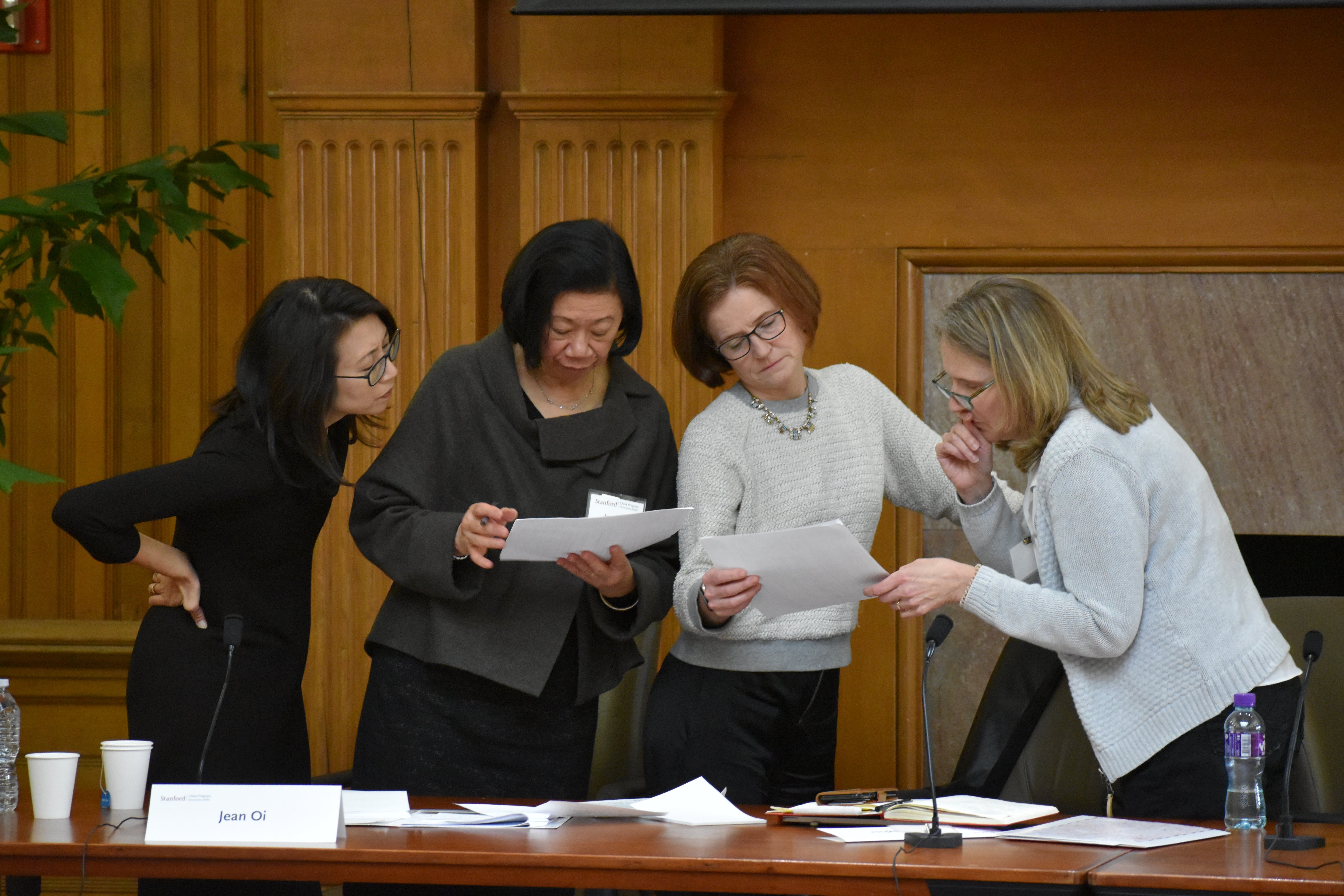
(From left to right): Stanford Professors Jean Oi (chair), Lisa Blaydes, Beatriz Magaloni (partially hidden), Michael McFaul, and Barry Weingast during the conference plenary session with comparative politics scholars

That first conference at Harvard reinforced the utility of inter-dialog and helped organizers secure a grant from APSA, which along with support from from FSI and Shorenstein APARC facilitated the second gathering, this time at Stanford. To ensure that the sessions allowed for maximum participant engagement, attendees were assigned into seven working groups. In the months preceding the conference, each group prepared a memo identifying the key questions in the field of Chinese politics, the ways to addressing these questions, and the synergies between Chinese politics and comparative politics .

“The State of the Field in Chinese Politics” conference opened with presentations by the seven small group leaders to a plenary session, followed by discussion of the various burning questions identified by the participants. Unsurprisingly, one prominent item across many of the memos was the oversized impact of Xi on China. Other areas of interest included “elite politics,” the relationship between newfound billionaires and the party, the renewed role of state-owned enterprises in the economy, and the current status of relationships between the private sector, the Party, and the state

Several groups also expressed their desire to learn more about the internal workings of the Party, specifically the adaptation of political institutions over time. While observers often point out that China’s political institutions have changed little compared to its economic institutions, scholars have also found that, in fact, the changes within China’s governmental organizations have been subtle yet profound. But how can we determine when an organizational structure changes the ways in which it operates, and who decides? The field of Chinese politics remains uncertain about these questions.

On the second day, conference attendees were joined by several Stanford scholars of comparative politics, including FSI Director Mike McFaul and FSI Senior Fellows Lisa BlaydesBeatriz Magaloni and Barry Weingast, who responded to the group memos. Breakout discussions of methodology followed.

Keeping the Fire Going

(From left to right): Professors Kellee Tsai, Hong Kong University of Science and Technology; Jean Oi, Stanford University; Mary Gallagher, University of Michigan; and Margaret Pearson, University of Maryland confer with one another

The conference concluded with a plenary session that focused on the questions "Where are we now?” and “Where do we go next?" One conclusion from the closing was an acknowledgment of the need to more fully consider China in the context of its interactions with other countries in the region as well as globally. “I think that ‘China in the Global Context’ may very well be the theme of our next conference,” said Oi.

A third conference is tentatively scheduled for December 2019. The five partners behind the series—Stanford University, Harvard University, Duke University, MIT, and the University of Michigan—are currently seeking outside funding to keep this effort going. The hope is that the next meeting will be at Duke University.

Hero Image
China Conference Panelists
(From left to right): Three of the presenters during the first plenary session: Professors Mary Gallagher, University of Michigan; Melanie Manion, Duke University; and Jean Oi, Stanford University
Andrea Brown, APARC
All News button
1
Shorenstein APARC Stanford University Encina Hall Stanford, CA 94305-6055
650.724.6404
0
Oksenberg-Rohlen Fellow
_ksa3419_lampton_2018_photo.jpg
David M. (“Mike”) Lampton is the Oksenberg-Rohlen Fellow at FSI and affiliated with Shorenstein APARC. Lampton (BA ’68, MA ’71, PhD ’74), an expert in Chinese politics and U.S.-China relations, is the Hyman Professor of China Studies and Director of the China Studies Program at the Johns Hopkins School of Advanced International Studies Emeritus.   Lampton's current book project is focused on the development of high-speed railways from southern China to Singapore. He is the author of a dozen books and monographs, including Following the Leader: Ruling China, from Deng Xiaoping to Xi Jinping (University of California Press, 2014, and second edition 2019) and The Three Faces of Chinese Power: Might, Money, and Minds (University of California Press, 2008). He has testified at multiple congressional and commission sessions and published numerous articles, essays, book reviews, and opinion pieces in many venues popular and academic in both the western world and in Chinese-speaking societies, including Foreign Affairs, Foreign Policy, The American Political Science Review, The China Quarterly, The New York Times, The Washington Post, and many others.   Over the course of his career, Lampton accompanied American public and private sector leaders to China, and Chinese leaders to the United States. Formerly President of the National Committee on United States-China Relations, Lampton consults with government, business, and social sector organizations, and has served on the boards of several non-governmental and educational organizations, including the Asia Foundation for which he served as chairman. The recipient of many academic awards, he is an Honorary Senior Fellow of the American Studies Institute of the Chinese Academy of Social Sciences, former Gilman Scholar at Johns Hopkins, and the inaugural winner of the Scalapino Prize in 2010, awarded by the National Bureau of Asian Research and the Woodrow Wilson International Center for Scholars in recognition of his exceptional contributions to America’s understanding of the vast changes underway in Asia.
-

Please note venue change to Bechtel Conference Room (Encina Hall, 1st Floor)


This panel aims to bring together a diverse spectrum of speakers to generate discussion and debate regarding Chinese Influence and American Interests: Promoting Constructive Vigilance, a report jointly issued on November 29, 2018 by the Hoover Institution at Stanford University and the Center on U.S.-China Relations at Asia Society.

Chinese Influence and American Interests: Promoting Constructive Vigilance has sparked sharp reactions as it urges American governments, organizations and individuals to engage in “constructive vigilance” to counter China’s illicit, influence-seeking operations across a broad spectrum of American political and civic life, including U.S. federal and state governments; university campuses; and the technology sector.  What is the evidence behind these claims? What are the implications of these claims? Is the Chinese threat real or speculative? How can we responsibly assess the difference? 

Link to report found


Image
chang headshot

Gordon H. Chang is the Olive H. Palmer Professor in Humanities and professor in the Department of History at Stanford University. With degrees from Princeton and Stanford, Chang specializes in the history of U.S.-China relations and Asian American history. He has written and edited many books and essays on these topics. Among these are Friends and   Enemies: The United States, China, and the Soviet Union, 1948-1972 (Stanford University Press, 1990); Morning Glory, Evening Shadow: Yamato Ichihashi and His Internment Writing, 1942-1945 (Stanford University Press, 1997); Asian Americans and Politics: Perspectives, Experiences, Prospects (Woodrow Wilson Center Press, 2001); Chinese American Voices From the Gold Rush to the Present (University of California Press, 2006); Asian American Art: A History, 1850-1970 (Stanford University Press, 2008); and Fateful Ties: A History of America’s Preoccupation with China (Harvard University Press, 2015). At Stanford, he is co-directing the Chinese Railroad Workers in North America Project that is   recovering and interpreting the history of Chinese workers who toiled on the first transcontinental rail line and other lines in the 19th century.


Image
diamond headshot

Larry Diamond is a senior fellow at the Hoover Institution and at the Freeman Spogli Institute (FSI) for International Studies. For more than six years, he directed FSI’s Center on Democracy, Development, and the Rule of Law, where he now leads its Program on Arab Reform and Democracy and its Global Digital Policy Incubator. He is the founding co-   editor of the Journal of Democracy and also serves as Senior Consultant at the International Forum for Democratic Studies of the National Endowment for Democracy. His research focuses on democratic trends and conditions around in the world, and on policies and reforms to defend and advance democracy.  His 2016 book, In Search of Democracy,  explores the challenges confronting democracy and democracy promotion, gathering together three decades of his writing and research, particularly on Africa and Asia.  He has just completed a new book on the global crisis of democracy, which will be published in 2019, and is now writing a textbook on democratic development.


Image
economy headshot

Elizabeth C. Economy is the C.V. Starr senior fellow and director for Asia studies at the Council on Foreign Relations and a distinguished visiting fellow at Stanford University’s Hoover Institution. Her most recent book, The Third Revolution: Xi Jinping and the New Chinese State,   (Oxford University Press, 2018) analyzes the contradictory nature of reform under President Xi Jinping. She is also author of By All Means Necessary: How China's Resource Quest is Changing the World(Oxford University Press, 2014) with Michael Levi, and The River Runs   Black: The Environmental Challenge to China's Future (Cornell University Press, 2004; 2nd edition, 2010; Japanese edition, 2005; Chinese edition, 2011). She has published articles in policy and scholarly journals including Foreign Affairs, Foreign Policy, and the Harvard   Business Review; and op-eds in the New York Times and Washington Post, among others. In June 2018, she was named one of the "10 Names That Matter on China Policy" by Politico Magazine.


Image
lampton headshot

David M. Lampton is Oksenberg-Rohlen Fellow and Research Scholar at Stanford University’s Shorenstein Asia-Pacific Research Center. He also is Hyman Professor and Director of China Studies Emeritus at the Johns Hopkins School of Advanced International Studies. Having started his academic career at The Ohio State University, Lampton has been   Chairman of the The Asia Foundation (2015-2018), president of the National Committee on United States-China Relations (1988-1997), and former Dean of Faculty at SAIS (2004-2012). He is the author of: Same Bed, Different Dreams: Managing U.S.-China Relations, 1989-2000 (2001); The Three Faces of Chinese Power: Might, Money, and   Minds (2008); and, The Making of Chinese Foreign and Security Policy (editor, Stanford University Press, 2001). He received his B.A., M.A., and Ph.D. degrees from Stanford University where, as an undergraduate student, he was a fireman. Lampton has an honorary doctorate from the Russian Academy of Sciences’ Institute of Far Eastern Studies. His   newest book, Following the Leader: Ruling China, from Deng Xiaoping to Xi Jinping, was first published in January 2014 and will be reissued in paperback with a new Preface early in 2019 by the University of California Press. His current field research and book-length project focuses on Beijing’s effort to build high-speed and other rail lines to Singapore from southern China.


Image
oi headshot

Jean C. Oi is the William Haas Professor of Chinese Politics in the department of political science and a Senior Fellow of FSI at Stanford University. She is the founding director of the Stanford China Program at Shorenstein APARC. Professor Oi also is the founding Lee Shau Kee Director of the Stanford Center at Peking University. Her work focuses on comparative politics, with special expertise on political economy and the process of reform in transitional systems.  Oi has written extensively on China’s political economy. Her most recent works include, Zouping Revisited: Adaptive Governance in a Chinese County, with Steven Goldstein (2018); Challenges in the Process of China’s Urbanization, with Karen Eggleston and Yiming Wang (2017); Going Private in China: The Politics of Corporate Restructuring and System Reform (2011); and Growing Pains: Tensions and Opportunity in China’s Transformation, with Scott Rozelle and Xueguang Zhou (2010).


This event is part of the China Program’s Colloquia Series entitled "A New Cold War?: Sharp Power, Strategic Competition, and the Future of U.S.-China Relations " sponsored by Shorenstein APARC's China Program.

A New Cold War?: Sharp Power, Strategic Competition, and the Future of U.S.-China Relations

Image
gears

Trade conflict has exploded. The media is rife with stories of China’s unfair trade practices, cyber theft, IP theft and forced technology transfers. Who will first scale the commanding heights of technological supremacy? Who will be the first mover in AI, robotics and biotechnology? What are the implications of Beijing’s ambitious infrastructure projects, including its Belt and Road Initiative? How is China’s “sharp power” deployed, and what are its implications for political and civic life in the U.S.? Can the Trump administration and Beijing’s leadership reach agreement on our trade disputes? Are these just the beginning salvos of an increasingly turbulent future? As U.S. policy towards China sharply veers away from “constructive engagement” to “strategic competition,” the Stanford China Program will host a series of talks by leading experts to explore the current state of our bilateral relations, its potential future, and their implications for the world order.

https://aparc.fsi.stanford.edu/china/research/new-cold-war-sharp-power-strategic-competition-and-future-us-china-relations


For a recap, audio, transcript and pictures of the event, please see the following link.

https://aparc.fsi.stanford.edu/china/multimedia/transcripts-chinese-influence-real-or-perceived

p.p1 {margin: 0.0px 0.0px 0.0px 0.0px; font: 12.0px Garamond} span.s1 {font-kerning: none; background-color: #fffb01} span.s2 {font-kerning: none}

Oksenberg Conference Room Encina Hall, 3rd Floor 616 Serra Mall, Stanford, CA 94305
Gordon H. Chang Professor, Department of History, Stanford University
Larry Diamond Senior Fellow, Hoover Institution, Stanford University
Elizabeth C. Economy Distinguished Visiting Fellow, Hoover Institution, Stanford University
David M. Lampton Oksenberg-Rohlen Fellow, FSI, Stanford University
Jean C. Oi Director, Stanford China Program; William Haas Professor of Chinese Studies, Stanford University
Seminars
Subscribe to Governance