International Development

FSI researchers consider international development from a variety of angles. They analyze ideas such as how public action and good governance are cornerstones of economic prosperity in Mexico and how investments in high school education will improve China’s economy.

They are looking at novel technological interventions to improve rural livelihoods, like the development implications of solar power-generated crop growing in Northern Benin.

FSI academics also assess which political processes yield better access to public services, particularly in developing countries. With a focus on health care, researchers have studied the political incentives to embrace UNICEF’s child survival efforts and how a well-run anti-alcohol policy in Russia affected mortality rates.

FSI’s work on international development also includes training the next generation of leaders through pre- and post-doctoral fellowships as well as the Draper Hills Summer Fellows Program.

News Type
News
Date
Paragraphs

Shorenstein APARC invites highly motivated and dedicated undergraduate- and graduate-level students to join our team as paid research assistant interns for the duration of the summer 2022 quarter. The research assistants work with assigned APARC faculty members on projects focused on contemporary Asia, studying varied issues related to the politics, economies, populations, security, foreign policies, and international relations of the countries of the Asia-Pacific region.

All research assistant positions are open to current Stanford students only.

Apply Now
 

APARC is now accepting applications for our summer 2022 RA positions. The deadline for submitting applications and letters of recommendation is March 1, 2022. 

All summer research assistant positions will be on campus for eight weeks. The hourly pay rate is $17 for undergraduate students, $25 for graduate students.

Decisions regarding the options for telecommuting work will be made closer to the appointment start dates in accordance with the evolving COVID-19 situation and the University's recommendations.


Please follow these application guidelines

I. Prepare the following materials:

II. Fill out the online application form for summer 2022, including the above two attachments, and submit the complete form.

III. Arrange for a letter of recommendation from a faculty to be sent directly to Shorenstein APARC.
Please note: the faculty members should email their letters directly to Kristen Lee at kllee@stanford.edu.

We will consider only applications that include all supporting documents.

Read More

Stanford arch and text calling for nominations for APARC's 2022 Shorenstein Journalism Award.
News

2022 Shorenstein Journalism Award Open to Nomination Entries

Sponsored by Stanford University’s Shorenstein Asia-Pacific Research Center, the annual award recognizes outstanding journalists and journalism organizations for excellence in coverage of the Asia-Pacific region. News editors, publishers, scholars, and organizations focused on Asia research and analysis are invited to submit nominations for the 2022 award through February 15.
2022 Shorenstein Journalism Award Open to Nomination Entries
Hero Image
Stanford
Rod Searcey
All News button
1
Subtitle

To support Stanford students working in the area of contemporary Asia, the Shorenstein Asia-Pacific Center is offering research assistant positions for summer 2022. The deadline for submitting applications and letters of recommendation is March 1, 2022. 

-

This is a virtual event. Please click here to register and generate a link to the talk. 
The link will be unique to you; please save it and do not share with others.


In China, market institutions are still being developed and private owned enterprises need help to overcome obstacles arising from the imperfection of market institutions. Such help can come from various levels of the government or state-owned enterprises. It is believed that such help is more likely if a major shareholder of the private enterprise has formed a joint venture with a state shareholder, either directly or indirectly. In this talk, Bai Chong-en will discuss ownership connections among state and private investors (ultimate shareholders) and their changes overtime. He will also examine the relationship between the degree of such connection and some important characteristics of the investors. His model suggests that such connections have played an important role in the growth of the private sector. 


Image
Portrait of Bai Chong-en
BAI Chong-En is the Mansfield Freeman Chair Professor and dean of the School of Economics and Management of Tsinghua University. He is also the director of both the National Institute for Fiscal Studies of Tsinghua University and the Institute for State-Owned Enterprises of Tsinghua University. He earned his PhD degree in economics from Harvard University. His research areas include institutional economics, economic growth and development, public economics, finance, corporate governance, and Chinese economy.

BAI is a member of the National Committee of the Chinese People’s Political Consultative Conference, the “14th Five-Year Plan” National Development Planning Expert Committee, the Chinese Economists 50 Forum, the China Finance 40 Forum, and Chinainfo 100. He was a member of the monetary policy committee of the People’s Bank of China from 2015 to 2018. He served as Adjunct Vice-President of Beijing State-Owned Assets Management Co., Ltd. from August 2011 to December 2012. He was a non-resident senior fellow of the Brookings Institution from 2006 to 2007.


Image
Chinese 100 yuan bills

This event is part of the 2022 Winter webinar series, The Future of China's Economy, sponsored by the APARC China Program.


Via Zoom Webinar. Register at: https://bit.ly/31peuDs

Bai Chong-en Professor and Dean of School of Economics and Management; Mansfield Freeman Chair Professor, Tsinghua University
Seminars

China’s spectacular growth over the last 40 years has slowed but remains strong, leading the world in economic recovery after the global financial crisis, and even in the current COVID-19 pandemic after a devasting blow early in 2020.  Yet, a number of worrying developments have emerged, most recently the troubles that China’s second largest property development company, the Evergrande Group, have suffered.

-

This is a virtual event. Please click here to register and generate a link to the talk. 
The link will be unique to you; please save it and do not share with others.


At the end of 2021 China Evergrande Group—one of China’s biggest property developers—finally defaulted on its bonds. The default didn’t spark a Lehman Moment—as widely prophesied—or any significant market upheaval, but it’s increasingly clear that Evergrande’s problems mark the start of a momentous shift in how China’s economy grows. Over the past 18 months, Beijing has induced a slowdown of the property sector with the goal of better ensuring financial sector stability and the sustainability of property sector growth. However, it has resulted in defaults, restructuring, and consolidation among China’s largest developers, and has implication for local government finance and the pace of economic growth. This talk will discuss the challenges posed by Evergrande’s decline and imminent restructuring, what Beijing is trying to achieve by reining in the property sector, and what risks are involved.


Portrait of Dinny McMahonDinny McMahon is the author of “China's Great Wall of Debt: Shadow Banks, Ghost Cities, Massive Loans, and the End of the Chinese Miracle,” a ground up look at the mechanics of China’s political economy, which he wrote while a fellow at the Woodrow Wilson Center for International Scholars. He later moved to MacroPolo, the Paulson Institute’s think tank in Chicago, where he researched China’s efforts to clean up its financial system. Dinny started his career as a financial journalist in China, spending six years in Beijing with The Wall Street Journal, and four years with Dow Jones Newswires in Shanghai, where he also contributed to the Far Eastern Economic Review. Dinny is currently working on a project for the Wilson Center on China’s efforts to reduce its reliance on the US dollar. He also provides independent research on China’s financial system for financial services firms.


Image
Chinese 100 yuan bills

This event is part of the 2022 Winter webinar series, The Future of China's Economy, sponsored by the APARC China Program.


Via Zoom Webinar. Register at: https://bit.ly/3pkTQfE

Dinny McMahon Global Fellow, Woodrow Wilson International Center for Scholars
Seminars
Authors
Callista Wells
News Type
News
Date
Paragraphs

On October 6, 2021, the APARC China Program hosted the panel program, "Engaging China: Fifty Years of Sino-American Relations." In honor of her recently released book of the same title, Director of the Grassroots China Initiative Anne Thurston was joined by contributors Mary Bullock, President Emerita of Agnes Scott College; Thomas Fingar, Shorenstein APARC Fellow; and David M. Lampton, Professor Emeritus at Johns Hopkins School of Advanced International Studies (SAIS). Thomas Fingar also moderated the panel.

Recent years have seen the U.S.-China relationship rapidly deteriorate. Engaging China brings together leading China specialists—ranging from academics to NGO leaders to former government officials—to analyze the past, present, and future of U.S.-China relations.

During their panel, Bullock, Fingar, Lampton, and Thurston reflected upon the complex and multifaceted nature of American engagement with China since the waning days of Mao’s rule. What initially motivated U.S.’ rapprochement with China? Until recent years, what logic and processes have underpinned the U.S. foreign policy posture towards China? What were the gains and the missteps made during five decades of America’s engagement policy toward China? What is the significance of our rapidly deteriorating bilateral relations today? Watch now: 

For more information about Engaging China or to purchase a copy, please click here.

Read More

Xi and Biden
Q&As

Biden, Xi Will Want To Diminish Exaggerated Characterizations of Bilateral Friction, Stanford Scholar Says

In this Q&A, Stanford scholar Thomas Fingar discusses what to expect when President Biden meets with Chinese President Xi Jinping.
Biden, Xi Will Want To Diminish Exaggerated Characterizations of Bilateral Friction, Stanford Scholar Says
Taiwan
Commentary

America's Future in Taiwan

Intensifying threats of a military conflict over Taiwan have brought uncertainty to the stability of regional security for Southeast Asia, according to Center Fellow Oriana Skylar Mastro on radio show On Point.
America's Future in Taiwan
USS Key West during during joint Australian-United States military exercises Talisman Sabre 2019 in the Coral Sea.
Commentary

In Defense of AUKUS

This is not only about nuclear-powered submarines; it is about a strengthened US commitment to Australia.
In Defense of AUKUS
Hero Image
"Engaging China: Fifty Years of Sino-American Relations" book cover
All News button
1
Subtitle

Was the strategy of engagement with China worthwhile? Experts Mary Bullock, Thomas Fingar, David M. Lampton, and Anne Thurston discuss their recent release, "Engaging China: Fifty Years of Sino-American Relations."

-

This is a virtual event. Please click here to register and generate a link to the talk. 
The link will be unique to you; please save it and do not share with others.


In September 2020, President Xi Jinping declared that China would achieve carbon neutrality by 2060.  This climate pledge is widely considered the most ambitious of all made to date, especially since the world’s largest carbon-emitting nation is still at a developing stage and has not yet achieved its emissions peak.  With the 26th UN Climate Change Conference of the Parties (COP26) on the horizon, the world is eager to learn about any potential new pledges from the Chinese leadership.  This talk will provide an overview of climate governance under President Xi Jinping and draw on the presenter’s work on local implementation of air pollution policies in China to discuss potential lessons for its ongoing efforts to curb carbon emissions.


Image
Portrait of Shiran Victoria Shen
Shiran Victoria Shen’s research primarily examines the organizational causes of and responses to environmental crises, with particular understanding of how local politics shape air pollution and climate management in China.  Professor Shen graduated Phi Beta Kappa and with high honors from Swarthmore College and holds an M.S. in civil and environmental engineering and a Ph.D. in political science, both from Stanford University.


Image
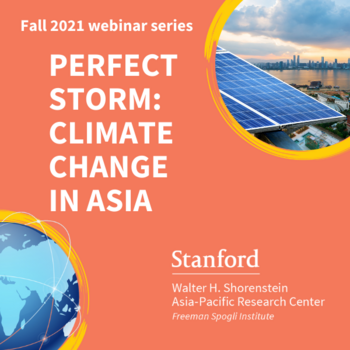
Perfect Storm: Climate Change in Asia series promo image

This event is part of the 2021 Fall webinar series, Perfect Storm: Climate Change in Asia, sponsored by the Walter H. Shorenstein Asia-Pacific Research Center.


Via Zoom Webinar. Register at: https://bit.ly/2XtnSDE

Shiran Victoria Shen Assistant Professor of Environmental Politics at the University of Virginia and W. Glenn Campbell and Rita Ricardo-Campbell National Fellow at the Hoover Institution
Seminars
Authors
News Type
News
Date
Paragraphs

The Walter H. Shorenstein Asia-Pacific Research Center (APARC) is pleased to invite applications for four types of fellowship in contemporary Asia studies for the 2022-23 academic year.

The Center offers postdoctoral fellowships that promote multidisciplinary research on contemporary Japan, contemporary Asia broadly defined, health or healthcare policy in the Asia-Pacific region, and a fellowship for experts on Southeast Asia. Learn more about each fellowship and its eligibility and specific application requirements:

Postdoctoral Fellowship on Contemporary Japan

Hosted by the Japan Program at APARC, the fellowship supports research on contemporary Japan in a broad range of disciplines including political science, economics, sociology, law, policy studies, and international relations. Appointments are for one year beginning in fall quarter 2022. The application deadline is January 3, 2022.
 

Shorenstein Postdoctoral Fellowship on Contemporary Asia

APARC offers two postdoctoral fellowship positions to junior scholars for research and writing on contemporary Asia. The primary research areas focus on political, economic, or social change in the Asia-Pacific region (including Northeast, Southeast, and South Asia), or international relations and international political economy in the region. Appointments are for one year beginning in fall quarter 2022. The application deadline is January 3, 2022.
 

Read More

[Left] Postdoc Spotlight, Jeffrey Weng, Shorenstein Postdoctoral Fellow in Contemporary Asia, [Right] Jeffrey Weng
Q&As

Postdoc Spotlight: Jeffrey Weng on Language and Society

Shorenstein Postdoctoral Fellow in Contemporary Asia Jeffrey Weng shares insights from his research into how language and society shape one another, particularly how the historical use of Mandarin affects contemporary Chinese society and linguistics.
Postdoc Spotlight: Jeffrey Weng on Language and Society
Hero Image
Autumn scene on the Stanford campus with a call to apply for APARC's 2022-23 fellowships for Asia schoalrs
All News button
1
Subtitle

The Center offers fellowships for postdoctoral scholars specializing in contemporary Asia, Japan, and Asia health policy and for experts on Southeast Asia.

Authors
Callista Wells
News Type
News
Date
Paragraphs

On May 5, 2021, the APARC China Program hosted Professor Yuen Yuen Ang, Associate Professor of Political Science at the University of Michigan for her program, "The Role of Corruption in China's Speedy, Risky Boom." Based on her recently published book, China's Gilded Age, Ang explored the impact of corruption on China's economy and how it compares to other countries around the world, including the United States during the late 1800s. Professor Jean Oi, William Haas Professor of Chinese Politics and director of the APARC China Program, moderated the event.

While corrupt countries are usually poor, China appears to be an exception. President Xi Jinping acknowledges that corruption in the country has reached crisis proportions. If this is true, Ang asks, why has China nevertheless sustained 40 years of economic growth and deep transformation?

In fact, Ang argues, China is not as anomalous as it seems; its experience is strikingly similar to America’s Gilded Age during the 19th century. Ang unbundles corruption into four different types that each harms the economy in a different way. Similar to America’s Gilded Age, reform-era China has steadily evolved toward a particular type of corruption: access money (elite exchanges of power and wealth). Simultaneously, beginning in the 2000s, the central government effectively curbed directly growth-damaging types of corruption such as embezzlement and bureaucratic extortion. Access money fueled commerce by rewarding politicians for aggressively promoting growth and connected capitalists for building more and taking on more risky ventures. But such corruption also produced systemic risks, distortions, and inequality—problems that define China's Gilded Age under Xi's leadership. As a result, China today is a high-growth but risky and imbalanced economy.

Despite popular perceptions that China and the United States are two polar opposites, Ang argues, contemporary China and 19th century America share more similarities than we normally think. Their divergent political systems, however, drove contrasting responses to the excesses of capitalism. Watch now:

Read More

National Emblem of the People's Republic of China on the Great Hall of the People
News

What’s ‘Communist’ about the Communist Party of China?

Is the Chinese Communist Party really communist at all? Expert Jude Blanchette, Freeman Chair in China Studies at the Center for Strategic and International Studies, weighs in.
What’s ‘Communist’ about the Communist Party of China?
Paper boats with Chinese and American flags
News

Partner, Competitor, and Challenger: Thoughts on the Future of America’s China Strategy

Ryan Hass, Michael H. Armacost Chair in Foreign Policy Studies at the Brookings Institution, discusses the future of US-China relations. Can we find room for cooperation in this contentious relationship?
Partner, Competitor, and Challenger: Thoughts on the Future of America’s China Strategy
United States Capitol Building from an angle
News

When Beijing Goes to Washington: Autocratic Lobbying Influence in Democracies

Professor Erin Baggot Carter tells us how autocratic lobbying affects political outcomes and media coverage in democracies.
When Beijing Goes to Washington: Autocratic Lobbying Influence in Democracies
Hero Image
Cover of "China's Gilded Age" by Yuen Yuen Ang
All News button
1
Subtitle

How has corruption simultaneously driven China’s economic boom and financial risks? Professor Yuen Yuen Ang explains its role in producing a high-growth but also high-risk economy.

-

Please note that the event end time has changed to 1 PM (PT) due to a last-minute schedule conflict for our speakers.


This is a virtual event. Please click here to register and generate a link to the talk. 
The link will be unique to you; please save it and do not share it with others.


Kurt Campbell, Deputy Assistant to the President and Coordinator for Indo-Pacific Affairs, United States National Security Council (NSC); and Laura Rosenberger, Special Assistant to the President and Senior Director for China and Taiwan, NSC, will discuss President Biden’s China strategy, how it might differ from that of the Trump administration, and how the US can best pursue its values and interests amidst China’s rise in the Indo-Pacific. 

The Oksenberg Conference, held annually honors the legacy of the late Professor Michel Oksenberg (1938–2001) who was a senior fellow at Shorenstein APARC and the Freeman Spogli Institute for International Studies. Professor Oksenberg also served as a key member of the National Security Council when the United States normalized relations with China, and consistently urged that the United States engage with Asia in a more considered manner. In tribute, the Oksenberg Lecture recognizes distinguished individuals who have helped to advance understanding between the United States and the nations of the Asia-Pacific.


Speakers 
 

Image
Portrait of Kurt Campbell
Kurt M. Campbell serves as Deputy Assistant to the President and Coordinator for Indo-Pacific Affairs on the United States National Security Council. He was previously Chairman and CEO of The Asia Group, LLC, a strategic advisory and capital management group. From 2009 to 2013, he served as the Assistant Secretary of State for East Asian and Pacific Affairs, where he is widely credited as being a key architect of the “pivot to Asia.” For advancing a comprehensive US strategy that took him to every corner of the Asia-Pacific region, Secretary Hillary Clinton awarded him the Secretary of State’s Distinguished Service Award (2013) — the nation’s highest diplomatic honor. Campbell was formerly the CEO and Co-Founder of the Center for a New American Security and concurrently served as the Director of the Aspen Strategy Group and Chairman of the Editorial Board of the Washington Quarterly. He is the author or editor of ten books including Difficult Transitions: Why Presidents Fail in Foreign Policy at the Outset of Power and Hard Power: The New Politics of National Security. He received his BA from UC San Diego and his Doctorate in International Relations from Brasenose College at Oxford University.
 

Image
Portrait of Laura Rosenberger
Laura Rosenberger serves as Special Assistant to the President and Senior Director for China and Taiwan on the United States National Security Council (NSC). Rosenberger was most recently the director of the Alliance for Securing Democracy and a senior fellow at The German Marshall Fund (GMF) of the United States. Before she joined GMF, she was foreign policy advisor for Hillary for America, where she coordinated development of the campaign’s national security policies, messaging, and strategy. Prior to that, she served in a range of positions at the State Department and the NSC. As chief of staff to Deputy Secretary of State Anthony Blinken and later as then-Deputy National Security Advisor Blinken’s senior advisor, she counseled on the full range of national security policy. In her role at the NSC, she also managed the interagency Deputies Committee, the U.S. government’s senior-level interagency decision-making forum on our country’s most pressing national security issues. Rosenberger also has extensive background in the Asia-Pacific region, particularly Northeast Asia. She served as NSC director for China and Korea, managing and coordinating U.S. policy on China and the Korean Peninsula, and in a variety of positions focused on the Asia-Pacific region at the Department of State, including managing U.S.–China relations and addressing North Korea’s nuclear programs. She also served as special assistant to Under Secretary of State for Political Affairs Bill Burns, advising him on Asia-Pacific affairs and on nonproliferation and arms control issues. Rosenberger first joined the State Department as a presidential management fellow.
 

Portrait of Michael McFaulMichael McFaul is Director at the Freeman Spogli Institute for International Studies, the Ken Olivier and Angela Nomellini Professor of International Studies in the Department of Political Science, and the Peter and Helen Bing Senior Fellow at the Hoover Institution. He joined the Stanford faculty in 1995. McFaul also is an International Affairs Analyst for NBC News and a columnist for The Washington Post. He served for five years in the Obama administration, first as Special Assistant to the President and Senior Director for Russian and Eurasian Affairs at the National Security Council at the White House (2009-2012), and then as U.S. Ambassador to the Russian Federation (2012-2014). He has authored several books, most recently the New York Times bestseller From Cold War to Hot Peace: An American Ambassador in Putin’s Russia. Earlier books include Advancing Democracy Abroad: Why We Should, How We Can; Transitions To Democracy: A Comparative Perspective (eds. with Kathryn Stoner); Power and Purpose: American Policy toward Russia after the Cold War (with James Goldgeier); and Russia’s Unfinished Revolution: Political Change from Gorbachev to Putin.

Via Zoom. Register at: https://bit.ly/3vWF2Wa

Kurt M. Campbell <br><i>Deputy Assistant to the President and Coordinator for Indo-Pacific Affairs, National Security Council</i><br><br>
Laura Rosenberger <br><i>Special Assistant to the President and Senior Director for China and Taiwan, National Security Council</i><br><br>
Michael McFaul, moderator <br><i>Director, Freeman Spogli Institute for International Studies; Ken Olivier and Angela Nomellini Professor of International Studies, Department of Political Science, Stanford University</i><br><br>
Conferences
Authors
Callista Wells
News Type
News
Date
Paragraphs

On April 21, 2021, the APARC China Program hosted Professor Erin Baggott Carter, Assistant Professor in the Department of Political Science and International Relations, University of Southern California, and Visiting Scholar at the Stanford Center on Democracy, Development and the Rule of Law. Her program, "When Beijing Goes to Washington: Autocratic Lobbying Influence in Democracies," explored how lobbying from China and China-based companies can affect policy in the United States. Professor Jean Oi, William Haas Professor of Chinese Politics and director of the APARC China Program, moderated the event.

Professor Baggot Carter based her talk on a dataset drawn from the public records of the US Foreign Agents Registration Act, which includes over 10,000 lobbying activities undertaken by the Chinese government between 2005 and 2019. According to Baggot Carter, the evidence suggests that Chinese government lobbying makes legislators at least twice as likely to sponsor legislation that is favorable to Chinese interests. Moreover, US media outlets that participated in Chinese-government sponsored trips subsequently covered China as less threatening. Coverage pivoted away from US-China military rivalry and the CCP’s persecution of religious minorities and toward US-China economic cooperation. These results suggest that autocratic lobbying poses an important challenge to democratic integrity. Watch now: 

Read More

National Emblem of the People's Republic of China on the Great Hall of the People
News

What’s ‘Communist’ about the Communist Party of China?

Is the Chinese Communist Party really communist at all? Expert Jude Blanchette, Freeman Chair in China Studies at the Center for Strategic and International Studies, weighs in.
What’s ‘Communist’ about the Communist Party of China?
Paper boats with Chinese and American flags
News

Partner, Competitor, and Challenger: Thoughts on the Future of America’s China Strategy

Ryan Hass, Michael H. Armacost Chair in Foreign Policy Studies at the Brookings Institution, discusses the future of US-China relations. Can we find room for cooperation in this contentious relationship?
Partner, Competitor, and Challenger: Thoughts on the Future of America’s China Strategy
American and Chinese flags
News

U.S.-China Relations in the Biden Era

Dr. Thomas Wright examines the recent history of US-China relations and what that might mean for the new administration.
U.S.-China Relations in the Biden Era
Hero Image
United States Capitol Building from an angle
Photo by Harold Mendoza on Unsplash
All News button
1
Subtitle

Professor Erin Baggot Carter tells us how autocratic lobbying affects political outcomes and media coverage in democracies.

Subscribe to International Development