International Relations

FSI researchers strive to understand how countries relate to one another, and what policies are needed to achieve global stability and prosperity. International relations experts focus on the challenging U.S.-Russian relationship, the alliance between the U.S. and Japan and the limitations of America’s counterinsurgency strategy in Afghanistan.

Foreign aid is also examined by scholars trying to understand whether money earmarked for health improvements reaches those who need it most. And FSI’s Walter H. Shorenstein Asia-Pacific Research Center has published on the need for strong South Korean leadership in dealing with its northern neighbor.

FSI researchers also look at the citizens who drive international relations, studying the effects of migration and how borders shape people’s lives. Meanwhile FSI students are very much involved in this area, working with the United Nations in Ethiopia to rethink refugee communities.

Trade is also a key component of international relations, with FSI approaching the topic from a slew of angles and states. The economy of trade is rife for study, with an APARC event on the implications of more open trade policies in Japan, and FSI researchers making sense of who would benefit from a free trade zone between the European Union and the United States.

News Type
Q&As
Date
Paragraphs

Chinese Vice President Xi Jinping recently visited the United States to meet with top officials and tour various cities. China experts followed the trip closely because Xi is anticipated to become China’s next president. Thomas Fingar spoke with the Shanghai Oriental Morning Post about the visit, and about the Obama administration’s Asia policy.

How will the Obama administration’s strategic adjustments towards the Asia-Pacific shape or influence Xi’s visit? Given the fast-changing environment and shift of power towards Asia, will there be any changes or differences in the United States’s treatment of China’s anticipated future leader?

The primary impact is likely to be on the discussions between Xi and his American interlocutors. I assume that U.S. officials will want to explain the announced strategic adjustments and that Xi will seek authoritative answers to questions that he and other Chinese leaders have about the objectives and implications of the adjustments.

Contrary to your question, I do not believe the environment is changing rapidly—shifts in the global system and the shift in dynamism and wealth toward Asia have been under way for decades. The United States has been and will remain a part of that transition. The U.S. goal is to ensure that the changes result in increased security and prosperity for all—a win-win situation not unlike what happened when first Japan and then the other “Asian tigers” preceded China on the path toward greater wealth and power. 

What interests Washington most about Vice President Xi? What expectations does the United States have for his visit?

Washington expects Xi to succeed Hu Jintao and understands that he will be first among equals in a collective leadership that constrains Xi’s ability to act independently. But U.S. officials also understand that Xi, like all leaders, brings personal preferences and agendas to the job and that dealing with him will be influenced by his personality, understanding of American culture, and goals for the relationship. Simply stated, the Americans Xi meets will want to get to know him and what he is like.

U.S. officials understand that he is here as China’s vice president and therefore is unlikely to be bringing new initiatives. They do expect him to have questions about U.S. and Obama administration positions on a wide range of global issues and to have questions about U.S. intentions in Asia.

Is the U.S. “pivot to Asia” strategy aimed at containing or encircling China? Almost all U.S. official statements try to clarify that the United States is not trying to contain China, but its policy focus and military deployments in the Asia-Pacific have made many Chinese scholars doubtful of U.S. intentions. What are your observations? Is U.S. rhetoric consistent with its actions?

I do not like the term “pivot to Asia” and am pleased that U.S. officials seem to have stopped using that term. The United States is not returning to Asia; we never left. I think the basic point of recent statements is that with the end of the U.S. role in the conflict in Iraq and plans to draw down in Afghanistan, the United States will be able to focus more attention on other parts of the world. Asia is, and has been, the most dynamic, fastest changing, and in many ways most-challenging region of the world for many years. The region is also very important to the United States and deserves more attention than it has received. The Asia-Pacific is a region of superlatives—biggest economies, largest militaries, most nuclear powers, largest military budgets, largest foreign exchange reserves, etc. It would be unwise and impossible not to pay attention to developments in and affecting the region and its relations with other parts of the global system.

I have been working on China for more than 45 years and working with Chinese counterparts for 40 years. I must say that I have just about abandoned efforts to persuade important groups in China that the United States is not attempting to surround, contain, or thwart China’s rise. They seem determined to believe that it is the case no matter what we say or do. It is impossible for me to look at the policies and actions of the last eight administrations and come to any conclusion except that the United States means what its leaders have said: that it is in the interest of the United States for China to be strong, secure, and prosperous. The record shows quite clearly that the United States has assisted China’s rise. It also shows that China’s rise has been beneficial to the United States. We are not poorer or weaker or more insecure because China’s people live better and China plays an increasingly important role on the world stage. 

Do you think the Obama administration has changed the direction of U.S. strategy toward China or Asia compared with the Bush administration?

The short answer is, “no. ” The Bush administration was preoccupied by terrorism, Iraq, and Afghanistan and devoted less time and attention to Asia. Obama is redressing the balance and better aligning attention with current interests. Arguably what has changed is the perception of China held by others in the region. A series of foreign policy blunders in 2010 undercut the success of China’s diplomacy and increased regional concern about China’s intentions. That prompted requests for reassurance that the United States would remain engaged in the region and that the Bush administration’s “neglect” of certain regional meetings was not a harbinger of a retreat from Asia. The Obama administration seeks to provide that assurance and to make clear that we are engaged in Asia because we are a Pacific power with great interests in the region. We are not there to contain or block anybody.

The United States is struggling with its economy and also cutting its defense budget. Do you think this strategy comes at the right time?

Downturns in the economy never come at a good time. The great recession has taken a heavy toll but we are recovering and will recover. We have been spending too much for too long and need to cut back. In my opinion, we also need to tax ourselves more to pay for modernization of infrastructure, better schools, and other requisites of continued prosperity. We are winding down two long and expensive wars and should reduce our defense budget. It will take time to replace worn out equipment and to reduce the large role that defense expenditures played in the U.S. economy during the Cold War, but we will get there eventually. More importantly, now is a good time to reduce defense expenditures and reorganize our military because we do not have any enemies and are not bent on conquering other nations.

Is the “pivot to Asia” strategy concrete or more of a “paper tiger” given the fact that other challenges, including Iran, are still occupying the United States?

As previously noted, the term “pivot to Asia” exaggerates the amount of change. The United States never left or lost interest in Asia, but is now able to devote more attention to the most dynamic, and in some respects most dangerous place in the world. Building a new security architecture that is inclusive—including China—and addresses concerns in and about North Korea is and should be a priority. Forging institutions to ensure continued stability and prosperity in the region despite paralysis at the global level and adjusting to changes in production and supply chains are among the long list of specific issues that need attention. The United States has a stake in the way these issues are addressed and must be engaged in the search for solutions.

Hero Image
BidenXi NEWSFEED
U.S. Vice President Joe Biden and Chinese Vice President Xi Jinping greet high school basketball players in Dujiangyan, China, Aug. 2011.
Official White House Photo/David Lienemann
All News button
1
Authors
News Type
Q&As
Date
Paragraphs

Since opening its doors to the world in 1978, China has pursued a sometimes erratic but reasonably steady course leading to increasing global economic and political interaction. Its interests now extend from Pyongyang to New York and Sydney to Riyadh. U.S. President Barack Obama’s announcement of a new “pivot” toward Asia, recent events on the Korean Peninsula, and China’s upcoming leadership transition provide additional reasons to seek greater understanding of China’s goals and interactions with other nations.

Thomas Fingar, Stanford’s Oksenberg-Rohlen Distinguished Fellow, is leading a new multiphase Shorenstein Asia-Pacific Research Center (Shorenstein APARC) initiative to explore the nuances and complexity of China’s foreign relations and domestic issues. The China and the World research project aims to contextualize and better understand China’s regional and global interactions, both from the perspective of China itself and from that of other countries. Beginning with Northeast Asia, the project will analyze China’s relations region-by-region throughout the world, and will involve experts from Stanford, China, and the regions studied. It kicks off with a Shorenstein APARC-organized workshop held Mar. 19 and 20 at the new Stanford Center at Peking University.

Fingar discusses the development of China’s foreign relations since 1978, and describes the project and workshop’s background.

In the three decades since Deng Xiaoping enacted his 1978 Open Door reforms, what have been the main trends in China’s global engagement?

The general trend since 1978 has been for China to become increasingly active and engaged in a growing number of places around the world. There have been a number of phases to this.

The “honeymoon period” of U.S.-China relations (1979–1989) was a period of essentially no competition to China’s interaction within the U.S.-led world economic system. China concentrated on the OECD countries—especially the United States, Japan, and Western Europe—that had money to invest and willingness to trade.

After the 1989 Tiananmen Square Incident, China’s international options became more constrained as its relations with the developed world plateaued. It began to reach out to the places that would deal with it: Southeast Asia and particularly Africa. This was in part diplomatically motivated, and in part a search for new markets for the low-end goods it was beginning to produce. It was also the beginning of its search for energy.

Around 2000, China transitioned from building a more modern economy towards being one—beginning the era of its “rise.” China’s demand for resources went up, as did its capacity to supply more markets and its ability to invest more of its growing foreign exchange earnings. It became globally active, proclaiming that it had a new, less exploitative model than what the United States and Europe offered.

What Northeast Asia issues do you think China will focus on this year, especially as it plans for a major leadership transition?

North Korea’s stability and China’s growing investments in the DPRK. Beijing is acutely interested in whether Kim Jong Un will prove a viable leader and whether the regime will be able to manage its new challenges. China is concerned about possible North Korean provocations that might trigger responses by South Korea and/or the United States, putting at risk the peaceful regional and international situation China needs for its political and economic development.

The second issue is answering the question: what does the U.S. pivot toward Asia mean? What does it mean in terms of security, economics, and relations with Japan and Korea? China is the largest trading partner for each of these countries. They value it as a market, and as a source of resources. Yet they also worry about being excessively dependent on China. They appear not to have worried about this quite so much when their dependence on the U.S. market was comparable.

Two full workshop sessions will be devoted to Japan and South Korea, both countries with close U.S. ties. What are the most important factors with regard to China’s rise for these two countries? What about for Southeast Asia?

One of the reasons for our upcoming Beijing workshop is to develop a general template of questions we can ask for each region. We want to avoid focusing the questions too narrowly on Northeast Asia.

For Japan and Korea, one factor has to do with economic opportunities and with their own vulnerabilities. The other has to do with the security challenges of China’s rise, and the uncertainty of its military aspirations. Japan and Korea do not want to be drawn into U.S.-led activities, but they still value the United States for protection. They are concerned about managing the decoupling of economic and security dependence, about no longer being dependent on the same country for both.

Many regional issues are interrelated, such as maritime territorial claims and naval expansion. China is an economic player in Southeast Asia, and the Philippines and Thailand have an alliance with the United States. Indonesia is a rising county in Southeast Asia, and India is an outside player in the region. The U.S. 7th Fleet currently defends the shipping lanes to Northeast Asia that go through Southeast Asia, which probably is not the long-term solution.  

Russia played an important role in shaping the political ideology in the early days of the People’s Republic of China, and the politics of both countries—especially Russia—have changed so much. What is their relationship like now?

Correct and limited. The West imposed a military hardware embargo on China after Tiananmen, so Russia is a limited alternative for that, and it is also a source of energy and other resources. It is fair to say China has something close to disdain for Russia, for what it sees as political confusion and economic mismanagement. The idea of a strategic triangle—using Russia to balance U.S. influence—is something China sees as unviable.

As you move forward with this project, what is the ultimate goal?

The goal is to understand the dynamics of interaction—to understand the bigger picture. Other countries have objectives and concerns with regard to China, while China has objectives and concerns of its own. It is about identifying things such as where they see the same and different kinds of opportunities; what concerns they have about third country interests or involvement; and how they evaluate the success of policies to date.  

Hero Image
DXP Billboard NEWSFEED
"Focus straight ahead on the development of Pudong [Shanghai commercial district]," says Deng Xiaoping on a poster at the 2010 Shanghai World Expo.
Flickr/sbszine
All News button
1
Authors
Thomas Fingar
News Type
News
Date
Paragraphs
For the past two decades China has been a poster child of successful globalization. But its integration into the world economy and global trends drive and constrain Beijing's ability to manage growing social, economic and political challenges. In a YaleGlobal Online series article, Thomas Fingar looks at the global implications of China’s development challenges.
Hero Image
YaoOlympics NEWSFEED
Chinese basketball superstar Yao Ming carries China's flag during the 2008 Summer Olympics opening ceremonies. Beijing's hosting of the Olympics marked a major symbolic milestone in China's development.
Flickr/U.S. Army
All News button
1
-

At present, the tobacco industry produces some six trillion cigarettes worldwide every year. Six trillion cigarettes per annum, each ready to release smoke filled with highly addictive nicotine and powerful carcinogens. A third of all these sticks were produced in China last year. In 2011, the world’s largest cigarette maker by volume, the China National Tobacco Corporation, contributed an all-time high of U.S. $214 billion in profits and taxes to the Chinese government, up 22 percent year-on-year. Currently the greatest cause of preventable death in the world, the cigarette is likely to kill ten times as many people in the 21st century as it did in the 20th century, epidemiologists tell us, with China bearing the largest burden. Until now, much global health research and intervention has focused with limited success on the cigarette consumer—addressing how one or another variable prompts people to take up or quit smoking, whether the cue for the consumer is biological, psychological, spatial, financial or symbolic. What though of the industrial sources of tobacco-related diseases? Where are the six trillion cigarettes that are released into circulation each year manufactured? Where are they rolled, wrapped, and boxed for shipment? This presentation will introduce the Cigarette Citadels Project, an innovative application of participatory GIS. With special attention given to China’s network of cigarette factories, Matthew Kohrman will explain how the Cigarette Citadels Project not only reveals conceptual roadblocks in public health policy but also lacuna in social theory pertaining to the state and the politics of life.


Matthew Kohrman joined Stanford’s faculty in 1999. His research and writing bring multiple methods to bear on the ways health, culture, and politics are interrelated. Focusing on the People's Republic of China, he engages various intellectual terrains such as governmentality, gender theory, political economy, critical science studies, and embodiment. His first monograph, Bodies of Difference: Experiences of Disability and Institutional Advocacy in the Making of Modern China, examines links between the emergence of a state-sponsored disability-advocacy organization and the lives of Chinese men who have trouble walking. In recent years, Kohrman has been conducting research projects aimed at analyzing and intervening in the biopolitics of cigarette smoking and production. These projects expand upon analytical themes of Kohrman’s disability research and engage in novel ways techniques of public health.

This event is part of the China's Looming Challenges series

Philippines Conference Room

Stanford University
Department of Anthropology
Building 50, Central Quad
Stanford, California 94305-2034

(650) 723-3421 (650) 725-0605
0
Associate Professor of Anthropology
Senior Fellow, by courtesy, at the Freeman Spogli Institute for International Studies
Faculty Affiliate at the Walter H. Shorenstein Asia-Pacific Research Center
Faculty Affiliate at the Stanford Center on China's Economy and Institutions
matthewkohrman-vert.jpeg

Matthew Kohrman joined Stanford’s faculty in 1999. His research and writing bring multiple methods to bear on the ways health, culture, and politics are interrelated. Focusing on the People's Republic of China, he engages various intellectual terrains such as governmentality, gender theory, political economy, critical science studies, and embodiment. His first monograph, Bodies of Difference: Experiences of Disability and Institutional Advocacy in the Making of Modern China, examines links between the emergence of a state-sponsored disability-advocacy organization and the lives of Chinese men who have trouble walking. In recent years, Kohrman has been conducting research projects aimed at analyzing and intervening in the biopolitics of cigarette smoking and production. These projects expand upon analytical themes of Kohrman’s disability research and engage in novel ways techniques of public health.

Date Label
Matthew Kohrman Associate Professor of Anthropology and Senior Fellow Speaker FSI
Seminars
Paragraphs
GoingPrivateinNEWSFEED1 0

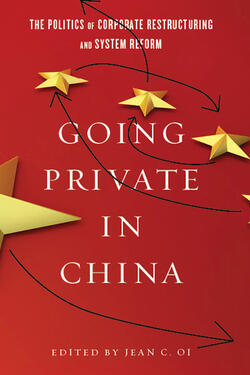
As the Chinese Communist Party (CCP) set about reforming its centrally planned economy, it faced the thorny policy question of how to reform its state-owned enterprises (SOEs). Should it support a shift from public to private ownership of the means of production? Such a shift would challenge not only the CCP's socialist ideology but also its very legitimacy. Mixing the business of corporate restructuring with the politics of socialism presented nothing short of a policy nightmare.

With policy-relevant acuity, the contributors to this wide-ranging volume address the questions about reform programs that have plagued China—and East Asia more broadly—since the 1990s. While China, Japan, and South Korea have all been criticized for implementing reform too slowly or too selectively, this volume delves into the broader contexts underlying certain institutional decisions. The book seeks to show that seemingly different political economies actually share surprising similarities, and problems. While Going Private in China sheds new light on China's corporate restructuring, it also offers new perspectives on how we think about the process of institutional change.

Desk, examination, or review copies can be requested through Stanford University Press.

All Publications button
1
Publication Type
Books
Publication Date
Subtitle

The Politics of Corporate Restructuring and System Reform

Authors
Jean C. Oi
Book Publisher
Shorenstein APARC
Paragraphs

For the peasants in rural China, the harvest season is the occasion when several different worlds—the business world of large companies, the entrepreneurial world of middlemen, local elites and peasant households—are compressed into the same social space, thereby inducing intensive economic and social interactions and crystallizing social relations among villagers, local elites and markets. Based on ethnographic research on the autumn harvest in a township in northern China, this study sheds light on distinctive modes of market transactions across produces, and diverse interactions between markets and local institutions involving different co-ordination mechanisms, rhythms and social relationships. A more nuanced image of market transactions emerges from these observations, calling for a more refined conceptualization of markets and further research on their implications for institutional changes.

All Publications button
1
Publication Type
Journal Articles
Publication Date
Journal Publisher
The China Quarterly
Authors
Xueguang Zhou
-

**Due to space restrictions, this event has reached capacity and we will no longer be taking RSVPs. Everyone is still welcome to attend but please plan to arrive early as seating is on a first come, first serve basis.**

Under the Hu-Wen leadership, China announced a shift in its development policy from a policy program that mainly emphasizes economic growth to one that pursues a “harmonious society.” The harmonious society program was a response to rapid increases in inequality during the 1990s, and its aim has been to ensure that the benefits from growth are widely shared.    

In recent years have the benefits from growth been widely shared? Has income inequality increased or decreased during the Hu-Wen era?

Drawing on recent findings from the China Household Income Project, a collaborative survey research project monitoring changes in incomes and inequality, Professor Terry Sicular will discuss recent trends in inequality and poverty in China. 

Terry Sicular is professor of economics at the University of Western Ontario. She received her doctorate at Yale and has taught at Stanford and Harvard. She is a specialist on the Chinese economy, speaks Mandarin, and has been studying and travelling to China for more than 30 years. Her recent research examines incomes and inequality in China, as well as related topics such as educational attainment and its intergenerational transmission, and the impact of housing reforms on household income and wealth. She has published widely in scholarly journals and books, and is as a contributor to and co-editor of Inequality and Public Policy, published by Cambridge University Press (2008). She has served as a consultant to international donor organizations, and is a leader in the ongoing, China Household Income Project, a collaborative research project that conducts a nationwide household survey and monitors trends in China’s incomes and inequality.

This event is part of the China's Looming Challenges series

Philippines Conference Room

Terry Sicular Professor Speaker Department of Economics, University of Western Ontario
Seminars
-

The team of leaders who will take the helm in China beginning next year—the so-called “Fifth Generation”—will be better educated, have greater exposure to the outside world, and extensive experience implementing policies that have facilitated sustained economic growth and growing international influence. They may view issues somewhat differently than their predecessors but have risen to the top by going along to get ahead and are unlikely to propose radical policy initiatives.  But they must confront a growing number of challenges fueled by China’s past success and recent behavior and will be constrained by structural features of the Chinese system and integration into the global market.

Thomas Fingar is the Oksenberg-Rohlen Distinguished Fellow at the Freeman Spogli Institute for International Studies (FSI). In 2009, he was the Payne Distinguished Lecturer at FSI. From May 2005 through December 2008, he served as the first deputy director of national intelligence for analysis and, concurrently, as chairman of the National Intelligence Council.

This event is part of the China's Looming Challenges series

Philippines Conference Room

Freeman Spogli Institute for International Studies
Stanford University
Encina Hall, C-327
Stanford, CA 94305-6055

(650) 723-9149 (650) 723-6530
0
Shorenstein APARC Fellow
Affiliated Scholar at the Stanford Center on China's Economy and Institutions
tom_fingar_vert.jpg PhD

Thomas Fingar is a Shorenstein APARC Fellow in the Freeman Spogli Institute for International Studies at Stanford University. He was the inaugural Oksenberg-Rohlen Distinguished Fellow from 2010 through 2015 and the Payne Distinguished Lecturer at Stanford in 2009.

From 2005 through 2008, he served as the first deputy director of national intelligence for analysis and, concurrently, as chairman of the National Intelligence Council. Fingar served previously as assistant secretary of the State Department’s Bureau of Intelligence and Research (2000-01 and 2004-05), principal deputy assistant secretary (2001-03), deputy assistant secretary for analysis (1994-2000), director of the Office of Analysis for East Asia and the Pacific (1989-94), and chief of the China Division (1986-89). Between 1975 and 1986 he held a number of positions at Stanford University, including senior research associate in the Center for International Security and Arms Control.

Fingar is a graduate of Cornell University (A.B. in Government and History, 1968), and Stanford University (M.A., 1969 and Ph.D., 1977 both in political science). His most recent books are From Mandate to Blueprint: Lessons from Intelligence Reform (Stanford University Press, 2021), Reducing Uncertainty: Intelligence Analysis and National Security (Stanford University Press, 2011), The New Great Game: China and South and Central Asia in the Era of Reform, editor (Stanford University Press, 2016), Uneasy Partnerships: China and Japan, the Koreas, and Russia in the Era of Reform (Stanford, 2017), and Fateful Decisions: Choices that will Shape China’s Future, co-edited with Jean Oi (Stanford, 2020). His most recent article is, "The Role of Intelligence in Countering Illicit Nuclear-Related Procurement,” in Matthew Bunn, Martin B. Malin, William C. Potter, and Leonard S Spector, eds., Preventing Black Market Trade in Nuclear Technology (Cambridge, 2018)."

Selected Multimedia

CV
Date Label
Thomas Fingar Oksenberg/Rohlen Distinguished Fellow Speaker FSI
Seminars
-

**Due to space restrictions, this event has reached capacity and we will no longer be taking RSVPs. Please plan to arrive early as seating is on a first come, first serve basis.**

Since 2008 China's banks have made loans that approach 30% of GDP each year. The central bank has used a broader measure of credit, total societal financing, that suggests credit extended in 2011 may exceed 40% of the country's GDP. It is inevitable that such profligate lending will result in significant amounts of problem loans.  The international market is well aware of this and Chinese bank shares have been hit hard for most of this year. How will these bad loans be managed? More importantly, why has the government once again used China's ostensibly commercial banks as if they were policy banks and what are the implications of this for China's economy going forward?

Carl E. Walter worked in China and its financial sector for the past 20 years and actively participated in many of the country’s financial reform efforts. While at Credit Suisse First Boston he played a major role in China’s groundbreaking first overseas IPO in 1992, as well as the first primary listing of a state-owned enterprise on the New York Stock Exchange in 1994. He was a member of senior management at China International Capital Corporation, China’s first and most successful joint venture investment bank where he supported a number of significant domestic and international stock and bond underwritings for major Chinese corporations. More recently at JPMorgan he was China Chief Operating Officer and Chief Executive Officer of its banking subsidiary. During this time Carl helped build a pioneering domestic security, risk and currency trading operation.

A long time resident of Beijing before his recent return to the United States, Carl is fluent in Mandarin and holds a PhD from Stanford University and a graduate certificate from Peking University. He is the co-author of Red Capitalism: the fragile financial foundations of China’s extraordinary rise as well as Privatizing China: inside China’s stock markets

This event is part of the China's Looming Challenges series

Philippines Conference Room

Shorenstein APARC Encina Hall Stanford University
1
Visiting Scholar at APARC, 2021-2022
Visiting Scholar at APARC, 2012-2013
WalterCarl_WEB.jpg

Carl Walter joined the Walter H. Shorenstein Asia-Pacific Research Center (Shorenstein APARC) as visiting scholar with the China Program for the 2021-2022 academic year. Prior to coming to APARC, he served as independent, non-executive Director at the China Construction Bank. He was also previously a visiting scholar with APARC during the winter and spring terms of the 2012–13 academic year after a career in banking spent largely in China. 

His research interests focus on China's financial system and its impact on financial and political organizations. During his time at Shorenstein APARC Walter will continue his book project on how fiscal reforms in China have impacted the banking system, the overall economy and the prospect for financial reform going forward.

Walter has contributed articles to publications including Caijing, the Wall Street Journal and the China Quarterly. He is also the co-author of Red Capitalism: The Fragile Financial Foundations of China's Extraordinary Rise (2012) and Privatizing China: Inside China's Stock Markets (2005).

Walter lived and worked in Beijing from 1991 to 2011, first as an investment banker involved in the earliest SOE restructurings and overseas public listings, then as chief operation officer of China's first joint venture investment bank, China International Capital Corporation. Over the last ten years he was JPMorgan's China chief operating officer as well as chief executive officer of its China banking subsidiary.

Walter holds a PhD in political science from Stanford University, a certificate of advanced study from Peking University and a BA in Russian Studies from Princeton University.

Carl Walter Former CEO Speaker JPMorgan Chase Bank China Co Ltd.
Seminars
News Type
News
Date
Paragraphs
The Shorenstein Asia Pacific Research Center and the Division of International, Comparative, and Area Studies are excited to offer highly qualified Stanford students an opportunity to extend classroom knowledge of East Asia to real-life working and cultural experiences through the East Asia Internship Program. Internship positions will cover a wide spectrum of business, non-profit, media, educational, medical, technology, and government activities.
Hero Image
HutongRoofDetail NEWSFEED
A roof detail in a Beijing hutong, Dec. 2007.
Flickr/Bridget Coila
All News button
1
Subscribe to International Relations