
 FSI researchers strive to understand how countries relate to one another, and what policies are needed to achieve global stability and prosperity. International relations experts focus on the challenging U.S.-Russian relationship, the alliance between the U.S. and Japan and the limitations of America’s counterinsurgency strategy in Afghanistan.
Foreign aid is also examined by scholars trying to understand whether money earmarked for health improvements reaches those who need it most. And FSI’s Walter H. Shorenstein Asia-Pacific Research Center has published on the need for strong South Korean leadership in dealing with its northern neighbor.
FSI researchers also look at the citizens who drive international relations, studying the effects of migration and how borders shape people’s lives. Meanwhile FSI students are very much involved in this area, working with the United Nations in Ethiopia to rethink refugee communities.
Trade is also a key component of international relations, with FSI approaching the topic from a slew of angles and states. The economy of trade is rife for study, with an APARC event on the implications of more open trade policies in Japan, and FSI researchers making sense of who would benefit from a free trade zone between the European Union and the United States.


Shorenstein APARC Names 2019-20 Postdoctoral Fellows
News Type
News
Date
Paragraphs
Shorenstein APARC is pleased to announce the selection of two scholars as postdoctoral fellows for the 2019-20 academic year. They will begin their appointments at Stanford in the coming Autumn quarter.
The Center offers the Shorenstein Postdoctoral Fellowship on Contemporary Asia to recent doctoral graduates dedicated to research and writing on contemporary Asia, primarily in the areas of political, economic, or social change in the Asia-Pacific region, or international relations and international political economy in the region. The Center’s Asia Health Policy Program sponsors the Asia Health Policy Postdoctoral Fellowship, supporting young scholars who pursue original research on contemporary health or healthcare policy of high relevance to low- and middle-income countries in the Asia-Pacific region
Fellows develop their dissertations and other projects for publication, present their research, and participate in the intellectual life at the Center and at Stanford at large. Our postdoctoral fellows often go on to pursue careers at top universities and research organizations around the world and continue to contribute to APARC research and publications.
Meet our new postdoctoral scholars:
Image

Asia Health Policy Postdoctoral Fellow
What are the conditions necessary to ensure the effectiveness of public health insurance programs?
Radhika Jain is completing her doctorate in the Department of Global Health at Harvard University. She studies the role of the private sector in the health system, frictions in health care markets, and the incidence of public health policy benefits.
Radhika’s dissertation examines the extent to which government subsidies for health care under insurance are captured by private hospitals instead of being passed through to patients, and whether accountability measures can help patients claim their entitlements. Radhika’s research has been supported by grants from the Weiss Family Fund and the Jameel Poverty Action Lab (JPAL). She has worked on impact evaluations of health programs in India and on the implementation of HIV programs across several countries in sub-Saharan Africa. She also held a doctoral fellowship at the Center for Global Development.
At Shorenstein APARC, Radhika will refine her dissertation research for publication in academic journals and start new work on the structure of health care markets in India and the impacts of measures to increase the effectiveness of public health insurance.
Image

Shorenstein Postdoctoral Fellow on Contemporary Asia
How does modernization influence cultural democratization in East Asia?
Hannah June Kim is completing her doctorate in the Department of Political Science at the University of California, Irvine. She researches public opinion, political behavior, theories of modernization, economic development, and democratic citizenship, focusing on East Asia.
Hannah’s dissertation examines how and why people view democracy in systematically different ways in six countries: China, Japan, Korea, Singapore, Taiwan, and Vietnam. Developing unique categories of democratic citizenship that measure the cognitive, affective, and behavioral patterns of individuals, she finds that state-led economic development limited the growth of cultural democratization among middle class groups in all three dimensions. The results imply that the classic causality between modernization and democratization may not be universally applicable to different cultural contexts.
At Shorenstein APARC, Hannah will work on developing her dissertation into a book manuscript and make progress on her next project that explores democratization and gender empowerment in East Asia. Hannah received an MA in International Studies from Korea University and a BA from UCLA. Her work has been published, or is forthcoming, in The Journal of Politics, PS: Political Science & Politics, and the Japanese Journal of Political Science.
Hero Image

All News button
1
How China Can Lead the Way Towards Cooperative Innovation: A Discussion with Amb. Craig Allen, President of U.S.-China Business Council
-
WE HAVE REACHED VENUE CAPACITY AND ARE NO LONGER ACCEPTING RSVPS
Forty years after the reestablishment of diplomatic relations between the United States and China, we are at a historic inflection point defined by more and more competition and less and less cooperation. Both countries have actively traded economic blows and we have demonstrably proven that we are most capable of hurting each other. There are voices on both sides clamoring for economic decoupling amidst a severe collapse of trust, and that trust deficit is most starkly on display in the realm of technology and innovation. In many respects, China’s technological transformation has been a boon to the United States. It is, in fact, impossible to imagine a Silicon Valley without China. But US concerns over China’s policies and practices in the high-tech sphere are very real. The US Trade Representative’s Section 301 report accurately identifies a suite of anti-competitive and unfair practices that cannot continue if cooperative innovation is to thrive. History shows that the United States and China can both choose to make progress together, or we can both choose to struggle together. There are steps China can take to right this course, steps that are in its own economic interests as well as ours.
Image

On July 26, 2018, Ambassador Craig Allen began his tenure in Washington, DC, as the sixth President of the United States-China Business Council, a private, nonpartisan, nonprofit organization representing over 200 American companies doing business with China. Ambassador Allen began his government career in 1985 at the Department of Commerce’s International Trade Administration (ITA) where, from 1986 to 1988, he worked as an international economist in ITA’s China Office. In 1988, Allen transferred to the American Institute in Taiwan, where he served as Director of the American Trade Center in Taipei. He returned to the Department of Commerce for a three-year posting at the US Embassy in Beijing as Commercial Attaché in 1992. In 1995, Allen was assigned to the US Embassy in Tokyo where he was promoted to Deputy Senior Commercial Officer in 1998. Allen became a member of the Senior Foreign Service in 1999. Starting from 2000, he served a two-year tour at the National Center for APEC in Seattle where he worked on the APEC Summits in Brunei, China, and Mexico. In 2002, Allen first served as the Senior Commercial Officer in Beijing where he was later promoted to the Minister Counselor rank of the Senior Foreign Service. After a four-year tour in South Africa, Ambassador Allen became Deputy Assistant Secretary for Asia at the US Department of Commerce’s International Trade Administration. He later became Deputy Assistant Secretary for China. Ambassador Allen was sworn in as the United States ambassador to Brunei Darussalam on December 19, 2014 where he served until he transitioned to take up his position as President of the US-China Business Council.
The US-China Business Council is a private, nonpartisan, nonprofit organization of approximately 200 American companies that do business with China. For more information regarding the USCBC, click here
This event is part of the China Program’s Colloquia Series entitled "A New Cold War?: Sharp Power, Strategic Competition, and the Future of U.S.-China Relations " sponsored by Shorenstein APARC's China Program.
A New Cold War?: Sharp Power, Strategic Competition, and the Future of U.S.-China Relations
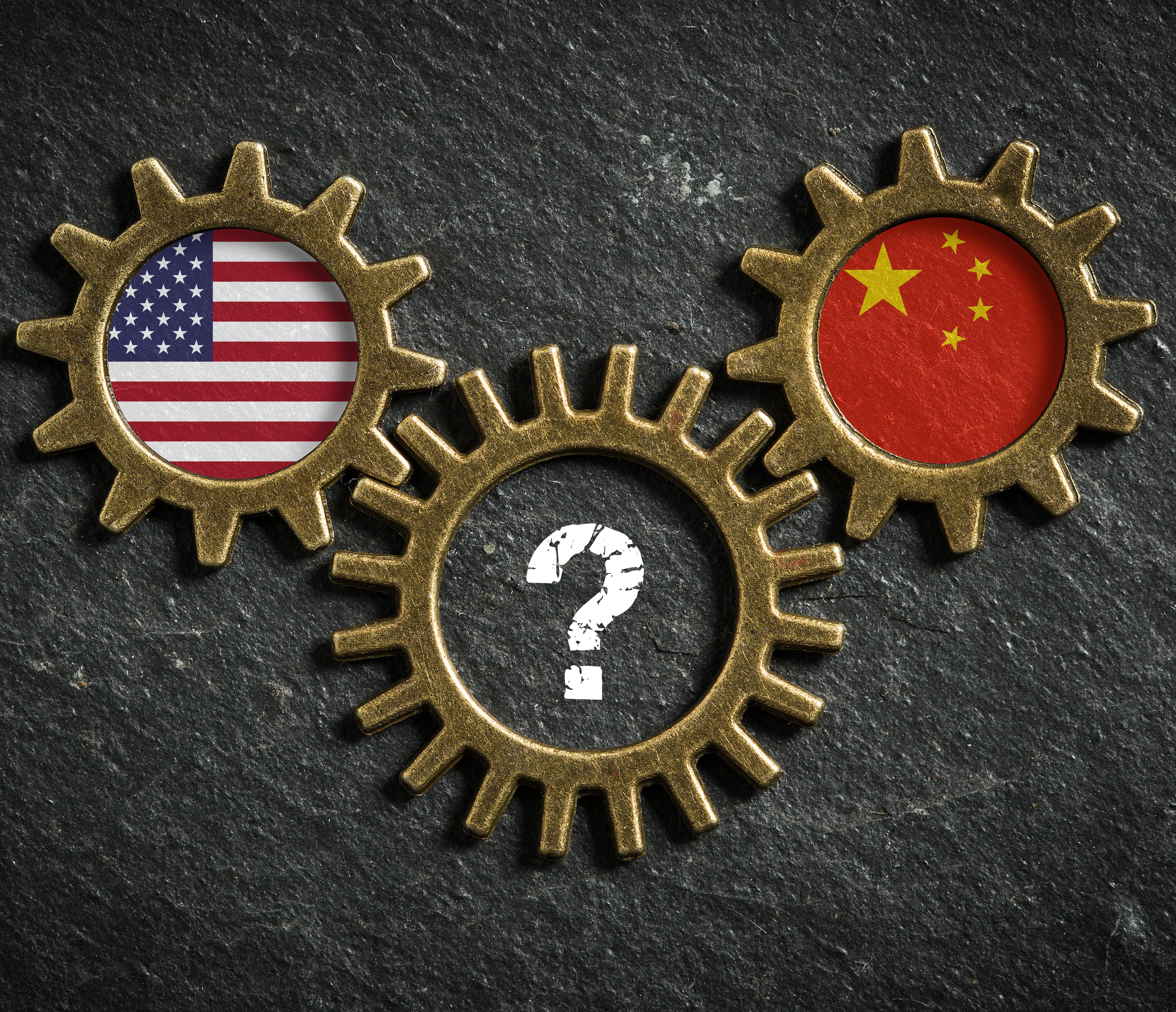 Trade conflict has exploded. The media is rife with stories of China’s unfair trade practices, cyber theft, IP theft and forced technology transfers. Who will first scale the commanding heights of technological supremacy? Who will be the first mover in AI, robotics and biotechnology? What are the implications of Beijing’s ambitious infrastructure projects, including its Belt and Road Initiative? How is China’s “sharp power” deployed, and what are its implications for political and civic life in the U.S.? Can the Trump administration and Beijing’s leadership reach agreement on our trade disputes? Are these just the beginning salvos of an increasingly turbulent future? As U.S. policy towards China sharply veers away from “constructive engagement” to “strategic competition,” the Stanford China Program will host a series of talks by leading experts to explore the current state of our bilateral relations, its potential future, and their implications for the world order.
Philippines Conference Room Encina Hall, 3rd Floor 616 Serra Mall, Stanford, CA 94305
Amb. Craig Allen
<i>President of US-China Business Council</i><br><br>
Seminars
Elizabeth Economy on Xi Jinping’s Third Revolution and the Future of U.S.-China Relations
News Type
News
Date
Paragraphs
In her acclaimed book The Third Revolution: Xi Jinping and the New Chinese State, Chinese domestic and foreign policy expert Elizabeth Economy argues that Xi Jinping’s dual-reform trajectories—a more authoritarian system at home and a more ambitious foreign policy abroad—provide Beijing with new levers of influence that the United States must learn to use to protect its own interests.
Economy, the C. V. Starr senior fellow and director for Asia studies at the Council on Foreign Relations and a distinguished visiting fellow at Stanford University's Hoover Institution, kicked off the China Program’s 2019 winter colloquia with a discussion of the transformations underway in China today and the future of U.S.-China relations.
Speaking to a packed audience, Economy described how, in the process of pursuing his vision of the rejuvenation of the Chinese dream, Xi Jinping has upended much of Deng Xiaoping’s "second revolution" and has put in motion four significant strategic shifts in Chinese domestic and foreign policy.
The first shift is a move away from Deng’s consensus- and collective-based decision-making process back toward a more single-man, authoritarian role. The second is a reassertion of the Chinese Communist Party more deeply into the everyday political and economic lives of the Chinese people. The third is a creation of a virtual wall of restrictions and regulations that allows Xi and the rest of the Chinese leadership to control more closely what comes into the country and what goes out. The fourth shift, the most visible one to people outside China, is the move from Deng’s low-profile foreign policy to a far more ambitious foreign policy.
This foreign policy shift, said Economy, is especially noteworthy in three areas: first, in Xi’s move from staking claims around Chinese sovereignty to realizing them; second, in his Belt and Road Initiative; and third, in his effort to reform institutions of global governance so that they reflect Chinese values and norms.
How should the United States address these changes in China’s domestic and foreign policy? Economy listed four ways of response: first, cooperation, namely, collaborating with China on global problems such as those concerning public health or the environment; second, coordination with U.S. allies; third, countering China by pushing back on, for example, its South China Sea claims and incidents of intellectual property infringement; and finally, competing with China by investing domestically in areas including education and research and technological development.
Hero Image

All News button
1
Display Hero Image Wide (1320px)
No
China Program Convenes Leading Scholars to Discuss the Field of Chinese Politics in the Era of Xi Jinping and to Chart Its Future
News Type
News
Date
Paragraphs
In the nearly seven years since assuming the role of General Secretary of the Communist Party of China, Xi Jinping has had far-ranging impact on the country’s policies at home and abroad. From his anti-corruption campaign and tightening restrictions on civil society to championing the Belt and Road initiative and abolishing China’s presidential term limits, Xi is transforming the Chinese state and its place on the global stage.
Among the cutting-edge topics that China scholars are beginning to explore is Xi’s impact on Chinese politics and its concomitant influence on what and how scholars study Chinese politics. Last December, the China Program at Shorenstein APARC hosted a conference that drew preeminent scholars of Chinese politics and comparative politics primarily from across the United States and Canada, where they gathered to assess the state of the discipline, and where the field might go next.
Too Big for One Room
The conference traces its origins to a prior gathering at the American Political Science Association (APSA). The number of attendees at that meeting outpaced any room upgrade APSA could provide. “We were impressed by the number of people studying Chinese politics,” said the China Program Director Jean Oi . “It was apparent to many of us who attended that meeting that it was time we convened a separate event with leaders in the field.”
The need to bring together the multiple generations of scholars of Chinese politics was also clear. “Younger scholars today are so much more well-equipped with various sophisticated methodologies such as machine learning and web scraping,” noted Oi. “We decided it would be useful to gather those doing various types of research, quantitative and qualitative, to think about what we don’t know about Chinese politics but would like to know; and how possibly we might go about doing that research. Our goal for this conference was to try to identify collectively some of those questions for the study of Chinese politics and how our research might contribute to the broader field of comparative politics.” The first gathering of Chinese politics scholars took place at Harvard in December 2017.
‘Burning Questions’ Light Up Second Gathering

That first conference at Harvard reinforced the utility of inter-dialog and helped organizers secure a grant from APSA, which along with support from from FSI and Shorenstein APARC facilitated the second gathering, this time at Stanford. To ensure that the sessions allowed for maximum participant engagement, attendees were assigned into seven working groups. In the months preceding the conference, each group prepared a memo identifying the key questions in the field of Chinese politics, the ways to addressing these questions, and the synergies between Chinese politics and comparative politics .
“The State of the Field in Chinese Politics” conference opened with presentations by the seven small group leaders to a plenary session, followed by discussion of the various burning questions identified by the participants. Unsurprisingly, one prominent item across many of the memos was the oversized impact of Xi on China. Other areas of interest included “elite politics,” the relationship between newfound billionaires and the party, the renewed role of state-owned enterprises in the economy, and the current status of relationships between the private sector, the Party, and the state
Several groups also expressed their desire to learn more about the internal workings of the Party, specifically the adaptation of political institutions over time. While observers often point out that China’s political institutions have changed little compared to its economic institutions, scholars have also found that, in fact, the changes within China’s governmental organizations have been subtle yet profound. But how can we determine when an organizational structure changes the ways in which it operates, and who decides? The field of Chinese politics remains uncertain about these questions.
On the second day, conference attendees were joined by several Stanford scholars of comparative politics, including FSI Director Mike McFaul and FSI Senior Fellows Lisa Blaydes, Beatriz Magaloni and Barry Weingast, who responded to the group memos. Breakout discussions of methodology followed.
Keeping the Fire Going
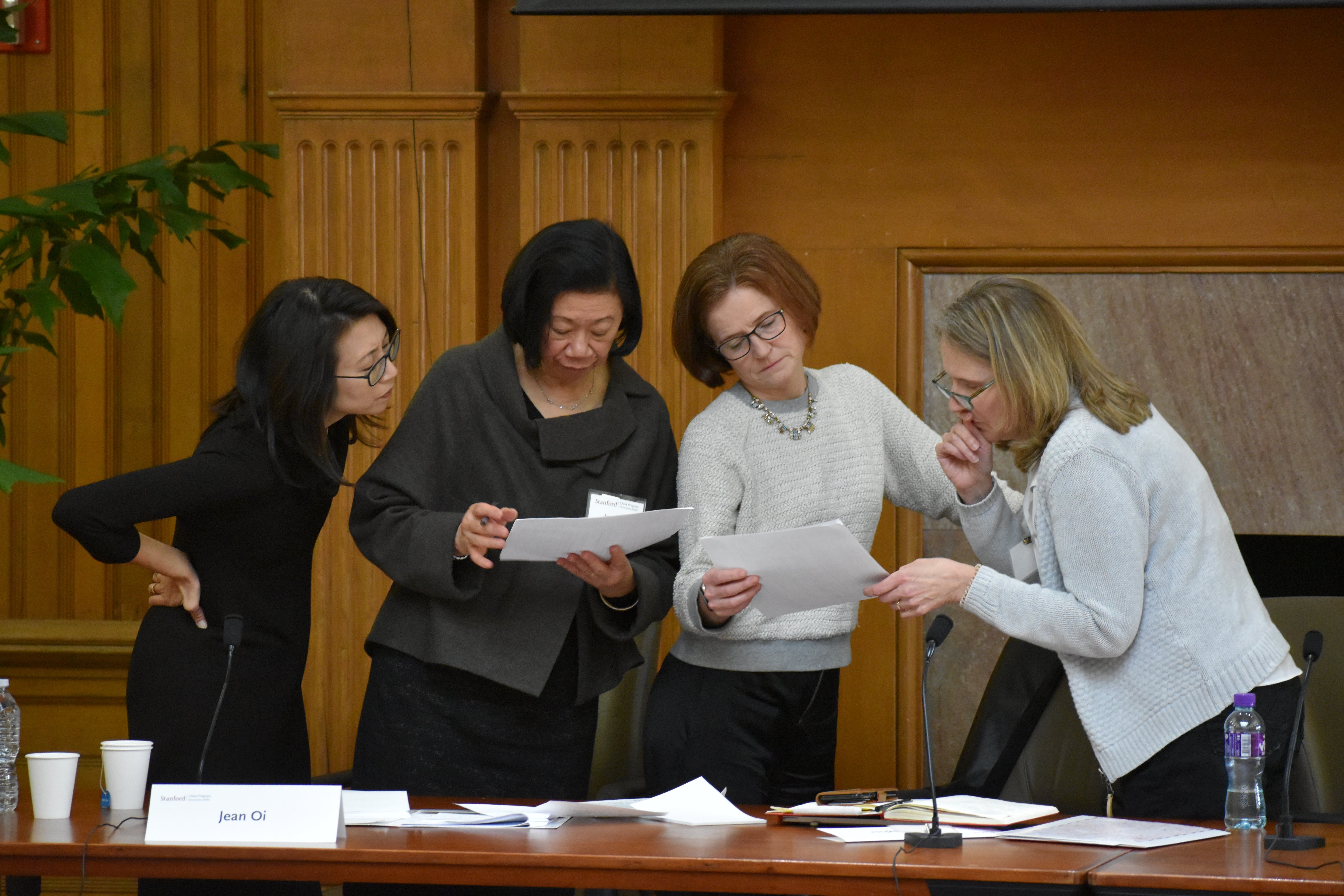
(From left to right): Professors Kellee Tsai, Hong Kong University of Science and Technology; Jean Oi, Stanford University; Mary Gallagher, University of Michigan; and Margaret Pearson, University of Maryland confer with one another
The conference concluded with a plenary session that focused on the questions "Where are we now?” and “Where do we go next?" One conclusion from the closing was an acknowledgment of the need to more fully consider China in the context of its interactions with other countries in the region as well as globally. “I think that ‘China in the Global Context’ may very well be the theme of our next conference,” said Oi.
A third conference is tentatively scheduled for December 2019. The five partners behind the series—Stanford University, Harvard University, Duke University, MIT, and the University of Michigan—are currently seeking outside funding to keep this effort going. The hope is that the next meeting will be at Duke University.
Hero Image

All News button
1
Hedging our Allies: Australia and the Battle Lines for Strategic Competition with China
-
The pace of China-U.S. strategic competition has accelerated in the Asia-Pacific, causing heightened concern among U.S. allies and partners in the region over China’s economic expansion, Belt and Road Initiative, and maritime ambitions that challenge U.S. dominance in the region. Even U.S. allies as reliable as Australia are wondering openly about the capacity of the U.S. to balance Chinese influence. The Trump administration’s isolationist rhetoric, abandonment of TPP, withdrawal from the Paris Climate Accords, and “flinch” during the recent trade war has increased this concern. China meanwhile has demonstrated increased sophistication in diplomacy and in neutralizing historical U.S. advantages. The new frontiers of cyber and space are the most likely domains in which these challenges will play out from a security perspective. The choices that the U.S. makes in these realms in the next two years may establish a course for the region that cannot be corrected later.
Image

Ambassador Jeffrey Bleich is the former US ambassador to Australia and Special Counsel to President Obama in the White House. He is currently a partner at Dentons and CEO of Dentons Diplomatic Solutions, where he focuses on privacy and data security, internal investigations, market access, and cross-border disputes involving the Indo-Pacific region.
As ambassador, his term was marked by the US "rebalance" to the Asia Pacific, with Australia being the focal point for that shift. His efforts included overseeing record growth in trade and investment between the US and Australia, bringing the Defense Trade Cooperation Treaty into force, establishing new alliance agreements for satellites and cybersecurity, executing a new space cooperation agreement that supported the Mars Curiosity rover landing, leading joint US-Australia efforts in Afghanistan’s Uruzgan province, and promoting regional human rights efforts. For his federal service, Amb. Bleich has received numerous awards, including the highest civilian honors awarded by the Director of National Intelligence and the United States Navy. In 2014, he received the State Department's highest award for a non-career ambassador, the Sue Cobb Prize for Exemplary Diplomatic Service.
Amb. Bleich currently serves as Chair of the Fulbright Foreign Scholarship Board (appointed by President Obama) and as a member of the East-West Center (appointed by Secretary Kerry). He also serves by appointment of the Governor on the Governor's 11-member International Trade and Investment Council. He was formerly the President of the State Bar of California, and the Chair of the California State University Board of Trustees, and currently serves on the Board of Stanford’s Center For the Advanced Study of Behavior Science, and the Board of Amherst College. He has been elected as a life member to both the American Law Institute and the Council on Foreign Relations.
Amb. Bleich received his B.A. from Amherst College (with high honors), M.P.P. from Harvard (with highest honors), and J.D. from U.C. Berkeley (with highest honors) where he also served as Editor-in-Chief of the California Law Review. He clerked for Judge Abner Mikva of the DC Circuit, Chief Justice William Rehnquist of the U.S. Supreme Court, and Judge Howard Holtzmann of the Iran-U.S. Claims Tribunal in the Hague, before becoming a partner at Munger Tolles & Olson. Amb. Bleich has been regularly listed among the Daily Journal's Top 100 attorneys in California, honored as a California Lawyer Attorney of the Year and listed in Lawdragon 500 and in America's Best Lawyers as a top “Bet the Company” lawyer.
p.p1 {margin: 0.0px 0.0px 0.0px 0.0px; font: 12.0px Calibri; color: #414141} span.s1 {font-kerning: none}
This event is part of the China Program’s Colloquia Series entitled "A New Cold War?: Sharp Power, Strategic Competition, and the Future of U.S.-China Relations " sponsored by Shorenstein APARC's China Program.
A New Cold War?: Sharp Power, Strategic Competition, and the Future of U.S.-China Relations
Trade conflict has exploded. The media is rife with stories of China’s unfair trade practices, cyber theft, IP theft and forced technology transfers. Who will first scale the commanding heights of technological supremacy? Who will be the first mover in AI, robotics and biotechnology? What are the implications of Beijing’s ambitious infrastructure projects, including its Belt and Road Initiative? How is China’s “sharp power” deployed, and what are its implications for political and civic life in the U.S.? Can the Trump administration and Beijing’s leadership reach agreement on our trade disputes? Are these just the beginning salvos of an increasingly turbulent future? As U.S. policy towards China sharply veers away from “constructive engagement” to “strategic competition,” the Stanford China Program will host a series of talks by leading experts to explore the current state of our bilateral relations, its potential future, and their implications for the world order.
Philippines Conference Room Encina Hall, 3rd Floor 616 Serra Mall, Stanford, CA 94305
Amb. Jeffrey Bleich
<i>Dentons</i><br><br>
Lectures
Audio: APARC Scholars on China’s Belt and Road Initiative
News Type
Commentary
Date
Paragraphs
APARC's Direcror of the Southeast Asia Program Donald K. Emmerson, Center Fellow Thomas Fingar, and Oksenberg-Rohlen Fellow David M. Lampton spoke with The New Silk Road Project as part of a series of conversations that explores China’s Belt and Road Initiative (BRI) from various perspectives. The New Silk Road Project is a student-led research project that aims to better understand and raise awareness of China’s BRI by documenting its land-based component and compiling interviews with leading academics.
Listen to the complete interviews below.
Donald K. Emmerson discusses Chinese investment in ASEAN, multilateralism, and the possibility of building the Kra Canal across Thailand to help offset China’s Malacca Dilemma:
Thomas Fingar discusses how Chinese policies and priorities interact with the goals and actions of other countries in Central and South Asia:
David M. Lampton discusses China’s development of high-speed railway networks in Southeast Asia:
Hero Image

All News button
1
Chinese Influence: Real or Perceived? Varying Responses to the Hoover Institution/Asia Society Report
-
Please note venue change to Bechtel Conference Room (Encina Hall, 1st Floor)
This panel aims to bring together a diverse spectrum of speakers to generate discussion and debate regarding Chinese Influence and American Interests: Promoting Constructive Vigilance, a report jointly issued on November 29, 2018 by the Hoover Institution at Stanford University and the Center on U.S.-China Relations at Asia Society.
Chinese Influence and American Interests: Promoting Constructive Vigilance has sparked sharp reactions as it urges American governments, organizations and individuals to engage in “constructive vigilance” to counter China’s illicit, influence-seeking operations across a broad spectrum of American political and civic life, including U.S. federal and state governments; university campuses; and the technology sector. What is the evidence behind these claims? What are the implications of these claims? Is the Chinese threat real or speculative? How can we responsibly assess the difference?
Link to report found
Image

Gordon H. Chang is the Olive H. Palmer Professor in Humanities and professor in the Department of History at Stanford University. With degrees from Princeton and Stanford, Chang specializes in the history of U.S.-China relations and Asian American history. He has written and edited many books and essays on these topics. Among these are Friends and Enemies: The United States, China, and the Soviet Union, 1948-1972 (Stanford University Press, 1990); Morning Glory, Evening Shadow: Yamato Ichihashi and His Internment Writing, 1942-1945 (Stanford University Press, 1997); Asian Americans and Politics: Perspectives, Experiences, Prospects (Woodrow Wilson Center Press, 2001); Chinese American Voices From the Gold Rush to the Present (University of California Press, 2006); Asian American Art: A History, 1850-1970 (Stanford University Press, 2008); and Fateful Ties: A History of America’s Preoccupation with China (Harvard University Press, 2015). At Stanford, he is co-directing the Chinese Railroad Workers in North America Project that is recovering and interpreting the history of Chinese workers who toiled on the first transcontinental rail line and other lines in the 19th century.
Image

Larry Diamond is a senior fellow at the Hoover Institution and at the Freeman Spogli Institute (FSI) for International Studies. For more than six years, he directed FSI’s Center on Democracy, Development, and the Rule of Law, where he now leads its Program on Arab Reform and Democracy and its Global Digital Policy Incubator. He is the founding co- editor of the Journal of Democracy and also serves as Senior Consultant at the International Forum for Democratic Studies of the National Endowment for Democracy. His research focuses on democratic trends and conditions around in the world, and on policies and reforms to defend and advance democracy. His 2016 book, In Search of Democracy, explores the challenges confronting democracy and democracy promotion, gathering together three decades of his writing and research, particularly on Africa and Asia. He has just completed a new book on the global crisis of democracy, which will be published in 2019, and is now writing a textbook on democratic development.
Image

Elizabeth C. Economy is the C.V. Starr senior fellow and director for Asia studies at the Council on Foreign Relations and a distinguished visiting fellow at Stanford University’s Hoover Institution. Her most recent book, The Third Revolution: Xi Jinping and the New Chinese State, (Oxford University Press, 2018) analyzes the contradictory nature of reform under President Xi Jinping. She is also author of By All Means Necessary: How China's Resource Quest is Changing the World(Oxford University Press, 2014) with Michael Levi, and The River Runs Black: The Environmental Challenge to China's Future (Cornell University Press, 2004; 2nd edition, 2010; Japanese edition, 2005; Chinese edition, 2011). She has published articles in policy and scholarly journals including Foreign Affairs, Foreign Policy, and the Harvard Business Review; and op-eds in the New York Times and Washington Post, among others. In June 2018, she was named one of the "10 Names That Matter on China Policy" by Politico Magazine.
Image

David M. Lampton is Oksenberg-Rohlen Fellow and Research Scholar at Stanford University’s Shorenstein Asia-Pacific Research Center. He also is Hyman Professor and Director of China Studies Emeritus at the Johns Hopkins School of Advanced International Studies. Having started his academic career at The Ohio State University, Lampton has been Chairman of the The Asia Foundation (2015-2018), president of the National Committee on United States-China Relations (1988-1997), and former Dean of Faculty at SAIS (2004-2012). He is the author of: Same Bed, Different Dreams: Managing U.S.-China Relations, 1989-2000 (2001); The Three Faces of Chinese Power: Might, Money, and Minds (2008); and, The Making of Chinese Foreign and Security Policy (editor, Stanford University Press, 2001). He received his B.A., M.A., and Ph.D. degrees from Stanford University where, as an undergraduate student, he was a fireman. Lampton has an honorary doctorate from the Russian Academy of Sciences’ Institute of Far Eastern Studies. His newest book, Following the Leader: Ruling China, from Deng Xiaoping to Xi Jinping, was first published in January 2014 and will be reissued in paperback with a new Preface early in 2019 by the University of California Press. His current field research and book-length project focuses on Beijing’s effort to build high-speed and other rail lines to Singapore from southern China.
Image

Jean C. Oi is the William Haas Professor of Chinese Politics in the department of political science and a Senior Fellow of FSI at Stanford University. She is the founding director of the Stanford China Program at Shorenstein APARC. Professor Oi also is the founding Lee Shau Kee Director of the Stanford Center at Peking University. Her work focuses on comparative politics, with special expertise on political economy and the process of reform in transitional systems. Oi has written extensively on China’s political economy. Her most recent works include, Zouping Revisited: Adaptive Governance in a Chinese County, with Steven Goldstein (2018); Challenges in the Process of China’s Urbanization, with Karen Eggleston and Yiming Wang (2017); Going Private in China: The Politics of Corporate Restructuring and System Reform (2011); and Growing Pains: Tensions and Opportunity in China’s Transformation, with Scott Rozelle and Xueguang Zhou (2010).
This event is part of the China Program’s Colloquia Series entitled "A New Cold War?: Sharp Power, Strategic Competition, and the Future of U.S.-China Relations " sponsored by Shorenstein APARC's China Program.
A New Cold War?: Sharp Power, Strategic Competition, and the Future of U.S.-China Relations
Image

Trade conflict has exploded. The media is rife with stories of China’s unfair trade practices, cyber theft, IP theft and forced technology transfers. Who will first scale the commanding heights of technological supremacy? Who will be the first mover in AI, robotics and biotechnology? What are the implications of Beijing’s ambitious infrastructure projects, including its Belt and Road Initiative? How is China’s “sharp power” deployed, and what are its implications for political and civic life in the U.S.? Can the Trump administration and Beijing’s leadership reach agreement on our trade disputes? Are these just the beginning salvos of an increasingly turbulent future? As U.S. policy towards China sharply veers away from “constructive engagement” to “strategic competition,” the Stanford China Program will host a series of talks by leading experts to explore the current state of our bilateral relations, its potential future, and their implications for the world order.
For a recap, audio, transcript and pictures of the event, please see the following link.
https://aparc.fsi.stanford.edu/china/multimedia/transcripts-chinese-influence-real-or-perceived
p.p1 {margin: 0.0px 0.0px 0.0px 0.0px; font: 12.0px Garamond} span.s1 {font-kerning: none; background-color: #fffb01} span.s2 {font-kerning: none}
Oksenberg Conference Room Encina Hall, 3rd Floor 616 Serra Mall, Stanford, CA 94305
Gordon H. Chang
Professor, Department of History, Stanford University
Larry Diamond
Senior Fellow, Hoover Institution, Stanford University
Elizabeth C. Economy
Distinguished Visiting Fellow, Hoover Institution, Stanford University
David M. Lampton
Oksenberg-Rohlen Fellow, FSI, Stanford University
Jean C. Oi
Director, Stanford China Program; William Haas Professor of Chinese Studies, Stanford University
Seminars
On Hostile Coexistence with China
-
WE HAVE REACHED VENUE CAPACITY AND ARE NO LONGER ACCEPTING RSVPS
President Trump’s trade war has infected every domain of Sino-American relations. For better or ill, Washington appears poised to dismantle China’s interdependence with the American economy, limit its role in global governance, counter its investments, and block its technological advances. How and on what terms will this end? The answer will depend on the capacity of the United States and China for statecraft and the effectiveness of each in raising its competitiveness. What challenges might hostile Sino-American coexistence entail for each nation? Which country is best positioned to develop the steadiest strategies, most purposive economic policies, and the most supportive relations with other states?
Image
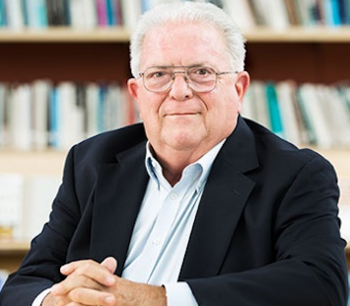
Ambassador Chas W. Freeman, Jr. is a senior fellow at Brown University's Watson Institute for International and Public Affairs. He is the former assistant secretary of defense for international security affairs (1993–1994), ambassador to Saudi Arabia (1989–1992), principal deputy assistant secretary of state for African affairs (1986–1989), and chargé d'affaires at Bangkok (1984–1986) and Beijing (1981–1984). He served as vice chair of the Atlantic Council (1996-2008); co-chair of the United States China Policy Foundation (1996–2009); and president of the Middle East Policy Council (1997–2009). He was the principal American interpreter during President Nixon's path-breaking 1972 visit to Beijing, the editor of the Encyclopedia Britannica article on diplomacy, and the author of America’s Continuing Misadventures in the Middle East; Interesting Times: China, America, and the Shifting Balance of Prestige; America’s Misadventures in the Middle East; The Diplomat’s Dictionary; and Arts of Power: Statecraft and Diplomacy. A compendium of his speeches is available at chasfreeman.net.
This event is part of the China Program’s Colloquia Series entitled "A New Cold War?: Sharp Power, Strategic Competition, and the Future of U.S.-China Relations " sponsored by Shorenstein APARC's China Program.
A New Cold War?: Sharp Power, Strategic Competition, and the Future of U.S.-China Relations
Image

Trade conflict has exploded. The media is rife with stories of China’s unfair trade practices, cyber theft, IP theft and forced technology transfers. Who will first scale the commanding heights of technological supremacy? Who will be the first mover in AI, robotics and biotechnology? What are the implications of Beijing’s ambitious infrastructure projects, including its Belt and Road Initiative? How is China’s “sharp power” deployed, and what are its implications for political and civic life in the U.S.? Can the Trump administration and Beijing’s leadership reach agreement on our trade disputes? Are these just the beginning salvos of an increasingly turbulent future? As U.S. policy towards China sharply veers away from “constructive engagement” to “strategic competition,” the Stanford China Program will host a series of talks by leading experts to explore the current state of our bilateral relations, its potential future, and their implications for the world order.
Ambassador Chas W. Freeman, Jr.
Seminars
A New Cold War?: Sharp Power, Strategic Competition, and the Future of U.S.-China Relations
Image