Society

FSI researchers work to understand continuity and change in societies as they confront their problems and opportunities. This includes the implications of migration and human trafficking. What happens to a society when young girls exit the sex trade? How do groups moving between locations impact societies, economies, self-identity and citizenship? What are the ethnic challenges faced by an increasingly diverse European Union? From a policy perspective, scholars also work to investigate the consequences of security-related measures for society and its values.

The Europe Center reflects much of FSI’s agenda of investigating societies, serving as a forum for experts to research the cultures, religions and people of Europe. The Center sponsors several seminars and lectures, as well as visiting scholars.

Societal research also addresses issues of demography and aging, such as the social and economic challenges of providing health care for an aging population. How do older adults make decisions, and what societal tools need to be in place to ensure the resulting decisions are well-informed? FSI regularly brings in international scholars to look at these issues. They discuss how adults care for their older parents in rural China as well as the economic aspects of aging populations in China and India.

-

WE HAVE REACHED VENUE CAPACITY AND ARE NO LONGER ACCEPTING RSVPS


Rising US-China economic tensions are normal and were to be expected as China modernized. The current discussion of possible “disengagement” between the two was not foreordained, and results from relatively recent divergence in Chinese policy-making from the 40 year trend. The trend is not inevitable, but it will strengthen unless Beijing reverts to market liberalization: nations built on fundamentally different economic systems cannot be as linked as those with like-minded approaches. But China is far from locked-in to a non-market future, and any talk of US disengagement should be rigorously tested against three principles: provisional, partial and peaceful.   

Image
drosen press

Daniel H. Rosen is a founding partner of Rhodium Group and leads the firm’s work on China, India and Asia.  Dan has twenty-six years of professional experience analyzing China’s economy, commercial sector and external interactions. He is widely recognized for his contributions on the US-China economic relationship. He is affiliated with a number of American think tanks focused on international economics, and is an Adjunct Associate Professor at Columbia University. From 2000-2001, Dan was Senior Adviser for International Economic Policy at the White House National Economic Council and National Security Council. He is a member of the Council on Foreign Relations, and board member of the National Committee on US-China Relations. A native of New York City, Dan graduated with distinction from the graduate School of Foreign Service of Georgetown University (MSFS) and with honors in Asian Studies and Economics from the University of Texas, Austin (BA).

This event is part of the China Program’s Colloquia Series entitled "A New Cold War?: Sharp Power, Strategic Competition, and the Future of U.S.-China Relations " sponsored by Shorenstein APARC's China Program.

A New Cold War?: Sharp Power, Strategic Competition, and the Future of U.S.-China Relations

Image

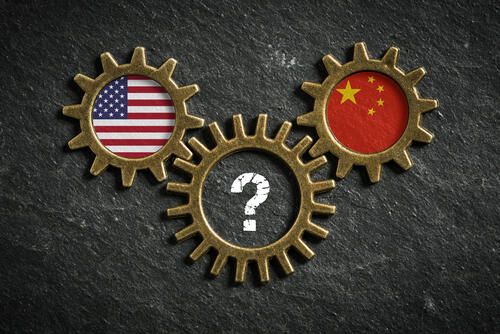
Trade conflict has exploded. The media is rife with stories of China’s unfair trade practices, cyber theft, IP theft and forced technology transfers. Who will first scale the commanding heights of technological supremacy? Who will be the first mover in AI, robotics and biotechnology? What are the implications of Beijing’s ambitious infrastructure projects, including its Belt and Road Initiative? How is China’s “sharp power” deployed, and what are its implications for political and civic life in the U.S.? Can the Trump administration and Beijing’s leadership reach agreement on our trade disputes? Are these just the beginning salvos of an increasingly turbulent future? As U.S. policy towards China sharply veers away from “constructive engagement” to “strategic competition,” the Stanford China Program will host a series of talks by leading experts to explore the current state of our bilateral relations, its potential future, and their implications for the world order.

p.p1 {margin: 0.0px 0.0px 0.0px 0.0px; font: 12.0px Calibri} span.s1 {font: 11.0px Calibri; font-kerning: none} span.s2 {font-kerning: none}

https://aparc.fsi.stanford.edu/china/research/new-cold-war-sharp-power-strategic-competition-and-future-us-china-relations

Philippines Conference Room Encina Hall, 3rd Floor 616 Serra Mall, Stanford, CA 94305
Daniel Rosen <i>Rhodium Group</i><br><br>
Seminars
Authors
News Type
News
Date
Paragraphs
In her acclaimed book The Third Revolution: Xi Jinping and the New Chinese State, Chinese domestic and foreign policy expert Elizabeth Economy argues that Xi Jinping’s dual-reform trajectories—a more authoritarian system at home and a more ambitious foreign policy abroad—provide Beijing with new levers of influence that the United States must learn to use to protect its own interests.
 
Economy, the C. V. Starr senior fellow and director for Asia studies at the Council on Foreign Relations and a distinguished visiting fellow at Stanford University's Hoover Institution, kicked off the China Program’s 2019 winter colloquia with a discussion of the transformations underway in China today and the future of U.S.-China relations.
 
Speaking to a packed audience, Economy described how, in the process of pursuing his vision of the rejuvenation of the Chinese dream, Xi Jinping has upended much of Deng Xiaoping’s "second revolution" and has put in motion four significant strategic shifts in Chinese domestic and foreign policy.
 
The first shift is a move away from Deng’s consensus- and collective-based decision-making process back toward a more single-man, authoritarian role. The second is a reassertion of the Chinese Communist Party more deeply into the everyday political and economic lives of the Chinese people. The third is a creation of a virtual wall of restrictions and regulations that allows Xi and the rest of the Chinese leadership to control more closely what comes into the country and what goes out. The fourth shift, the most visible one to people outside China, is the move from Deng’s low-profile foreign policy to a far more ambitious foreign policy.
 
This foreign policy shift, said Economy, is especially noteworthy in three areas: first, in Xi’s move from staking claims around Chinese sovereignty to realizing them; second, in his Belt and Road Initiative; and third, in his effort to reform institutions of global governance so that they reflect Chinese values and norms.
 
How should the United States address these changes in China’s domestic and foreign policy? Economy listed four ways of response: first, cooperation, namely, collaborating with China on global problems such as those concerning public health or the environment; second, coordination with U.S. allies; third, countering China by pushing back on, for example, its South China Sea claims and incidents of intellectual property infringement; and finally, competing with China by investing domestically in areas including education and research and technological development.
 
Listen to Economy’s discussion. A transcript is also available below.
 

Hero Image
Elizabeth Economy speaking at a podium Thom Holme
All News button
1
-

Please note venue change to Bechtel Conference Room (Encina Hall, 1st Floor)


This panel aims to bring together a diverse spectrum of speakers to generate discussion and debate regarding Chinese Influence and American Interests: Promoting Constructive Vigilance, a report jointly issued on November 29, 2018 by the Hoover Institution at Stanford University and the Center on U.S.-China Relations at Asia Society.

Chinese Influence and American Interests: Promoting Constructive Vigilance has sparked sharp reactions as it urges American governments, organizations and individuals to engage in “constructive vigilance” to counter China’s illicit, influence-seeking operations across a broad spectrum of American political and civic life, including U.S. federal and state governments; university campuses; and the technology sector.  What is the evidence behind these claims? What are the implications of these claims? Is the Chinese threat real or speculative? How can we responsibly assess the difference? 

Link to report found


Image
chang headshot

Gordon H. Chang is the Olive H. Palmer Professor in Humanities and professor in the Department of History at Stanford University. With degrees from Princeton and Stanford, Chang specializes in the history of U.S.-China relations and Asian American history. He has written and edited many books and essays on these topics. Among these are Friends and   Enemies: The United States, China, and the Soviet Union, 1948-1972 (Stanford University Press, 1990); Morning Glory, Evening Shadow: Yamato Ichihashi and His Internment Writing, 1942-1945 (Stanford University Press, 1997); Asian Americans and Politics: Perspectives, Experiences, Prospects (Woodrow Wilson Center Press, 2001); Chinese American Voices From the Gold Rush to the Present (University of California Press, 2006); Asian American Art: A History, 1850-1970 (Stanford University Press, 2008); and Fateful Ties: A History of America’s Preoccupation with China (Harvard University Press, 2015). At Stanford, he is co-directing the Chinese Railroad Workers in North America Project that is   recovering and interpreting the history of Chinese workers who toiled on the first transcontinental rail line and other lines in the 19th century.


Image
diamond headshot

Larry Diamond is a senior fellow at the Hoover Institution and at the Freeman Spogli Institute (FSI) for International Studies. For more than six years, he directed FSI’s Center on Democracy, Development, and the Rule of Law, where he now leads its Program on Arab Reform and Democracy and its Global Digital Policy Incubator. He is the founding co-   editor of the Journal of Democracy and also serves as Senior Consultant at the International Forum for Democratic Studies of the National Endowment for Democracy. His research focuses on democratic trends and conditions around in the world, and on policies and reforms to defend and advance democracy.  His 2016 book, In Search of Democracy,  explores the challenges confronting democracy and democracy promotion, gathering together three decades of his writing and research, particularly on Africa and Asia.  He has just completed a new book on the global crisis of democracy, which will be published in 2019, and is now writing a textbook on democratic development.


Image
economy headshot

Elizabeth C. Economy is the C.V. Starr senior fellow and director for Asia studies at the Council on Foreign Relations and a distinguished visiting fellow at Stanford University’s Hoover Institution. Her most recent book, The Third Revolution: Xi Jinping and the New Chinese State,   (Oxford University Press, 2018) analyzes the contradictory nature of reform under President Xi Jinping. She is also author of By All Means Necessary: How China's Resource Quest is Changing the World(Oxford University Press, 2014) with Michael Levi, and The River Runs   Black: The Environmental Challenge to China's Future (Cornell University Press, 2004; 2nd edition, 2010; Japanese edition, 2005; Chinese edition, 2011). She has published articles in policy and scholarly journals including Foreign Affairs, Foreign Policy, and the Harvard   Business Review; and op-eds in the New York Times and Washington Post, among others. In June 2018, she was named one of the "10 Names That Matter on China Policy" by Politico Magazine.


Image
lampton headshot

David M. Lampton is Oksenberg-Rohlen Fellow and Research Scholar at Stanford University’s Shorenstein Asia-Pacific Research Center. He also is Hyman Professor and Director of China Studies Emeritus at the Johns Hopkins School of Advanced International Studies. Having started his academic career at The Ohio State University, Lampton has been   Chairman of the The Asia Foundation (2015-2018), president of the National Committee on United States-China Relations (1988-1997), and former Dean of Faculty at SAIS (2004-2012). He is the author of: Same Bed, Different Dreams: Managing U.S.-China Relations, 1989-2000 (2001); The Three Faces of Chinese Power: Might, Money, and   Minds (2008); and, The Making of Chinese Foreign and Security Policy (editor, Stanford University Press, 2001). He received his B.A., M.A., and Ph.D. degrees from Stanford University where, as an undergraduate student, he was a fireman. Lampton has an honorary doctorate from the Russian Academy of Sciences’ Institute of Far Eastern Studies. His   newest book, Following the Leader: Ruling China, from Deng Xiaoping to Xi Jinping, was first published in January 2014 and will be reissued in paperback with a new Preface early in 2019 by the University of California Press. His current field research and book-length project focuses on Beijing’s effort to build high-speed and other rail lines to Singapore from southern China.


Image
oi headshot

Jean C. Oi is the William Haas Professor of Chinese Politics in the department of political science and a Senior Fellow of FSI at Stanford University. She is the founding director of the Stanford China Program at Shorenstein APARC. Professor Oi also is the founding Lee Shau Kee Director of the Stanford Center at Peking University. Her work focuses on comparative politics, with special expertise on political economy and the process of reform in transitional systems.  Oi has written extensively on China’s political economy. Her most recent works include, Zouping Revisited: Adaptive Governance in a Chinese County, with Steven Goldstein (2018); Challenges in the Process of China’s Urbanization, with Karen Eggleston and Yiming Wang (2017); Going Private in China: The Politics of Corporate Restructuring and System Reform (2011); and Growing Pains: Tensions and Opportunity in China’s Transformation, with Scott Rozelle and Xueguang Zhou (2010).


This event is part of the China Program’s Colloquia Series entitled "A New Cold War?: Sharp Power, Strategic Competition, and the Future of U.S.-China Relations " sponsored by Shorenstein APARC's China Program.

A New Cold War?: Sharp Power, Strategic Competition, and the Future of U.S.-China Relations

Image
gears

Trade conflict has exploded. The media is rife with stories of China’s unfair trade practices, cyber theft, IP theft and forced technology transfers. Who will first scale the commanding heights of technological supremacy? Who will be the first mover in AI, robotics and biotechnology? What are the implications of Beijing’s ambitious infrastructure projects, including its Belt and Road Initiative? How is China’s “sharp power” deployed, and what are its implications for political and civic life in the U.S.? Can the Trump administration and Beijing’s leadership reach agreement on our trade disputes? Are these just the beginning salvos of an increasingly turbulent future? As U.S. policy towards China sharply veers away from “constructive engagement” to “strategic competition,” the Stanford China Program will host a series of talks by leading experts to explore the current state of our bilateral relations, its potential future, and their implications for the world order.

https://aparc.fsi.stanford.edu/china/research/new-cold-war-sharp-power-strategic-competition-and-future-us-china-relations


For a recap, audio, transcript and pictures of the event, please see the following link.

https://aparc.fsi.stanford.edu/china/multimedia/transcripts-chinese-influence-real-or-perceived

p.p1 {margin: 0.0px 0.0px 0.0px 0.0px; font: 12.0px Garamond} span.s1 {font-kerning: none; background-color: #fffb01} span.s2 {font-kerning: none}

Oksenberg Conference Room Encina Hall, 3rd Floor 616 Serra Mall, Stanford, CA 94305
Gordon H. Chang Professor, Department of History, Stanford University
Larry Diamond Senior Fellow, Hoover Institution, Stanford University
Elizabeth C. Economy Distinguished Visiting Fellow, Hoover Institution, Stanford University
David M. Lampton Oksenberg-Rohlen Fellow, FSI, Stanford University
Jean C. Oi Director, Stanford China Program; William Haas Professor of Chinese Studies, Stanford University
Seminars
-

Over the past six years, Chinese leader Xi Jinping and the rest of the senior Chinese leadership have unleashed a powerful set of political and economic reforms: the centralization of power under Xi himself, the expansion of the Communist Party's role in Chinese political, social and economic life, and the construction of a virtual wall of regulations to control more closely the exchange of ideas and capital between China and the outside world. Beyond its borders, Beijing has recast itself as a great power, seeking to reclaim its past glory and to create a system of international norms that better serves its more ambitious geo-strategic objectives. What are the implications of the Chinese leaders' reform efforts? How sustainable are they? What are the implications for relations with the United States and the rest of the world?

Image
elizabeth economy headshot 20181 copy

Elizabeth Economy is the C.V. Starr senior fellow and director for Asia studies at the Council on Foreign Relations and a distinguished visiting fellow at Stanford University’s Hoover Institution. Her most recent book, The Third Revolution: Xi Jinping and the New Chinese State, (Oxford University Press, 2018) analyzes the contradictory nature of reform under President Xi Jinping. She is also author of By All Means Necessary: How China's Resource Quest is Changing the World (Oxford University Press, 2014) with Michael Levi, and The River Runs Black: The Environmental Challenge to China's Future (Cornell University Press, 2004; 2nd edition, 2010; Japanese edition, 2005; Chinese edition, 2011). She has published articles in policy and scholarly journals including Foreign Affairs, Foreign Policy, and the Harvard Business Review; and op-eds in the New York Times and Washington Post, among others. In June 2018, she was named one of the "10 Names That Matter on China Policy" by Politico Magazine.


This event is part of the China Program’s Colloquia Series entitled "A New Cold War?: Sharp Power, Strategic Competition, and the Future of U.S.-China Relations " sponsored by Shorenstein APARC's China Program.

A New Cold War?: Sharp Power, Strategic Competition, and the Future of U.S.-China Relations

Image
Gears of US and China

Trade conflict has exploded. The media is rife with stories of China’s unfair trade practices, cyber theft, IP theft and forced technology transfers. Who will first scale the commanding heights of technological supremacy? Who will be the first mover in AI, robotics and biotechnology? What are the implications of Beijing’s ambitious infrastructure projects, including its Belt and Road Initiative? How is China’s “sharp power” deployed, and what are its implications for political and civic life in the U.S.? Can the Trump administration and Beijing’s leadership reach agreement on our trade disputes? Are these just the beginning salvos of an increasingly turbulent future? As U.S. policy towards China sharply veers away from “constructive engagement” to “strategic competition,” the Stanford China Program will host a series of talks by leading experts to explore the current state of our bilateral relations, its potential future, and their implications for the world order.

https://aparc.fsi.stanford.edu/china/research/new-cold-war-sharp-power-strategic-competition-and-future-us-china-relations

Philippines Conference Room Encina Hall, 3rd Floor 616 Serra Mall, Stanford, CA 94305
Elizabeth Economy Distinguished Visiting Fellow, Hoover Institution
Seminars
News Type
Commentary
Date
Paragraphs

On November 29, 2018, a working group, co-chaired by Larry Diamond, senior fellow at the Freeman Spogli Institute for International Studies and at the Hoover Institution, and Orville Schell, Arthur Ross director of the Asia Society’s Center on U.S.-China Relations, released the report “Chinese Influence and American Interests: Promoting Constructive Vigilance," which documents the extent of China’s influence-seeking activities in American society. The report details a range of assertive and opaque “sharp power” efforts that China has stepped up within the United States in multiple sectors. These, argue members of the working group, penetrate deeply the social and political fabric of our democratic society and exploit its openness. 

APARC’s Donald K. Emmerson and Thomas Fingar provided the Chinese international affairs website Dunjiaodu with their own commentaries on the report. English language versions of both pieces were published by IPP Review (here and here), and are provided below.

APARC also hosted a special roundtable discussion of the report's findings and recommendations, featuring Diamond and Schell. You can listen to the event's audio recording on our website.


Comment on "Chinese Influence and American Interests"
By Donald K. Emmerson
December 24, 2018

Chinese Influence and American Interests: Promoting Constructive Vigilance is an important and timely report. It deserves translation into Chinese and wide circulation inside the PRC. It should be made available on-line for free downloading by people in China from all walks of life, including scholars, teachers, authors, entrepreneurs, and officials from Beijing down to the lowest levels of administration throughout the country. Relations between the US and China are far too important to the citizenries of our two countries to restrict access to the report to a miniscule proportion of China’s population—the elite English-reading few who enjoy privileged (uncensored) exposure to critical facts and comments regarding the Chinese government’s behavior abroad.

I willingly attended a meeting of the Working Group on Chinese Influence Activities in the United States. My academic specialty is Southeast Asia, including its relations with China, so I chose not contribute text to the report. Understandably, not every sentence in its the 199 pages exactly matches what I might have preferred to read or decided to write. (Relevant is my “Singapore and Goliath?” in the April 2018 Journal of Democracy.) But I supported the Working Group’s work and I agree with its outcome.

Included in the report is a dissenting opinion by Susan Shirk. I respect her view. But I am less concerned than she that the report risks “putting all ethnic Chinese under a cloud of suspicion.” The word “constructive” in the report’s subtitle explicitly conveys the Working Group’s desire neither to stereotype nor denigrate people of Chinese descent. At the meeting I attended, this wish was repeatedly expressed. I endorse and appreciate the editors’ caution that, alongside our critique, we “must be mindful to do no harm,” and that the report should not be misused to disparage ethnically Chinese people, who have indeed, as the editors state, made “enormous” contributions to American progress. I would merely enlarge that gratitude to include the economic, political, and cultural benefits attributable to ethnic Chinese individuals, historically and now, throughout the world—my own specialty, Southeast Asia, notably included.


"Flies and Barriers": On the China-U.S. Relationship
By Thomas Fingar
December 20, 2018

The recent report of the Working Group on Chinese Influence Activities in the United States was not timed to coincide with the 40th anniversary of Reform and Opening and the restoration of US-China diplomatic relations but it provides “teaching moment” opportunities for reflection on the ways in which China and the United States have managed the challenges of deeper engagement. I hope that the full report will be available in China and urge readers of this commentary to read it and to think about the issues it raises. I had no role in the preparation of the report but concur with the views expressed by Susan Shirk in her dissenting opinion.

One cluster of issues centers on important asymmetries in the US-China relationship. The report describes numerous ways in which Chinese entities interact with institutions and individuals in the United States and correctly notes the almost complete absence of legal and procedural impediments to such interaction. One cannot say the same about China. Four decades into the era of reform and opening, China remains far less open to foreign ideas, interaction, and influence than is the United States. I encourage readers to ask why that is the case and to consider the consequences and implications for China’s future development. To paraphrase Deng Xiaoping, the concerns raised in the Working Group report represent “flies” that entered the United States through the window of extensive engagement with China. The report calls for dealing with the flies, not closing the window. China seems increasingly determined to prevent the intrusion of foreign “flies” by erecting (or failing to lower) barriers.

Asymmetries in access are not limited to the dimensions of US-China relations discussed in this report. The US economy remains far more open to goods, investment, and ownership from China than China is to comparable forms of engagement by Americans. For decades, US laws, policy, and citizens accepted — even fostered — such asymmetries to strengthen our allies and partners. China has benefitted from this asymmetry, as have dozens of other countries. Policies to make our partners and allies stronger and more prosperous were designed to — and did — enhance American security and prosperity, but almost three decades after the end of the Cold War, many Americans understandably ask why we continue to accept such a high degree of inequality. What made sense during the Cold War and before our partners became stronger and more prosperous now seems unfair and unwise. As a result, American thinking about the ways we interact with other nations is shifting from acceptance of asymmetries to demands for reciprocity and equal treatment.

Some Chinese commentaries on the Working Group report have asserted that it reflects waning self-confidence and fear of China’s rise. Such assessments are wrong. Belief that we should receive essentially the same treatment from other countries as they accord to the United States and American citizens, firms, NGOs, and other entities reflects the strength of our commitment to fairness, not fear of competition. The long-held consensus that US policy should treat all countries (except explicit enemies, which China was from 1950 until the late 1960s) equally regardless of how they treated the United States has eroded significantly. That consensus is being replaced by calls for stricter reciprocity and treating other countries in the same way that they treat us. This sentiment is not limited to engagement with China but the Working Group report captures the emerging consensus by noting that Chinese media have far greater access to the United States than American reporters, newspapers, and broadcasts have to Chinese audiences. That is a fact, not an expression of paranoia or lack of confidence. Indeed, readers of this commentary might reflect upon why it is that China seems to lack confidence in the ability of its people to make their own judgments about foreign ideas and compete with foreign firms.

I was in China when the report was published and many Chinese interlocutors depicted its findings and recommendations as “proof” that the United States had abandoned engagement and reverted to containment policies designed to thwart China’s rise. Both their characterization of the report and their assertions about American policy are wrong. None of these interlocutors had read the report (their opinions were based on negative commentary), and I suspect that many would change their assessment if they had a chance to do so. I also suspect that many in China would change their minds about whether the United States is attempting to “contain” China if they had access to more — and more accurate — information about American willingness to acknowledge and manage the “flies” of engagement and Chinese efforts to erect barriers to Western ideas.

Hero Image
Thomas Fingar and Donald Emmerson, aong with cover of Chinese Influence Report Rod Searcey
All News button
1
Date Label
-

Populist leaders around the world often fight against corruption in an effort to win public support. Conventional wisdom holds that this strategy works because leaders can signal their benevolent intentions by removing corrupt officials. We argue that fighting against corruption can produce unintended consequences. By revealing scandals of corrupt officials, anti-corruption campaigns can alter citizens’ beliefs about public officials and lead to disenchantment about political institutions. We test this argument by examining how China’s current anti-corruption campaign has changed citizens’ public support for the government and the Communist Party. We analyze the results of two surveys conducted before and during the campaign, and employ a difference-in-differences strategy to show that corruption investigations decrease respondents’ support for the central government and party. We also examine our respondents’ prior and posterior beliefs, and the results support our updating mechanism. 

SPEAKER:
Image
Yuhua Wang
 
Yuhua Wang is an assistant professor in the Department of Government at Harvard University. He received his B.A. from Peking University and his Ph.D. from the University of Michigan. Yuhua's research has focused on the emergence of state institutions, with a regional focus on China. Yuhua is the author of Tying the Autocrat’s Hands: The Rise of the Rule of Law in China (Cambridge University Press, 2015). He is currently working on a book-length project to examine long-term state development in China. 

Philippines Conference Room
Encina Hall, 3rd Floor
616 Serra Mall
Stanford, CA 94305

Yuhua Wang Assistant Professor, Department of Government at Harvard University
Paragraphs

In a new article for Contemporary American Review, Shorenstein APARC Distinguished Fellow Thomas Fingar examines how, twenty-five years after the demise of the Soviet Union, Americans are still struggling to understand and adjust to the costs and consequences of success. Since 1991, diplomats, military professionals, and others showed an inclination towards the same approach to international affairs that brought success in the Cold War. The result was a foreign policy both stable and predictable. Under the Trump administration, however, this no longer appears to be the case.
 

For much of the world, and for many in the U.S., recents changes are unsettling. Some hope that U.S. foreign policy will soon return to the status quo; others believe the present to simply be indicative of an inescapabe decline in U.S. leadership. Professor Fingar argues that American foreign policy will once again become stable and predictable, but that it will not "simply revert to the policies of a now byone era."

All Publications button
1
Publication Type
Journal Articles
Publication Date
Authors
Thomas Fingar
Subscribe to Society