Environment

FSI scholars approach their research on the environment from regulatory, economic and societal angles. The Center on Food Security and the Environment weighs the connection between climate change and agriculture; the impact of biofuel expansion on land and food supply; how to increase crop yields without expanding agricultural lands; and the trends in aquaculture. FSE’s research spans the globe – from the potential of smallholder irrigation to reduce hunger and improve development in sub-Saharan Africa to the devastation of drought on Iowa farms. David Lobell, a senior fellow at FSI and a recipient of a MacArthur “genius” grant, has looked at the impacts of increasing wheat and corn crops in Africa, South Asia, Mexico and the United States; and has studied the effects of extreme heat on the world’s staple crops.

News Type
News
Date
Paragraphs

As 2017 approaches, the Shorenstein Asia-Pacific Research Center documents highlights from the 2015-16 academic year. The latest edition of the Center Overview, entitled "Challenges to Globalization," includes research, people, events and outreach features, and is now available for download online.

Hero Image
containers port singapore
A container is loaded onto a ship docked at the terminal port in Singapore, June 2016.
ROSLAN RAHMAN/AFP/Getty Images
All News button
1
News Type
News
Date
Paragraphs

The Shorenstein Asia-Pacific Research Center (APARC) at Stanford is now accepting applications for the Shorenstein Postdoctoral Fellowship in Contemporary Asia, an opportunity made available to two junior scholars for research and writing on Asia.

Fellows conduct research on contemporary political, economic or social change in the Asia-Pacific region, and contribute to Shorenstein APARC’s publications, conferences and related activities. To read about this year’s fellows, please click here.

The fellowship is a 10-mo. appointment during the 2017-18 academic year, and carries a salary rate of $52,000 plus $2,000 for research expenses.

For further information and to apply, please click here. The application deadline is Dec. 16, 2016.

Hero Image
27193530153 58630c4828 o
All News button
1
-

This forum will focus on the importance of community health services and primary health care reform in China and discuss the deepening efforts to establish a two-way referral system to help boost access and equality of high-quality medical resources and basic public health services.  At this year’s annual forum, distinguished experts will present research examining China’s emerging hierarchical medical system (including insurance payments, referral arrangements, and chronic and acute disease treatment initiatives). Policymakers, providers, and researchers will introduce China's overall policies towards this new system as well as describe the practice and challenges of primary care delivery and innovative approaches of internet-based and integrated medical care systems.

Presentation English
Download pdf
Xiaofang Han Former Director of Beijing Municipal Development and Reform Commission
Xinbo Liao Inspector of The Health and Family Planning Commission of Guangdong Province
Jifu Zhan Deputy Mayor of Sanming, Fujian province
Su Xu Deputy Director General of Shanghai Health and Family Planning Commission, Director of Shanghai health care reform office
"and other speakers; please see agenda"
Workshops
-

Background: Substance abuse has been an important social and public health problem in Thailand for decades. The National Household Survey on Substance and Alcohol Use in Thailand, which has been conducted 5 times, shows that substance abuse has steadily increased. Extrapolated country-wide in recent data, the estimated number of people who had ever used at least one addictive substance at some time in their life was 3,531,436 or 7.30% of the total population aged 12-65 years. Krathom, Methamphetamine, Ice, and cannabis were the most prevalent substances of abuse.

Methods: Historical documentation, policy reports, and group discussion with key professionals who work in the substance abuse community were used in this study. The objectives of this study were to complete a document review, determine the effectiveness of previous  Thai illegal substance measures, and consider options for the future.

Findings: Although the Thai government has dedicated human resources and an enormous budget to controlling drug use, substance abuse has become a more severe problem when compared with previous years. There are many organizations trying to create and develop programs, measures, and policies for dealing with substance abuse. These policies usually have had loopholes which resulted in corruption of officers, undercutting the public health value, creating dilemmas for impoverished families experiencing drug abuse, ignoring human rights, and creating a negative attitude among society toward drug users. Barriers to establishing successful drug abuse policies in Thailand include limited access to data and data management, a lack of efficiency and cost-benefit measures and policies, and limited use of evidence-based research.

Conclusion: To address illegal substance abuse in the future, the stakeholders should work to reduce the incidence of new sellers and the prevalence of new users. This would result in diminishing the health impact and criminal aspect of illegal substance use, increase social awareness, and motivate communities to participate in managing this issue. To reach these goals, the policy should concurrently aim at curtailing the supply of illicit drugs and reducing their demand. The strategies relevant to drug policy consist of primary prevention, services for chronic drug users, supply control and regulations, prescription regimes, and the use of criminal sanctions, especially consideration of decriminalization of krathom use.

Image
darika 4x6
Darika Saingam is a researcher from Thailand. Her research works have focused on patterns and consequences of alcohol, tobacco, and illegal substance use. Currently she joins the Walter H. Shorenstein Asia-Pacific Research Center as the Developing Asia Health Policy Postdoctoral Fellow for the 2015-16 year. She completed her doctorate in epidemiology at the Prince of Songkla University in 2012, and has worked as a researcher at the University’s epidemiology unit since, as well as a researcher at the Thailand Substance Abuse Academic Network since 2014.

Darika Saingam 2015-16 Developing Asia Health Policy Postdoctoral Fellow
Seminars
-

Image
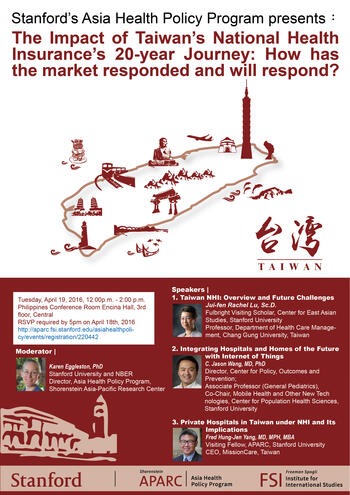
april 19 flyer
In 2015, Taiwan National Health Insurance (NHI) is celebrating its 20th anniversary since its historical inauguration in 1995. The NHI program, which provides universal health coverage (UHC) to Taiwan’s population of 23 million, has had a profound impact on Taiwan's health care market.   This seminar will showcase Taiwan's NHI scheme, the challenges encountered, and the market responses.

The single-payer NHI program, operated by National Health Insurance Administration (NHIA), was established through integrating three existing social insurance schemes and extended the coverage to the then uninsured 43% of the population. Taiwan NHI offers comprehensive benefit coverage that includes ambulatory care as well as inpatient services. On the service side, Taiwan has a market-oriented health care delivery system, reflecting its free-enterprise economy, as evidenced by the pluralistic organization of health services. Hospital ownership is mixed where public hospitals only account for 35% of all beds. Sixty-three percent of allopathic physicians are salaried employees of hospitals; the remainder, fee-for-service private practitioners. Over the years, hospitals have developed large outpatient departments and affiliated clinics for primary care in order to maintain inpatient volume and compete with private practitioners who operate free-standing clinics with beds. There is no gate keeping mechanism and the insured essentially enjoy complete freedom of choice which is likely a source of overuse.

NHI revenue mainly relies on payroll-based premiums, supplemented by a levy on non-payroll income and government subsidies. In 2013, NHI spent roughly NTD 492 (USD 16.4) billion on medical claims, accounting for approximately 52% of national health expenditures, and in total, Taiwan devoted 6.6% of GDP to health.  As a single payer, NHIA has effectively exploited its market power to experiment with various payment reforms in its 20-year history.  NHIA gradually set up separate global budgets for dental services, Chinese medicines, primary care services, and hospital services since 1998.  The annual growth rate of the total NHI budget is negotiated among stakeholders. 

Our seminar will look to the future with presentations on innovative healthcare delivery models and coping strategies by private hospitals.

Shorenstein APARC
Stanford University
Encina Hall E301
Stanford, CA 94305-6055

(650) 723-9072 (650) 723-6530
0
Senior Fellow at the Freeman Spogli Institute for International Studies
Center Fellow at the Center for Health Policy and the Center for Primary Care and Outcomes Research
Faculty Research Fellow of the National Bureau of Economic Research
Faculty Affiliate at the Stanford Center on China's Economy and Institutions
karen-0320_cropprd.jpg PhD

Karen Eggleston is a Senior Fellow at the Freeman Spogli Institute for International Studies (FSI) at Stanford University and Director of the Stanford Asia Health Policy Program at the Shorenstein Asia-Pacific Research Center at FSI. She is also a Fellow with the Center for Innovation in Global Health at Stanford University School of Medicine, and a Faculty Research Fellow of the National Bureau of Economic Research (NBER). Her research focuses on government and market roles in the health sector and Asia health policy, especially in China, India, Japan, and Korea; healthcare productivity; and the economics of the demographic transition.

Eggleston earned her PhD in public policy from Harvard University and has MA degrees in economics and Asian studies from the University of Hawaii and a BA in Asian studies summa cum laude (valedictorian) from Dartmouth College. Eggleston studied in China for two years and was a Fulbright scholar in Korea. She served on the Strategic Technical Advisory Committee for the Asia Pacific Observatory on Health Systems and Policies and has been a consultant to the World Bank, the Asian Development Bank, and the WHO regarding health system reforms in the PRC.

Director of the Asia Health Policy Program, Shorenstein Asia-Pacific Research Center
Stanford Health Policy Associate
Faculty Fellow at the Stanford Center at Peking University, June and August of 2016
CV
Date Label
Moderator Director, Asia Health Policy Program, Shorenstein Asia Pacific Research Center, Stanford University
Jui-fen Rachel Lu Professor, Department of Health Care Management Speaker Chang Gung University, Taiwan
C. Jason Wang Associate Professor (General Pediatric), Co-Chair, Mobile Health and Other New Technologies, Center for Population Health Sciences Speaker Stanford University
Fred Hung-Jen Yang Visiting Fellow, APARC, Stanford University Speaker CEO, MissionCare, Taiwan
Seminars
-

The lecture aims to introduce the prevalence of Non-communicable Diseases (NCDs) in Zhejiang Province in China, and also share experience of Control and Prevention of NCDs. The lecture is composed by five parts. Firstly, NCDs surveillance system in Zhejiang will be introduced, including its establishment history and system coverage. Then, epidemiological characteristics of major NCDs (such as diabetes, cancer, stroke, and acute coronary heart disease events) will be presented, as well as NCDs related behavioral risk factors and hospital-based injury surveillance. Next, current work of NCDs prevention and control in Zhejiang Province will be described, including work network, human resources, community management and pilot programs for NCDs. Fourthly, economic cost of diabetes will be illustrated. Finally, countermeasures for NCDs Prevention and Control will be discussed.

Image
photo of min yu 113015 4x6
Min Yu is deputy director of Zhejiang Provincial Center for Disease Control and Prevention. He was awarded as New-Century 151 Talents of Zhejiang Province, China. He is a committee member of Epidemiology Branch of Chinese Preventive Medicine Association. He is the leader of key discipline of Non-Communicable Diseases epidemiology (NCDs), and led the establishing of NCDs and behavioral risk factor surveillance system in Zhejiang province.  

Yu got Medical degree in Zhejiang University and Master degree of Public Health in Peking Medical University. Now his research focuses on epidemiology of NCDs, strategy for NCDs control and prevention, and disease burden.

Min Yu Deputy director of Zhejiang Provincial Center for Disease Control and Prevention
Seminars
-
Co-sponsored by the Asia Health Policy Program & the Southeast Asia Program
 
This paper analyzes the effects of an early-life shock in Indonesia on children’s human capital formation and parental responses to these shocks. We exploit the geographical variation of Indonesia’s forest fires during the El Nino phenomenon in 1997, as well as cohort variation in exposure. Children affected by these shocks in utero and in early years have worse health outcomes relative to children not exposed to these shocks. We find that the health effects persist, but other factors mitigate the initial effect on cognitive skills.
 
My main research interest lies at the intersection of development and health economics. I am particularly interested in how social policies affect health outcomes for the poor, early health investments, and health-seeking behavior in limited resource settings, focusing on the evaluation of different strategies that seek to promote health investments and the effects of these interventions. Specifically, I have analyzed the effects of Indonesia’s household conditional cash transfer program on health outcomes, local health care price, and quality of care. I have also analyzed the long-term effects of a large-scale midwifery program in Indonesia. Current projects study the effects of early life shocks on children’s human capital outcomes in Indonesia and the Philippines.
 
Image
triyana margaret crop 113015a 4x6
Margaret Triyana is currently Assistant Professor of Economics at Nanyang Technological University, Singapore. Triyana graduated from the Harris School of Public Policy at the University of Chicago. She was previously the Asia Health Policy Postdoctoral Fellow at the Shorenstein Asia Pacific Research Center in 2013-14.
Margaret Triyana Assistant Professor of Economics, Nanyang Technological University, Singapore
Seminars
-

This event has moved from the 4:30pm talk to a noon talk.

Nonprofit organizations are engaged in public sector management as service deliverers, and more recently, as governance partners. Such a role shift of nonprofits can be explained by a couple of spontaneous mechanisms that link service contracting to collaborative governance. The evolving elderly service contracting in Shanghai discloses that contracting may induce power sharing, consolidate mutual trust, reshape community governance networks, and spur nonprofit development. Contracting nonprofits thus may make decisions, enforce regulatory functions, set rules, and influence community governance. An evolutionary perspective provides a new angle on the changing government-nonprofit relations in China.

Image
dr jing yijia4x6
Dr. Yijia Jing is a professor in Public Administration and associate director of foreign affairs at Fudan University. He is the editor-in-chief of Fudan Public Administration Review, and serves as the vice president of International Research Society for Public Management. He is associate editor of Public Administration Review and Co-editor of International Public Management Journal. He is also the founding co-editor of a Palgrave book series---Governing China in the 21 Century.

Yijia Jing Professor in Public Administration and Associate Director of Foreign Affairs, Fudan University
Seminars
-

Co-sponsored by the Health Economics Seminar

We present the first direct evidence on the relative quality of public and private healthcare in a low-income setting, using a unique set of audit studies. We sent standardized (fake) patients to rural primary care providers in the Indian state of Madhya Pradesh, and recorded the quality of care provided and prices charged in each interaction. We report three main findings. First, most private providers lacked formal medical training, but they spent more time with patients and completed more essential checklist items than public providers and were equally likely to provide a correct treatment. Second, we compare the performance of qualified public doctors across their public and private practices and find that the same doctors exerted higher effort and were more likely to provide a correct treatment in their private practices. Third, in the private sector, we find that prices charged are positively correlated with provider effort and correct treatment, but also with unnecessary treatments. In the public sector, we find no correlation between provider salaries and any measure of quality. We develop a simple theoretical framework to interpret our results and show that in settings with low levels of effort in the public sector, the benefits of higher diagnostic effort in the private sector may outweigh the costs of market incentives to over treat. These differences in provider effort may partly explain the dominant market share of fee-charging private providers even in the presence of a system of free public healthcare.

Image
karthik portrait4x6
Karthik Muralidharan is an associate professor of economics at the University of California, San Diego where he joined the faculty as an assistant professor in 2008.

Born and raised in India, he earned an A.B. in economics (summa cum laude) from Harvard, an M.Phil. in economics from Cambridge (UK), and a Ph.D. in economics from Harvard. He is a Research Associate of the National Bureau of Economic Research (NBER), an Affiliate at the Bureau for Research and Economic Analysis of Development (BREAD), a Member of the Jameel Poverty Action Lab (J-PAL) network, an Affiliate at the Center for Effective Global Action (CEGA), and a Research Affiliate with Innovations for Poverty Action (IPA).

Prof. Muralidharan's primary research interests include development, public, and labor economics. Specific topics of interest include education, health, and social protection; measuring quality of public service delivery; program evaluation; and improving the effectiveness of public spending (with a focus on developing countries). Courses taught include undergraduate and graduate classes in development economics, program evaluation, and the economics of education.


Quality and Accountability in Healthcare Delivery: Audit-Study Evidence from Primary Care in India
Download pdf
Quality and Accountability in Healthcare Delivery: Audit-Study Evidence from Primary Care in India
Download pdf
Karthik Muralidharan Associate Professor of Economics at the University of California, San Diego
Seminars
-

Publicly provided long-term care (LTC) insurance with means-tested benefits is suspected to crowd out either private LTC insurance (Brown and Finkelstein, 2008), private saving (Gruber and Yelowitz, 1999; Sloan and Norton, 1997), or informal care (Pauly, 1990; Zweifel and Strüwe, 1997). This contribution predicts crowding-out effects for both private LTC insurance and informal care on the one hand and private saving and informal care on the other. These effects result from the interaction of a parent who decides about private LTC insurance before retirement and the amount of saving in retirement and a caregiver who decides about effort devoted to informal care. Some of the predictions are tested using a recent survey from China.

Image
photo
Peter Zweifel is an Emeritus of the University of Zurich. After a postdoc position with  the University of Wisconsin-Madison in 1974-75, he received tenure with the University of Zurich in 1984. Publications include more than 100 articles in refereed journals (AER, EnJ, EurJHE, JHE, JRI, JRU, PubCh) as well as Health Economics (with F. Breyer und M. Kifmann) and Insurance Economics (with R. Eisen); Energy Economics (with G. Erdmann and A. Praktiknjo) will be available by the end of 2015.

Long-term care: Is there crowding out of informal care, private insurance as well as saving?
Download pdf
Peter Zweifel Emeritus, University of Zurich, Switzerland
Seminars
Subscribe to Environment