Health and Medicine

FSI’s researchers assess health and medicine through the lenses of economics, nutrition and politics. They’re studying and influencing public health policies of local and national governments and the roles that corporations and nongovernmental organizations play in providing health care around the world. Scholars look at how governance affects citizens’ health, how children’s health care access affects the aging process and how to improve children’s health in Guatemala and rural China. They want to know what it will take for people to cook more safely and breathe more easily in developing countries.

FSI professors investigate how lifestyles affect health. What good does gardening do for older Americans? What are the benefits of eating organic food or growing genetically modified rice in China? They study cost-effectiveness by examining programs like those aimed at preventing the spread of tuberculosis in Russian prisons. Policies that impact obesity and undernutrition are examined; as are the public health implications of limiting salt in processed foods and the role of smoking among men who work in Chinese factories. FSI health research looks at sweeping domestic policies like the Affordable Care Act and the role of foreign aid in affecting the price of HIV drugs in Africa.

-

China implemented a Zero-markup Policy for Essential Drugs (ZPED) since 2009 and this study evaluated the impact of ZPED on patients, county hospital revenue, and government subsidy levels. Data from Ningshan and Zhenping county hospitals were collected. The primary method of analysis was difference-in-differences. The results showed that ZPED had significant effects on patients and county hospital revenue but limited impact on government subsidy levels.  With regard to patients, for outpatient services, the total expense per visit and the drug expense per visit reduced by 19.02 CNY (3.12 USD) and by 27.20 CNY (4.47 USD), respectively. Importantly, this implies that the non-drug expense increased by 8.18 CNY (1.34 USD) for outpatient services. For inpatient services, the total expense per admission reduced by 399.6 CNY (65.60 USD), with reduction in both drug and non-drug expenses. With regard to the impact on county hospital revenue, ZPED led to an increase in health care provision and a sustained total hospital income despite a decrease in drug revenue. Lastly, the research demonstrates that with minimal or no subsidy, the government can catalyze the zero-markup policy and generate positive outcomes for patients and county hospitals.

Image
yanfang su4x6
Yanfang’s research focuses primarily on health systems from a political economy perspective. She holds a BA in Economics from Dongbei University of Finance and Economics, China, a Master’s in Management from Tsinghua University, China, and a ScD in Global Health and Population from Harvard University, USA. As the first author or the corresponding author, Yanfang has published on evaluation of health policy, equity of healthcare utilization, and estimates of elasticity of demand for healthcare in Health Policy, International Journal for Equity in Health, PLOS ONE, Chinese Health Economics, Chinese Journal of Health Policy, and other academic journals. She has also published news articles in Harvard College Global Health Review, HSPH International Student Newsletter, Hong Kong Economic Journal and People's Daily Overseas Edition. Yanfang's other research interests include survey methodology and field experiments, with a particular interest in cognitive interviewing, list experiments and anchoring vignette methods. Besides research, Yanfang is committed to community service. She is the initiator and currently the project director of the pilot, “Free Prenatal Text Messages to Improve Newborn Health”. Her team has been supported by the UBS Optimus Foundation (with 160,000 USD) to serve 6,000 pregnant women in rural Shaanxi, China, from 2013 to 2016. Prior to Harvard, Yanfang was a Visiting Researcher with the Hong Kong Policy and Research Institute in 2005 and a Research Fellow at Tsinghua University in 2007. In 2009, she entered a training program on qualitative program evaluation at the Center for Disease Control (CDC) in Atlanta, Georgia. Following this, in 2010, she became a Desmond and Whitney Shum Fellow at Harvard's Fairbank Center for Chinese Studies. Currently, she is a Policy Consultant to Bill & Melinda Gates Foundation.

Yanfang Su, Sc.D Policy Consultant, Bill & Melinda Gates Foundation
Seminars
-

Background: Substance abuse has been an important social and public health problem in Thailand for decades. The National Household Survey on Substance and Alcohol Use in Thailand, which has been conducted 5 times, shows that substance abuse has steadily increased. Extrapolated country-wide in recent data, the estimated number of people who had ever used at least one addictive substance at some time in their life was 3,531,436 or 7.30% of the total population aged 12-65 years. Krathom, Methamphetamine, Ice, and cannabis were the most prevalent substances of abuse.

Methods: Historical documentation, policy reports, and group discussion with key professionals who work in the substance abuse community were used in this study. The objectives of this study were to complete a document review, determine the effectiveness of previous  Thai illegal substance measures, and consider options for the future.

Findings: Although the Thai government has dedicated human resources and an enormous budget to controlling drug use, substance abuse has become a more severe problem when compared with previous years. There are many organizations trying to create and develop programs, measures, and policies for dealing with substance abuse. These policies usually have had loopholes which resulted in corruption of officers, undercutting the public health value, creating dilemmas for impoverished families experiencing drug abuse, ignoring human rights, and creating a negative attitude among society toward drug users. Barriers to establishing successful drug abuse policies in Thailand include limited access to data and data management, a lack of efficiency and cost-benefit measures and policies, and limited use of evidence-based research.

Conclusion: To address illegal substance abuse in the future, the stakeholders should work to reduce the incidence of new sellers and the prevalence of new users. This would result in diminishing the health impact and criminal aspect of illegal substance use, increase social awareness, and motivate communities to participate in managing this issue. To reach these goals, the policy should concurrently aim at curtailing the supply of illicit drugs and reducing their demand. The strategies relevant to drug policy consist of primary prevention, services for chronic drug users, supply control and regulations, prescription regimes, and the use of criminal sanctions, especially consideration of decriminalization of krathom use.

Image
darika 4x6
Darika Saingam is a researcher from Thailand. Her research works have focused on patterns and consequences of alcohol, tobacco, and illegal substance use. Currently she joins the Walter H. Shorenstein Asia-Pacific Research Center as the Developing Asia Health Policy Postdoctoral Fellow for the 2015-16 year. She completed her doctorate in epidemiology at the Prince of Songkla University in 2012, and has worked as a researcher at the University’s epidemiology unit since, as well as a researcher at the Thailand Substance Abuse Academic Network since 2014.

Darika Saingam 2015-16 Developing Asia Health Policy Postdoctoral Fellow
Seminars
-

Image
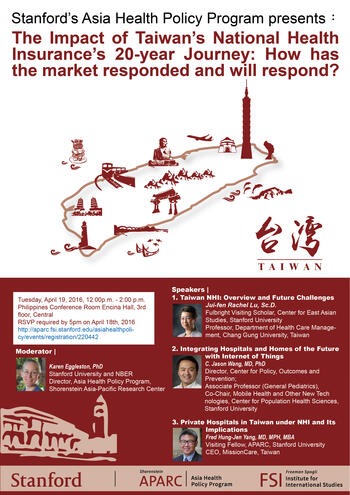
april 19 flyer
In 2015, Taiwan National Health Insurance (NHI) is celebrating its 20th anniversary since its historical inauguration in 1995. The NHI program, which provides universal health coverage (UHC) to Taiwan’s population of 23 million, has had a profound impact on Taiwan's health care market.   This seminar will showcase Taiwan's NHI scheme, the challenges encountered, and the market responses.

The single-payer NHI program, operated by National Health Insurance Administration (NHIA), was established through integrating three existing social insurance schemes and extended the coverage to the then uninsured 43% of the population. Taiwan NHI offers comprehensive benefit coverage that includes ambulatory care as well as inpatient services. On the service side, Taiwan has a market-oriented health care delivery system, reflecting its free-enterprise economy, as evidenced by the pluralistic organization of health services. Hospital ownership is mixed where public hospitals only account for 35% of all beds. Sixty-three percent of allopathic physicians are salaried employees of hospitals; the remainder, fee-for-service private practitioners. Over the years, hospitals have developed large outpatient departments and affiliated clinics for primary care in order to maintain inpatient volume and compete with private practitioners who operate free-standing clinics with beds. There is no gate keeping mechanism and the insured essentially enjoy complete freedom of choice which is likely a source of overuse.

NHI revenue mainly relies on payroll-based premiums, supplemented by a levy on non-payroll income and government subsidies. In 2013, NHI spent roughly NTD 492 (USD 16.4) billion on medical claims, accounting for approximately 52% of national health expenditures, and in total, Taiwan devoted 6.6% of GDP to health.  As a single payer, NHIA has effectively exploited its market power to experiment with various payment reforms in its 20-year history.  NHIA gradually set up separate global budgets for dental services, Chinese medicines, primary care services, and hospital services since 1998.  The annual growth rate of the total NHI budget is negotiated among stakeholders. 

Our seminar will look to the future with presentations on innovative healthcare delivery models and coping strategies by private hospitals.

Shorenstein APARC
Stanford University
Encina Hall E301
Stanford, CA 94305-6055

(650) 723-9072 (650) 723-6530
0
Senior Fellow at the Freeman Spogli Institute for International Studies
Center Fellow at the Center for Health Policy and the Center for Primary Care and Outcomes Research
Faculty Research Fellow of the National Bureau of Economic Research
Faculty Affiliate at the Stanford Center on China's Economy and Institutions
karen-0320_cropprd.jpg PhD

Karen Eggleston is a Senior Fellow at the Freeman Spogli Institute for International Studies (FSI) at Stanford University and Director of the Stanford Asia Health Policy Program at the Shorenstein Asia-Pacific Research Center at FSI. She is also a Fellow with the Center for Innovation in Global Health at Stanford University School of Medicine, and a Faculty Research Fellow of the National Bureau of Economic Research (NBER). Her research focuses on government and market roles in the health sector and Asia health policy, especially in China, India, Japan, and Korea; healthcare productivity; and the economics of the demographic transition.

Eggleston earned her PhD in public policy from Harvard University and has MA degrees in economics and Asian studies from the University of Hawaii and a BA in Asian studies summa cum laude (valedictorian) from Dartmouth College. Eggleston studied in China for two years and was a Fulbright scholar in Korea. She served on the Strategic Technical Advisory Committee for the Asia Pacific Observatory on Health Systems and Policies and has been a consultant to the World Bank, the Asian Development Bank, and the WHO regarding health system reforms in the PRC.

Director of the Asia Health Policy Program, Shorenstein Asia-Pacific Research Center
Stanford Health Policy Associate
Faculty Fellow at the Stanford Center at Peking University, June and August of 2016
CV
Date Label
Moderator Director, Asia Health Policy Program, Shorenstein Asia Pacific Research Center, Stanford University
Jui-fen Rachel Lu Professor, Department of Health Care Management Speaker Chang Gung University, Taiwan
C. Jason Wang Associate Professor (General Pediatric), Co-Chair, Mobile Health and Other New Technologies, Center for Population Health Sciences Speaker Stanford University
Fred Hung-Jen Yang Visiting Fellow, APARC, Stanford University Speaker CEO, MissionCare, Taiwan
Seminars
Authors
News Type
News
Date
Paragraphs
Myanmar’s historic election last year brought an end to more than 50 years of military rule, ushering in the National League for Democracy party led by Aung San Suu Kyi. A new administration brings with it an opportunity to rehabilitate the country’s fragile health system, experts wrote in the Lancet.
 
In the editorial, Stanford health economist Karen Eggleston and co-authors Thant Sun Htoo, Ngoc Minh Pham and Phyu Phyu Thin Zaw call for innovative leadership in Myanmar’s public healthcare system, which is currently facing substantial challenges and inequalities. Creating policies that equitably allocate health resources should be a key goal of the administration that has set out to achieve universal health coverage by 2030. This would not only work to raise public health but also build much-needed trust between the population and government, they said.
 
Pham and Zaw are both former visiting fellows of the Asia Health Policy Program, who spent the 2014-15 academic year working on research activities at the Walter H. Shorenstein Asia-Pacific Research Center. Last July, Zaw wrote an op-ed in The Diplomat highlighting a doctor-led campaign against the “militarization” of the Ministry of Health called the “Black Ribbon Movement.” The movement is comprised of doctors and healthcare staff who are protesting the appointment of military staff to top health administration positions.
 
The Lancet's focus on healthcare in Myanmar coincided with the global commemoration of Universal Health Coverage Day, an annual day that urges greater action toward ensuring equal access to essential health services worldwide: http://universalhealthcoverageday.org/.

The Stanford Program on International and Cross-Cultural Education also interviewed Zaw while at Stanford. In this video released on March 10, Zaw highlights the changes Myanmar has already undertaken to reform its healthcare sytem and the challenges the country still faces.


Hero Image
rtr34r42
Myanmar pro-democracy leader Aung San Suu Kyi attends a parliamentary meeting at the Lower House of Parliament in Naypyitaw, July 9, 2012.
Reuters/Soe Zeya Tun
All News button
1
Paragraphs

Myanmar (Burma) is undergoing a complex political and economic transformation, from a long civil war and military regime to a peace process and democratisation. Since 2011, the Myanmar Ministry of Health has started to rehabilitate the fragile health system, setting the goal of achieving universal health coverage by 2030. To achieve this target, Myanmar will have to face substantial challenges; arguably one of the most important difficulties is how to allocate limited health-care resources equitably and effectively.

All Publications button
1
Publication Date
Journal Publisher
The Lancet
Authors
Pham Ngoc Minh
Karen Eggleston
Number
10008
Authors
News Type
News
Date
Paragraphs

China announced plans to discontinue its “one-child policy” in October, relaxing over three decades of controversial family planning policies and changing to a universal two-child policy. This new policy is a step forward, but China’s population aging and gender imbalance will create challenges for decades, according to a leading Stanford health researcher.

“China has reached a certain level of social and economic development where low fertility and population aging have become norms,” said Karen Eggleston, a senior fellow in the Freeman Spogli Institute (FSI) and director of the Asia Health Policy Program. “Similar trends are seen in Japan and South Korea, and governments are struggling to catch up.”


[[{"fid":"214529","view_mode":"crop_870xauto","fields":{"format":"crop_870xauto","field_file_image_description[und][0][value]":"","field_file_image_alt_text[und][0][value]":false,"field_file_image_title_text[und][0][value]":false,"field_credit[und][0][value]":"Rod Searcey","field_caption[und][0][value]":"","field_related_image_aspect[und][0][value]":"0","thumbnails":"crop_870xauto"},"type":"media","field_deltas":{"1":{"format":"crop_870xauto","field_file_image_description[und][0][value]":"","field_file_image_alt_text[und][0][value]":false,"field_file_image_title_text[und][0][value]":false,"field_credit[und][0][value]":"Rod Searcey","field_caption[und][0][value]":"","field_related_image_aspect[und][0][value]":"0","thumbnails":"crop_870xauto"}},"link_text":null,"attributes":{"width":"870","style":"margin-bottom: 30px; margin-left: 15px; float: right; width: 250px; height: 285px;","class":"media-element file-crop-870xauto","data-delta":"1"}}]]


The policy change comes amid concerns of potential labor shortages and a burgeoning aging population that could pressure the Chinese economy for years to come. 

The country has had record growth – China’s GDP growth rate averaged 8.6 percent over the past five years – which is now slowing. That trend coupled with China’s rising life expectancy reinforces the need for a healthy, economically productive population to support the elderly, experts say.

“Demographers who study China knew a policy change was coming, but not when,” said Eggleston. “The policy was strategically announced with the Five Year Plan – a sort of developmental roadmap for the country.”

A forthcoming book, Policy Challenges from Demographic Change in China and India, edited by Eggleston examines the policy challenges posed by demographic change in China and India, from family planning to social pensions systems that support the elderly. One chapter looks exclusively at population policy, sex ratio and fertility in China.

A spur to action?

A shift to a consistent, nationwide two-child policy is a step in the right direction, Eggleston said, and it is unlikely to translate to a boom in the birthrate.

Some areas of the country and specific couples already enjoyed a two-child policy due to local policy differences and an earlier national policy easing. In 2013, the Chinese government allowed couples with a husband or wife from a single-child family to have a second child.

Chinese cities that never had a one-child policy to begin with, like Hong Kong and Macau, have very low fertility. A recent article in China Journal noted that, despite the ubiquity of the one-child policy campaign, China’s rapid economic development since 1980 deserves the “lion’s share of credit” for reduced births as the country’s total fertility rate has declined.

“The real question is how responsive the Chinese will be,” Eggleston said. “It’s not clear that there will be a noticeable response in the short or medium-term.”

Implementation of the policy will take time, but China will work “quite expeditiously” to apply such policies so that people’s expectations are met. Alongside legal change of China’s varying local policies, it’s expected that China will employ several public education campaigns and its cadre of family planning staff as conduits for disseminating the new national policy, Eggleston said.


Image
Chinese Family Planning Poster

A 1986 poster highlights China's one-child policy.

Credit: Flickr/Collection Stefan R. Landsberger, International Institute of Social History (Amsterdam).


But other factors are at play, too, such as urbanization and changes in labor force participation.

“Young and middle-aged couples will be thinking twice about having another child because of education expense, job demands and the need to support aging parents,” Eggleston said.

paper published by Eggleston and three other scholars in the Journal of Labor & Development analyzed how employment of females from rural areas affected fertility, using data from a survey of 2,355 married women in China. The survey examined “off-farm” employment, which was defined as travel to another village, town or city for work.

The researchers found that off-farm employment for those women reduced the probability of having more than one child by 54.8 percent and the probability of preferring more than one child by 49.6 percent. An earlier blog piece on VoxEU highlighted those research outcomes.

Another aspect of China’s demographic change is gender imbalance. Male preference has long been a cultural factor in China and, with the pressures of the one-child policy, a cause behind its skewed population.

That reality will not dramatically change soon, Eggleston said. Even if the end to the one-child policy brought the sex ratio at birth back to normal levels, the existing imbalance of the younger population will create millions of “forced bachelors” among poorer men who cannot find brides, as well as a whole set of related issues.

Choice restored

What the policy assuredly does, though, is remove a barrier. Many Chinese women who before did not have the opportunity to give birth to a second child, now have that opportunity.


[[{"fid":"221573","view_mode":"crop_870xauto","fields":{"format":"crop_870xauto","field_file_image_description[und][0][value]":"","field_file_image_alt_text[und][0][value]":false,"field_file_image_title_text[und][0][value]":false,"field_credit[und][0][value]":"","field_caption[und][0][value]":"","field_related_image_aspect[und][0][value]":"","thumbnails":"crop_870xauto"},"type":"media","field_deltas":{"3":{"format":"crop_870xauto","field_file_image_description[und][0][value]":"","field_file_image_alt_text[und][0][value]":false,"field_file_image_title_text[und][0][value]":false,"field_credit[und][0][value]":"","field_caption[und][0][value]":"","field_related_image_aspect[und][0][value]":"","thumbnails":"crop_870xauto"}},"link_text":null,"attributes":{"width":"870","style":"margin-right: 15px; padding: 10px; float: left; height: 321px; width: 230px;","class":"media-element file-crop-870xauto","data-delta":"3"}}]]


“This is a crucial arena of choice restored to the Chinese,” Eggleston wrote of the 2013 policy relaxation in a brief presented at the Federal Reserve Bank of Kansas City.

Previously, the absence of such a freedom led some couples to face substantial fines from the government, depending on the local variation of the one-child policy.

“Regardless of the new policy, demographic trends point to the importance of investing in child education, nutrition and skill development,” Eggleston said.

A similar message is carried in a chapter in Policy Challenges, co-authored by Sanghyop Lee and Qiulin Chen, who suggest that putting resources toward human capital development – education and health – can offset the destabilizing effects of demographic transition.

Research being done by FSI’s Rural Education Action Program led by Stanford professor Scott Rozelle works to directly inform education, health and nutrition policy in China.

Spending more on education – particularly for women and girls – is win-win. It complements pro-employment policies, and boosts productivity for women and the economy as a whole, Eggleston said.

Hero Image
beijing woman ballons
A woman in Beijing, China, holds children's balloons.
Flickr/Michael Abshear
All News button
1
-

The lecture aims to introduce the prevalence of Non-communicable Diseases (NCDs) in Zhejiang Province in China, and also share experience of Control and Prevention of NCDs. The lecture is composed by five parts. Firstly, NCDs surveillance system in Zhejiang will be introduced, including its establishment history and system coverage. Then, epidemiological characteristics of major NCDs (such as diabetes, cancer, stroke, and acute coronary heart disease events) will be presented, as well as NCDs related behavioral risk factors and hospital-based injury surveillance. Next, current work of NCDs prevention and control in Zhejiang Province will be described, including work network, human resources, community management and pilot programs for NCDs. Fourthly, economic cost of diabetes will be illustrated. Finally, countermeasures for NCDs Prevention and Control will be discussed.

Image
photo of min yu 113015 4x6
Min Yu is deputy director of Zhejiang Provincial Center for Disease Control and Prevention. He was awarded as New-Century 151 Talents of Zhejiang Province, China. He is a committee member of Epidemiology Branch of Chinese Preventive Medicine Association. He is the leader of key discipline of Non-Communicable Diseases epidemiology (NCDs), and led the establishing of NCDs and behavioral risk factor surveillance system in Zhejiang province.  

Yu got Medical degree in Zhejiang University and Master degree of Public Health in Peking Medical University. Now his research focuses on epidemiology of NCDs, strategy for NCDs control and prevention, and disease burden.

Min Yu Deputy director of Zhejiang Provincial Center for Disease Control and Prevention
Seminars
-
Co-sponsored by the Asia Health Policy Program & the Southeast Asia Program
 
This paper analyzes the effects of an early-life shock in Indonesia on children’s human capital formation and parental responses to these shocks. We exploit the geographical variation of Indonesia’s forest fires during the El Nino phenomenon in 1997, as well as cohort variation in exposure. Children affected by these shocks in utero and in early years have worse health outcomes relative to children not exposed to these shocks. We find that the health effects persist, but other factors mitigate the initial effect on cognitive skills.
 
My main research interest lies at the intersection of development and health economics. I am particularly interested in how social policies affect health outcomes for the poor, early health investments, and health-seeking behavior in limited resource settings, focusing on the evaluation of different strategies that seek to promote health investments and the effects of these interventions. Specifically, I have analyzed the effects of Indonesia’s household conditional cash transfer program on health outcomes, local health care price, and quality of care. I have also analyzed the long-term effects of a large-scale midwifery program in Indonesia. Current projects study the effects of early life shocks on children’s human capital outcomes in Indonesia and the Philippines.
 
Image
triyana margaret crop 113015a 4x6
Margaret Triyana is currently Assistant Professor of Economics at Nanyang Technological University, Singapore. Triyana graduated from the Harris School of Public Policy at the University of Chicago. She was previously the Asia Health Policy Postdoctoral Fellow at the Shorenstein Asia Pacific Research Center in 2013-14.
Margaret Triyana Assistant Professor of Economics, Nanyang Technological University, Singapore
Seminars
-

Professor MENG Qingyue, Dean of the Peking University School of Public Health and Director of the China Center for Health Development Studies at Peking University, will share his deep experience with research and policy advising about health and healthcare in the PRC. In the colloquium, Professor Meng will summarize the achievements of China’s health system reforms as well as the formidable challenges remaining -- strengthening primary care, reforming payment incentives, and multiple other reform priorities.

Professor Meng is lead author of the first-ever comprehensive overview of the PRC health system [http://www.wpro.who.int/asia_pacific_observatory/hits/series/chn/en/], which documents that the PRC has made great strides in raising health status and improving access to medical care, in large part thanks to emphasis on cost- effective public health programs, renewed commitments of government financing, expansion of social health insurance and other forms of financial protection, and investments in the healthcare delivery system. However, challenges remain in the form of large and in some cases growing inequalities in health and healthcare – across regions, urban-rural areas, or involving migrants and other vulnerable groups– as well as in improving the quality of healthcare, reforming public hospitals, and making expenditure growth sustainable through payment reforms and improved strategic purchasing.

Image
meng qing yue
Professor Meng Qingyue (MD, PhD), is Professor in Health Economics and Policy, Dean of Peking University School of Public Health, and Executive Director of Peking University China Center for Health Development Studies.

He obtained his Bachelor degree in medicine from Shandong Medical University (now Shandong University), Masters in public health from Shanghai Medical University (now Fudan University), Masters in economics from University of the Philippines, and PhD in health economics and policy from Karolinska Institutet in Sweden.

Before taking the current position, he was the Dean of Shandong University School of Public Health and Director of Shandong University Center for Health Management and Policy. His research interests include health financing policy and health provider payment systems.

He has led a team doing dozens of research projects supported by both domestic and international funding sources. He has been Member of the Expert Committee on Health Policy and Management to China Ministry of Health over the past decade. He is the Board Member of Health Systems Global elected from the Asia and Pacific Region.


China's health system
Download pdf
Meng Qingyue Professor in Health Economics and Policy, Dean of Peking University School of Public Health, and Executive Director of Peking University China Center for Health Development Studies
Seminars
Subscribe to Health and Medicine