Aging
Authors
News Type
Commentary
Date
Paragraphs

As a new U.S. administration assumes office next year, it will face numerous policy challenges in the Asia-Pacific, a region that accounts for nearly 60 percent of the world’s population and two-thirds of global output.

Despite tremendous gains over the past two decades, the Asia-Pacific region is now grappling with varied effects of globalization, chief among them, inequities of growth, migration and development and their implications for societies as some Asian economies slow alongside the United States and security challenges remain at the fore.

Seven scholars from Stanford’s Shorenstein Asia-Pacific Research Center (APARC) offered views on policy challenges in Asia and some possible directions for U.S.-Asia relations during the next administration.

View the scholars' commentary by scrolling down the page or click on the individual links below to jump to a certain topic.

U.S.-China relations

U.S.-Japan relations

North Korea

Southeast Asia and the South China Sea

Global governance

Population aging .

Trade


U.S.-China relations

By Thomas Fingar

Image
thomasfingar 3x4
Managing the United States’ relationship with China must be at the top of the new administration’s foreign policy agenda because the relationship is consequential for the region, the world and American interests. Successful management of bilateral issues and perceptions is increasingly difficult and increasingly important.

Alarmist predictions about China’s rise and America’s decline mischaracterize and overstate tensions in the relationship. There is little likelihood that the next U.S. administration will depart from the “hedged engagement” policies pursued by the last eight U.S. administrations. America’s domestic problems cannot be solved by blaming China or any other country. Indeed, they can best be addressed through policies that have contributed to peace, stability and prosperity.

Strains in U.S.-China relations require attention, not radical shifts in policy. China is not an enemy and the United States does not wish to make it one. Nor will or should the next administration resist changes to the status quo if change can better the rules-based international order that has served both countries well. Washington’s objective will be to improve the liberal international system, not to contain or constrain China’s role in that system.

The United States and China have too much at stake to allow relations to become dangerously adversarial, although that is unlikely to happen. But this is not a reason to be sanguine. In the years ahead, managing the relationship will be difficult because key pillars of the relationship are changing. For decades, the strongest source of support for stability in U.S.-China relations has been the U.S. business community, but Chinese actions have alienated this key group and it is now more likely to press for changes than for stability. A second change is occurring in China. As growth slows, Chinese citizens are pressing their government to make additional reforms and respond to perceived challenges to China’s sovereignty.

The next U.S. administration is more likely to continue and adapt current policies toward China and Asia more broadly than to pursue a significantly different approach. Those hoping for or fearing radical changes in U.S. policy will be disappointed..

Thomas Fingar is a Shorenstein Distinguished Fellow and former chairman of the U.S. National Intelligence Council. He leads a research project on China and the World that explores China’s relations with other countries.


U.S.-Japan relations

By Daniel Sneider

Image
danielsneider 3x4
U.S.-Japan relations have enjoyed a remarkable period of strengthened ties in the last few years. The passage of new Japanese security legislation has opened the door to closer defense cooperation, including beyond Japan’s borders. The Japan-Korea comfort women agreement, negotiated with American backing, has led to growing levels of tripartite cooperation between the U.S. and its two principal Northeast Asian allies. And the negotiation of a bilateral agreement within the Trans-Pacific Partnership (TPP) talks brought trade and investment policy into close alignment. The U.S. election, however, brings some clouds to this otherwise sunny horizon.

Three consecutive terms held by the same party would certainly preserve the momentum behind the ‘pivot to Asia’ strategy of the last few years, especially on the security front. Still there are some dangers ahead. If Japan moves ahead to make a peace treaty with Russia, resolving the territorial issue and opening a flow of Japanese investment into Russia, that could be a source of tension. The new administration may also want to mend fences early with China, seeking cooperation on North Korea and avoiding tensions in Southeast Asia.

The big challenge, however, will be guiding the TPP through Congress. While there is a strong sentiment within policy circles in favor of rescuing the deal, perhaps through some kind of adjustment of the agreement, insiders believe that is highly unlikely. The Sanders-Warren wing of the Democratic party has been greatly strengthened by this election and they will be looking for any sign of retreat on TPP. Mrs. Clinton has an ambitious agenda of domestic policy initiatives – from college tuition and the minimum wage to immigration reform – on which she will need their support. One idea now circulating quietly in policy circles is to ‘save’ the TPP, especially its strategic importance, by separating off a bilateral Japan-U.S. Free Trade Agreement. Tokyo is said to be opposed to this but Washington may put pressure on for this option, leaving the door open to a full TPP down the road. .

Daniel Sneider is the associate director for research and a former foreign correspondent. He is the co-author of Divergent Memories: Opinion Leaders and the Asia-Pacific Wars (Stanford University Press, 2016) and is currently writing about U.S.-Japan security issues.


North Korea

By Kathleen Stephens

Image
kathleenstephens 3x4
North Korea under Kim Jong Un has accelerated its campaign to establish itself as a nuclear weapons state. Two nuclear tests and multiple missile firings have occurred in 2016. More tests, or other provocations, may well be attempted before or shortly after the new American president is inaugurated next January. The risk of conflict, whether through miscalculation or misunderstanding, is serious. The outgoing and incoming administrations must coordinate closely on policy and messaging about North Korea with each other and with Asian allies and partners.

From an American foreign policy perspective, North Korea policy challenges will be inherited by the next president as “unfinished business,” unresolved despite a range of approaches spanning previous Republican and Democratic administrations. The first months in a new U.S. president’s term may create a small window to explore potential new openings. The new president should demonstrate at the outset that North Korea is high on the new administration’s priority list, with early, substantive exchanges with allies and key partners like China to affirm U.S. commitment to defense of its allies, a denuclearized Korean Peninsula and the vision agreed to at the Six-Party Talks in the September 2005 Joint Statement of Principles. Early messaging to Pyongyang is also key – clearly communicating the consequences of further testing or provocations, but at the same time signaling the readiness of the new administration to explore new diplomatic approaches. The appointment of a senior envoy, close to the president, could underscore the administration’s seriousness as well as help manage the difficult policy and political process in Washington itself.

2017 is a presidential election year in South Korea, and looks poised to be a particularly difficult one. This will influence Pyongyang’s calculus, as will the still-unknown impact of continued international sanctions. The challenges posed by North Korea have grown greater with time, but there are few new, untried options acceptable to any new administration in Washington. Nonetheless, the new administration must explore what is possible diplomatically and take further steps to defend and deter as necessary. .

Kathleen Stephens is the William J. Perry Distinguished Fellow and former U.S. ambassador to the Republic of Korea. She is currently writing and researching on U.S. diplomacy in Korea.


Southeast Asia and the South China Sea

By Donald K. Emmerson

Image
donaldkemmerson 3x4
The South China Sea is presently a flashpoint, prospectively a turning point, and actually the chief challenge to American policy in Southeast Asia. The risk of China-U.S. escalation makes it a flashpoint. Future historians may call it a turning point if—a big if—China’s campaign for primacy in it and over it succeeds and heralds (a) an eventual incorporation of some portion of Southeast Asia into a Chinese sphere of influence, and (b) a corresponding marginalization of American power in the region.

A new U.S. administration will be inaugurated in January 2017. Unless it wishes to adapt to such outcomes, it should:

(1) renew its predecessor’s refusal to endorse any claim to sovereignty over all, most, or some of the South China Sea and/or its land features made by any of the six contending parties—Brunei, China, Malaysia, the Philippines, Taiwan, Vietnam—pending the validation of such a claim under international law.

(2) strongly encourage all countries, including the contenders, to endorse and implement the authoritative interpretation of the U.N. Convention on the Law of the Sea (UNCLOS) issued on July 12, 2016, by an UNCLOS-authorized court. Washington should also emphasize that it, too, will abide by the judgment, and will strive to ensure American ratification of UNCLOS.

(3) maintain its commitment to engage in publicly acknowledged freedom of navigation operations (FONOPs) in the South China Sea on a regular basis. Previous such FONOPs were conducted in October 2015 by the USS Lassen, in January 2016 by the USS Wilbur, in May 2016 by the USS Lawrence, and in October 2016 by the USS Decatur. The increasingly lengthy intervals between these trips, despite a defense official’s promise to conduct them twice every quarter, has encouraged doubts about precisely the commitment to freedom of navigation that they were meant to convey.

(4) announce what has hitherto been largely implicit: The FONOPs are not being done merely to brandish American naval prowess. Their purpose is to affirm a core geopolitical position, namely, that no single country, not the United States, nor China, nor anyone else, should exercise exclusive or exclusionary control over the South China Sea.

(5) brainstorm with Asian-Pacific and European counterparts a range of innovative ways of multilateralizing the South China Sea as a shared heritage of, and a resource for, its claimants and users alike. .

Donald K. Emmerson is a senior fellow emeritus and director of the Southeast Asia Program. He is currently editing a Stanford University Press book that examines China’s relations with Southeast Asia.


Global governance

By Phillip Y. Lipscy

Image
phillipylipscy 3x4
The basic features of the international order established by the United States after the end of World War II have proven remarkably resilient for over 70 years. The United States has played a pivotal role in East Asia, supporting the region’s rise by underpinning geopolitical stability, an open world economy and international institutions that facilitate cooperative relations. Absent U.S. involvement, it is highly unlikely that the vibrant, largely peaceful region we observe today would exist. However, the rise of Asia also poses perhaps the greatest challenge for the U.S.-supported global order since its creation.

Global economic activity is increasingly shifting toward Asia – most forecasts suggest the region will account for about half of the global economy by the midpoint of the 21st century. This shift is creating important incongruities within the global architecture of international organizations, such as the United Nations, International Monetary Fund and World Bank, which are a central element of the U.S.-based international order and remain heavily tilted toward the West in their formal structures, headquarter locations and personnel compositions. This status quo is a constant source of frustration for policymakers in the region, who seek greater voice consummate with their newfound international status. 

The next U.S. administration should prioritize reinvigoration of the global architecture.  One practical step is to move major international organizations toward multiple headquarter arrangements, which are now common in the private sector – this will mitigate the challenges of recruiting talented individuals willing to spend their careers in distant headquarters in the West. The United States should join the Asian Infrastructure Investment Bank, created by China, to tie the institution more closely into the existing architecture, contribute to its success and send a signal that Asian contributions to international governance are welcome. The Asian rebalance should be continued and deepened, with an emphasis on institution-building that reassures our Asian counterparts that the United States will remain a Pacific power. .

Philip Y. Lipscy is an assistant professor of political science and the Thomas Rohlen Center Fellow. He is the author of the forthcoming book Renegotiating the World Order: Institutional Change in International Relations (Cambridge University Press, 2017).


Population aging

By Karen Eggleston

Image
kareneggleston 3x4
Among the most pressing policy challenges in Asia, U.S. policymakers should bear in mind the longer-term demographic challenges underlying Asia’s economic and geopolitical resurgence. East Asia and parts of Southeast Asia face the headwinds of population aging. Japan has the largest elderly population in the world and South Korea’s aging rate is even more rapid. By contrast, South Asian countries are aging more gradually and face the challenge of productively employing a growing working-age population and capturing their “demographic dividend” (from declining fertility outweighing declining mortality). Navigating these trends will require significant investment in the human capital of every child, focused on health, education and equal opportunity.

China’s recent announcement of a universal two-child policy restored an important dimension of choice, but it will not fundamentally change the trajectory of a shrinking working-age population and burgeoning share of elderly. China’s population aged 60 and older is projected to grow from nearly 15 percent today to 33 percent in 2050, at which time China’s population aged 80 and older will be larger than the current population of France. This triumph of longevity in China and other Asian countries, left unaddressed, will strain the fiscal integrity of public and private pension systems, while urbanization, technological change and income inequality interact with population aging by threatening the sustainability and perceived fairness of conventional financing for many social programs.

Investment in human capital and innovation in social and economic institutions will be central to addressing the demographic realities ahead. The next administration needs to support those investments as well as help to strengthen public health systems and primary care to control chronic disease and prepare for the next infectious disease pandemic, many of which historically have risen in Asia. .

Karen Eggleston is a senior fellow and director of the Asia Health Policy Program. She is the editor of the recently published book Policy Challenges from Demographic Change in China and India (Brookings Institution Press/Shorenstein APARC, 2016).


Trade

By Yong Suk Lee

Image
Portrait of Yong Suk Lee.
Trade policy with Asia will be one of the main challenges of the new administration. U.S. exports to Asia is greater than that to Europe or North America, and overall, U.S. trade with Asia is growing at a faster rate than with any other region in the world. In this regard, the new administration’s approach to the Trans-Pacific Partnership will have important consequences to the U.S. economy.

Anti-globalization sentiment has ballooned in the past two years, particularly in regions affected by the import competition from and outsourcing to Asia. However, some firms and workers have benefited from increasing trade openness. The U.S.-Korea Free Trade Agreement of 2012, for example, led to substantial growth in exports in the agricultural, automotive and pharmaceutical sectors. Yet, there are winners and losers from trade agreements. Using an economist’s hypothetical perspective, one would assume firms and workers in the losing industry move to the exporting sector and take advantage of the gains from trade. In reality, adjustment across industries and regions from such movements are slow. Put simply, a furniture worker in North Carolina who lost a job due to import competition cannot easily assume a new job in the booming high-tech industry in California. They would require high-income mobility and a different skill set.

Trade policy needs to focus on facilitating the transition of workers to different industries and better train students to prepare for potential mobility in the future. Trade policy will also be vital in determining how international commerce is shaped. As cross-border e-commerce increases, it will be in the interest of the United States to participate in and lead negotiations that determine future trade rules. The Trans-Pacific Partnership should not simply be abandoned. The next administration should educate both policymakers and the public about the effects of trade openness and the economic and strategic importance of trade agreements for the U.S. economy.

Yong Suk Lee is the SK Center Fellow and deputy director of Korea Program. He leads a research project focused on Korean education, entrepreneurship and economic development.

Hero Image
urbanization beijing
A woman walks past a construction site in Beijing, China, Sept. 2014. | GREG BAKER/AFP/Getty Images
All News button
1
Paragraphs
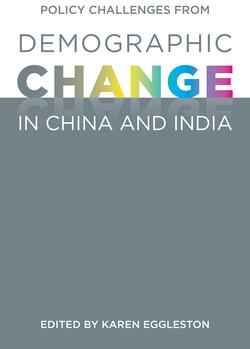
Abstract cover image for book Policy Challenges from Demographic Change in China and India

The world’s two most populous countries face numerous policy challenges from rapid demographic change. Drawing on social science expertise from China, India, and the United States, the contributors examine the social and economic challenges for policies across a range of domains, from China’s changed family planning policies and India’s efforts to address gender imbalance, to both countries’ policies regarding old-age support, human capital investment, poverty alleviation, and broader issues of governance.

Sections focus on:

  • Policy Challenges and Economic Impact
  • Fertility and Sex Imbalance
  • Human Capital and Urbanization
  • Population Aging

Desk or examination copies can be ordered from Stanford University Press.

All Publications button
1
Publication Type
Books
Publication Date
Authors
Karen Eggleston
Book Publisher
Shorenstein APARC
News Type
News
Date
Paragraphs

More than fifty experts met in Xi’an, China, for an international academic conference on demographic change and social development last week. Several scholars from the Freeman Spogli Institute for International Studies (FSI) spoke at the conference, including Karen Eggleston, Marcus Feldman, Jean Oi and Scott Rozelle.

The conference marked the 120th anniversary of Xi’an Jiaotong University’s founding and more than three decades of collaboration with Stanford scholars. Researchers at Xi’an Jiaotong University’s Institute for Population and Development Studies collaborate on policy-relevant research and educational activities with Stanford faculty at FSI as well as the Morrison Institute and Woods Institute.

For more information on FSI’s work in the areas of global health and medicine, please visit this page and the Asia Health Policy Program website.

Image
xian group

Hero Image
xian summit logo
All News button
1
Authors
News Type
News
Date
Paragraphs

China announced plans to discontinue its “one-child policy” in October, relaxing over three decades of controversial family planning policies and changing to a universal two-child policy. This new policy is a step forward, but China’s population aging and gender imbalance will create challenges for decades, according to a leading Stanford health researcher.

“China has reached a certain level of social and economic development where low fertility and population aging have become norms,” said Karen Eggleston, a senior fellow in the Freeman Spogli Institute (FSI) and director of the Asia Health Policy Program. “Similar trends are seen in Japan and South Korea, and governments are struggling to catch up.”


[[{"fid":"214529","view_mode":"crop_870xauto","fields":{"format":"crop_870xauto","field_file_image_description[und][0][value]":"","field_file_image_alt_text[und][0][value]":false,"field_file_image_title_text[und][0][value]":false,"field_credit[und][0][value]":"Rod Searcey","field_caption[und][0][value]":"","field_related_image_aspect[und][0][value]":"0","thumbnails":"crop_870xauto"},"type":"media","field_deltas":{"1":{"format":"crop_870xauto","field_file_image_description[und][0][value]":"","field_file_image_alt_text[und][0][value]":false,"field_file_image_title_text[und][0][value]":false,"field_credit[und][0][value]":"Rod Searcey","field_caption[und][0][value]":"","field_related_image_aspect[und][0][value]":"0","thumbnails":"crop_870xauto"}},"link_text":null,"attributes":{"width":"870","style":"margin-bottom: 30px; margin-left: 15px; float: right; width: 250px; height: 285px;","class":"media-element file-crop-870xauto","data-delta":"1"}}]]


The policy change comes amid concerns of potential labor shortages and a burgeoning aging population that could pressure the Chinese economy for years to come. 

The country has had record growth – China’s GDP growth rate averaged 8.6 percent over the past five years – which is now slowing. That trend coupled with China’s rising life expectancy reinforces the need for a healthy, economically productive population to support the elderly, experts say.

“Demographers who study China knew a policy change was coming, but not when,” said Eggleston. “The policy was strategically announced with the Five Year Plan – a sort of developmental roadmap for the country.”

A forthcoming book, Policy Challenges from Demographic Change in China and India, edited by Eggleston examines the policy challenges posed by demographic change in China and India, from family planning to social pensions systems that support the elderly. One chapter looks exclusively at population policy, sex ratio and fertility in China.

A spur to action?

A shift to a consistent, nationwide two-child policy is a step in the right direction, Eggleston said, and it is unlikely to translate to a boom in the birthrate.

Some areas of the country and specific couples already enjoyed a two-child policy due to local policy differences and an earlier national policy easing. In 2013, the Chinese government allowed couples with a husband or wife from a single-child family to have a second child.

Chinese cities that never had a one-child policy to begin with, like Hong Kong and Macau, have very low fertility. A recent article in China Journal noted that, despite the ubiquity of the one-child policy campaign, China’s rapid economic development since 1980 deserves the “lion’s share of credit” for reduced births as the country’s total fertility rate has declined.

“The real question is how responsive the Chinese will be,” Eggleston said. “It’s not clear that there will be a noticeable response in the short or medium-term.”

Implementation of the policy will take time, but China will work “quite expeditiously” to apply such policies so that people’s expectations are met. Alongside legal change of China’s varying local policies, it’s expected that China will employ several public education campaigns and its cadre of family planning staff as conduits for disseminating the new national policy, Eggleston said.


Image
Chinese Family Planning Poster

A 1986 poster highlights China's one-child policy.

Credit: Flickr/Collection Stefan R. Landsberger, International Institute of Social History (Amsterdam).


But other factors are at play, too, such as urbanization and changes in labor force participation.

“Young and middle-aged couples will be thinking twice about having another child because of education expense, job demands and the need to support aging parents,” Eggleston said.

paper published by Eggleston and three other scholars in the Journal of Labor & Development analyzed how employment of females from rural areas affected fertility, using data from a survey of 2,355 married women in China. The survey examined “off-farm” employment, which was defined as travel to another village, town or city for work.

The researchers found that off-farm employment for those women reduced the probability of having more than one child by 54.8 percent and the probability of preferring more than one child by 49.6 percent. An earlier blog piece on VoxEU highlighted those research outcomes.

Another aspect of China’s demographic change is gender imbalance. Male preference has long been a cultural factor in China and, with the pressures of the one-child policy, a cause behind its skewed population.

That reality will not dramatically change soon, Eggleston said. Even if the end to the one-child policy brought the sex ratio at birth back to normal levels, the existing imbalance of the younger population will create millions of “forced bachelors” among poorer men who cannot find brides, as well as a whole set of related issues.

Choice restored

What the policy assuredly does, though, is remove a barrier. Many Chinese women who before did not have the opportunity to give birth to a second child, now have that opportunity.


[[{"fid":"221573","view_mode":"crop_870xauto","fields":{"format":"crop_870xauto","field_file_image_description[und][0][value]":"","field_file_image_alt_text[und][0][value]":false,"field_file_image_title_text[und][0][value]":false,"field_credit[und][0][value]":"","field_caption[und][0][value]":"","field_related_image_aspect[und][0][value]":"","thumbnails":"crop_870xauto"},"type":"media","field_deltas":{"3":{"format":"crop_870xauto","field_file_image_description[und][0][value]":"","field_file_image_alt_text[und][0][value]":false,"field_file_image_title_text[und][0][value]":false,"field_credit[und][0][value]":"","field_caption[und][0][value]":"","field_related_image_aspect[und][0][value]":"","thumbnails":"crop_870xauto"}},"link_text":null,"attributes":{"width":"870","style":"margin-right: 15px; padding: 10px; float: left; height: 321px; width: 230px;","class":"media-element file-crop-870xauto","data-delta":"3"}}]]


“This is a crucial arena of choice restored to the Chinese,” Eggleston wrote of the 2013 policy relaxation in a brief presented at the Federal Reserve Bank of Kansas City.

Previously, the absence of such a freedom led some couples to face substantial fines from the government, depending on the local variation of the one-child policy.

“Regardless of the new policy, demographic trends point to the importance of investing in child education, nutrition and skill development,” Eggleston said.

A similar message is carried in a chapter in Policy Challenges, co-authored by Sanghyop Lee and Qiulin Chen, who suggest that putting resources toward human capital development – education and health – can offset the destabilizing effects of demographic transition.

Research being done by FSI’s Rural Education Action Program led by Stanford professor Scott Rozelle works to directly inform education, health and nutrition policy in China.

Spending more on education – particularly for women and girls – is win-win. It complements pro-employment policies, and boosts productivity for women and the economy as a whole, Eggleston said.

Hero Image
beijing woman ballons
A woman in Beijing, China, holds children's balloons. | Flickr/Michael Abshear
All News button
1
News Type
Q&As
Date
Paragraphs

Demographic change is fast becoming one of the most globally significant trends of the 21st century. Declining fertility rates and rising life expectancy -- two of the patterns triggering demographic change -- will cause vast socioeconomic strains, especially in the Asia-Pacific region, which has some of the world's most populous countries. Stanford health researcher Karen Eggleston says comparison and cross-collaboration are needed to induce creative solutions.

In an interview with the Office of International Affairs, Eggleston discusses her research approaches and partnerships in the study of healthcare systems and health policy in the Asia-Pacific region. She leads a multiyear research initative that examines comparative policy responses to demographic change in East Asia. Eggleston says the goal is to help move global health policy to a place where everyone has an "equal opportunity for a healthier and longer life."

The Q&A may be viewed in full by clicking here.

Analyzing demographic change in China, Japan and South Korea is the focus of the book Aging Asiaan outcome of a conference between the Walter H. Shorenstein Asia-Pacific Research Center and the Stanford Center on Longevity.

Eggleston also coedited a special issue of the Journal of the Economics of Ageing with David Bloom, a professor at Harvard University, looking at a range of economic issues related to population change in China and India.

Hero Image
dsc 4402 online
Karen Eggleston (left) confers with a healthcare worker at a primary care clinic in Hangzhou, China. | Robin Yao
All News button
1
-

A tremendous amount of radioactive products were discharged as a result of the accident at the Fukushima nuclear power plant in March 2011, which resulted in radioactive contamination of the plant and surrounding areas. While geographical distribution of radioactive iodine, tellurium, and cesium in the surface soils was smoothly (but not always systematically) widespread all over the region, health risk information by the government, media, and other organizations is most likely to be given in terms of administrative boundaries (cf. prefectures, municipalities, etc.) and/or distance from the radiation source.

This paper estimates the effect of such health risk information rather than the actual health risks of radiation on land and other prices in different locations. We find that the prefecture and municipality border effects – but not the distance effect from the nuclear power plant – are significantly related to a reduction in land and other prices after the accident. This shows that people responded to health risk information based on administrative boundaries rather than the actual health risk of radiation after the disaster. Although health risk information based on prefecture and municipality boundaries has an obvious advantage of distilling large and complex risk information into a simple one, the government, media, and other organizations need to recognize and carefully examine the potential of misclassifying non-contaminated areas into contaminated prefectures. Doing so will avoid unintentional consequences to the region’s economy.

Hiroaki Matsuura is currently Departmental Lecturer in the Economy of Japan in the School of Interdisciplinary Area Studies, University of Oxford and a Junior Research Fellow of St. Antony’s College. His main interests are health economics and demography, with a special interest in the relation between laws and population health. Hiroaki received his B.A. in Economics from Keio University, M.A. in Social Science from the University of Chicago, M.S. in Project Management from Northwestern University’s McCormick School of Engineering and Applied Science, and Sc.D. in Global Health and Population (Economics track) from Harvard University’s School of Public Health. In the past, he was affiliated with Institute of Quantitative Social Sciences, Human Rights in Development, and Takemi Program in International Health at Harvard University. He also worked as a research assistant at the National Bureau of Economic Research. His doctoral dissertation research explores a right to health or to health care in national constitutions of 157 countries and state constitutions of the 50 U.S. states and estimates the impact of introducing (or removing) a right to health or to health care into national and state constitutions on health system and population health outcomes. His most recent article, “The Right to Health in Japan: Challenges of a Super Aging Society and Implication from Its 2011 Public Health Emergency” (with Eriko Sase) will be appeared on “Advancing the Human Right to Health”, edited by José M. Zuniga, Stephen P. Marks, and Lawrence O. Gostin, Oxford University Press, 2013. 

Daniel and Nancy Okimoto Conference Room

Hiroaki Matsuura Departmental Lecturer in the Economy of Japan in the School of Interdisciplinary Area Studies Speaker University of Oxford
Seminars
Paragraphs

China's population of 1.34 billion is now 50 percent urban, over 13 percent above age 60, and with 118 boys born for every 100 girls. For such a large population at a relatively low level of per capita income, how will aging interact with substantial gender imbalance and rapid urbanization?

Will Demographic Change Slow China’s Rise? In the eponymous article recently published in the Journal of Asia Studies, five Stanford scholars of political science, sociology, and economics based at the Shorenstein Asia-Pacific Research Center — Karen Eggleston, Jean C. Oi, Scott Rozelle, Andrew Walder, and Xueguang Zhou, with a former postdoctoral fellow Ang Sun — discuss how the intertwined demographic changes pose an unprecedented challenge to social and economic governance, contributing to and magnifying the effects of a slower rate of economic growth.

The authors touch upon a wide range of topics of policy import:
· China must overhaul rural education quickly if it is going to avoid producing tens of millions of workers who will be marginalized in the nation's future high-wage, high-skill economy.
· Growth slowdowns are almost always productivity growth slowdowns. Many forces impinge on multi-factor productivity; the stability and predictability of markets and governance are lynchpins. Discontent with widening disparities in China could undermine this fundamental foundation of growth.
· Demographic change will fundamentally challenge the conventional governance structures in China. Efforts to impose a bureaucratic solution to the intertwined social challenges China faces will almost inevitably stoke tensions between the society and the state. In both urban and rural areas, expansion of the bureaucratic state may become the central target of popular contention.
· China's high savings rate is partly explained by low fertility and parents' need to save for their own old-age support. Initiation of rural pensions and significant expansion of health insurance coverage and are examples of the social policy responses that China has undertaken to prepare for “growing old before becoming rich.” But much remains to be done.
· China's increasing burden of chronic disease further exacerbates the growth-slowing potential of a more elderly population and its associated medical expenditure burden.
· Although reducing precautionary savings and increasing domestic consumption as an engine of economic growth are widely acknowledged goals for China's economy, a rapid decline in savings could also imperil China's future economic growth by jeopardizing the current basis of the financial system.
· Demographic change will shape almost every aspect of how China copes with a slowing rate of economic growth, and may play a decisive role in the future social stability of China, with spillover effects for the region and the rest of the world.
The research is one product of a 3-year project analyzing Asian demographic change which will conclude in 2014 with a conference and edited book on demographic change and urbanization in China, in comparative international perspective.

All Publications button
1
Publication Type
Journal Articles
Publication Date
Journal Publisher
The Journal of Asian Studies
Authors
Karen Eggleston
Ang Sun
Paragraphs

"Old while not affluent" situation, together with an unsustainable high investment rate and high dependency on foreign trade, spurs hot debates on the challenges of a fast-aging population and the exploitation of the second demographic dividend in today’s China. Literature related to elderly health in countries other than China often starts with medical concepts and then dwells on economic issues, mainly focusing on socioeconomic, behavioral, and environmental factors and their effects on the health of the elderly. This article reviews economic research on these topics and then discusses possible implications for the economic analysis of aging China.

All Publications button
1
Publication Type
Working Papers
Publication Date
Journal Publisher
Asia Health Policy Program working paper # 34
Authors
-

Grant Miller will discuss the results of his SAPARC-funded research in rural China, supplementing a large NIH-funded project about pay-for-performance to improve health. The research was designed to test the effect of offering school principals small incentives for anemia reduction on the health and academic performance of primary school students – potentially leading to substantially more cost-effective health policies.

Grant Miller, PHD, MPP, is an Associate Professor of Medicine at the Stanford School of Medicine, a Core Faculty Member at the Center for Health Policy/Primary Care and Outcomes Research, and a Research Associate at the National Bureau of Economic Research (NBER). He is also a Faculty Fellow of the Stanford Center for International Development and a Faculty Affiliate of the Stanford Center for Latin American Studies. His primary areas of interest are health and development economics and economic demography.

Miller's current research focuses broadly on behavioral obstacles to health improvement in developing countries. One line of studies investigates household decision-making underlying puzzlingly low adoption rates of highly efficacious health technologies (like point-of-use drinking water disinfectants and improved cookstoves) in many poor countries. Another vein of research investigates misaligned macro- and micro-level incentives governing the supply of health technologies and services. He has conducted these and other research projects at institutions including the National Bureau of Economic Research, the Urban Institute, and the University of California-San Francisco's Institute for Health Policy Studies. He received a BA in psychology from Yale College, a master's degree in public policy from the Kennedy School of Government at Harvard University, and a PhD in health policy/economics also from Harvard.

Philippines Conference Room

Grant Miller Associate Professor of Medicine; Associate Professor, by courtesy, of Economics and of Health Research and Policy; Senior Fellow at FSI and CHP/PCOR Core Faculty Member Speaker Stanford University
Seminars
Subscribe to Aging