Disease
Authors
News Type
Blogs
Date
Paragraphs

Mongolia, a nation bordered by China and Russia, does not usually attract much public attention. Its success so far in containing COVID-19, however, is well worth considering.

Any of several factors could make Mongolia highly vulnerable to COVID-19: its weak healthcare system, its proximity to China, the first epicenter of the coronavirus, and its close ties to South Korea, which experienced one of the largest initial outbreaks of COVID-19 outside China and which is home to a relatively large population of Mongolian migrant workers. Yet Mongolia’s strategy in fighting the pandemic seems to have worked well thus far for its 3.2 million people.

In the following post, Dr. Gendengarjaa Baigalimaa, a gynecological oncologist at the Mungun Guur Hospital in Ulaanbaatar, Mongolia’s capital, discusses the country’s response to the pandemic and its implications. Baigalimaa was a 2013-14 postdoctoral fellow on developing Asia health policy with APARC’s Asia Health Policy Program.


This is the second installment in our series, “Stories in a Time of Pandemic,” in which APARC alumni across Asia share their perspectives on the responses to and implications of COVID-19 in their communities. You can read the first part in the series, featuring reflections by several former Global Affiliates Program Fellows.

[To get stories like this delivered directly to your inbox sign up for our newsletters]


Dr. Gendengarjaa Baigalimaa Dr. Gendengarjaa Baigalimaa
As of May 17, 2020, the number of new coronavirus infections in Mongolia has reached 136. All of them are imported cases, including four foreigners and 132 Mongolians who came from abroad. They have been treated by the National Center for Communicable Diseases and some have been discharged as totally recovered. Most notably, there have been no reports of community transmission.

Following the World Health Organization's recommendation of January 22 that countries begin considering containment measures, Mongolia immediately activated its inter-agency State Emergency Commission in support of the Ministry of Health as a lead agency in the response against the coronavirus outbreak. The Mongolian government made an unprecedented decision to close all schools and kindergartens starting January 25. All classes are now being conducting via TV and the internet.


Already in mid-February, with the pandemic's spreading in China, the Mongolian government’s strategy was to adopt decisive preventative measures, including the cancelation of the national holiday Tsagaan Sar, the Mongolian lunar new year, and closure of all travel between Ulaanbaatar and provinces outside the capital. Mongolia also closed its borders with China and Russia, stopping the inflow and outflow of people, and banned international flights from all airlines. The government has been mobilizing its citizens to return home from countries like South Korea, Japan, Turkey, and Russia. Those arriving are quarantined for an extended 21-day period, with multiple coronavirus screenings.

The Mongolian government’s strategy was to adopt decisive preventative measures. These steps have helped immensely to contain the spread of COVID-19. They have also had the added benefit of reducing the number of flu infections.
Dr. Gendengarjaa Baigalimaa

The use of masks, especially from early November, when flu season starts and air pollution worsens, is already familiar to Mongolians. This season, the government has enforced mask-wearing in public places. In the capital city of Ulaanbaatar, the requirement that all employees at government offices, banks, shops, and markets wear masks was imposed as early as January 25. The State Emergency Commission would issue fines of 150,000₮ (54 USD) for violating the order. At the same time, health professionals and community leaders conveyed the importance of mask-wearing and handwashing and worked to increase sanitation at all public places.    

These steps have helped immensely to contain the spread of COVID-19. They have also had the added benefit of sharply reducing the number of flu infections. At the start of the flu season last year, almost 12.7 percent of all hospital visits were flu-related, compared to 1.8 percent this year. Another unexpected benefit was the drop in gastrointestinal infections among children. Children were staying home and washing their hands properly. As a result, there have been no cases of gastrointestinal infections registered this year so far.

“Not only did Mongolia close its borders early and move promptly, but also did a great job at quarantining evacuees from overseas immediately upon arrival and taking safety measures,” said Mr. Sergey Diorditsa, the WHO representative to Mongolia. He praised the country’s economic stimulus measures and noted that prolonged restrictions may adversely affect its social and economic sectors and that WHO Mongolia is conducting a study on the in-country impacts of COVID-19. Indeed, data provided by the National Statistical Office shows that the country’s economy is expected to decline sharply due to the adverse effects of the pandemic.

Mongolia’s urgent response to COVID-19 offers lessons for vulnerable communities on containment of the coronavirus and prevention of its spread. The country is also a relevant case study for the economic repercussions of the pandemic.

Read More

Cover image of the book "Healthy Aging in Asia", showing a smiling elderly Chinese woman with a cane standing in a small village.
News

New Book Highlights Policy Initiatives and Economic Research on Healthy Longevity Across Asia

Asia health policy expert Karen Eggleston’s new volume, ‘Healthy Aging in Asia,’ examines how diverse Asian economies – from Singapore and Hong Kong to Japan, India, and China – are preparing for older population age structures and transforming health systems to support patients who will live with chronic disease for decades.
New Book Highlights Policy Initiatives and Economic Research on Healthy Longevity Across Asia
Michael McFaul, Xueguang Zhou, Karen Eggleston, Gi-Wook Shin, Don Emmerson, and Yong Suk Lee
News

FSI Hosts APARC Panel on COVID-19 Impacts in Asia

Scholars from each of APARC's programs offer insights on policy responses to COVID-19 throughout Asia.
FSI Hosts APARC Panel on COVID-19 Impacts in Asia
Karen Eggleston, Hongbin Li, Scott Rozelle, and Xueguang Zhou during a virtual panel discussion
News

APARC Scholars Discuss the Economic Impact of COVID-19 in China

Karen Eggleston, Scott Rozelle, and Xueguang Zhou join the King Center on Global Development’s Hongbin Li to examine how COVID-19 has impacted urban and rural employment in China’s health care sectors.
APARC Scholars Discuss the Economic Impact of COVID-19 in China
Hero Image
A coronavirus spinning with Mongolia flag behind Photo credit: Ahmed Zaggoudi via Getty Images
All News button
1
Subtitle

Dr. Gendengarjaa Baigalimaa, an oncologist at a hospital in Mongolia’s capital and former postdoctoral fellow with APARC’s Asia Health Policy Program, explains how decisive preventative measures have helped the country prevail in the fight against COVID-19.

Authors
News Type
News
Date
Paragraphs

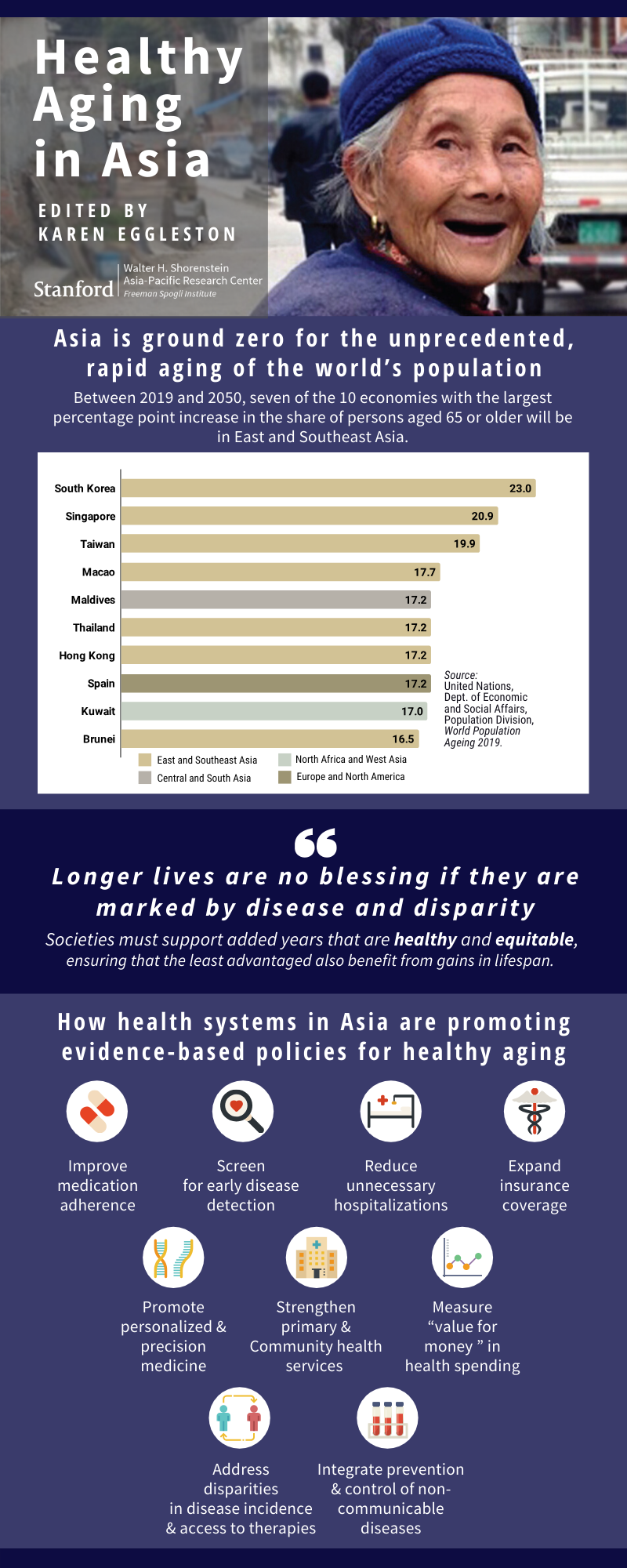
Rapid population aging is transforming societies around the world, and the Asia-Pacific region is on the frontlines of this unprecedented demographic shift. Life expectancy in Japan, South Korea, and much of urban China has now outpaced that of the United States and other high-income countries. With this triumph of longevity, however, comes a host of health, social, and economic challenges.

Longer lifespans will necessitate working to older ages, “but extending work lives will only be feasible if the added years are healthy ones, and will only be equitable if the least advantaged also benefit from healthy aging,” writes APARC Deputy Director and Asia Health Policy Program Director Karen Eggleston in her new book, Healthy Aging in Asia. “The great blessing of longer lives dims when clouded by pain, disability, and loss of dignity.”

[Listen to our conversation with Eggelston about the book and continue reading below. To receive stories like this directly in your inbox sign up for APARC newsletters]

Shorenstein APARC · Healthy Aging In Asia | Karen Eggleston

Image
Poster featuring the book Healthy Aging in Asia


Societies around the world must reduce disparities in health outcomes and address the older age-associated rise in the burden of noncommunicable diseases (NCDs) such as diabetes, hypertension, and cancer. Indeed, the COVID-19 pandemic has underscored the vulnerability of older adults suffering from NCDs to newly emerging pathogens and the importance of building long-term, resilient health systems.


How are health systems in Asia promoting evidence-based policies for healthy aging? What strategies have they used to prevent NCDs, screen for early disease detection, raise the quality of care, improve medication adherence, reduce unnecessary hospitalizations, and increase “value for money” in health spending?

The concise chapters in Healthy Aging in Asia examine these questions, covering multiple aspects of policy initiatives and economic research on healthy longevity in diverse Asian economies — from cities such as Singapore and Hong Kong to powerhouses such as Japan, India, and China — as they transform their health systems to support wellbeing in older age. Eggleston edited and contributed multiple chapters to this new volume, now available via Brookings Institution Press. This publication is part of APARC’s in-house series with the Brookings Institution.

Dr. Karen Eggleston

Karen Eggleston

Senior Fellow at the Freeman Spogli Institute for International Studies, Director of the Asia Health Policy Program, and Deputy Director of the Shorenstein Asia-Pacific Research Center
Full Biography

Read More

Karen Eggleston speaking to an online panel.
News

Karen Eggleston Testifies on China’s Healthcare System to Congressional Review Commission

Asia health policy expert Karen Eggleston provides testimony for a U.S.-China Economic and Security Review Commission hearing on China's domestic healthcare infrastructure and the use of technology in its healthcare system amid COVID-19.
Karen Eggleston Testifies on China’s Healthcare System to Congressional Review Commission
Elderly Chinese citizens sit together on a park bench.
Q&As

Karen Eggleston Examines China’s Looming Demographic Crisis, in Fateful Decisions

Karen Eggleston Examines China’s Looming Demographic Crisis, in Fateful Decisions
Michael McFaul, Xueguang Zhou, Karen Eggleston, Gi-Wook Shin, Don Emmerson, and Yong Suk Lee
News

FSI Hosts APARC Panel on COVID-19 Impacts in Asia

Scholars from each of APARC's programs offer insights on policy responses to COVID-19 throughout Asia.
FSI Hosts APARC Panel on COVID-19 Impacts in Asia
All News button
1
Subtitle

Asia health policy expert Karen Eggleston’s new volume, ‘Healthy Aging in Asia,’ examines how diverse Asian economies – from Singapore and Hong Kong to Japan, India, and China – are preparing for older population age structures and transforming health systems to support patients who will live with chronic disease for decades.

Paragraphs
Cover of Healthy Aging in Asia that shows an elderly woman in a Chinese village.
Life expectancy in Japan, South Korea, and much of urban China has now outpaced that of the United States and other high-income countries. With this triumph of longevity, however, comes a rise in the burden of noncommunicable diseases (NCDs) like diabetes and hypertension, reducing healthy life years for individuals in these aging populations, as well as challenging the healthcare systems they rely on for appropriate care.  
 
The challenges and disparities are even more pressing in low- and middle-income economies, such as rural China and India. Moreover, the COVID-19 pandemic has underscored the vulnerability to newly emerging pathogens of older adults suffering from NCDs, and the importance of building long-term, resilient health systems. 
 
What strategies have been tried to prevent NCDs—the primary cause of morbidity and mortality — as well as to screen for early detection, raise the quality of care, improve medication adherence, reduce unnecessary hospitalizations and increase “value for money” in health spending? 
 
Fourteen concise chapters cover multiple aspects of policy initiatives for healthy aging and economic research on chronic disease control in diverse health systems — from cities such as Singapore and Hong Kong to large economies such as Japan, India, and China. 
 

Desk, examination, or review copies can be requested through Stanford University Press.

All Publications button
1
Publication Type
Books
Publication Date
Authors
Karen Eggleston
Book Publisher
Shorenstein APARC
Authors
News Type
Q&As
Date
Paragraphs

Updated January 24
Millions of residents in China are under lockdown measures as the number of reported deaths from the coronavirus outbreak rises to 26. In the United States, dozens of people are being monitored for the virus. The World Health Organization on January 23 said at a press conference the outbreak did not yet constitute a global public health emergency.


The outbreak of a novel coronavirus that began in December 2019 in Wuhan, China “is evolving and complex,” said the head of the World Health Organization (WHO) after its emergency committee convened on Wednesday, January 22, and decided that more information was needed before the WHO declares whether or not the outbreak is a public health emergency of international concern. The new virus, known as 2019-nCoV, causes respiratory illness and continues to spread across China. Chinese health authorities, reports the Washington Post, announced that at least 17 people have now died as a result of infection and confirmed cases have been reported in Japan, Thailand, South Korea, Hong Kong, and Macao, with one travel-related case detected in the United States, in the State of Washington. The WHO decision was made as the city of Wuhan shut down all air and train traffic to try to contain the spread of the virus.

With concern over and coverage of the situation rapidly developing, Karen Eggleston, APARC Deputy Director and the Asia Health Policy Program Director at the Shorenstein Asia-Pacific Research Center, offered her insights on the outbreak and its impact on both Asian and international healthcare systems.

Q: Why has this outbreak raised so much concern in China and internationally, and how worried should people be about it?

Infectious disease outbreaks can challenge any health system. Events such as SARS, Ebola, and MERS outbreaks, and even the devastating flu pandemic a century ago, remind us of the frightening power that infectious diseases with high-case fatality can have. The global burden of mortality and morbidity is mostly from non-communicable chronic diseases, but no country or society is immune to old, newly emerging, and re-emerging infectious diseases. And although health systems are generally stronger now and have more technologies to trace and contain outbreaks, there are also deep and complicated challenges that make swift, coordinated disease response difficult even in the modern era.

Any government leadership or healthcare responders who have tried to manage an outbreak situation before are hyper-aware of the need to prepare for and manage future incidents, but we are living in a moment of very complicated social dynamics surrounding public health and healthcare. Distrust in drug companies and government agencies, controversies over vaccines, and increasing skepticism in science, even if only from vocal minorities, all make it more difficult to manage a cohesive international response to an outbreak situation and protect vulnerable people.

Q: As you’ve mentioned, many people looking at this situation with the memory of outbreaks such as SARS or H1N1 in mind. How is the Chinese government addressing this crisis and how does its reaction compare with China’s history of emergency health responses?

China’s health system is much more prepared now, compared to the SARS crisis 17 years ago. More training and investment in primary health care, disease surveillance and technology systems for tracking and monitoring outbreaks, and the achievement of universal health coverage with improving catastrophic coverage even for the rural population, all suggest a health system that is much better prepared to handle a situation like this. Top-level leadership in China had already begun to publicly address the situation within days of the outbreak to assure the public that strict prevention measures will be taken and to urge local officials to take responsibility and share full information. Until more information is gained and more is understood about the nature of this virus, it’s been categorized as a “Grade B infectious disease” but will be managed as if it is a "Grade A infectious disease," which requires the strictest prevention and control measures, including mandatory quarantine of patients and medical observation for those who have had close contact with patients, according to the commission. China currently only classifies two other diseases as Grade A infection diseases—bubonic plague and cholera—and so that tells you something about how seriously this is being treated by those in leadership positions.

Q: And what about the response from the international health communities?

As with any major healthcare crisis, health systems around the globe must also respond with alacrity and integrity, including effective surveillance, monitoring, and infection control. Individuals also play a crucial role in supporting the instructions and recommendations made by established healthcare professionals. For example, the individual with the confirmed case in Washington State proactively told medical personnel about his recent visit to the Wuhan area. His medical providers then exercised appropriate levels of caution, given the unknown nature of the virus, and isolated him while his symptoms developed. He is currently combatting an infection similar in severity to that of mild pneumonia, and so far no other cases have been reported in the United States, though some may arise in the coming days and weeks.

There is always a fine balance between safeguarding public health while still respecting individual rights, civil liberties, and undertaking a prudent, scientific response. The aim is to remain clear and transparent in communications and actions without reverting to disproportionate or overly aggressive responses which lead to panic, distortion, and misinformation about the situation. Some countries, like the Democratic People’s Republic of Korea, may choose to seal their international borders until more is understood about the nature of this virus, but most nations will use tried-and-tested methods of monitoring travelers and alerting population health systems so that information about cases is widely available to health authorities and medical researchers trying to understand the cause and develop a potential cure.

Q: As this situation continues to develop, and with inevitable future disease outbreaks around the globe, what would you hope people keep in mind about the role we all play in healthcare crises and in public health?

One issue this outbreak reminds us of in a visceral and intimate way is how closely people are linked together across the world. Globalization and air travel almost instantaneously link continents, countries, and regions. The timing of this outbreak is particularly fraught, because it’s the beginning of the Lunar New Year, when there is a vast migration of people both within China, throughout greater Asia, and across the globe as massive populations go home to celebrate the holidays with family. The potential for a contagious disease to spread easily through crowds and across borders in circumstances like this is very high, and highlights the need for the international communities to share information, scientific expertise, and understanding.

We need to remember that this is not just a problem in a remote part of the world that has no impact on those of us who live in relative comfort in high-income countries. Rather, this is something that could easily impact anyone. Perhaps this latest outbreak and response will showcase how vital additional, ongoing investments in both domestic and international healthcare systems, technologies, and people are.

Hero Image
Security personnel check the temperature of passengers in the Wharf at the Yangtze River on January 22, 2020 in Wuhan, Hubei province, China.
Getty Images
All News button
1
Paragraphs

The substantial social and economic burden attributable to smoking is well‐known, with heavy smokers at higher risk of chronic disease and premature mortality than light smokers and nonsmokers. In aging societies with high rates of male smoking such as in East Asia, smoking is a leading preventable risk factor for extending lives (including work‐lives) and healthy aging. However, little is known about whether smoking interventions targeted at heavy smokers relative to light smokers lead to disproportionately larger improvements in life expectancy and prevalence of chronic diseases and how the effects vary across populations.

Using a microsimulation model, the authors examine the health effects of smoking reduction by simulating an elimination of smoking among subgroups of smokers in South Korea, Singapore, and the United States. They find that life expectancy would increase by 0.2 to 1.5 years among light smokers and 2.5 to 3.7 years among heavy smokers. Whereas both interventions led to an increased life expectancy and decreased the prevalence of chronic diseases in all three countries, the life‐extension benefits were greatest for those who would otherwise have been heavy smokers. The authors' findings illustrate how smoking interventions may have significant economic and social benefits, especially for life extension, that vary across countries.

All Publications button
1
Publication Type
Journal Articles
Publication Date
Journal Publisher
Health Economics
Authors
Karen Eggleston
Paragraphs

With an estimated 84 million people suffering from diabetes in South Asia, the disease imposes substantial economic burdens on individuals, families, and society. Furthermore, since the disease burden increasingly occurs in the most productive midlife period, it adversely affects workforce productivity and macroeconomic development. Diabetes-related complications lead to markedly higher treatment costs, causing catastrophic medical spending for many households, thus underscoring the importance of preventing diabetes-related complications.

This review describes the unique features of the diabetes epidemic in South Asia, critically assesses and identifies the gaps in the current literature on the economic impact of diabetes in South Asia, and finally, offers recommendations on ways to mitigate the economic burden of diabetes.

All Publications button
1
Publication Type
Journal Articles
Publication Date
Journal Publisher
Current Diabetes Reports
Authors
Karen Eggleston
Authors
News Type
News
Date
Paragraphs

In the summer of 2018, the Asia Health Policy Program (AHPP) at the Shorenstein Asia-Pacific Research Center (co)hosted two conferences in Beijing. From June 25-26, AHPP hosted “Healthy Aging and Chronic Disease Management in China and India in International Comparison” at the Stanford Center at Peking University in Beijing. Immediately following the event, June 26-27 AHPP cohosted, along with Professor Fang Hai, Peking University China Center for Health Development Studies, the “Fourth Annual Conference on Primary Care and China’s Health System Reform”, focused this year on China’s family doctor system.

Healthy Aging and Chronic Disease

Day one of the Healthy Aging and Chronic Disease Management conference combined discussions of chronic disease control in India and China (part of an ongoing SCPKU Team Innovation faculty fellowship) with a workshop focused on assessing net value of diabetes management across Asia.

Research teams from Hong Kong, South Korea, India, Taiwan, and the United States convened to discuss research on net value analysis of diabetes in their respective countries. The Net Value in Diabetes Management project seeks to develop a method for measuring net value of diabetes internationally­–based on previous methods discussed in an 2009 study by Karen Eggleston and Joseph Newhouse with data from the Mayo Clinic for Type 2 Diabetes.

The research teams provided updates to their calculations from the gathering last year and explained the strengths and weaknesses of their data sets, the risk prediction model they employed or created for their specific population, and the cost effectiveness analyses conducted with their data.

Participants included Kavita Singh from the Public Health Foundation of India, Janet Lam from Hong Kong University, Hongsoo Kim and Wankyo Chung from Seoul National University, Rachel Lu and Ying Isabel Chen of Chang Gung University Taiwan, and Kyueun Lee and Karen Eggleston of Stanford University.

Non-communicable/Chronic Disease Control

The afternoon of day one featured presentations by various representatives from provincial and national-level Centers for Disease Control and Prevention (CDC) in China regarding non-communicable disease (NCD) control initiatives.

Dong Jianqun from the People’s Republic of China CDC presented the “Effect of Community-Based 5+1 staged diabetes management.” This research project–fielded in sites in three different provinces–involved staged diabetes targeting management. Results showed that examination rates for complications management increased. Fang Le from the Zhejiang Provincial CDC presented updates on community management of NCDs in Zhejiang, including the intensive follow-up system for high risk diabetes patients. Representatives from Shandong University and the Shandong CDC, including Dr. WANG Yan, presented “The Status, Problems, and Determinants of community management and control of diabetes in Shandong Province” while also discussing current policy and implementation.

The afternoon ended in a session comparing health care systems and ongoing initiatives for chronic disease control in China and India. Kavita Singh discussed issues in India’s health system, including high out of pocket expenditure, over-privatization, and large health inequities across states and between urban and rural areas. Singh introduced existing innovations being used, including smartphone-based decision support software in heart disease monitoring. Dong Jianqun and colleagues discussed NCD control in China, including the demonstration areas that have integrated initiatives including better surveillance and management of diabetes and hypertension, and prevention education.

The first conference closed the next morning by bringing together representatives from various Chinese organizations to discuss the current state of primary care, family doctor system, and health care reform within the country. During a highly immersive classroom session for the Diabetes Net Value Teams, Dr. Sanjay Basu shared insights regarding best practices in predictive risk modeling.

China’s Family Doctor System

Beginning the afternoon of June 26, the second conference was devoted to China’s family doctor system, primary care, and health care reforms.  The event opened with remarks from Zhuang Ning, Deputy Director of the State Department of Health, System Reform Department, about the importance of community health and greater recognition of primary health providers in China.

The director’s remarks were followed by an opening keynote address by Professor MENG Qingyue, Dean of the Peking University School of Public Health and Director of the China Center for Health Development Studies at Peking University. Professor Meng reflected on the role of primary care in the development of China’s health system. Qin Jiangmei, Director of the Community Health Research Center, National Health and Family Planning Commission Health Development Research Center, next introduced the necessity of comprehensive health reform in China as well as funding challenges.

Afterwards, representatives from the Beijing Dongcheng district, Shanghai Changning district,  Xiamen City, and Shenzhen Luohu Hospital Group shared their experiences constructing family doctor systems within their respective regions. Important points stressed by the presenters included consolidation, maintaining a good evaluation system, and establishing trust with their patients.

The day ended with a Primary Medical Care Roundtable Discussion featuring four directors of district-level community health centers. The panelists answered questions concerning the future model of primary care in China, as well as changes they would like to see at the community and policy levels. The district directors advocated that more funds be allocated to general practitioners, believing that they will be the dominant form of primary care in China. Participants also spoke of the additional need for clearer targets to ensure that primary care providers are better funded (so that, with enough time, patients will begin to recognize the importance of the family physician).

The second conference concluded on June 27 by way of a highly engaging classroom session on the continuing collaboration between the Zhejiang Provincial CDC and Stanford University Asia Health Policy Program.

Hero Image
Diabetes Net Value teams
All News button
1
News Type
News
Date
Paragraphs

Rural areas of China have made remarkable progress in reducing adult mortality within the past 15 years yet broadened health insurance was not a casual factor in that decline, according to a new study by an international research team that includes Asia Health Policy Program Director Karen Eggleston.

The New Cooperative Medical Scheme (NCMS), a government-subsidized insurance program that began in 2002-03, expanded to cover all of rural China within a decade. Examining NCMS and cause-specific mortality data for a sample of 72 counties between 2004 and 2012, the researchers found that there were no significant effects of health insurance expansion on increased life expectancy.

The study, published in the September issue of Health Affairs, showed results consistent with previous studies that also did not find a correlation between insurance and survival, although much research confirms NCMS increased access to healthcare, including preventive services, and shielded families from high health expenditures.

Commenting on the study, Eggleston said population health policies remain central to China’s efforts to increase life expectancy and to bridge the gap between rural and urban areas.

Eggleston also noted that multiple factors beyond the availability of health care determine how long people live, and anticipates the research team will continue to explore the impacts of NCMS by extending the study to look at infants and youth.

Read the study (may require subscription) and view a related article on the Stanford Scope blog.

Hero Image
luoding china
Farmers dry star anise seeds in a country yard in Tanbin Township, China, Nov. 26, 2005.
Getty Images
All News button
1
Shorenstein APARC616 Serra StreetEncina Hall E301Stanford, CA 94305-6055
(650) 725-2507 (650) 723-6530
0
pham_ngoc_minh.jpg Ph.D.

Pham Ngoc Minh joins the Walter H. Shorenstein Asia-Pacific Research Center (Shorenstein APARC) as the 2014-2015 Developing Asia Health Policy Fellow as a health researcher and administrator.

His main interests are public health, disease prevention and the rural-urban divide in developing countries. At Stanford, Pham will be studying epidemiological trends and policy perspectives of diabetes in Vietnam, particularly those among adults in mountainous areas of that country. Pham has more than six years of experience working as a medical lecturer at the Thai Nguyen University of Medicine and Pharmacy in Vietnam, and spent two and a half years conducting postdoctoral research in Japan. He received a Bachelor of Medicine from the Thai Nguyen University of Medicine and Pharmacy, a BA in English from Hanoi University, an MPH from the University of Melbourne, and a PhD in medical science from Kyushu University.

2014-2015 Developing Asia Health Policy Postdoctoral Fellow
Subscribe to Disease