Society

FSI researchers work to understand continuity and change in societies as they confront their problems and opportunities. This includes the implications of migration and human trafficking. What happens to a society when young girls exit the sex trade? How do groups moving between locations impact societies, economies, self-identity and citizenship? What are the ethnic challenges faced by an increasingly diverse European Union? From a policy perspective, scholars also work to investigate the consequences of security-related measures for society and its values.

The Europe Center reflects much of FSI’s agenda of investigating societies, serving as a forum for experts to research the cultures, religions and people of Europe. The Center sponsors several seminars and lectures, as well as visiting scholars.

Societal research also addresses issues of demography and aging, such as the social and economic challenges of providing health care for an aging population. How do older adults make decisions, and what societal tools need to be in place to ensure the resulting decisions are well-informed? FSI regularly brings in international scholars to look at these issues. They discuss how adults care for their older parents in rural China as well as the economic aspects of aging populations in China and India.

Authors
News Type
Commentary
Date
Paragraphs

As a new U.S. administration assumes office next year, it will face numerous policy challenges in the Asia-Pacific, a region that accounts for nearly 60 percent of the world’s population and two-thirds of global output.

Despite tremendous gains over the past two decades, the Asia-Pacific region is now grappling with varied effects of globalization, chief among them, inequities of growth, migration and development and their implications for societies as some Asian economies slow alongside the United States and security challenges remain at the fore.

Seven scholars from Stanford’s Shorenstein Asia-Pacific Research Center (APARC) offered views on policy challenges in Asia and some possible directions for U.S.-Asia relations during the next administration.

View the scholars' commentary by scrolling down the page or click on the individual links below to jump to a certain topic.

U.S.-China relations

U.S.-Japan relations

North Korea

Southeast Asia and the South China Sea

Global governance

Population aging .

Trade


U.S.-China relations

By Thomas Fingar

Image
thomasfingar 3x4
Managing the United States’ relationship with China must be at the top of the new administration’s foreign policy agenda because the relationship is consequential for the region, the world and American interests. Successful management of bilateral issues and perceptions is increasingly difficult and increasingly important.

Alarmist predictions about China’s rise and America’s decline mischaracterize and overstate tensions in the relationship. There is little likelihood that the next U.S. administration will depart from the “hedged engagement” policies pursued by the last eight U.S. administrations. America’s domestic problems cannot be solved by blaming China or any other country. Indeed, they can best be addressed through policies that have contributed to peace, stability and prosperity.

Strains in U.S.-China relations require attention, not radical shifts in policy. China is not an enemy and the United States does not wish to make it one. Nor will or should the next administration resist changes to the status quo if change can better the rules-based international order that has served both countries well. Washington’s objective will be to improve the liberal international system, not to contain or constrain China’s role in that system.

The United States and China have too much at stake to allow relations to become dangerously adversarial, although that is unlikely to happen. But this is not a reason to be sanguine. In the years ahead, managing the relationship will be difficult because key pillars of the relationship are changing. For decades, the strongest source of support for stability in U.S.-China relations has been the U.S. business community, but Chinese actions have alienated this key group and it is now more likely to press for changes than for stability. A second change is occurring in China. As growth slows, Chinese citizens are pressing their government to make additional reforms and respond to perceived challenges to China’s sovereignty.

The next U.S. administration is more likely to continue and adapt current policies toward China and Asia more broadly than to pursue a significantly different approach. Those hoping for or fearing radical changes in U.S. policy will be disappointed..

Thomas Fingar is a Shorenstein Distinguished Fellow and former chairman of the U.S. National Intelligence Council. He leads a research project on China and the World that explores China’s relations with other countries.


U.S.-Japan relations

By Daniel Sneider

Image
danielsneider 3x4
U.S.-Japan relations have enjoyed a remarkable period of strengthened ties in the last few years. The passage of new Japanese security legislation has opened the door to closer defense cooperation, including beyond Japan’s borders. The Japan-Korea comfort women agreement, negotiated with American backing, has led to growing levels of tripartite cooperation between the U.S. and its two principal Northeast Asian allies. And the negotiation of a bilateral agreement within the Trans-Pacific Partnership (TPP) talks brought trade and investment policy into close alignment. The U.S. election, however, brings some clouds to this otherwise sunny horizon.

Three consecutive terms held by the same party would certainly preserve the momentum behind the ‘pivot to Asia’ strategy of the last few years, especially on the security front. Still there are some dangers ahead. If Japan moves ahead to make a peace treaty with Russia, resolving the territorial issue and opening a flow of Japanese investment into Russia, that could be a source of tension. The new administration may also want to mend fences early with China, seeking cooperation on North Korea and avoiding tensions in Southeast Asia.

The big challenge, however, will be guiding the TPP through Congress. While there is a strong sentiment within policy circles in favor of rescuing the deal, perhaps through some kind of adjustment of the agreement, insiders believe that is highly unlikely. The Sanders-Warren wing of the Democratic party has been greatly strengthened by this election and they will be looking for any sign of retreat on TPP. Mrs. Clinton has an ambitious agenda of domestic policy initiatives – from college tuition and the minimum wage to immigration reform – on which she will need their support. One idea now circulating quietly in policy circles is to ‘save’ the TPP, especially its strategic importance, by separating off a bilateral Japan-U.S. Free Trade Agreement. Tokyo is said to be opposed to this but Washington may put pressure on for this option, leaving the door open to a full TPP down the road. .

Daniel Sneider is the associate director for research and a former foreign correspondent. He is the co-author of Divergent Memories: Opinion Leaders and the Asia-Pacific Wars (Stanford University Press, 2016) and is currently writing about U.S.-Japan security issues.


North Korea

By Kathleen Stephens

Image
kathleenstephens 3x4
North Korea under Kim Jong Un has accelerated its campaign to establish itself as a nuclear weapons state. Two nuclear tests and multiple missile firings have occurred in 2016. More tests, or other provocations, may well be attempted before or shortly after the new American president is inaugurated next January. The risk of conflict, whether through miscalculation or misunderstanding, is serious. The outgoing and incoming administrations must coordinate closely on policy and messaging about North Korea with each other and with Asian allies and partners.

From an American foreign policy perspective, North Korea policy challenges will be inherited by the next president as “unfinished business,” unresolved despite a range of approaches spanning previous Republican and Democratic administrations. The first months in a new U.S. president’s term may create a small window to explore potential new openings. The new president should demonstrate at the outset that North Korea is high on the new administration’s priority list, with early, substantive exchanges with allies and key partners like China to affirm U.S. commitment to defense of its allies, a denuclearized Korean Peninsula and the vision agreed to at the Six-Party Talks in the September 2005 Joint Statement of Principles. Early messaging to Pyongyang is also key – clearly communicating the consequences of further testing or provocations, but at the same time signaling the readiness of the new administration to explore new diplomatic approaches. The appointment of a senior envoy, close to the president, could underscore the administration’s seriousness as well as help manage the difficult policy and political process in Washington itself.

2017 is a presidential election year in South Korea, and looks poised to be a particularly difficult one. This will influence Pyongyang’s calculus, as will the still-unknown impact of continued international sanctions. The challenges posed by North Korea have grown greater with time, but there are few new, untried options acceptable to any new administration in Washington. Nonetheless, the new administration must explore what is possible diplomatically and take further steps to defend and deter as necessary. .

Kathleen Stephens is the William J. Perry Distinguished Fellow and former U.S. ambassador to the Republic of Korea. She is currently writing and researching on U.S. diplomacy in Korea.


Southeast Asia and the South China Sea

By Donald K. Emmerson

Image
donaldkemmerson 3x4
The South China Sea is presently a flashpoint, prospectively a turning point, and actually the chief challenge to American policy in Southeast Asia. The risk of China-U.S. escalation makes it a flashpoint. Future historians may call it a turning point if—a big if—China’s campaign for primacy in it and over it succeeds and heralds (a) an eventual incorporation of some portion of Southeast Asia into a Chinese sphere of influence, and (b) a corresponding marginalization of American power in the region.

A new U.S. administration will be inaugurated in January 2017. Unless it wishes to adapt to such outcomes, it should:

(1) renew its predecessor’s refusal to endorse any claim to sovereignty over all, most, or some of the South China Sea and/or its land features made by any of the six contending parties—Brunei, China, Malaysia, the Philippines, Taiwan, Vietnam—pending the validation of such a claim under international law.

(2) strongly encourage all countries, including the contenders, to endorse and implement the authoritative interpretation of the U.N. Convention on the Law of the Sea (UNCLOS) issued on July 12, 2016, by an UNCLOS-authorized court. Washington should also emphasize that it, too, will abide by the judgment, and will strive to ensure American ratification of UNCLOS.

(3) maintain its commitment to engage in publicly acknowledged freedom of navigation operations (FONOPs) in the South China Sea on a regular basis. Previous such FONOPs were conducted in October 2015 by the USS Lassen, in January 2016 by the USS Wilbur, in May 2016 by the USS Lawrence, and in October 2016 by the USS Decatur. The increasingly lengthy intervals between these trips, despite a defense official’s promise to conduct them twice every quarter, has encouraged doubts about precisely the commitment to freedom of navigation that they were meant to convey.

(4) announce what has hitherto been largely implicit: The FONOPs are not being done merely to brandish American naval prowess. Their purpose is to affirm a core geopolitical position, namely, that no single country, not the United States, nor China, nor anyone else, should exercise exclusive or exclusionary control over the South China Sea.

(5) brainstorm with Asian-Pacific and European counterparts a range of innovative ways of multilateralizing the South China Sea as a shared heritage of, and a resource for, its claimants and users alike. .

Donald K. Emmerson is a senior fellow emeritus and director of the Southeast Asia Program. He is currently editing a Stanford University Press book that examines China’s relations with Southeast Asia.


Global governance

By Phillip Y. Lipscy

Image
phillipylipscy 3x4
The basic features of the international order established by the United States after the end of World War II have proven remarkably resilient for over 70 years. The United States has played a pivotal role in East Asia, supporting the region’s rise by underpinning geopolitical stability, an open world economy and international institutions that facilitate cooperative relations. Absent U.S. involvement, it is highly unlikely that the vibrant, largely peaceful region we observe today would exist. However, the rise of Asia also poses perhaps the greatest challenge for the U.S.-supported global order since its creation.

Global economic activity is increasingly shifting toward Asia – most forecasts suggest the region will account for about half of the global economy by the midpoint of the 21st century. This shift is creating important incongruities within the global architecture of international organizations, such as the United Nations, International Monetary Fund and World Bank, which are a central element of the U.S.-based international order and remain heavily tilted toward the West in their formal structures, headquarter locations and personnel compositions. This status quo is a constant source of frustration for policymakers in the region, who seek greater voice consummate with their newfound international status. 

The next U.S. administration should prioritize reinvigoration of the global architecture.  One practical step is to move major international organizations toward multiple headquarter arrangements, which are now common in the private sector – this will mitigate the challenges of recruiting talented individuals willing to spend their careers in distant headquarters in the West. The United States should join the Asian Infrastructure Investment Bank, created by China, to tie the institution more closely into the existing architecture, contribute to its success and send a signal that Asian contributions to international governance are welcome. The Asian rebalance should be continued and deepened, with an emphasis on institution-building that reassures our Asian counterparts that the United States will remain a Pacific power. .

Philip Y. Lipscy is an assistant professor of political science and the Thomas Rohlen Center Fellow. He is the author of the forthcoming book Renegotiating the World Order: Institutional Change in International Relations (Cambridge University Press, 2017).


Population aging

By Karen Eggleston

Image
kareneggleston 3x4
Among the most pressing policy challenges in Asia, U.S. policymakers should bear in mind the longer-term demographic challenges underlying Asia’s economic and geopolitical resurgence. East Asia and parts of Southeast Asia face the headwinds of population aging. Japan has the largest elderly population in the world and South Korea’s aging rate is even more rapid. By contrast, South Asian countries are aging more gradually and face the challenge of productively employing a growing working-age population and capturing their “demographic dividend” (from declining fertility outweighing declining mortality). Navigating these trends will require significant investment in the human capital of every child, focused on health, education and equal opportunity.

China’s recent announcement of a universal two-child policy restored an important dimension of choice, but it will not fundamentally change the trajectory of a shrinking working-age population and burgeoning share of elderly. China’s population aged 60 and older is projected to grow from nearly 15 percent today to 33 percent in 2050, at which time China’s population aged 80 and older will be larger than the current population of France. This triumph of longevity in China and other Asian countries, left unaddressed, will strain the fiscal integrity of public and private pension systems, while urbanization, technological change and income inequality interact with population aging by threatening the sustainability and perceived fairness of conventional financing for many social programs.

Investment in human capital and innovation in social and economic institutions will be central to addressing the demographic realities ahead. The next administration needs to support those investments as well as help to strengthen public health systems and primary care to control chronic disease and prepare for the next infectious disease pandemic, many of which historically have risen in Asia. .

Karen Eggleston is a senior fellow and director of the Asia Health Policy Program. She is the editor of the recently published book Policy Challenges from Demographic Change in China and India (Brookings Institution Press/Shorenstein APARC, 2016).


Trade

By Yong Suk Lee

Image
Portrait of Yong Suk Lee.
Trade policy with Asia will be one of the main challenges of the new administration. U.S. exports to Asia is greater than that to Europe or North America, and overall, U.S. trade with Asia is growing at a faster rate than with any other region in the world. In this regard, the new administration’s approach to the Trans-Pacific Partnership will have important consequences to the U.S. economy.

Anti-globalization sentiment has ballooned in the past two years, particularly in regions affected by the import competition from and outsourcing to Asia. However, some firms and workers have benefited from increasing trade openness. The U.S.-Korea Free Trade Agreement of 2012, for example, led to substantial growth in exports in the agricultural, automotive and pharmaceutical sectors. Yet, there are winners and losers from trade agreements. Using an economist’s hypothetical perspective, one would assume firms and workers in the losing industry move to the exporting sector and take advantage of the gains from trade. In reality, adjustment across industries and regions from such movements are slow. Put simply, a furniture worker in North Carolina who lost a job due to import competition cannot easily assume a new job in the booming high-tech industry in California. They would require high-income mobility and a different skill set.

Trade policy needs to focus on facilitating the transition of workers to different industries and better train students to prepare for potential mobility in the future. Trade policy will also be vital in determining how international commerce is shaped. As cross-border e-commerce increases, it will be in the interest of the United States to participate in and lead negotiations that determine future trade rules. The Trans-Pacific Partnership should not simply be abandoned. The next administration should educate both policymakers and the public about the effects of trade openness and the economic and strategic importance of trade agreements for the U.S. economy.

Yong Suk Lee is the SK Center Fellow and deputy director of Korea Program. He leads a research project focused on Korean education, entrepreneurship and economic development.

Hero Image
urbanization beijing
A woman walks past a construction site in Beijing, China, Sept. 2014.
GREG BAKER/AFP/Getty Images
All News button
1
Authors
Karen Eggleston
News Type
News
Date
Paragraphs

China’s recent initiatives to deepen health reform, control antimicrobial resistance, and strengthen primary health services are the topics of ongoing collaborative research by the Asia Health Policy Program (AHPP) at Stanford’s Shorenstein Asia-Pacific Research Center and Chinese counterparts. For example, with generous support from ACON Biotechnology and in partnership with the ACON Biotech Primary Care Research Center in Hangzhou, China, AHPP hosts an annual conference on community health services and primary health care reform in China.

The conference, titled Forum on Community Health Services and Primary Health Care Reform, was held in June at the Stanford Center at Peking University (SCPKU) in Beijing. It featured distinguished policymakers, providers and researchers who discussed a wide-range of topics from China’s emerging “hierarchical medical system” for referring patients to the appropriate level of care (fenji zhenliao), as well as the practice and challenges of innovative approaches to primary care and integrated medical care systems. Yongquan Chen, director of Yong’an City Hospital and representative for the mayor’s office of Sanming, talked about health reforms in Sanming City, Fujian Province, a famous example within China. He discussed the incentives and reasoning behind the reforms, which focus on removing incentives for over-prescription of medications, demonstrating government leadership for comprehensive reforms, consolidating three agencies into one, monitoring implementation and easing tensions between doctors and patients. He pointed out the feasibility and early successes of reform by comparing public hospitals in the city in terms of their revenues and costs, reduced reliance on net revenue from medication sales, and other dimensions of performance. Finally, he addressed reform implementation and future plans on both the hospital's and the government's part.

Xiaofang Han, former director of the Beijing Municipal Development and Reform Commission, shared her personal views on the challenges patients face in navigating China’s health system (kan bing nan) and the need to improve the structure of the delivery system, including a revision to the incentives driving over-prescription in China’s fee-for-service payment system. She emphasized that patients’ distrust of primary care providers can only be overcome by demonstrating improved quality (e.g. with a systematic training program for general practitioners, GPs), and that referral systems should be based on the actual capabilities of the clinicians, not their formal labels. To reach China’s goal of over 80 percent of patients receiving management and first-contact care within their local communities will require improved training and incentive programs for newly-minted MDs, a more flexible physician labor market, and innovations in e-health and patient choice regarding gatekeeping or “contract physician services” (qianyue fuwu).        

Guangde County People's Hospital Director Mingliang Xu spoke about practices and exploration of healthcare alliances and initiatives to provide transparent incentives linking medical staff bonuses to metrics of quality. Ping Zhu from Community Healthcare Service Development and Research Center in Ningbo addressed building solid relationships between doctors and residents and providing more patient-centered services.        

Professor Yingyao Chen from Fudan University School of Public Health discussed performance assessment of community health service agencies based on his research in Shanghai. He introduced the strengths and weaknesses of the incentives embedded in the assessment system for China’s primary care providers, and concluded with suggestions for future research. Dr. Linlin Hu, associate professor at Peking Union Medical College, discussed China's progress and challenges of providing universal coverage of national essential public health services.

Professor Hufeng Wang of Renmin University of China discussed China’s vision for a “hierarchical medical system”– bearing resemblance to “integrated care,” “managed care,” or NHS-like coordination of primary and specialized care – with examples of pilot reforms from Xiamen, Zhenjiang and Dalian cities. Dr. Zuxun Lu, professor of Tongji Medical College of Huazhong University of Science and Technology, also discussed hierarchical medical systems and declared that China currently had a “discounted gatekeeper system.”

Dr. Yaping Du of Zhejiang University presented his research on mobile technology for management of lipid levels and with the help of a volunteer, demonstrated “Dyslipidemia Manager,” a mobile app-based product for both patients and doctors. Innovative strategies for primary prevention of cardiovascular diseases in low- and middle-income countries were the focus of remarks by Dr. Guanyang Zou from the Institute for Global Health and Development at Queen Margaret University, including its connections to international experiences with China’s current efforts in that area.  

In sum, the 2016 Forum elicited lively, evidence-based discussions about the opportunities and challenges in improving primary care and sustaining universal coverage for China.  Plans are underway for convening the third annual ACON Biotech-Stanford AHPP Forum on Community Health Services and Primary Health Care Reform in June 2017 at SCPKU. Anyone with original research or innovative experiences with primary care in China may contact Karen Eggleston regarding participation in next year’s Forum. 

Hero Image
groupphotoscpku062216
Policymakers, healthcare providers and researchers gathered at Stanford Center at Peking University to discuss community health services and primary healthcare reform, Beijing, June 2016.
All News button
1
Authors
News Type
News
Date
Paragraphs

A long line of research has shown that women live longer than men, yet according to Karen Eggleston, director of the Asia Health Policy Program, and four other Stanford health researchers, mortality rate differences between men and women are much more variable than previously thought, following predictable patterns. Life expectancy differs depending on time, location and socioeconomic circumstance, not on biological factors alone, according to their newly published findings.

The researchers found that women have greater resilience when faced with socioeconomic adversity in a developing country—living nearly 10 years longer than men on average—but this pattern changes as the country evolves. Developed countries typically have smaller gaps in mortality rates between men and women than developing countries do.

Japan and South Korea are outliers, however, with higher mortality rate differences between men and women than is average for developed countries. In addition to the prevalence of male smoking, one possible explanation they draw is the lack of career-related opportunities for women in Japan and South Korea, two countries that have low gender wage equity among Organisation of Economic Co-operation and Development members.

Eggleston, who is part of the core faculty at the Shorenstein Asia-Pacific Research Center, et al. suggested the idea that reducing gender inequality may help narrow the mortality gap: men increase years lived when fewer barriers for women exist, but concluded that their findings supporting this conclusion merit further inquiry.

Their findings were published in the August edition of SSM – Population Health and highlighted in an earlier column on Voxeu.

Hero Image
woman walking tokyo
A woman walking in Tokyo, Japan.
Getty Images/Kiyoshi Ota
All News button
1
News Type
News
Date
Paragraphs

The Shorenstein Asia-Pacific Research Center (APARC) at Stanford is now accepting applications for the Shorenstein Postdoctoral Fellowship in Contemporary Asia, an opportunity made available to two junior scholars for research and writing on Asia.

Fellows conduct research on contemporary political, economic or social change in the Asia-Pacific region, and contribute to Shorenstein APARC’s publications, conferences and related activities. To read about this year’s fellows, please click here.

The fellowship is a 10-mo. appointment during the 2017-18 academic year, and carries a salary rate of $52,000 plus $2,000 for research expenses.

For further information and to apply, please click here. The application deadline is Dec. 16, 2016.

Hero Image
27193530153 58630c4828 o
All News button
1
News Type
News
Date
Paragraphs

The Asia Health Policy Program at Stanford’s Shorenstein Asia-Pacific Research Center, in collaboration with scholars from Stanford Health Policy's Center on Demography and Economics of Health and Aging, the Stanford Institute for Economic Policy Research, and the Next World Program, is soliciting papers for the third annual workshop on the economics of ageing titled Financing Longevity: The Economics of Pensions, Health Insurance, Long-term Care and Disability Insurance held at Stanford from April 24-25, 2017, and for a related special issue of the Journal of the Economics of Ageing.

The triumph of longevity can pose a challenge to the fiscal integrity of public and private pension systems and other social support programs disproportionately used by older adults. High-income countries offer lessons – frequently cautionary tales – for low- and middle-income countries about how to design social protection programs to be sustainable in the face of population ageing. Technological change and income inequality interact with population ageing to threaten the sustainability and perceived fairness of conventional financing for many social programs. Promoting longer working lives and savings for retirement are obvious policy priorities; but in many cases the fiscal challenges are even more acute for other social programs, such as insurance systems for medical care, long-term care, and disability. Reform of entitlement programs is also often politically difficult, further highlighting how important it is for developing countries putting in place comprehensive social security systems to take account of the macroeconomic implications of population ageing.

The objective of the workshop is to explore the economics of ageing from the perspective of sustainable financing for longer lives. The workshop will bring together researchers to present recent empirical and theoretical research on the economics of ageing with special (yet not exclusive) foci on the following topics:

  • Public and private roles in savings and retirement security
  • Living and working in an Age of Longevity: Lessons for Finance
  • Defined benefit, defined contribution, and innovations in design of pension programs
  • Intergenerational and equity implications of different financing mechanisms for pensions and social insurance
  • The impact of population aging on health insurance financing
  • Economic incentives of long-term care insurance and disability insurance systems
  • Precautionary savings and social protection system generosity
  • Elderly cognitive function and financial planning
  • Evaluation of policies aimed at increasing health and productivity of older adults
  • Population ageing and financing economic growth
  • Tax policies’ implications for capital deepening and investment in human capital
  • The relationship between population age structure and capital market returns
  • Evidence on policies designed to address disparities – gender, ethnic/racial, inter-regional, urban/rural – in old-age support
  • The political economy of reforming pension systems as well as health, long-term care and disability insurance programs


Submission for the workshop

Interested authors are invited to submit a 1-page abstract by Sept. 30, 2016, to Karen Eggleston at karene@stanford.edu. The authors of accepted abstracts will be notified by Oct. 15, 2016, and completed draft papers will be expected by April 1, 2017.

Economy-class travel and accommodation costs for one author of each accepted paper will be covered by the organizers.

Invited authors are expected to submit their paper to the Journal of the Economics of Ageing. A selection of these papers will (assuming successful completion of the review process) be published in a special issue.


Submission to the special issue

Authors (also those interested who are not attending the workshop) are invited to submit papers for the special issue in the Journal of the Economics of Ageing by Aug. 1, 2017. Submissions should be made online. Please select article type “SI Financing Longevity.”


About the Next World Program

The Next World Program is a joint initiative of Harvard University’s Program on the Global Demography of Aging, the WDA Forum, Stanford’s Asia Health Policy Program, and Fudan University’s Working Group on Comparative Ageing Societies. These institutions organize an annual workshop and a special issue in the Journal of the Economics of Ageing on an important economic theme related to ageing societies.


More information can be found in the PDF below.


Hero Image
Flickr/Vinoth Chandar Flickr/Vinoth Chandar
All News button
1
Paragraphs
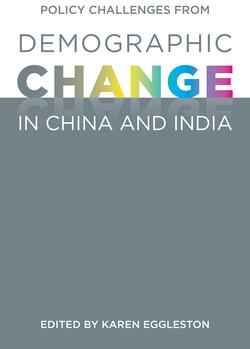
Abstract cover image for book Policy Challenges from Demographic Change in China and India

The world’s two most populous countries face numerous policy challenges from rapid demographic change. Drawing on social science expertise from China, India, and the United States, the contributors examine the social and economic challenges for policies across a range of domains, from China’s changed family planning policies and India’s efforts to address gender imbalance, to both countries’ policies regarding old-age support, human capital investment, poverty alleviation, and broader issues of governance.

Sections focus on:

  • Policy Challenges and Economic Impact
  • Fertility and Sex Imbalance
  • Human Capital and Urbanization
  • Population Aging

Desk or examination copies can be ordered from Stanford University Press.

All Publications button
1
Publication Type
Books
Publication Date
Authors
Karen Eggleston
Book Publisher
Shorenstein APARC
News Type
News
Date
Paragraphs

More than fifty experts met in Xi’an, China, for an international academic conference on demographic change and social development last week. Several scholars from the Freeman Spogli Institute for International Studies (FSI) spoke at the conference, including Karen Eggleston, Marcus Feldman, Jean Oi and Scott Rozelle.

The conference marked the 120th anniversary of Xi’an Jiaotong University’s founding and more than three decades of collaboration with Stanford scholars. Researchers at Xi’an Jiaotong University’s Institute for Population and Development Studies collaborate on policy-relevant research and educational activities with Stanford faculty at FSI as well as the Morrison Institute and Woods Institute.

For more information on FSI’s work in the areas of global health and medicine, please visit this page and the Asia Health Policy Program website.

Image
xian group

Hero Image
xian summit logo
All News button
1
Paragraphs

In this article, I consider what a casual observer can see of a notorious product’s primary place of fabrication. Few products have been criticized in recent years more than cigarettes. Meanwhile, around the world, the factories manufacturing cigarettes rarely come under scrutiny. What have been the optics helping these key links in the cigarette supply chain to be overlooked? What has prompted such optics to be adopted and to what effect? I address these questions using a comparative approach and drawing upon new mapping techniques, fieldwork, and social theory. I argue that a corporate impulse to hide from public health measures, including those of tobacco control, is not the only force to be reckoned with here. Cigarette factory legibility has been coproduced by multiple processes inherent to many forms of manufacturing. Cigarette makers, moreover, do not always run from global tobacco control. Nor have they been avoiding all other manifestations of biopolitics. Rather, in various ways, cigarette makers have been embracing biopolitical logics, conditioning them, and even using them to manage factory legibility. Suggestive of maneuvers outlined by Butler (2009) and Povinelli (2011) such as “norms of recognizability” and “arts of disguise,” cigarette factory concealment foregrounds the role of infrastructural obfuscation in the making of what Berlant (2007) calls “slow death.” Special focus on manufacturing in China illustrates important variations in the public optics of cigarette factories. The terms cloak and veil connote these variations. Whereas tactics currently obscuring cigarette manufacturing facilities generally skew toward an aesthetic of the opaque cloak in much of the world, there are norms of recognizability and arts of disguise applied to many factories across China that are more akin to a diaphanous, playful veil. I conclude with a discussion of how this article’s focus on factory legibility gestures toward novel forms of intervention for advocates working at tackling tobacco today, offering them an alternative political imaginary in what is one of the world’s most important areas of public policy making.

All Publications button
1
Publication Type
Journal Articles
Publication Date
Journal Publisher
Anthropological Quarterly
Authors
Number
4
News Type
News
Date
Paragraphs

The Walter H. Shorenstein Asia-Pacific Research Center (APARC), in pursuit of training the next generation of scholars on contemporary Asia, has selected three postdoctoral fellows for the 2016-17 academic year. The cohort includes two Shorenstein Postdoctoral Fellows and one Developing Asia Health Policy Fellow; they carry a broad range of interests from hospital reform to the economic consequences of elite politics in Asia.

The fellows will begin their year of academic study and research at Stanford this fall.

Shorenstein APARC has for more than a decade sponsored numerous junior scholars who come to the university to work closely with Stanford faculty, develop their dissertations for publication, participate in workshops and seminars, and present their research to the broader community. In 2007, the Asia Health Policy Program began its fellowship program to specifically support scholars undertaking comparative research on Asia health and healthcare policy.

The 2016-17 fellows’ bios and their research plans are listed below:


Shorenstein Postdoctoral Fellows


Image
aditya dasgupta   photo
Aditya "Adi" Dasgupta is completing his doctorate in the Department of Government at Harvard University. At Stanford, he will work on converting his dissertation on the historical decline of single-party dominance and transformation of distributive politics in India into a book manuscript. More broadly, his research interests include the comparative economic history of democratization and distributive politics in emerging welfare states, which he studies utilizing formal models and natural experiments. He received a Bachelor of Arts from Cambridge University and a Master of Science from Oxford University and has worked at the Public Defender Service in Washington D.C., his hometown.


Image
dong zhang photo2
Dong Zhang is a political scientist whose research interests include political economy of development, with focus on the economic consequences of elite politics, and on the historical origins of long-run economic development. His dissertation examines the political logic of sustaining state capitalism model in weakly institutionalized countries with a primary focus on China. At Stanford, Zhang will develop his dissertation into a book manuscript and pursue other research projects on comparative political economy and authoritarian politics. He will receive his doctorate in political science from Northwestern University in 2016. Zhang holds bachelor’s degrees in public policy and economics, and a master’s degree in public policy from Peking University, Beijing.


Developing Asia Health Policy Postdoctoral Fellow


Image
ngando pic
Ngan Do is strongly interested in health system related issues, especially health financing, human resources for health, and health care service delivery. Do implemented comparison studies at regional level as well as participated in fieldwork in Cambodia, Lao, the Philippines, Korea and Vietnam. At Stanford, she will work on the public hospital reforms in Asia, focusing on dual practice of public hospital physicians and provider payment reforms. Do achieved her doctorate in health policy and management at the College of Medicine, Seoul National University. She earned her master’s degree in public policy at the KDI School of Public Policy and Management in Seoul, and her bachelor’s degree in international relations at the Diplomacy Academy of Vietnam (previously the Institute for International Relations).


Hero Image
160105 3244
All News button
1
Subscribe to Society