
Taiwan Studies Students and Scholars Gather at Stanford to Advance New Directions for the Field
Taiwan Studies Students and Scholars Gather at Stanford to Advance New Directions for the Field
The North American Taiwan Studies Association’s 2025 conference invited participants to embrace the “otherwise,” elevating overlooked aspects of Taiwan and reimagining the field of Taiwan studies to challenge dominant narratives and disciplinary methodologies.

The Taiwan Program at the Shorenstein Asia-Pacific Research Center (APARC) was pleased to join the North American Taiwan Studies Association (NATSA) as a co-host of NATSA’s 2025 annual conference, Toward an Otherwise in Taiwan and Beyond. Held at Stanford University from June 30 to July 2, the conference continued NATSA’s three-decade tradition of convening Taiwan scholars across disciplines. Stanford East Asia Library and the National Museum of Taiwan Literature were the event’s additional co-hosts.
Organizing the annual interdisciplinary academic forum is a core mission of NATSA, a nonprofit organization operated by North American and overseas Taiwanese doctoral students and recent graduates studying Taiwan. This year’s conference invited participants to engage with the “otherwise,” a framework adopted by fields tied to social movements, including Black, Indigenous, Latinx, Asian American, and gender and sexuality studies. Using this framework, the conference aimed to recenter marginalized aspects of Taiwan and challenge conventional methodologies and narratives in Taiwan studies.
The conference opened with welcome remarks by Stanford sociologist and APARC Director Gi-Wook Shin, who also serves as the director of the Taiwan Program. The ensuing agenda explored diverse topics and included roundtables, workshops, a mentoring session, a film screening, and a book display. The conversations underscored the need for scholarship rooted in solidarity, critical inquiry, and imagination. The following are highlights from selected roundtable discussions.
Sign up for APARC newsletters to receive event invitations and highlights >
Reflecting on Three Decades of Taiwan Studies
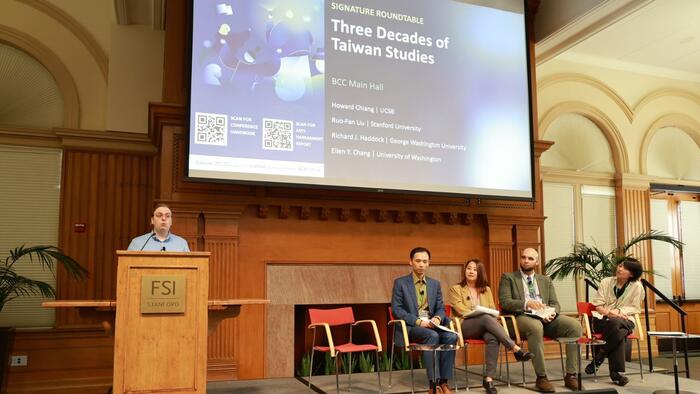
The opening signature roundtable, Three Decades of Taiwan Studies, brought together four scholars from different programs to reflect on the historical development of Taiwan studies in North America. It featured Howard Chiang, a professor of history at the University of California, Santa Barbara; sociologist Ruo-Fan Liu, the 2024-26 Taiwan Program postdoctoral fellow at APARC; Richard J. Haddock, the assistant director of the Sigur Center for Asian Studies at the George Washington University, where he is also pursuing a doctorate in public policy and public administration; and University of Washington’s Ellen Y. Chang, a film scholar and art curator/practitioner.
The four speakers traced the transformation of Taiwan studies from its roots in traditional area studies into an interdisciplinary field. They emphasized that, despite growing academic interest in Taiwan and the field’s expansion in both content and relevance, institutional support remains precarious and long-term financial commitment is uncertain.
Taiwan’s Democratic Resilience in the Age of AI
The roundtable AI, Misinformation, and Global Security examined Taiwan’s leadership role in combating digital disinformation and defending democratic institutions. Mei-Chun Lee, an anthropologist at Academia Sinica, introduced Taiwan’s civil society responses to misinformation, including initiatives such as the Fake News Cleanser program, which helps older populations navigate misinformation. She emphasized a "security and care" framework combining fact-checking and civic education networks.
Thung-Hong Lin, a sociologist at Academia Sinica, examined Taiwan’s democratic resilience amid China’s sharp power tactics, sharing findings from a large dataset that tracks cross-Strait informational networks and their influence on voting patterns in Taiwan.
Herbert Chang, a computational social scientist at Dartmouth College who studies social networks and online politics, analyzed the role of generative AI in misinformation during Taiwan’s 2024 elections. While memes (including AI-generated ones) spread rapidly, his study finds that AI did not significantly shift voting behavior due to entrenched political polarization.
Yuan Hsiao, a Yale University sociologist studying the intersection of digital media, social networks, and collective action, discussed the emotional effects of misinformation on social media, focusing on how emotional manipulation drives identification with protest movements. He also raised methodological challenges in measuring misinformation.
Imagining Alternative Futures Across Asia
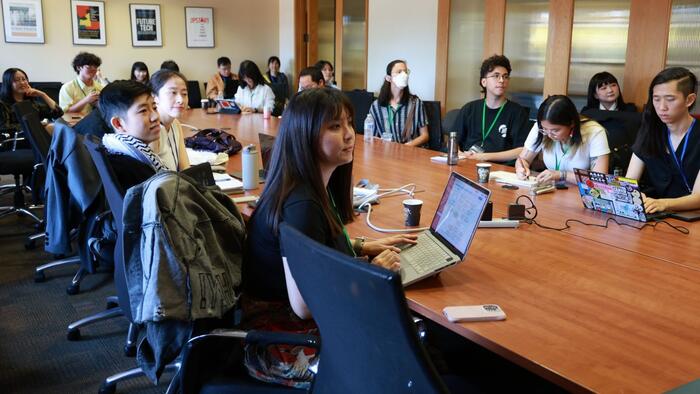
The roundtable Toward Otherwise Futures in Asia brought together scholars focusing on the intersecting yet distinct cultural and political landscapes of China, Hong Kong, Taiwan, and Tibet. The conversation featured Harvard University’s political theorist Samuel Chan; Cornell University’s doctoral candidate in anthropology Yu Liang, also known as Leeve Palray; Stanford University’s political theorist and postdoctoral scholar Simon Sihang Luo; and Tenzing Wangdak, a doctoral student in anthropology at the University of California, Irvine.
Together, they explored how communities in the four distinct regions respond to cultural displacement, political repression, and transnational authoritarianism. The discussion centered on how each place navigates power asymmetries relative to China and whether there is any alternative path to democratization in China. The conversation raised questions about alternative political futures and relational frameworks for understanding different types of power dynamics in East Asia.
The Evolving Contours of Taiwan Studies
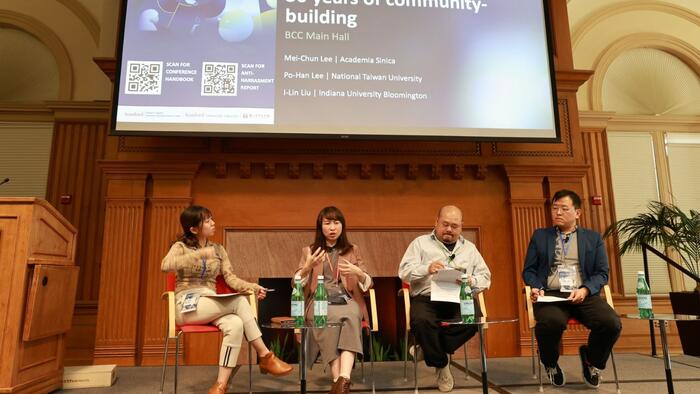
The closing forum, Working Across Differences: NATSA and 30 Years of Community-Building, invited three scholars to reflect on the overall theme of the conference, drawing on their disciplinary perspectives and rich engagement with NATSA. The conversation featured anthropologist Mei-Chun Lee of Academia Sinica; legal and public health scholar Po-Han Lee of National Taiwan University; and I-Lin Liu, a doctoral candidate in media studies at Indiana University Bloomington.
The panelists considered NATSA’s unique position as a student-led network that fosters scholarly exchange across disciplines and generations. They discussed the importance of promoting flexibility and inclusiveness as the field of Taiwan studies responds to academic and political shifts. Looking ahead, the speakers called for incorporating marginalized voices from Taiwan.
As Taiwan increasingly gains visibility on the world stage, the conference affirmed the importance of advancing Taiwan studies as an interdisciplinary, justice-oriented, and globally connected field.