
Social Housing as a Solution in Taiwan and the United States
Social Housing as a Solution in Taiwan and the United States
Tuesday, May 6, 202512:00 PM - 1:30 PM (Pacific)
Philippines Conference Room
Encina Hall, Third Floor, Central, C330
616 Jane Stanford Way, Stanford, CA 94305
Encina Hall, Third Floor, Central, C330
616 Jane Stanford Way, Stanford, CA 94305
The social housing movement in Taiwan emerged after 2010 in response to soaring housing prices. Grassroots activism successfully pushed the government to act, resulting in 68,182 units of social housing completed or under construction by 2024—a major achievement in Taiwan’s housing history. Taiwan’s housing policies have long been influenced by the United States since the Cold War. Like the U.S., Taiwan has prioritized homeownership and treated housing as a commodity rather than a basic right. However, Taiwan has never been a welfare state, with low social spending and limited government involvement in housing before 1990. This laissez-faire approach led to a widespread informal housing sector, which remains a challenge today. Democratization in the 1990s brought calls for more state intervention, but neoliberal ideology shaped the response. Instead of building public housing, Taiwan promoted mortgage access and market stimulation—strategies that mirrored U.S. policies and widened inequality. In the U.S., neoliberalism since the 1980s has led to privatization and a decline in public housing. Government withdrawal, rising speculation, and limited regulation have contributed to a severe housing crisis. Homelessness has become widespread in cities like Seattle and San Francisco, and housing instability now affects the middle class as well. Recently, social rental housing has gained attention as a potential solution in the US, drawing on Western European models. In 2023, Seattle passed Initiative I-135 to create a public developer for social housing—an important step forward. This study defines social rental housing as affordable housing available to a broad range of income levels. It examines how neoliberalism has shaped housing systems in both Taiwan and the U.S. and explores whether social rental housing can emerge as a sustainable and equitable alternative.
Speaker:

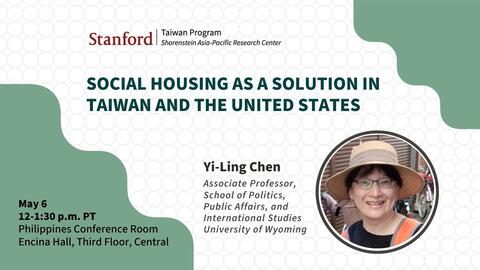
Yi-Ling Chen is an Associate Professor in the School of Politics, Public Affairs, and International Studies at the University of Wyoming, USA. Prior to joining the University of Wyoming, she taught for eight years at National Dong Hua University in Taiwan. She has been actively involved in Taiwan’s housing movement since the Snail Without Shell movement in 1989. Her research focuses on neoliberalism, urban social movements, gender, housing, and urban development in Taiwan, with her publications primarily examining housing and urban transformation from political-economic and feminist perspectives. In 2019, she edited Neoliberal Urbanism, Contested Cities, and Housing in Asia (The Contemporary City) with Palgrave Macmillan. Her recent research explores housing policies, policy mobility and diffusion, and financialization in East Asia, the United States, and the Netherlands. She was the Taiwan Chair at Ghent University in Belgium in 2020 and has held visiting professorships at the University of British Columbia, the University of Amsterdam, the National University of Singapore, Hong Kong Baptist University, the Seoul Institute, Seoul National University, Academia Sinica in Taiwan, and Tübingen University in Germany.