Partner, Competitor, and Challenger: Thoughts on the Future of America’s China Strategy
This is a virtual event. Please click here to register and generate a link to the talk.
The link will be unique to you; please save it and do not share with others.
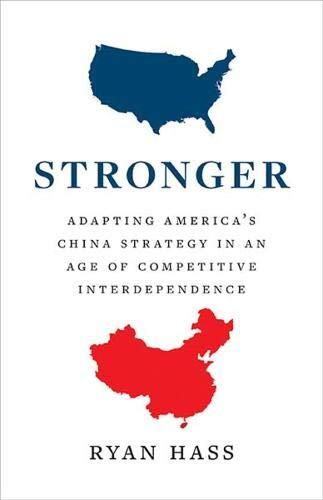
How can the U.S. best manage its relationship with China? The country is at once a major and increasingly hostile competitor to the U.S., a formidable challenger to U.S.’ regional and global leadership, and an important partner on a range of transnational challenges. Will it be possible for both sides to coexist amidst intensifying competition? How great is the risk of US-China conflict, including over Taiwan? Ryan Hass, author of Stronger: Adapting America’s China Strategy in an Age of Competitive Interdependence, will address these questions and more in opening comments before engaging in an open Q&A on the future of the world’s most consequential bilateral relationship.


Via Zoom Webinar. Register at: https://bit.ly/3c3v10W
 Erin Baggott Carter is an Assistant Professor at the Department of Political Science and International Relations at the University of Southern California. There, she is also a Co-PI at the Lab on Non-Democratic Politics. She received a Ph.D. in Government from Harvard University, is currently a visiting scholar at the Stanford Center on Democracy, Development and the Rule of Law, and was previously a Fellow at the Stanford Center for International Security and Cooperation.



 Hau L. Lee is the Thoma Professor of Operations, Information and Technology at the Graduate School of Business at Stanford University. He was the founding faculty director of the Stanford Institute for Innovation in Developing Economies (SEED), and is the current Co-Director of the Stanford Value Chain Innovations Initiative. Professor Lee’s expertise is on global supply chain management and value chain innovations. He has published widely in top journals on supply chain management. He was inducted to the US National Academy of Engineering, and elected a Fellow of MSOM, POMS; and INFORMS. He was the previous Editor-in-Chief of Management Science. In 2006-7, he was the President of the Production and Operations Management Society. His article, “The Triple-A Supply Chain,” was the Second Place Winner of the McKinsey Award for the Best Paper in 2004 in the Harvard Business Review. In 2004, his co-authored paper in 1997, “Information Distortion in a Supply Chain: The Bullwhip Effect,” was voted as one of the ten most influential papers in the history of Management Science. His co-authored paper, “The Impact of Logistics Performance on Trade,” won the Wickham Skinner Best Paper Award by the Production and Operations Management Society in 2014. In 2003, he received the Harold Lardner Prize for International Distinction in Operations Research, Canadian Operations Research Society. Professor Lee obtained his