FSI researchers work to understand continuity and change in societies as they confront their problems and opportunities. This includes the implications of migration and human trafficking. What happens to a society when young girls exit the sex trade? How do groups moving between locations impact societies, economies, self-identity and citizenship? What are the ethnic challenges faced by an increasingly diverse European Union? From a policy perspective, scholars also work to investigate the consequences of security-related measures for society and its values.
The Europe Center reflects much of FSI’s agenda of investigating societies, serving as a forum for experts to research the cultures, religions and people of Europe. The Center sponsors several seminars and lectures, as well as visiting scholars.
Societal research also addresses issues of demography and aging, such as the social and economic challenges of providing health care for an aging population. How do older adults make decisions, and what societal tools need to be in place to ensure the resulting decisions are well-informed? FSI regularly brings in international scholars to look at these issues. They discuss how adults care for their older parents in rural China as well as the economic aspects of aging populations in China and India.
The New York Times has described The Divine Grace of Islam Nusantara as “a 90-minute film that amounts to a relentless, religious repudiation of the [self-styled] Islamic State and the opening salvo in a global campaign by the world’s largest Muslim group [Nahdlatul Ulama] to challenge [IS’s] ideology head-on.” The film documents the enthusiasm with which Indonesian Muslims have commemorated the historic role of the 15th-16th century Walisongo (“Nine Saints”) movement—a movement that precipitated the development in the East Indies (now Indonesia) of a great Islamic civilization rooted in the principle of universal love and compassion (rahmah).
The film and a panel discussion the following day will unpack a perspective that has been historically central to Muslim cultures stretching from North Africa to Southeast Asia. The essence and mission of Islam Nusantara is to build civilization, not to destroy it. Yahya Staquf has described the film as an invitation to Muslims everywhere to reject radicalism and theological straight-jackets and stand up for their own cultural adaptation of Islam.
Kyai Haji Yahya Cholil Staquf is a leader of what is widely regarded as the largest Muslim organization in the world. Located in Indonesia, Nahdlatul Ulama adheres to the traditions of Sunni Islam. Yahya has primary responsibility for the expansion of NU’s activities to include North America, Europe, and the Middle East. Earlier positions included service as spokesperson for Indonesia’s 1999-2001 president Abdurrahman Wahid, the country’s first democratically elected head of state.
C. Holland Taylor’s leadership of the LibForAll Foundation dates from its co-founding in 2003 by Taylor and former Indonesian president Wahid. The Wall Street Journal has called LibForAll “a model of what a competent public diplomacy effort in the Muslim world should look like.” An expert on Islam and Islamization in Southeast Asia, Taylor has lived, studied, and worked in Muslim societies from Iran to Indonesia. He was educated at the University of North Carolina at Chapel Hill and Princeton University.
Note: Although the panel will reference the film, the panelists will range beyond the film to present and discuss the role and relevance of the concept of Islam Nusantara in Indonesia and the larger Muslim world. Viewing the film is thus not a prerequisite to understanding the panel.
Film screening and brief discussion: Wednesday, April 6, 2016 (screening: 4:00 – 5:30 pm; discussion: 5:30 – 6:00 pm)
Debate surrounding democratization in Muslim-majority countries has centered on the potential for the political process to strengthen or constrain radical Islamist forces. Virtually absent from this discourse is empirical evidence linking the passage of Islamist policies to subsequent electoral outcomes at the local level. Aiming to fill this gap, Dr. Buehler will present and analyze an original dataset of shari’a regulations passed by local governments across Indonesia. He will examine the content and timing of newly-passed shari’a regulations in relation to geopolitical history, the electoral cycle, and electoral outcomes. Such regulations are strongly concentrated in areas with a history of political Islam. They map on to the electoral cycle in ways that suggest that those passing them are motivated less by religious doctrine than by the quest for electoral advantage. However, those passing shari’a regulations do not excel in subsequent elections. In Indonesia, profane political agendas appear to trump Islamist agendas.
Image
Michael Buehler’s specialty at SOAS is Southeast Asian politics with particular reference to state-society relations during democratization and decentralization. His many publications include articles in Comparative Politics, Party Politics, and Indonesia; chapters in Beyond Oligarchy, Deepening Democracy in Indonesia, and Problems of Democratisation in Indonesia; and on-line contributions to Aljazeera, The Diplomat, and New Mandala. His book “The Politics of Shari’a Law: Islamist Activists and the State in Democratizing Indonesia” will be published by Cambridge University Press in August 2016.
Michael’s scholarly career has included teaching positions and research fellowships at Columbia University, Northern Illinois University, Northwestern University, and the Royal Netherlands Institute of Southeast Asian and Caribbean Studies. His doctorate is from The London School of Economics and Political Science.
It was meant to be a sunny summit. Welcoming ASEAN’s leaders at the Sunnylands estate, President Obama said he had invited them to southern California, not cold and snowy Washington, to reciprocate the warm welcomes he had received in their own countries on his seven presidential trips to Southeast Asia. Appreciative laughter ensued.
Naturally Obama ignored the futility implied by the name of the city where Sunnylands sits: Rancho Mirage. But as a metaphor for ASEAN’s hopes of moderating China’s behavior in the South China Sea, and the summit’s efficacy in that regard, the name of the city is more apt than that of the estate. Rancho Mirage lies in the northern tip of the Sonoran Desert. In the driver’s seat on a desert road in the shimmering heat, ASEAN might be fooled into seeing a geopolitical oasis – a meaningful agreement with China on the South China Sea – finally near and achievable with continuing patience and faith in the “ASEAN Way” of regional diplomacy by consensus and declaration.
The Sunnylands Declaration, released on 16 February at the end of the two-day summit, lays out 17 principles to guide US-ASEAN cooperation going forward. The fifth of these reaffirms “respect and support for ASEAN Centrality and ASEAN-led mechanisms in the evolving regional architecture of the Asia-Pacific.”
On the day the declaration was announced, news broke that China had just deployed surface-to-air missile batteries on a land feature in the South China Sea controlled by China but also claimed by Vietnam and Taiwan – Woody Island in the Paracels. So much for the efficacy of the declaration’s eighth principle of “shared commitment” to “non-militarization and self-restraint in the conduct of activities.”
After “activities,” the Sunnyland drafters could not even agree to add “in the South China Sea,” let alone mention China, its encompassing “nine-dash line,” or the dredging, up-building, and runway-laying that Beijing has being doing at a breakneck, unilateral, mind-your-own-business pace on the contested features that it controls. Missile launchers on Woody? Score another point for the “PRC Way” of creating lethal facts while the “ASEAN Way” drafts wishful norms.
To its credit, the summit did convey “shared commitment” to “freedom of navigation and overflight” in and above the South China Sea, and twice endorsed the UN Convention on the Law of the Sea. But those phrases will not soften China’s refusal to allow international rules to restrain its maritime ambitions.
A mirage that gained false credibility at the summit: a notion that announcing principles will change behavior.
The notion that announcing principles will change behavior is the main mirage that gained false credibility in Rancho Mirage, at least among Southeast Asians who are disposed to value lowest-common-denominator diplomacy. They hope that China will be influenced by ASEAN-propagated norms to moderate its maritime ambition and behavior.
More than a few of Obama’s guests at Sunnylands retain faith in a single should-be, will-be solution: a Code of Conduct, or COC, in the South China Sea. The declaration does not refer to this illusion. But allegiance to such a code was evident in conversations among participants at the summit and in interviews afterwards.
For well over a decade in Southeast Asia and beyond, diplomats have been discussing the need for a – still non-existent – COC. In 2002 China and the ASEAN governments did sign a Document on Conduct of Parties in the South China Sea, or DOC But its hortatory spirit and provisions were violated almost from the outset by nearly all six claimants – Brunei, China, Malaysia, the Philippines, Taiwan, and Vietnam. China’s placement of missile launchers on Woody Island, cheekily on the eve of the Sunnylands summit, was but the latest nail in the DOC’s coffin.
China and ASEAN signed a Document on Conduct for the South China Sea. Provisions were soon violated.
China and the ASEAN states undertook in the DOC “to exercise self-restraint in the conduct of activities that would complicate or escalate disputes and affect peace and stability” in the South China Sea. China’s leaders could have observed this principle. Instead they chose to bully Manila and Hanoi, respectively, by seizing Scarborough Shoal and stationing a huge oil rig in waters claimed by Vietnam. They chose to harass and expel Southeast Asians from a vast nine-sided fishing zone unilaterally drawn and appropriated for China’s own priority use. They chose to complicate and escalate disputes, damage peace, and cause instability by unilaterally enlarging, outfitting, and militarizing land features under Beijing’s contested control in a manner that dwarfs in scale and lethality the up-building efforts of other claimants.
It is not in China’s expansionist interest to implement a mere declaration, the DOC. Still less attractive in Beijing’s eyes is a code with teeth – a COC whose enforcing mechanism might actually punish violations. To encourage delay, Beijing insists that the DOC must be implemented first, before a COC can be drawn up and signed. To avoid commitment and to maximize the divide et impera asymmetry of separate bilateral talks between China and each Southeast Asian claimant, Beijing calls the discussions with ASEAN “consultations,” not “negotiations.”
In 2004 China did agree with the ASEAN states to establish a Joint Working Group on the Implementation of the DOC. In October 2015 in Chengdu, China, the group met for the 15th time. Afterwards, a Chinese foreign ministry spokeswoman assured listeners that the participants had reaffirmed “their commitment to fully and effectively implementing the DOC” and their readiness “to “work toward the early conclusion of a COC on the basis of consensus” [emphasis added].
Dissensus helps China ensure that the mirage of a code of conduct remains in sight, motivating ASEAN.
In Southeast Asia, views of China’s behavior range from acquiescence (Cambodia, Laos) to antipathy (the Philippines, Vietnam). Manipulating this dissensus helps China ensure that the mirage of a COC remains in sight, motivating ASEAN, but continues to recede, protecting China.
ASEAN’s faith in its own centrality and the validation of that credence in Rancho Mirage reinforce passivity and complacence in Southeast Asia, including the idea that because ASEAN is indispensable, it need not be united, proactive, or original.
Southeast Asian officials and analysts who excuse ASEAN’s inertia argue that the grouping isn’t a government; China’s not that much of a threat; and geography has, after all, put China permanently next door. Coaxing the four Southeast Asian claimants to settle their own overlapping claims, some say, is just too hard to do. Brainstorming alleviations and ameliorations, let alone solutions, for the South China Sea? That’s too daunting as well. Isn’t the problem really a Sino-American struggle for power? Why get involved? Why not prolong the happy combination of American ships for deterrence and Chinese markets for profit? China’s leaders at least say that they want an eventual COC. Why not keep believing in that and them and avoid rocking the boat?
By its actions, China is signaling its intent to dominate some, most, or all of the South China Sea – the heartwater of Southeast Asia. If and when China manages to coopt and cow the ASEAN states into deference and resignation, Beijing will likely “disinvite” the US Navy from accessing what China controls. If this happens, the “Centrality” of ASEAN that was lauded in Rancho Mirage will have merited that city’s name, and China’s centrality will be all too real.
Donald Emmerson is director of the Southeast Asia Program at the Shorenstein Asia-Pacific Research Center and a senior fellow emeritus at the Freeman Spogli Institute for International Studies.
This article was originally carried by YaleGlobal Online on Feb. 23, 2016, and reposted with permission.
Hero Image
Flags of nations within the Asia-Pacific region fly side-by-side June 18, 2013, outside of the Multinational Coordination Centre in Muara, Brunei. | U.S. Marines
Co-sponsored by the Asia Health Policy Program & the Southeast Asia Program
This paper analyzes the effects of an early-life shock in Indonesia on children’s human capital formation and parental responses to these shocks. We exploit the geographical variation of Indonesia’s forest fires during the El Nino phenomenon in 1997, as well as cohort variation in exposure. Children affected by these shocks in utero and in early years have worse health outcomes relative to children not exposed to these shocks. We find that the health effects persist, but other factors mitigate the initial effect on cognitive skills.
My main research interest lies at the intersection of development and health economics. I am particularly interested in how social policies affect health outcomes for the poor, early health investments, and health-seeking behavior in limited resource settings, focusing on the evaluation of different strategies that seek to promote health investments and the effects of these interventions. Specifically, I have analyzed the effects of Indonesia’s household conditional cash transfer program on health outcomes, local health care price, and quality of care. I have also analyzed the long-term effects of a large-scale midwifery program in Indonesia. Current projects study the effects of early life shocks on children’s human capital outcomes in Indonesia and the Philippines.
Shorenstein APARC's center overviews provide detailed information about Shorenstein APARC's mission, history, faculty, financial support, organizational structure, projects, and programs.
The United Nations has thus far fulfilled its charter to prevent a third world war, but with 60 million refugees, continued bloodshed with unresolved civil conflicts and terrorism spreading like cancer, the world's leading peacekeeping organization must spearhead global action, U.N. Secretary-General Ban Ki-moon said Friday at Stanford on the 70th anniversary of the international organization.
Ban, the U.N.'s eighth secretary-general, did not rest on any laurels during his speech at a public event sponsored by the Walter H. Shorenstein Asia-Pacific Research Center (APARC). "I humbly accept criticism that the U.N. is not doing enough," he said.
However, the situation could have been worse if not for the United Nations, he continued. "Without peacekeepers, or without the U.N.'s continued humanitarian assistance and advocacy of human rights, I'm afraid to tell you that this world would have been poorer, more dangerous and even bloodier without the United Nations."
Ban's visit to Stanford – his second to the university in less than three years – was part of a trip to the Bay Area to commemorate the signing of the U.N. charter. In 1945, representatives from 50 nations gathered in San Francisco to create the United Nations – an international organization aimed at saving future generations from the "scourge of war."
Today, the United Nations has grown to 193 member nations. Its challenges – from climate change and poverty to civil wars and terrorism – have never been greater, Ban said.
"This is a critical year; 2015 is a year of global action," he said. "The U.N. cannot do it alone. We need strong solidarity among government, business communities and civil societies, from each and every citizen."
The fact that so many young people around the globe are drawn to violent narratives is worrisome, Ban said. "Violent terrorism is spreading like cancer around the world."
The rise in terrorist activities stems from "a failure of leadership," he said. That's why the United Nations needs to develop a comprehensive plan of action to address extremism, he maintained.
The U.N.'s 70th anniversary coincidentally fell on a momentous day of tragedy and celebration around the world. Dozens were killed when terrorists launched horrific attacks across three continents – in France, Tunisia and Kuwait – fueling anger, sadness and fear of more violence.
But in the United States, celebrations rang out in response to a landmark U.S. Supreme Court ruling that legalizes same-sex marriages nationwide.
Ban, who has long advocated for equality and last year pushed the United Nations to recognize same-sex marriages of its staff, drew a round of applause when he heralded the court ruling as "a great step forward for human rights."
As people around the world look to support earthquake relief efforts in Nepal, scholars from Stanford and the London School of Economics and Political Science offer new research that can help donors make better decisions about where and how to contribute their money.
“NGO reports tend to focus on quantity in delivery, such as numbers of homes and people served—but not on quality,” write Yong Suk Lee (Stanford) and J. Vernon Henderson (LSE).
In a forthcoming paper, the coauthors evaluate reconstruction efforts in Indonesia following the 2004 earthquake and tsunami, and find two trends: aid agencies that directly execute their services—point-to-point—perform the highest quality work. And, when agencies contract their services, higher quality work is performed when a global, not domestic, implementer completes the work.
Knowing this reality, and with improved disclosure of outcomes, the coauthors hope that donors would be able to make more informed choices.
Fishing village survey
Figure 1. A map details the survival rate of the population and flood damage within northern Indonesia in 2004. Darker shaded areas show a higher survival rate, lighter shaded areas show a lower survival rate. Striped areas denote flooding, largely on the northeastern border. Boundaries marked with thicker lines are ‘kabupaten,’ or county divisions, and lightly colored lines are ‘kecamatan,’ or sub-county units larger than a village alone. (Courtesy of Yong Lee).
Through fieldwork and three rounds of surveys – in 2005, 2007 and 2009 – Henderson and Lee investigated aid work in Aceh, an area of coastal villages in northern Indonesia (Figure 1).
Humanitarian efforts there focused on “hard aid” such as construction of houses and fishing boats. Total aid delivered amounted to $7.7 billion and was implemented by international and domestic aid agencies—some directly and some as contractors—as well as the Indonesian government.
First, Henderson and Lee conducted a pilot survey, and then with a cohort of surveyors from the University of Indonesia, held interviews with village leaders and fishing families. Participants were asked to rate their housing accommodation, and if applicable, how their fishing activity compared to before the disaster.
“Mostly, we sat with villagers to see how willing they were to talk about aspects of aid,” Lee said. “Since it was several years after the tsunami hit, people were pretty open throughout the process.”
Data from those surveys was combined with information from the Recovery Aceh-Nias relief project database maintained by the government and the U.N., as well as demographic information provided by participants.
Delivering aid: Global v. local
Empirical analysis revealed that aid agencies such as the Red Cross and Catholic Relief Services reflected higher quality aid delivery (at a mean quality near 3.00), while agencies such as Save the Children and Concern Worldwide reflected lower quality (at a mean quality between 1.0-1.5).
“What’s surprising is that reputation didn’t really line up with what was expected,” Lee said, citing a few renowned agencies that didn’t receive high marks.
Lee said this could be explained by the fact that aid agencies that specialize in disaster recovery are better equipped, while a learning curve might exist for agencies with wider missions.
Global aid agencies are more likely to have logistical experience given their reach across multiple disaster situations. And while all NGOs face reputational costs for their results, global aid agencies are greater exposed to criticism because, by size, they’re more visible.
Yet, while global aid agencies and implementers may have the raw skills, local implementers have the cultural know-how.
“Local implementers might not have the most experience – like how to construct a house or manufacture a fishing boat – but they will likely know what’s actually desired,” Lee said. “So, there are obvious tradeoffs at play.”
For example, villagers reported bad ventilation in houses. This was because some aid agencies used small windows and concrete instead of wood material more traditionally used in Indonesia. Some boats were impossible to use because of improper design; they sank upon first use or fell apart after a few months.
Image
Collection of photos from fieldwork in Aceh, Indonesia, provided courtesy of Yong Lee. Upper left: A house built in an aid project village shows windows retrofitted after initial construction. Upper right: Boats constructed by aid agencies for fishing activity are refashioned to serve as water taxis for people and cars. Lower: Fishing boats sit unused on the side of the road many of them impossible to use, according to villagers surveyed.
Upper left: A house built in an aid project village shows windows retrofitted after initial construction. Upper right: Boats constructed by aid agencies for fishing activity are refashioned to taxi people and cars. Lower: Fishing boats sit unused on the side of the road many of them impossible to operate, according to villagers surveyed. (Courtesy of Yong Lee).
Logistics and oversight
Aid delivery depends in many ways on the location and scale of the disaster. But, a few main aspects can determine if an aid agency doing its own work or operating as an implementer meets or exceeds expectations.
Henderson and Lee suggest that agencies that were highly supervisory had greater positive outcomes from their workers. In the case of Aceh, better monitoring and insistence on quality by leadership is a likely corollary between construction of better quality homes and boats.
“Rather than just give money, NGOs need to really oversee the projects. Organization and management are essential facets,” Lee said. “And that requires a lot of additional effort on their part.”
Oversight is especially relevant in disaster situations because of the often-overwhelming need for reconstruction. A flood of less-skilled workers enters the market to fill this gap, and on average the quality of work degrades.
“It’s much more difficult to impose quality control at this point,” Lee said. “So the implication that comes out of it is how does the implementer effectively utilize less-skilled workers.”
Getting to know the implementers and evaluating their work in-progress would help ensure quality on behalf of the aid agency. And, better dissemination of information about aid outcomes would help assure donors that their monies are being applied in the best possible way.
Future study
Most “hard aid” delivered to Aceh’s villages had finished by 2010, but “soft aid” such as democracy promotion and women’s empowerment stayed longer.
Henderson and Lee conducted one final survey in 2011. The data has been offered as open source material for researchers along with the larger data set.
Noting this, Lee said, “We’re thrilled that people are looking into the data further. It’s exactly what we wanted.”
Research projects applying the data include the impact of the tsunami on Aceh’s local economies and health effects on the population, among other areas.
Hero Image
A United Nations Humanitarian Air Service helicopter offloads relief supplies from the World Food Programme in Gorkha District, Nepal. Villagers help distribute tents and food. | WFP/Angeli Mendoza
Asia-Pacific leaders recently met in Beijing at the annual APEC summit, and after two days of discussion, concluded with some significant pledges and remarkable moments. President Xi Jinping of China and Prime Minister Shinzo Abe of Japan held a landmark meeting, and the United States and China discussed two agreements that are both symbolic, and lay groundwork for regional progress, say Stanford scholars.
High-level intergovernmental meetings are often more theatre than substance, but this year the 21-member Asia-Pacific Economic Cooperation, the oldest trans-Pacific regional organization, delivered important messages and may spur actions by member governments.
“Any summit is a ‘hurry up, get this done’ motivator,” says Thomas Fingar, the Oksenberg-Rohlen Distinguished Fellow at the Freeman Spogli Institute for International Studies. “The head of state goes to the meeting – and generally speaking – he doesn’t want to arrive and say ‘my guys were asleep for the last year.’”
Fingar says the APEC summit prodded countries to work on “deliverables,” particularly the goals and projects on the agenda from previous meetings. He recently returned from Beijing, and shared his perspectives with students in the Asia-Pacific Scholars Program.
Writing for the East Asia Forum, Donald Emmerson, director of the Southeast Asia Program at the Walter H. Shorenstein Asia-Pacific Research Center, said many of the commitments declared at the APEC summit, and at the subsequent meetings of the G20 in Australia and the Association of Southeast Asian Nations in Myanmar, will have implications for global governance, particularly as China holds a more influential role in the region.
APEC countries account for over 40 percent of the world’s population and nearly half of global trade – and true to form, the grand vision of the summit is to advance regional economic integration.
Yet, “the ancillary things – things that went on in the margins – are in many ways more important,” Fingar says, referring to areas outside of the summit’s obvious focus, and what’s discussed on the sidelines of the public talks.
Image
Key outcomes from the 2014 gathering include:
The leaders of Japan and China met for the first time since coming into office, afterward acknowledging that the two countries have “disagreements” in their official statements. Of the Xi-Abe meeting, Fingar says, “it helps clear the way for lower level bureaucrats to go to work on real issues."
The United States and China announced a proposal to extend visas for students and businesspeople on both sides. While the immediate effects would be helpful, the change is symbolically superior. “You don’t give 5-10 year visas to adversaries,” he says, it shows that “‘we’re in [the relationship] for the long-term.’”
China proposed the development of a new “Silk Road,” pledging $40 billion in resources toward infrastructure projects shared with South and Central Asian neighbors. “It’s tying the region together and creating economy-of-scale possibilities for other countries,” he says. “A real win-win situation.”
The United States and China, the world’s two largest energy consumers, announced bilateral plans to cut carbon emissions over the next two decades. “It’s significant because those two countries must be the ones to lead the world in this area. Unless we are seen to be in basic agreement, others will hold back.”
China codified the Asian Infrastructure Investment Bank (AIIB), a global financial institution intended as an alternative to institutions like the World Bank. “China has been frustrated with its role in existing international institutions,” Fingar says, explaining a likely motivation behind the AIIB’s creation.
Emmerson said the outcomes of the APEC summit from the U.S.-China standpoint were better than expected, speaking to McClatchy News. The visa and climate deals, as well as their commitment to lowering global tariffs on IT products, will lessen chances of conflict between the two countries.
However, the summit did leave some areas unsolved. One of the most important is the Trans-Pacific Partnership (TPP), a trade pact proposed by the United States that includes 11 others countries in the region, but does not yet include China.
Leaders “made positive noises” coming out of the TPP discussions, Fingar says, but nothing was passed. The gravity and complexity of trade-related issues, especially agriculture and intellectual property, is likely to blame for slow action.
Hero Image
Leaders pose for a group photo at the 22nd APEC Economic Leaders' Meeting in Beijing, China. | APEC/(Xinhua/Yao Dawei)
Ms. Ohnmar Ei Ei Chaw is the Country Program Coordinator of the Australian-Asia Program to Combat Trafficking in Persons (AAPTIP) for Myanmar (Burma). Prior to this, she was the United Nations Inter-Agency Project on Human Trafficking’s Myanmar National Coordinator. She is responsible for the overall coordination and management of AAPTIP Myanmar Country Program, which is currently the largest of six country programs in the Australian $50 million five-year AAPTIP program. She liaises closely with whole-of-government partners on issues relevant to criminal justice sector capacity building, coordination, and law and policy harmonization, and other initiatives focusing on anti-trafficking in persons at the national level and regional level especially, ASEAN Trafficking in Persons Working Group’s initiatives.
Image
Mr. Mark Taylor is the Team Leader for the Australia–Asia Program to Combat Trafficking in Persons (AAPTIP). The AAPTIP project was started in June 2013, and is a continuation of the Australian AID-funded Asia Regional Trafficking in Persons (ARTIP) Project. AAPTIP operates at both regional and national level and provides support to the Association of South East Asian Nations (ASEAN) and individual partner countries: Cambodia, Indonesia, Lao PDR, Myanmar, the Philippines, Thailand and Vietnam. Prior to this, Mr. Taylor spent 10 years working for the US State Department in Washington DC as a Senior Coordinator for Reports and Political Affairs. He spent two years based at the US Embassy in Nigeria where he opened the US State Department’s Narcotics and Law Enforcement Affairs Program in Lagos and Abuja, after years of aid embargo on Abacha ruled Nigeria. Mr. Taylor was in charge of developing and implementing over $12 million in projects over a range of eight issues including drug control, people smuggling, human trafficking, financial fraud, corruption, police reform and money laundering. Mr. Taylor also spent time in Yangon, Myanmar where he was responsible for reporting on the dynamic narco-insurgency landscape in the Shan State, and following the July 1995 release from house arrest of Daw Aung San Suu Kyi -- the political and human rights situation in the country, including coverage of NLD speeches, policy statements, and the party's leadership. He has a degree in Political Science and Government from Gordon College.
Senior Fellow Emeritus at the Freeman Spogli Institute for International Studies
Affiliated Faculty, CDDRL
Affiliated Scholar, Abbasi Program in Islamic Studies
aparc_dke.jpg
PhD
At Stanford, in addition to his work for the Southeast Asia Program and his affiliations with CDDRL and the Abbasi Program in Islamic Studies, Donald Emmerson has taught courses on Southeast Asia in East Asian Studies, International Policy Studies, and Political Science. He is active as an analyst of current policy issues involving Asia. In 2010 the National Bureau of Asian Research and the Woodrow Wilson International Center for Scholars awarded him a two-year Research Associateship given to “top scholars from across the United States” who “have successfully bridged the gap between the academy and policy.”
Emmerson’s research interests include Southeast Asia-China-US relations, the South China Sea, and the future of ASEAN. His publications, authored or edited, span more than a dozen books and monographs and some 200 articles, chapters, and shorter pieces. Recent writings include The Deer and the Dragon: Southeast Asia and China in the 21st Century (ed., 2020); “‘No Sole Control’ in the South China Sea,” in Asia Policy (2019); ASEAN @ 50, Southeast Asia @ Risk: What Should Be Done? (ed., 2018); “Singapore and Goliath?,” in Journal of Democracy (2018); “Mapping ASEAN’s Futures,” in Contemporary Southeast Asia (2017); and “ASEAN Between China and America: Is It Time to Try Horsing the Cow?,” in Trans-Regional and –National Studies of Southeast Asia (2017).
Earlier work includes “Sunnylands or Rancho Mirage? ASEAN and the South China Sea,” in YaleGlobal (2016); “The Spectrum of Comparisons: A Discussion,” in Pacific Affairs (2014); “Facts, Minds, and Formats: Scholarship and Political Change in Indonesia” in Indonesian Studies: The State of the Field (2013); “Is Indonesia Rising? It Depends” in Indonesia Rising (2012); “Southeast Asia: Minding the Gap between Democracy and Governance,” in Journal of Democracy (April 2012); “The Problem and Promise of Focality in World Affairs,” in Strategic Review (August 2011); An American Place at an Asian Table? Regionalism and Its Reasons (2011); Asian Regionalism and US Policy: The Case for Creative Adaptation (2010); “The Useful Diversity of ‘Islamism’” and “Islamism: Pros, Cons, and Contexts” in Islamism: Conflicting Perspectives on Political Islam (2009); “Crisis and Consensus: America and ASEAN in a New Global Context” in Refreshing U.S.-Thai Relations (2009); and Hard Choices: Security, Democracy, and Regionalism in Southeast Asia (edited, 2008).
Prior to moving to Stanford in 1999, Emmerson was a professor of political science at the University of Wisconsin-Madison, where he won a campus-wide teaching award. That same year he helped monitor voting in Indonesia and East Timor for the National Democratic Institute and the Carter Center. In the course of his career, he has taken part in numerous policy-related working groups focused on topics related to Southeast Asia; has testified before House and Senate committees on Asian affairs; and been a regular at gatherings such as the Asia Pacific Roundtable (Kuala Lumpur), the Bali Democracy Forum (Nusa Dua), and the Shangri-La Dialogue (Singapore). Places where he has held various visiting fellowships, including the Institute for Advanced Study and the Woodrow Wilson International Center for Scholars.
Emmerson has a Ph.D. in political science from Yale and a BA in international affairs from Princeton. He is fluent in Indonesian, was fluent in French, and has lectured and written in both languages. He has lesser competence in Dutch, Javanese, and Russian. A former slam poet in English, he enjoys the spoken word and reads occasionally under a nom de plume with the Not Yet Dead Poets Society in Redwood City, CA. He and his wife Carolyn met in high school in Lebanon. They have two children. He was born in Tokyo, the son of U.S. Foreign Service Officer John K. Emmerson, who wrote the Japanese Thread among other books.

 FSI researchers work to understand continuity and change in societies as they confront their problems and opportunities. This includes the implications of





 Figure 1. A map details the survival rate of the population and flood damage within northern Indonesia in 2004. Darker shaded areas show a higher survival rate, lighter shaded areas show a lower survival rate. Striped areas denote flooding, largely on the northeastern border. Boundaries marked with thicker lines are ‘kabupaten,’ or county divisions, and lightly colored lines are ‘kecamatan,’ or sub-county units larger than a village alone. (Courtesy of Yong Lee).
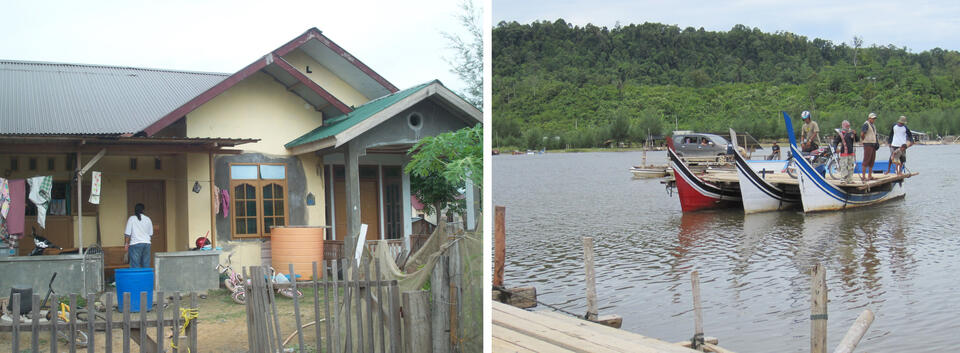
 Collection of photos from fieldwork in Aceh, Indonesia, provided courtesy of Yong Lee. Upper left: A house built in an aid project village shows windows retrofitted after initial construction. Upper right: Boats constructed by aid agencies for fishing activity are refashioned to serve as water taxis for people and cars. Lower: Fishing boats sit unused on the side of the road many of them impossible to use, according to villagers surveyed.


